AI Generated Quiz
Secondary 4 Social Studies Conflict International Relations Quiz
Free Sec 4 Social Studies Conflict IR quiz, AI version, with questions, answers, and O Level-style practice for Singapore students.
These static practice materials are generated from the site's syllabus and paper-generation workflow, with source and model context shown so students and parents can evaluate the material before use.
Questions
Free quiz and exam paper access
Enter your details to view this paper
Your access is remembered on this device.
Answers
Secondary 4 Social Studies Quiz - Conflict International Relations: Answer Key
Total Marks: 50
Section A: Understanding Conflict (Questions 1–5) [Total: 13 marks]
Question 1 [2 marks]
Define the term "armed conflict" in the context of international relations.
Answer: Armed conflict refers to a dispute between two or more groups (typically states or organised armed groups) that involves the use of armed force, resulting in a minimum of 25 battle-related deaths per year. It can range from small-scale skirmishes to full-scale war.
Marking Scheme:
- 1 mark for identifying that it involves the use of armed force/weapons
- 1 mark for indicating it occurs between states or organised groups (or mentioning a threshold of violence)
Teaching Note: The key distinction between "armed conflict" and general "conflict" is the use of weapons and organised violence. Students should understand that not all disagreements between countries become armed conflicts; many are resolved through diplomacy.
Question 2 [2 marks]
State two causes of conflict between nations.
Answer: Any two of the following: (a) Territorial disputes (disagreements over land or maritime boundaries) (b) Competition for resources (e.g., oil, water, minerals) (c) Ideological differences (e.g., political systems, religious beliefs) (d) Historical grievances (e.g., past wars, colonialism) (e) Economic rivalry (e.g., trade disputes, access to markets)
Marking Scheme:
- 1 mark for each correct cause stated (2 marks total)
- Accept any reasonable cause with a brief explanation
Teaching Note: Students should be able to distinguish between causes (underlying reasons) and triggers (immediate events that spark conflict). For example, historical grievances may be a long-term cause, while a border incident could be the trigger.
Question 3 [3 marks]
Explain how territorial disputes can lead to conflict between countries. Use an example to support your answer.
Answer: Territorial disputes arise when two or more countries claim sovereignty over the same piece of land or maritime area. These disputes can lead to conflict because:
- Countries may view the territory as strategically important for security or economic reasons
- National pride and identity may be tied to the territory
- Resources within the disputed area (e.g., oil, fishing grounds) create economic stakes
Example: The dispute between India and Pakistan over Kashmir has led to multiple wars and ongoing military confrontations because both countries claim the region based on historical and religious grounds.
Marking Scheme:
- 1 mark for explaining how territorial disputes create tension
- 1 mark for explaining why this leads to conflict (e.g., strategic importance, resources, national pride)
- 1 mark for a relevant and accurate example
Teaching Note: Encourage students to think about why territory matters beyond just land—it involves resources, security, national identity, and sometimes the rights of people living there. The South China Sea disputes are another good example.
Question 4 [4 marks]
Differentiate between "interstate conflict" and "intrastate conflict." Provide one example of each.
Answer:
| Aspect | Interstate Conflict | Intrastate Conflict |
|---|---|---|
| Definition | Conflict between two or more sovereign states | Conflict within the borders of a single state |
| Parties involved | National armies/governments of different countries | Government forces vs. rebel groups, or between different groups within a country |
| Example | The Russia-Ukraine war (2022–present) | The Syrian Civil War (2011–present) |
Marking Scheme:
- 1 mark for correctly defining interstate conflict
- 1 mark for correctly defining intrastate conflict
- 1 mark for a relevant example of interstate conflict
- 1 mark for a relevant example of intrastate conflict
Teaching Note: Students sometimes confuse these terms. A helpful memory aid: "inter" = between (countries), "intra" = within (a country). Note that intrastate conflicts (civil wars) can become internationalised when other countries intervene, but the primary conflict is still within one state.
Question 5 [2 marks]
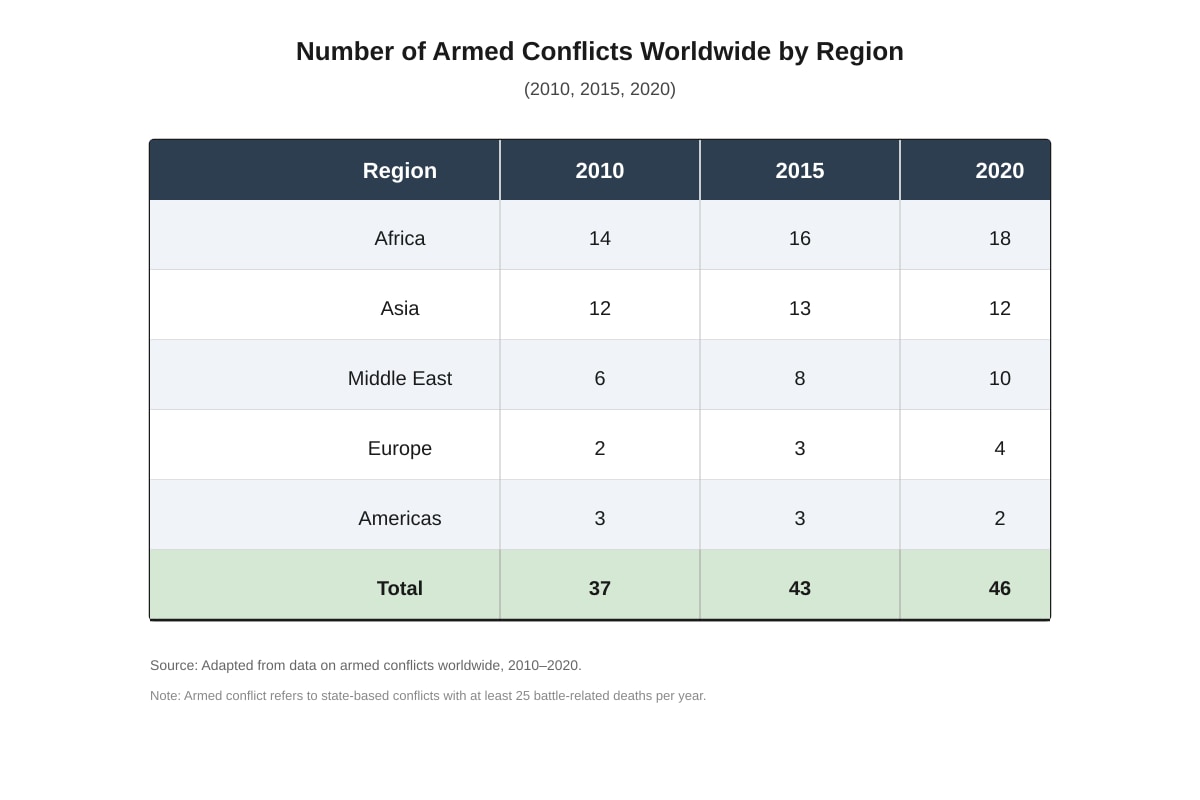
Describe one trend shown in the table regarding armed conflicts worldwide.
Answer: One trend is that the number of armed conflicts has increased across all regions between 2010 and 2020. For example, Africa saw an increase from 12 conflicts in 2010 to 22 in 2020, while Asia increased from 15 to 19.
Alternative acceptable answer: The Middle East has consistently had a high number of conflicts, increasing from 8 in 2010 to 14 in 2020, showing that this region remains a hotspot for armed conflict.
Marking Scheme:
- 1 mark for identifying a clear trend (increase, decrease, or pattern)
- 1 mark for supporting the trend with specific data from the table
Teaching Note: When describing trends from data, students should:
- State the overall pattern (e.g., "increasing," "decreasing," "fluctuating")
- Support with specific numbers or comparisons
- Avoid simply reading individual data points without identifying a pattern
Section B: Responses to Conflict (Questions 6–10) [Total: 14 marks]
Question 6 [2 marks]
State two roles of the United Nations (UN) in managing international conflicts.
Answer: Any two of the following: (a) Peacekeeping – deploying UN troops (blue helmets) to monitor ceasefires and maintain peace (b) Mediation and diplomacy – facilitating negotiations between conflicting parties (c) Imposing sanctions – authorising economic or diplomatic measures against aggressor states (d) Authorising military intervention – approving the use of force to protect civilians (R2P) (e) Providing humanitarian aid – coordinating relief efforts for conflict-affected populations
Marking Scheme:
- 1 mark for each correct role stated (2 marks total)
Teaching Note: The UN has multiple tools for conflict management. Students should understand that peacekeeping requires consent of the parties, while peace enforcement (Chapter VII) can be imposed without consent. The UN Security Council is the primary body responsible for maintaining international peace and security.
Question 7 [3 marks]
Explain how economic sanctions can be used as a tool to address conflict between nations.
Answer: Economic sanctions are penalties imposed by one or more countries against a target country to change its behaviour. They work by:
- Restricting trade (e.g., banning imports/exports of certain goods)
- Freezing assets of government officials or companies
- Limiting access to international financial systems
The goal is to pressure the target country's economy and leadership to cease aggressive actions and come to the negotiating table. For example, sanctions on Iran over its nuclear programme aimed to force it to negotiate limits on uranium enrichment.
Marking Scheme:
- 1 mark for defining/explaining what economic sanctions are
- 1 mark for explaining how they create pressure (e.g., economic hardship, isolation)
- 1 mark for explaining the intended outcome (change in behaviour/negotiation)
Teaching Note: Students should understand that sanctions are a middle ground between diplomacy and military action. However, they can also harm ordinary citizens more than leaders, and their effectiveness is debated. The Russia sanctions (2022 onwards) are a current example.
Question 8 [4 marks]
Explain two limitations of UN peacekeeping missions as suggested in Source A.
Answer: (i) Need for host country consent: Source A states that peacekeeping missions "require the consent of the host country." This means the UN cannot deploy peacekeepers without the agreement of the government of the country where the conflict is occurring. If the government refuses, the UN cannot act.
(ii) Need for cooperation from all parties: Source A mentions that peacekeeping requires "the cooperation of all parties involved." If one side in the conflict does not cooperate, peacekeepers cannot do their job effectively. This limits their ability to maintain peace when parties are not committed to peace.
Marking Scheme:
- 1 mark for each limitation correctly identified and explained (2 marks per limitation)
- Award marks only if the answer explicitly references Source A
Teaching Note: This question tests source comprehension. Students must extract specific limitations mentioned in the source, not general knowledge about peacekeeping. The source explicitly mentions two conditions for success (consent and cooperation), and the limitations are implied when these conditions are absent.
Question 9 [3 marks]
Describe how diplomacy can help prevent conflicts from escalating.
Answer: Diplomacy helps prevent conflict escalation through:
- Negotiation and dialogue – Bringing conflicting parties together to discuss their differences and find mutually acceptable solutions
- Mediation by third parties – Neutral countries or organisations (e.g., UN, ASEAN) can facilitate communication and propose compromise solutions
- Confidence-building measures – Agreements to reduce tensions, such as hotlines between leaders, troop withdrawals from borders, or information sharing
These diplomatic tools allow parties to resolve disputes without resorting to violence, creating space for peaceful resolution.
Marking Scheme:
- 1 mark for each well-explained method (3 marks total)
- Accept any reasonable diplomatic approach with clear explanation
Teaching Note: Diplomacy is often called "the first line of defence" against conflict. Students should understand that diplomacy is not just talking—it involves specific techniques like shuttle diplomacy, Track II diplomacy (unofficial channels), and preventive diplomacy. The Iran nuclear deal (JCPOA) is an example of diplomacy preventing potential military conflict.
Question 10 [2 marks]
Using Source B, explain one challenge faced by the International Criminal Court (ICC) in addressing conflict-related crimes.
Answer: One challenge is the lack of universal jurisdiction/enforcement. Source B states that "the country involved does not recognise the ICC's jurisdiction." This means the ICC cannot investigate or prosecute crimes committed in that country unless the country accepts the ICC's authority. Even if arrest warrants are issued, the ICC has no police force to enforce them, so suspects may never face trial.
Marking Scheme:
- 1 mark for identifying the challenge (lack of jurisdiction/enforcement)
- 1 mark for explaining using evidence from Source B
Teaching Note: The ICC relies on states to cooperate with its investigations and arrests. Major powers like the US, China, and Russia are not ICC members. This limits the court's ability to hold perpetrators accountable, especially when they are from powerful nations or have political protection.
Section C: Case Study – The Russia-Ukraine Conflict (Questions 11–15) [Total: 12 marks]
Question 11 [1 mark]
State one reason why the Russia-Ukraine conflict, which began in 2014 and escalated in 2022, is considered a major international conflict.
Answer: Any one of the following:
- It involves a permanent member of the UN Security Council (Russia) invading a sovereign neighbour
- It has drawn in major world powers (NATO, EU, US) through sanctions and military aid
- It has caused the largest refugee crisis in Europe since World War II
- It has disrupted global food and energy supplies, affecting countries worldwide
Marking Scheme:
- 1 mark for a valid reason
Teaching Note: The Russia-Ukraine conflict is significant because it challenges the post-WWII international order, where borders are not supposed to be changed by force. It also shows how a regional conflict can have global consequences.
Question 12 [2 marks]
Explain how the Russia-Ukraine conflict has affected global energy prices.
Answer: The conflict has caused global energy prices to rise significantly. Russia is a major producer of oil and natural gas, and the war disrupted supplies to Europe. Western sanctions on Russian energy exports further reduced supply. At the same time, countries rushed to find alternative energy sources, increasing demand. This combination of reduced supply and increased demand drove up prices for oil, gas, and electricity worldwide.
Marking Scheme:
- 1 mark for identifying the impact (prices increased/rose)
- 1 mark for explaining the mechanism (reduced supply from Russia + sanctions + increased demand for alternatives)
Teaching Note: This question tests understanding of supply and demand in a real-world context. Students should connect the conflict to specific economic consequences. The price surge affected not just Europe but also countries in Asia and Africa that compete for the same energy supplies.
Question 13 [4 marks]
Using Source C, describe two humanitarian consequences of the Russia-Ukraine conflict.
Answer: (i) Mass displacement of people: Source C states that "over 8 million Ukrainians have been displaced internally, while more than 6 million have fled to neighbouring countries." This means millions of people have been forced to leave their homes, becoming refugees or internally displaced persons (IDPs).
(ii) Lack of access to basic necessities: Source C mentions that "millions lack access to clean water, healthcare, and shelter as winter approaches." The conflict has destroyed infrastructure and made it difficult for aid to reach affected populations, creating a severe humanitarian crisis.
Marking Scheme:
- 1 mark for each consequence correctly identified (2 marks)
- 1 mark for each consequence explained using evidence from Source C (2 marks)
Teaching Note: Students must use the source as evidence, not just general knowledge. The source provides specific numbers and details that should be referenced. "Humanitarian consequences" refers to impacts on human welfare and dignity.
Question 14 [3 marks]
Explain how economic sanctions imposed on Russia by Western countries are intended to work.
Answer: The sanctions are intended to work through several mechanisms:
- Financial pressure – Freezing Russian central bank assets and cutting off access to SWIFT (international payment system) limits Russia's ability to finance its war effort
- Trade restrictions – Banning exports of technology and components needed for Russian military production
- Individual sanctions – Freezing assets and imposing travel bans on Russian officials and oligarchs close to President Putin
The overall goal is to impose economic costs on Russia that make continuing the war too expensive, forcing a change in policy or negotiation.
Marking Scheme:
- 1 mark for identifying the goal (to pressure Russia to change behaviour/end the war)
- 1 mark for explaining one mechanism (e.g., financial, trade, individual)
- 1 mark for explaining how the mechanism creates pressure
Teaching Note: Students should understand that sanctions are a form of coercive diplomacy—using economic pressure rather than military force. The effectiveness of sanctions on Russia is debated, as Russia has redirected trade to China and India and adapted to some restrictions.
Question 15 [2 marks]
Using Source D, explain one challenge faced by countries that impose sanctions on Russia.
Answer: One challenge is the economic cost to the sanctioning countries themselves. Source D states that sanctions "come at a cost to our own economies, with rising inflation and energy prices." This means that while countries want to punish Russia, their own citizens suffer from higher prices and economic difficulties, which may reduce public support for continued sanctions.
Marking Scheme:
- 1 mark for identifying the challenge (economic cost/impact on own economy)
- 1 mark for explaining using evidence from Source D
Teaching Note: This question tests the ability to identify trade-offs in policy decisions. Sanctions are not cost-free for the countries imposing them. The source highlights the tension between supporting Ukraine's sovereignty and protecting domestic economic interests.
Section D: Evaluating Responses to Conflict (Questions 16–20) [Total: 21 marks]
Question 16 [6 marks]
How far do Sources E and F agree on the use of military intervention? Explain your answer.
Answer:
Points of agreement:
- Both sources acknowledge that military intervention is a significant action with major consequences
- Both sources recognise that the decision to use military force is important and should not be taken lightly
Points of disagreement:
- Source E supports military intervention when diplomacy fails and when authorised by the UN Security Council. It frames intervention as a "responsibility" to protect civilians and restore peace.
- Source F opposes military intervention, arguing it "almost always makes conflicts worse," causes civilian casualties, and creates "long-term resentment." It advocates for diplomatic solutions and local peacebuilding instead.
Degree of agreement: The sources largely disagree on the use of military intervention. Source E sees it as a legitimate and sometimes necessary tool, while Source F views it as counterproductive and harmful. Their only common ground is that the decision is significant, but they reach opposite conclusions about whether it should be used.
Marking Scheme:
- 1–2 marks: Identifies surface-level agreement or disagreement without detailed evidence
- 3–4 marks: Identifies specific points of agreement and disagreement with evidence from both sources
- 5–6 marks: Provides a balanced analysis with specific evidence, explains the degree of agreement, and reaches a reasoned conclusion
Teaching Note: This is a comparative source analysis question. Students should:
- Identify specific claims in each source
- Compare them directly (agree/disagree/partial agreement)
- Use quotations or paraphrases as evidence
- Conclude with a judgement on the overall degree of agreement
- Avoid simply summarising each source separately without comparing
Question 17 [3 marks]
Explain how the concept of "responsibility to protect" (R2P) can be controversial in international relations.
Answer: The Responsibility to Protect (R2P) is controversial because:
- Sovereignty concerns – Some countries argue that R2P violates national sovereignty by allowing external intervention in internal affairs
- Selective application – Critics argue that R2P is applied selectively, with powerful countries intervening in weaker states while ignoring conflicts in other regions
- Risk of abuse – There are concerns that R2P can be used as a pretext for military intervention for political or economic reasons rather than genuine humanitarian protection
Marking Scheme:
- 1 mark for each well-explained controversy (3 marks total)
Teaching Note: R2P was adopted by the UN in 2005 and states that the international community has a responsibility to protect populations from genocide, war crimes, ethnic cleansing, and crimes against humanity. The controversy centres on who decides when to intervene and whether intervention makes situations better or worse. The NATO intervention in Libya (2011) is often cited as a controversial example.
Question 18 [2 marks]
Using Source G, explain one reason why the international community is struggling to address the global refugee crisis.
Answer: One reason is the sheer scale of the crisis. Source G states that "the number of people forced to flee their homes... has surpassed 100 million for the first time on record" and "has doubled in the past decade." This massive and rapidly growing number of displaced people overwhelms the capacity of host countries and international aid organisations to provide adequate shelter, food, healthcare, and other support.
Marking Scheme:
- 1 mark for identifying the reason (scale/magnitude of the crisis)
- 1 mark for explaining using evidence from Source G
Teaching Note: Students should extract the specific data points from the source (100 million, doubled in a decade) to support their answer. The source also mentions "struggling to provide adequate protection and support," which directly answers the question.
Question 19 [4 marks]
Evaluate the effectiveness of international law in preventing conflicts between nations.
Answer:
Arguments that international law is effective:
- Provides a framework for resolving disputes peacefully (e.g., International Court of Justice)
- Establishes norms against aggression (e.g., UN Charter prohibits use of force)
- Creates accountability mechanisms (e.g., ICC prosecutes war crimes)
- Deters some states from violating rules due to reputational costs
Arguments that international law is limited:
- Lacks enforcement mechanisms – no global police force to ensure compliance
- Powerful states can ignore or bypass international law (e.g., Russia's invasion of Ukraine)
- Slow and cumbersome processes may not prevent fast-moving conflicts
- States can withdraw from treaties or refuse to recognise jurisdiction
Evaluation: International law has some deterrent effect and provides important norms, but its effectiveness is limited by the lack of enforcement and the willingness of powerful states to violate it. It is more effective at preventing minor disputes from escalating than stopping major powers from using force.
Marking Scheme:
- 1–2 marks: Provides one-sided argument or general statements without specific examples
- 3 marks: Provides balanced argument with some specific examples
- 4 marks: Provides well-balanced evaluation with specific examples and a reasoned conclusion
Teaching Note: This question requires evaluation, not just description. Students should present both sides and reach a judgement. Key examples include the ICJ ruling on Ukraine (limited enforcement) versus the role of international law in resolving maritime disputes (more effective).
Question 20 [6 marks]
"The United Nations is no longer effective in maintaining international peace and security." Using examples from this quiz, explain how far you agree with this statement.
Answer:
Arguments that the UN is ineffective (agree):
- The UN Security Council is often paralysed by veto power, as seen in the Russia-Ukraine conflict where Russia (a permanent member) vetoed resolutions condemning its actions
- UN peacekeeping missions face limitations, as shown in Source A (need for consent and cooperation)
- The UN has been unable to prevent major conflicts like the war in Ukraine or the Syrian civil war
- The ICC (a related institution) struggles with enforcement, as shown in Source B
Arguments that the UN remains relevant (disagree):
- The UN provides a platform for diplomacy and negotiation that might not otherwise exist
- UN agencies provide crucial humanitarian aid to conflict-affected populations (Source C, Source G)
- The UN has successfully mediated some conflicts and maintained peace in certain regions
- The UN establishes international norms and laws that shape state behaviour
Evaluation: I partially agree with the statement. The UN has significant structural limitations, particularly the Security Council veto power, which prevents it from acting effectively in conflicts involving major powers. However, the UN remains important for humanitarian work, peacekeeping in smaller conflicts, and setting international norms. The UN is not "no longer effective" overall, but it is ineffective in certain types of conflicts, especially those involving permanent Security Council members.
Marking Scheme:
- 1–2 marks: Simple agreement or disagreement without detailed reasoning or examples
- 3–4 marks: Provides arguments on both sides with some examples from the quiz
- 5–6 marks: Well-structured response with balanced arguments, specific examples from multiple sources/questions, and a clear, justified conclusion
Teaching Note: This is a higher-order evaluation question. Students should:
- Define what "effective" means (able to achieve its stated purpose)
- Present evidence for both sides
- Use specific examples from the quiz (Russia-Ukraine, peacekeeping limitations, ICC challenges, humanitarian role)
- Reach a nuanced conclusion rather than a simple yes/no
- Show awareness that effectiveness varies by context
Common mistakes to flag:
- Only arguing one side
- Making general statements without specific examples
- Not referencing material from the quiz
- Weak or absent conclusion
END OF ANSWER KEY