About TuitionGoWhere
Free Singapore exam papers, practice questions, and lessons for PSLE, O Level, and A Level students. No sign-up, no fees, just resources.
Why Aren't We Charging?
Tuition has become a tax on parents. When everyone pays for tuition, no one gains an advantage - only the tuition industry profits.
Quality education has become a privilege of families who can afford it. We believe this is wrong.
Free. That's it. Done.
Leveling the Playing Field with AI
If tuition centers can use AI, so can you. For free.
Preparing for AI-Generated Exams
Exam boards might be using AI to generate questions. Use AI with AI - practice with AI-generated questions aligned to how Singapore educators think.
Why Original Content?
We use past exam papers to reference and train AI to generate fresh, syllabus-aligned questions.
Who's Behind This?
IT professionals giving back to the community. We're not strictly anonymous, but we'd rather let the work speak for itself. We cover the AI, hosting, and development costs.
Singapore Education and Exam FAQs
Who are these cute animal characters?
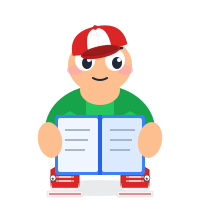
Our mascots are a loving tribute to PETS (Primary English Teaching Syllabus) - the iconic animal characters from Singapore's primary school English textbooks in the 1990s.
If you grew up in Singapore during that era, you might remember Terry the Turtle, and his friends - the bunny, myna bird, squirrel, monkey, and mouse. These characters taught a generation of Singaporeans to read and write English.
We've reimagined them for a new generation, keeping their friendly personalities while giving them a fresh, modern look. It's our way of celebrating Singapore's educational heritage while building something new.
Why is this completely free?
Because tuition has become an arms race. When every family pays for tuition, no one gains an advantage - only the tuition industry profits.
We're IT professionals who believe quality education shouldn't be gatekept by price. We cover all the AI, hosting, and development costs ourselves.
Is the content aligned to MOE syllabus?
Yes! All our content is generated based on official MOE syllabus documents. We use AI to interpret the syllabus and create lessons, practice questions, and exam papers that match what students learn in school.
How accurate is AI-generated content?
We use state-of-the-art AI models and carefully review the output, but no system is perfect. If you spot any errors, please let us know at admin@tuitiongowhere.com.
Will you add more subjects/levels?
We're continuously expanding! Currently we cover Primary 1-6 and Secondary 1-4 for core subjects. More content is being added regularly.
How does the Singapore education system work from Primary School to post-secondary education?
Singapore students generally progress from six years of primary education to secondary education and then to post-secondary pathways such as junior college, Millennia Institute, polytechnic, or ITE. The best route depends on a student’s strengths, interests, learning needs, and subject results rather than on one single definition of success.
What is the PSLE and why is it important in Singapore?
The Primary School Leaving Examination is a national checkpoint at the end of Primary 6. It helps indicate a student’s readiness for secondary education and is used together with school choices and posting rules for Secondary 1 placement.
How is the PSLE scored using Achievement Levels?
The PSLE uses Achievement Levels, or ALs, for individual subjects, with the subject ALs combined into a PSLE Score for posting purposes. The score is intended to show a student’s level of understanding and readiness, rather than create very fine differences between students.
Does the PSLE have a pass or fail grade?
The PSLE does not use a simple overall pass-or-fail result in the way many parents expect. The result provides subject Achievement Levels and a PSLE Score that help indicate suitable secondary school posting groups and subject levels.
What PSLE score is needed to enter a particular secondary school?
There is no permanent PSLE score that guarantees entry to a school. Cut-off points can change each year according to the cohort, school choices, available places, and tie-breakers, so parents should treat past cut-off points as a guide rather than a promise.
How does Secondary 1 posting work after the PSLE?
Families submit secondary school choices during the Secondary 1 posting exercise. Posting considers the student’s PSLE Score first, followed by the published tie-breakers and the order of school choices where relevant; parents should read the current MOE instructions for each posting exercise.
What is a secondary school cut-off point in Singapore?
A cut-off point, or COP, is the score of the last student posted to a school in a particular posting exercise. It is historical information, not a fixed admission requirement, and it can move when student choices and vacancies change.
What is Full Subject-Based Banding in Singapore secondary schools?
Full Subject-Based Banding gives students more flexibility to take different subjects at levels suited to their strengths and learning needs. Students can learn in mixed form classes for some areas while taking selected subjects at G1, G2, or G3 subject levels.
What do G1, G2, and G3 mean in secondary school?
G1, G2, and G3 describe subject levels under Full Subject-Based Banding, with G3 generally being the most demanding level. A student may take different subjects at different levels, depending on the student’s results, aptitude, interests, school advice, and available subject combinations.
Can a secondary school student take different subjects at different levels?
Yes. Subject-Based Banding is designed to allow greater flexibility, so a student’s level can reflect their strengths and support needs in each subject. Schools will advise on combinations and monitor whether the workload and subject level remain suitable.
How does subject-based banding work in Primary 5 and Primary 6?
Primary subject-based banding allows a child to take a combination of standard and foundation subjects according to strengths and learning needs. The school reviews the child’s progress and recommends a suitable combination; taking a foundation subject is intended to build a stronger foundation, not label a child’s potential.
Which subjects are tested at the PSLE?
The PSLE subject areas include English Language, Mother Tongue Languages, Mathematics, and Science, with standard, foundation, or higher-level arrangements depending on the student’s subject combination. Parents should check the current official assessment documents for the exact paper structure and requirements.
Is taking a foundation subject a disadvantage for PSLE students?
A foundation subject is not automatically a disadvantage. It is intended to match the learning load to the child’s current needs and can help the child build core understanding; parents should discuss later subject choices and progression options with the school.
What is Higher Mother Tongue in Singapore primary and secondary schools?
Higher Mother Tongue is a more demanding language option offered to eligible students based on school guidance and the student’s readiness. It can support deeper language development, but the appropriate choice should consider interest, workload, confidence, and the child’s wider subject combination.
When should a child start preparing for the PSLE?
PSLE preparation should build gradually from strong concepts and regular reading rather than begin as a last-minute paper marathon. In Primary 5 and Primary 6, families can add timed practice, correction of recurring mistakes, and revision of weaker topics while protecting sleep and motivation.
How can parents help a child prepare for the PSLE without creating too much stress?
A useful routine combines short, consistent practice with time for rest, play, sleep, and questions. Parents can focus on progress and specific skills, review mistakes calmly, and coordinate with the child’s teachers instead of comparing every result with another child.
How should students use past-year papers for PSLE revision?
Past-year papers are most useful after a student understands the relevant topic. Use them to study question wording, marks, timing, and common mistakes, then review every correction rather than focusing only on the final score.
What should parents look for in a good Primary school practice paper?
A good paper should match the child’s level, cover the intended topics, use clear instructions, assign sensible marks, and fit the expected working time. It should also include answers or explanations that help the child understand the method rather than simply reveal a letter or number.
How do secondary school subject choices affect future pathways?
Subject choices can affect which courses and subjects a student is prepared to take later, but they do not determine a child’s entire future. Parents should consider the student’s interests, foundational skills, workload, school advice, and possible post-secondary requirements together.
What subjects do students study in lower secondary school?
Lower secondary students generally study a broad set of languages, mathematics, science, humanities, and common curriculum areas. The exact subject list and level options vary by school, so parents should use the school’s current subject information rather than an old generic list.
How should students choose secondary school subjects?
Students should balance interest, demonstrated understanding, learning habits, and future exploration rather than choose a subject only because it is considered popular. Schools can explain the demands of each subject level and how the combination connects with later options.
What are O-Level examinations in Singapore?
The Singapore-Cambridge GCE O-Level examinations assess selected secondary school subjects at the end of the relevant course of study. Results can be used when applying to post-secondary options, subject to the admission rules and requirements of each institution or programme.
Are O-Level examinations changing under Full Subject-Based Banding?
Singapore is moving toward the Singapore-Cambridge Secondary Education Certificate, or SEC, with changes introduced in phases for different cohorts. Families should check the latest MOE and SEAB information for the student’s graduating cohort instead of relying on an older O-Level timetable or subject guide.
How can a student prepare effectively for O-Level examinations?
Effective O-Level preparation combines syllabus-based revision, targeted topic practice, timed full papers, and careful correction of errors. Students should also learn the paper instructions, marks allocation, required notation, and answer style for each subject rather than revise every subject in exactly the same way.
What is the difference between E-Mathematics and Additional Mathematics?
E-Mathematics focuses on core secondary mathematics concepts and applications, while Additional Mathematics goes further into topics and methods such as algebra, functions, trigonometry, and calculus-related ideas. Students should follow their school’s subject combination and confirm the current syllabus before planning revision.
What is the difference between Combined Science and Pure Science at O-Level?
Combined Science covers selected areas from more than one science discipline within a combined subject and assessment structure. Pure Science subjects study one discipline in greater depth; the right choice depends on the student’s interests, strengths, workload, and later course plans.
What are A-Level examinations in Singapore?
The Singapore-Cambridge GCE A-Level is a pre-university qualification commonly taken in junior colleges or Millennia Institute. It develops subject knowledge, thinking skills, communication, and preparation for further study, with subject combinations and admission requirements varying by institution and course.
What is the difference between H1, H2, and H3 A-Level subjects?
H1 and H2 describe different A-Level subject scopes and workloads, while H3 is an additional advanced subject option for eligible students. The exact subject availability, content, and admission considerations can change, so students should consult their school and the current official subject syllabuses.
How should students choose A-Level subjects?
A-Level choices should reflect genuine interest, preparation from secondary school, expected workload, and possible university or course prerequisites. Students should check the latest subject combination rules with their junior college or Millennia Institute rather than choose only by perceived prestige.
Should a student choose junior college or polytechnic after secondary school?
Junior college and polytechnic offer different learning experiences and routes, so the choice should be based on the student’s preferred pace, learning style, interests, and possible next step. Parents can compare the programme structure, subject requirements, progression options, and admissions exercises before deciding.
Why is Mother Tongue Language important in Singapore schools?
Mother Tongue Language is part of Singapore’s bilingual education approach and supports language ability, cultural understanding, and communication. The appropriate subject level and any exemption or alternative arrangement depend on the student’s circumstances and current MOE or school guidance.
Where can parents find the official Singapore school syllabus?
Parents should start with the current MOE curriculum and subject-syllabus pages, and with examination information from SEAB for national examinations. A practice website can help organise revision, but the official documents remain the authority when a syllabus, format, or date changes.
Where can I find free exam papers and test papers in Singapore?
Parents can use school-provided papers, official specimen materials, reputable educational resources, and carefully selected free practice websites. Before using any paper, check that its level, subject, syllabus year, language, marks, and time limit match the student’s current course.
Are free online exam papers useful for Singapore exam preparation?
They can be useful when they are used selectively and matched to the current syllabus. A smaller number of well-checked papers, followed by detailed corrections and a second attempt, is usually more valuable than completing many papers without reviewing the mistakes.
How can parents tell whether a practice paper is suitable for their child?
Check the stated level, subject, syllabus reference, question format, marks, estimated time, and answer quality. The language should be appropriate for the student, and the paper should test taught skills rather than introduce unrelated advanced content.
What should an answer key contain for Mathematics and Science questions?
For questions involving calculation or reasoning, a useful answer key shows the method, substitutions, units, notation, and final answer where relevant. For explanation questions, it should identify the key idea and make clear why the answer earns the available marks.
Are AI-generated exam papers reliable for school revision?
AI-generated papers can provide additional practice, but they should not replace official syllabus documents, teacher feedback, or school assessments. They need checks for factual accuracy, language, difficulty, format, notation, marks, timing, and whether the answers actually support the questions.
Are TuitionGoWhere exam papers official MOE papers?
No. TuitionGoWhere is an independent education resource, and its generated quizzes and papers are supplementary practice materials rather than official MOE or SEAB examination papers. Official documents should be used whenever parents need the authoritative syllabus or examination format.
How does TuitionGoWhere check its generated practice content?
The site uses benchmark checks for syllabus fit, language suitability, exam-style structure, answer quality, notation, difficulty, timing, and other practical criteria. Resources that need review may be withheld or replaced, so the visible catalogue can change as quality checks are rerun.
How can I report an error in a practice paper?
Send the page URL and a short description of the problem to [email protected]. Reporting the exact question, answer, wording, or missing image makes it easier to reproduce the issue and review the resource.
Heads Up
We've put a lot of care into creating this content with AI, but hey, mistakes happen. If you spot something off, let us know!
admin@tuitiongowhere.com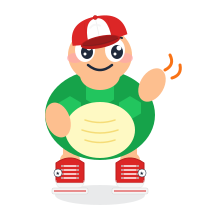
Get in Touch
Have questions or feedback? We'd love to hear from you.
Email Usadmin@tuitiongowhere.com