AI Generated Quiz
Secondary 4 Social Studies Conflict International Relations Quiz
Free Sec 4 Social Studies Conflict IR quiz, AI version, with questions, answers, and O Level-style practice for Singapore students.
These static practice materials are generated from the site's syllabus and paper-generation workflow, with source and model context shown so students and parents can evaluate the material before use.
Questions
Free quiz and exam paper access
Enter your details to view this paper
Your access is remembered on this device.
Answers
Secondary 4 Social Studies Quiz - Conflict International Relations (Answer Key)
Total Marks: 40
Section A: Short-Answer Questions (Questions 1-5)
Question 1 [1 mark]
Define the term "transnational terrorism."
Answer: Transnational terrorism refers to terrorist acts that are planned, funded, or carried out across national borders, involving perpetrators, targets, or supporters from more than one country.
Marking Note:
- Award 1 mark for a clear definition that includes the cross-border element.
- Accept variations: "terrorism that crosses national boundaries," "terrorist activities that involve multiple countries."
- Do NOT award for simply saying "terrorism" without the transnational aspect.
Question 2 [2 marks]
State two main causes of armed conflict between countries in the 21st century.
Answer (any two acceptable):
- Territorial disputes (e.g., over land or maritime boundaries)
- Competition for resources (e.g., oil, water, minerals)
- Ideological differences or political rivalry
- Nationalism or ethnic tensions
- Great power rivalry and geopolitical competition
- Violation of sovereignty or international law
Marking Note:
- Award 1 mark for each valid cause (max 2 marks).
- Accept specific examples like "South China Sea disputes" or "Russia-Ukraine conflict" as illustrations of the cause.
- Do NOT accept vague answers like "arguments" or "disagreements" — the cause must be a clearly identified factor.
Question 3 [2 marks]
What is the role of the United Nations Security Council (UNSC) in managing international conflicts?
Answer: The UN Security Council is responsible for maintaining international peace and security. Its roles include:
- Authorising peacekeeping missions
- Imposing economic sanctions on countries or groups
- Authorising the use of military force to address threats to peace
- Passing resolutions that demand an end to hostilities or aggression
(Award 2 marks for a comprehensive answer covering at least two roles. Award 1 mark for mentioning one role with brief explanation.)
Question 4 [3 marks]
Explain why territorial disputes can lead to armed conflict.
Answer (Suggested points): Territorial disputes can lead to armed conflict for several reasons:
- National sovereignty and pride — Countries view their territory as non-negotiable and may see any challenge to their claims as a direct attack on their sovereignty. [1 mark]
- Resource competition — Disputed territories often contain valuable resources (e.g., oil, gas, fish, minerals), creating strong economic incentives for countries to fight for control. [1 mark]
- Strategic importance — Some territories have military or strategic value, such as controlling sea lanes or providing a buffer zone, making countries unwilling to compromise. [1 mark]
- Domestic political pressure — Leaders may feel compelled to take a hardline stance on territorial claims to maintain public support, making diplomatic compromise difficult and increasing the risk of war.
Marking Note:
- Award 1 mark for each well-explained reason (max 3 marks).
- Accept specific examples (e.g., South China Sea, Kashmir, Crimea) as illustrations.
- Full marks require explanation of why territorial disputes lead to conflict, not just a list of disputed territories.
Question 5 [2 marks]
Identify two ways in which economic sanctions can be used as a tool to address international conflicts.
Answer (any two):
- Imposing trade embargoes (banning exports/imports) to pressure a country economically
- Freezing assets of government officials or entities involved in conflict
- Restricting access to international financial systems (e.g., SWIFT)
- Banning investment in key sectors (e.g., defence, energy)
- Imposing travel bans on leaders or officials
Marking Note:
- Award 1 mark for each correctly identified method (max 2 marks).
- Must be an economic tool — do not accept military or diplomatic measures.
Section B: Source-Based Questions (Questions 6-14)
Question 6 [2 marks]
According to Source A, what are TWO security challenges facing Singapore?
Answer:
- Great power rivalry between the US and China creating uncertainties in the region
- Territorial disputes in the South China Sea as a potential flashpoint
- The ongoing threat of terrorism (ideology of ISIS continuing to inspire attacks)
(Award 1 mark for each correctly identified challenge from Source A, max 2 marks.)
Question 7 [3 marks]
Using Source B only, explain what motivates terrorist groups in Southeast Asia.
Answer (Suggested points from Source B):
- Religious ideology — Some groups are driven by religious extremism (e.g., inspired by global networks like ISIS). [1 mark]
- Economic grievance — Some groups are motivated by economic hardship or dissatisfaction. [1 mark]
- Local political disputes — Some groups are drawn into terrorism due to local political conflicts or grievances. [1 mark]
Marking Note:
- Source B states: "some are driven by religious ideology, others by economic grievance or local political disputes."
- Award 1 mark for each correctly identified motivation from the source.
- Accept paraphrasing — they do not need to quote exact words.
- Students must use only Source B; do not award marks for external knowledge.
Question 8 [3 marks]
How does Source B show that international cooperation helps address transnational terrorism?
Answer (Suggested points from Source B):
- Cooperation between Southeast Asian governments through platforms like the ASEAN Defence Ministers' Meeting (ADMM) has been effective. [1 mark]
- These platforms allow for intelligence sharing between countries, helping to detect and prevent terrorist plots. [1 mark]
- They enable joint operations to disrupt terrorist networks across borders. [1 mark]
Marking Note:
- Students must reference Source B explicitly.
- Accept paraphrasing of: "cooperation... through platforms like the ASEAN Defence Ministers' Meeting... has been effective in sharing intelligence and conducting joint operations."
Question 9 [6 marks]
Study Source A and Source B. To what extent do the two sources agree on the nature of the terrorist threat? Explain your answer using evidence from both sources.
Answer (Suggested structure and content):
Marking Descriptors:
| Marks | Description |
|---|---|
| 5-6 | Shows clear understanding of both agreement and disagreement, with specific evidence from both sources and a balanced conclusion. |
| 3-4 | Identifies some points of comparison but may be one-sided or lack specific evidence. |
| 1-2 | Identifies only surface similarities or differences without explanation. |
| 0 | No relevant response. |
Suggested Answer: The two sources partially agree on the nature of the terrorist threat but also have different emphases.
Points of agreement:
- Both sources acknowledge that terrorism remains a significant threat. Source A states the "threat of terrorism has not gone away," while Source B notes that local extremist groups "maintain operational capabilities."
- Both sources recognise that the threat is international in nature. Source A refers to ISIS ideology inspiring attacks "globally," while Source B mentions "global terrorist networks" that provide funding and training.
Points of disagreement/difference:
- Source A focuses more on the ideological/global dimension — the ISIS ideology continues to inspire attacks. Source B focuses more on local dynamics — groups like JI and ASG have their own local motivations (economic grievance, political disputes).
- Source A emphasises the need for domestic counter-terrorism measures in Singapore, while Source B highlights regional cooperation (ASEAN platforms) as the key response.
Conclusion: The sources agree that terrorism is a persistent and transnational threat, but they differ in their focus. Source A is more concerned with the global ideological threat and national response, while Source B emphasises local motivations and regional cooperation. Therefore, there is partial agreement but not full alignment.
Question 10 [2 marks]
According to Source C, what are two global consequences of the Russia-Ukraine conflict for Singapore?
Answer:
- Raised food and energy prices
- Disrupted supply chains and increased economic uncertainty
(Award 1 mark for each correctly identified consequence from Source C, max 2 marks.)
Question 11 [3 marks]
Using Source C, explain why Singapore's response to the Russia-Ukraine conflict is described as a 'balancing act.'
Answer (Suggested points from Source C):
- Singapore "strongly supports the sovereignty and territorial integrity of Ukraine" and condemned Russia's invasion as a violation of international law. This shows Singapore takes a principled stand. [1 mark]
- However, Singapore "cannot afford to alienate any major power" — implying it must maintain good relations with all powers, including Russia and China. [1 mark]
- This creates a tension between standing up for principles (sovereignty, international law) and maintaining pragmatic diplomatic relations, hence a 'balancing act.' [1 mark]
Marking Note:
- Award 1 mark for each point that explains the balancing act using Source C evidence.
Question 12 [4 marks]
How might the Russia-Ukraine conflict affect the way smaller states like Singapore approach international relations? Use evidence from Source C in your answer.
Answer (Suggested points):
Marking Descriptors:
| Marks | Description |
|---|---|
| 3-4 | Explains TWO or more effects with clear use of Source C evidence and well-reasoned explanation. |
| 1-2 | Identifies one effect with some reference to Source C or limited explanation. |
| 0 | No relevant response. |
Suggested Answer: The Russia-Ukraine conflict might affect smaller states like Singapore in the following ways:
-
Greater emphasis on principled diplomacy — Source C shows Singapore taking a clear stand supporting Ukraine's sovereignty. Smaller states may feel compelled to uphold international law because they are vulnerable to aggression from larger powers. [2 marks]
-
Careful navigation of great power relations — Source C states Singapore "cannot afford to alienate any major power." Smaller states must maintain relationships with all major powers without being seen as taking sides, especially between the US and China. This requires skilful diplomacy. [2 marks]
-
Renewed interest in regional organisations — Source C mentions "renewed interest in ASEAN's role in maintaining regional stability." Smaller states may rely more on regional organisations for collective security and diplomatic support.
(Award up to 4 marks for any two well-explained points with Source C evidence.)
Question 13 [4 marks]
Based on your understanding of international relations, explain why the principle of sovereignty is important in maintaining global order.
Answer (Suggested points):
Marking Descriptors:
| Marks | Description |
|---|---|
| 3-4 | Explains TWO or more reasons with clear reasoning and examples. |
| 1-2 | Identifies one reason with limited explanation. |
| 0 | No relevant response. |
Suggested Answer: The principle of sovereignty is important for maintaining global order because:
-
Prevents aggression and war — Sovereignty means that countries cannot interfere in the internal affairs of other states. This principle, embedded in the UN Charter, provides a legal barrier against invasion and conquest. Without it, powerful countries could justify attacking weaker neighbours. [2 marks]
-
Provides a basis for diplomacy — Sovereignty allows countries to engage as equals in diplomatic negotiations. It creates a framework for treaties, trade agreements, and conflict resolution. [1 mark]
-
Maintains stability and predictability — When borders and governments are respected, countries can plan and cooperate with confidence. Violations of sovereignty (like Russia's invasion of Ukraine) create uncertainty and destabilise the international system. [1 mark]
(Accept relevant examples like the UN Charter, ASEAN's principle of non-interference, or the Russia-Ukraine conflict.)
Question 14 [2 marks]
Using Source C, identify TWO reasons why regional organisations like ASEAN are seen as important for managing conflicts.
Answer:
- They can help maintain regional stability (Source C mentions "renewed interest in ASEAN's role in maintaining regional stability").
- They provide a platform for member states to coordinate their responses to conflicts.
Marking Note:
- Award 1 mark for each reason identified from Source C.
- Accept paraphrasing.
Section C: Extended Response Questions (Questions 15-20)
Question 15 [5 marks]
"Economic interdependence between countries reduces the likelihood of armed conflict." Using examples, explain how far you agree with this statement.
Answer (Suggested structure and content):
Marking Descriptors:
| Marks | Description |
|---|---|
| 5 | Strong, balanced argument with clear examples, showing both sides with a reasoned conclusion. |
| 3-4 | Good argument but may be one-sided or lack specific examples. |
| 1-2 | Limited or vague response, may not address the question fully. |
| 0 | No relevant response. |
Suggested Answer: I partially agree with this statement. Economic interdependence can reduce the likelihood of conflict, but it is not a guarantee.
How interdependence reduces conflict:
- Countries that trade heavily with each other have a strong economic incentive to avoid war, as conflict would disrupt trade and harm both economies. For example, the European Union was created after WWII to bind European economies together, making war between member states unthinkable. The EU has since maintained peace among its members. [2 marks]
Limitations and counter-arguments:
- Despite high levels of economic interdependence, conflicts can still occur. For example, Russia and the EU had significant energy trade before the 2022 invasion of Ukraine, yet war still broke out. This shows that economic ties can be overridden by other factors like security concerns, nationalism, or ideological differences. [2 marks]
- Interdependence can also create vulnerabilities. A country might use economic leverage (e.g., cutting off energy supplies) as a form of coercion or weaponisation, which can escalate tensions rather than reduce them. [1 mark]
Conclusion: Economic interdependence generally reduces the likelihood of conflict, but it is not a foolproof mechanism. Political, security, and ideological factors can override economic considerations.
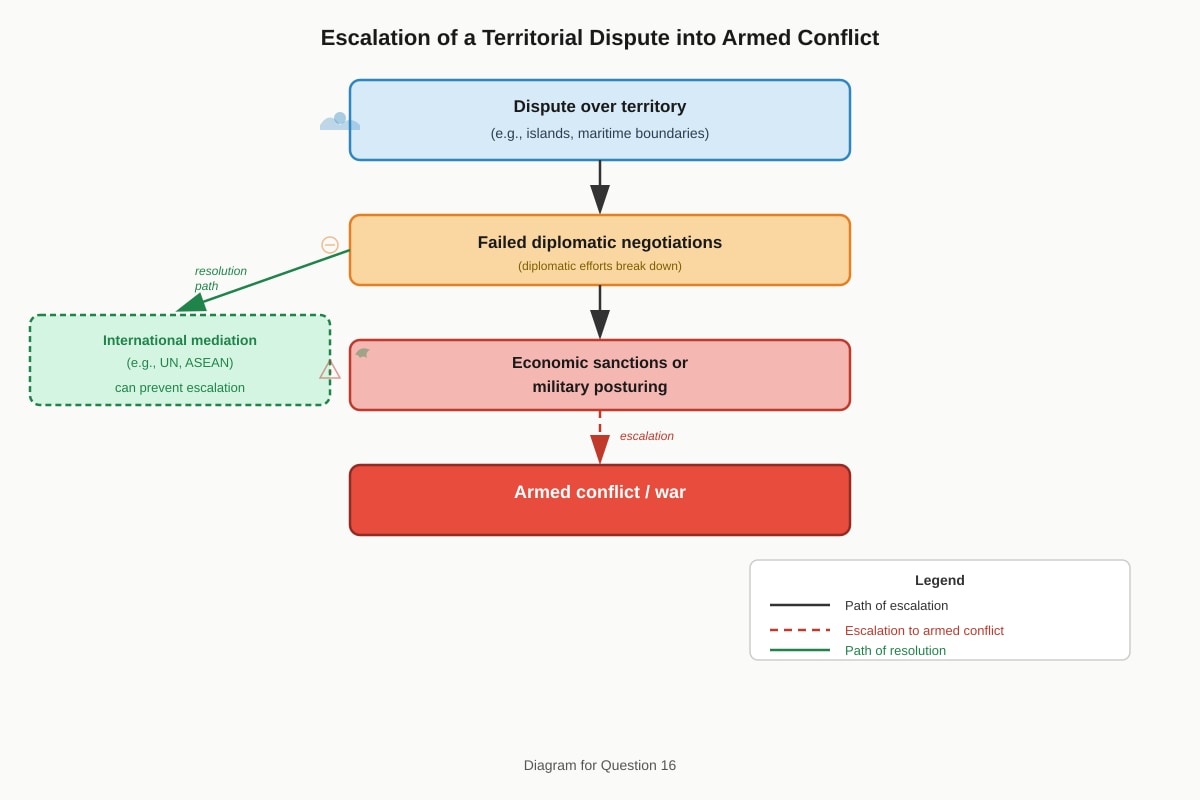
Question 16 [3 marks]
Study the diagram above that shows the escalation of a territorial dispute. Explain how international mediation can help prevent the dispute from reaching armed conflict.
Answer (Suggested points):
The diagram shows that after failed diplomatic negotiations, a dispute can either escalate (through sanctions/military posturing to armed conflict) or be resolved through international mediation.
International mediation can prevent armed conflict by:
- Providing a neutral platform for disputing parties to negotiate with the help of a trusted third party (e.g., the UN, ASEAN), which can facilitate communication and reduce hostility. [1 mark]
- Proposing compromise solutions that both sides may find acceptable, such as joint development of disputed resources or referral to international courts (e.g., International Court of Justice). [1 mark]
- Exerting diplomatic pressure from the international community, which makes it harder for a country to pursue military action without facing condemnation or sanctions. [1 mark]
Question 17 [1 mark]
Suggest one reason why a country might choose to use diplomacy rather than military force to resolve an international conflict.
Answer (any one):
- Military force is costly in terms of lives, money, and resources.
- Diplomacy can achieve a lasting solution, while military victory may breed resentment and future conflict.
- The use of force may lead to international condemnation or sanctions.
- The country may lack military capability to win the conflict.
- Diplomacy preserves trade and diplomatic relationships.
(Award 1 mark for any valid reason.)
Question 18 [5 marks]
"The threat of terrorism in the 21st century requires global cooperation to address effectively." Using examples, explain why you agree or disagree with this statement.
Answer (Suggested structure and content):
Marking Descriptors:
| Marks | Description |
|---|---|
| 5 | Strong, balanced argument with clear examples and a reasoned conclusion. |
| 3-4 | Good argument with some examples. |
| 1-2 | Limited or vague response. |
| 0 | No relevant response. |
Suggested Answer: I strongly agree that the threat of terrorism in the 21st century requires global cooperation.
Why global cooperation is necessary:
- Cross-border nature of terrorism — Modern terrorist networks operate across national borders. Source B shows that global networks provide "funding, training, and inspiration" to local groups. No single country can tackle this alone, as terrorists can move funds, people, and ideas across borders. [2 marks]
- Intelligence sharing — Effective counter-terrorism depends on timely and accurate intelligence. Cooperation between countries through platforms like the ASEAN Defence Ministers' Meeting allows for sharing of intelligence and joint operations, as Source B indicates. [1 mark]
- Addressing root causes collectively — Terrorism is often fueled by grievances that span multiple countries (e.g., political instability, poverty, radical ideology). Global cooperation is needed to address these root causes through development aid, education, and deradicalisation programmes. [1 mark]
Counter-argument (for balance): Some may argue that national security measures are sufficient. However, even the most powerful countries (like the US) found that domestic efforts alone could not prevent all terrorist attacks and needed international cooperation (e.g., the Global Coalition Against ISIS). [1 mark]
Conclusion: Given the transnational nature of modern terrorism, global cooperation is essential for effective counter-terrorism.
Question 19 [2 marks]
Identify and explain one limitation of economic sanctions as a tool to resolve international conflicts.
Answer (Suggested points):
Acceptable limitation with explanation:
-
Harms civilians more than governments — Sanctions often affect ordinary citizens through shortages of food, medicine, and essential goods, while political leaders may remain unaffected. This can create humanitarian crises without achieving the desired political change. [2 marks]
-
Require widespread cooperation — Sanctions are only effective if many countries participate. If some countries (e.g., China, Russia) continue to trade with the sanctioned country, the sanctions may have little impact. [2 marks]
-
Can be slow to have effect — Sanctions take time to pressure a regime, and the targeted country may become more entrenched rather than comply. [2 marks]
(Award 2 marks for identifying AND explaining one limitation. Award 1 mark for identification only.)
Question 20 [3 marks]
In your opinion, what is the most important factor that prevents countries from going to war with each other? Explain your reasoning.
Answer (Suggested points):
Marking Descriptors:
| Marks | Description |
|---|---|
| 3 | Clear identification of a factor with well-reasoned explanation. |
| 2 | Identifies a factor with some explanation. |
| 1 | Identifies a factor with limited or no explanation. |
| 0 | No relevant response. |
Acceptable factors and reasoning:
Option 1: Economic interdependence Countries that trade heavily with each other have too much to lose from war. Disrupting trade would damage their economies and harm citizens' livelihoods. For example, EU countries have not gone to war since WWII because their economies are deeply integrated.
Option 2: International law and organisations The UN Charter prohibits aggressive war, and international organisations like the UN provide mechanisms for diplomacy and dispute resolution. The threat of sanctions or international isolation makes countries think twice before launching an attack.
Option 3: Nuclear deterrence Countries with nuclear weapons are unlikely to attack each other directly because of mutually assured destruction (MAD). This has prevented direct war between nuclear powers like the US and Russia.
(Award 3 marks for a clear factor and well-reasoned explanation. Accept any well-supported opinion.)
END OF ANSWER KEY