AI Generated Quiz
Secondary 4 Social Studies Ancient Civilisations Quiz
Free Sec 4 Social Studies Ancient Civilisations quiz, AI version, with questions, answers, and O Level-style practice for Singapore students.
These static practice materials are generated from the site's syllabus and paper-generation workflow, with source and model context shown so students and parents can evaluate the material before use.
Questions
Free quiz and exam paper access
Enter your details to view this paper
Your access is remembered on this device.
Answers
Secondary 4 Social Studies Quiz - Ancient Civilisations: Answer Key
Total Marks: 40
Section A: Multiple Choice and Short Answer Questions (Questions 1–5)
1. Which of the following is considered a key characteristic of a civilisation?
- Answer: B) The development of writing systems [1 mark]
- Explanation: A civilisation is typically defined by several key characteristics, including the development of writing systems, urban centres, organised government, complex religions, social hierarchy, and specialised labour. Option A (nomadic lifestyle) is incorrect because civilisations are generally settled. Option C (barter-only economy) is incorrect because civilisations often develop more complex economies, including trade and currency. Option D (absence of social hierarchy) is incorrect because civilisations usually have distinct social classes.
- Marking note: Award 1 mark for the correct letter.
2. The ancient civilisation of Mesopotamia developed between which two rivers?
- Answer: B) The Tigris and the Euphrates [1 mark]
- Explanation: Mesopotamia, meaning "land between the rivers" in Greek, was located between the Tigris and Euphrates rivers in present-day Iraq. The other options are incorrect: the Nile is associated with Ancient Egypt, the Yellow River with Ancient China, and the Ganges with ancient India.
- Marking note: Award 1 mark for the correct letter.
3. State two reasons why the development of agriculture was important for the rise of ancient civilisations.
- Answer: Any two of the following (1 mark each, total 2 marks):
- (a) Agriculture allowed for a stable and reliable food supply, which meant that not everyone needed to be involved in food production. This led to specialisation of labour, where people could become artisans, priests, soldiers, and administrators.
- (b) Surplus food from agriculture supported larger populations, leading to the growth of towns and cities, which are a key feature of civilisations.
- (c) Agriculture required settled communities, which led to the development of permanent structures, property rights, and organised governance.
- Explanation: Before agriculture, humans were hunter-gatherers who moved frequently. The shift to farming (the Neolithic Revolution) was a turning point because it allowed people to settle in one place. This settlement created the conditions for population growth, the division of labour, trade, and the development of complex social and political structures that we associate with civilisations.
- Marking note: Award 1 mark for each valid reason, up to 2 marks. Accept any reasonable explanation that links agriculture to the development of civilisation.
4. What is the term used to describe a system of government in which a single ruler, often considered divine, holds absolute power?
- Answer: C) Theocracy [1 mark]
- Explanation: A theocracy is a system of government where a ruler is considered to be divinely guided or is a god themselves. In Ancient Egypt, the Pharaoh was considered a living god. Option A (democracy) is rule by the people. Option B (oligarchy) is rule by a small group. Option D (monarchy) is rule by a king or queen, but not necessarily with divine status.
- Marking note: Award 1 mark for the correct letter.
5. Explain one way in which the geography of Ancient Egypt influenced the development of its civilisation.
- Answer: Any one of the following (2 marks):
- The Nile River provided fertile soil through annual flooding, which allowed for reliable agriculture and food surplus. This supported population growth and the development of a complex civilisation. [2 marks]
- The Nile River served as a natural highway for transportation and trade, connecting Upper and Lower Egypt and facilitating communication and economic exchange. [2 marks]
- The deserts on either side of the Nile Valley provided natural protection from invasion, allowing Egyptian civilisation to develop with relative stability and continuity. [2 marks]
- Explanation: Geography plays a crucial role in the development of civilisations. For Ancient Egypt, the Nile was the lifeline. The predictable flooding deposited rich silt (fertile soil) on the riverbanks, making agriculture highly productive. The river also served as a transportation route, and the surrounding deserts acted as a barrier against invaders. This combination of factors allowed Egyptian civilisation to flourish for thousands of years.
- Marking note: Award 1 mark for identifying a valid geographical factor and 1 mark for explaining how it influenced development. Accept any reasonable answer that shows a clear cause-and-effect relationship between geography and civilisation development.
Section B: Source-Based Questions (Questions 6–10)
6. According to Source A, what was the significance of the Twelve Tables?
- Answer: The Twelve Tables provided a written code of laws that applied to all Roman citizens, establishing the principle of rule of law where even the powerful were subject to legal constraints. [2 marks]
- Explanation: The question asks specifically "according to Source A," so the answer must be drawn directly from the source text. The source states that the Twelve Tables "provided a written code of laws that applied to all Roman citizens" and that this "principle of rule of law, where even the powerful were subject to legal constraints, was revolutionary."
- Marking note: Award 1 mark for identifying that the Twelve Tables were a written code of laws. Award 1 mark for explaining that they established the rule of law/that everyone was subject to the law. Accept paraphrasing of the source text.
7. Using Source B, identify two limitations of Athenian democracy.
- Answer: Any two of the following (1 mark each, total 2 marks):
- (a) Only adult male citizens could participate in voting and decision-making.
- (b) Women were excluded from political participation.
- (c) Slaves were excluded from political participation.
- (d) Foreigners (metics) were excluded from political participation.
- Explanation: Source B explicitly states that "Athenian democracy was limited—only adult male citizens could participate, excluding women, slaves, and foreigners." The question asks for "two limitations," so students should select any two of the four groups mentioned.
- Marking note: Award 1 mark for each valid limitation identified. Accept any two of the four groups mentioned in the source.
8. How far do Sources A and B agree on the contributions of ancient civilisations to modern governance? Explain your answer using evidence from both sources.
- Answer: The sources partially agree but also have different emphases. [4 marks]
- Agreement (1 mark): Both sources agree that ancient civilisations made significant contributions to modern governance. Source A highlights Rome's contribution of the rule of law and legal principles, while Source B highlights Greece's contribution of democratic ideas.
- Difference/Emphasis (1 mark): However, they focus on different aspects of governance. Source A focuses on legal systems and the rule of law, while Source B focuses on political participation and democracy.
- Evidence from Source A (1 mark): Source A mentions the Twelve Tables, the principle that "even the powerful were subject to legal constraints," and concepts like "innocent until proven guilty."
- Evidence from Source B (1 mark): Source B mentions the Athenian "experiment" where "citizens could vote directly on laws and policies" and the idea that "citizens should have a voice in governance."
- Conclusion (implicit in the above): The sources agree that ancient civilisations shaped modern governance, but they disagree on which aspect (law vs. democracy) is the primary contribution. They are complementary rather than contradictory.
- Explanation: This is a comparative analysis question. Students need to identify points of agreement and disagreement (or different emphasis) and support each point with evidence from both sources. The key is to show that the sources are not in direct conflict but focus on different aspects of governance.
- Marking scheme:
- 1 mark: Identifies that both sources agree ancient civilisations contributed to modern governance.
- 1 mark: Identifies a difference in focus (law vs. democracy).
- 1 mark: Provides evidence from Source A.
- 1 mark: Provides evidence from Source B.
- Common mistakes: Students may simply summarise each source without comparing them. They may also claim the sources completely disagree when they are actually complementary.
9. Which source is more useful as evidence of the lasting impact of ancient civilisations on modern society? Explain your answer.
- Answer: Either source can be argued as more useful, provided the reasoning is sound. A strong answer would compare both sources. [3 marks]
- Example answer arguing for Source A: Source A is more useful because it provides specific examples of how Roman legal principles (rule of law, innocent until proven guilty, fair trial) directly influence modern legal systems. It shows a clear and direct link between the ancient past and the present. [3 marks]
- Example answer arguing for Source B: Source B is more useful because it explains both the contribution (democracy) and its limitations (exclusion of women, slaves, foreigners). This balanced perspective helps us understand not just the legacy but also the historical context, making it more useful for a nuanced understanding. [3 marks]
- Example answer arguing for both: Both sources are useful in different ways. Source A is useful for understanding the legal legacy, while Source B is useful for understanding the political legacy. Together, they provide a more complete picture of how ancient civilisations shaped modern governance. [3 marks]
- Explanation: This question tests the ability to evaluate source usefulness. Key criteria include: relevance to the question, specificity of evidence, credibility of the author, and the depth of information provided. Students should explain why a source is useful, not just state that it is.
- Marking scheme:
- 1 mark: States which source is more useful (or argues both are useful in different ways).
- 1 mark: Provides a valid criterion for usefulness (e.g., specificity, direct link, balanced perspective).
- 1 mark: Explains how the source meets that criterion using evidence from the source.
- Common mistakes: Students may simply say "Source A is more useful because it has more information" without explaining what makes that information useful. They may also fail to compare the sources.
10. Having read Source A, are you surprised by the information in Source B? Explain your answer.
- Answer: A well-reasoned answer could argue either "yes" or "no," as long as the reasoning is clear. [3 marks]
- Example answer arguing "No, not surprised": I am not surprised by Source B. Source A shows that Rome developed a sophisticated legal system, which suggests that ancient civilisations were capable of complex governance. It is therefore not surprising that Greece, another advanced civilisation, also developed innovative political ideas like democracy. Both sources show that ancient civilisations were experimenting with different forms of governance. [3 marks]
- Example answer arguing "Yes, surprised": I am somewhat surprised by Source B. Source A focuses on Rome's legal system, which was based on written laws and the rule of law. This suggests a top-down, orderly system. Source B, however, describes Athenian democracy, which was a bottom-up system where citizens voted directly on laws. The contrast between a legal system controlled by authorities and a democratic system controlled by citizens is surprising, as they represent very different approaches to governance. [3 marks]
- Explanation: This question tests inference and the ability to connect information from two sources. The key is to show understanding of what Source A says, form an expectation based on it, and then compare that expectation with the content of Source B.
- Marking scheme:
- 1 mark: States a clear position (surprised or not surprised).
- 1 mark: Shows understanding of Source A's content.
- 1 mark: Explains the reasoning connecting Source A to Source B.
- Common mistakes: Students may answer "yes" or "no" without explanation. They may also fail to reference Source A when forming their expectation.
Section C: Data Interpretation and Structured Questions (Questions 11–15)
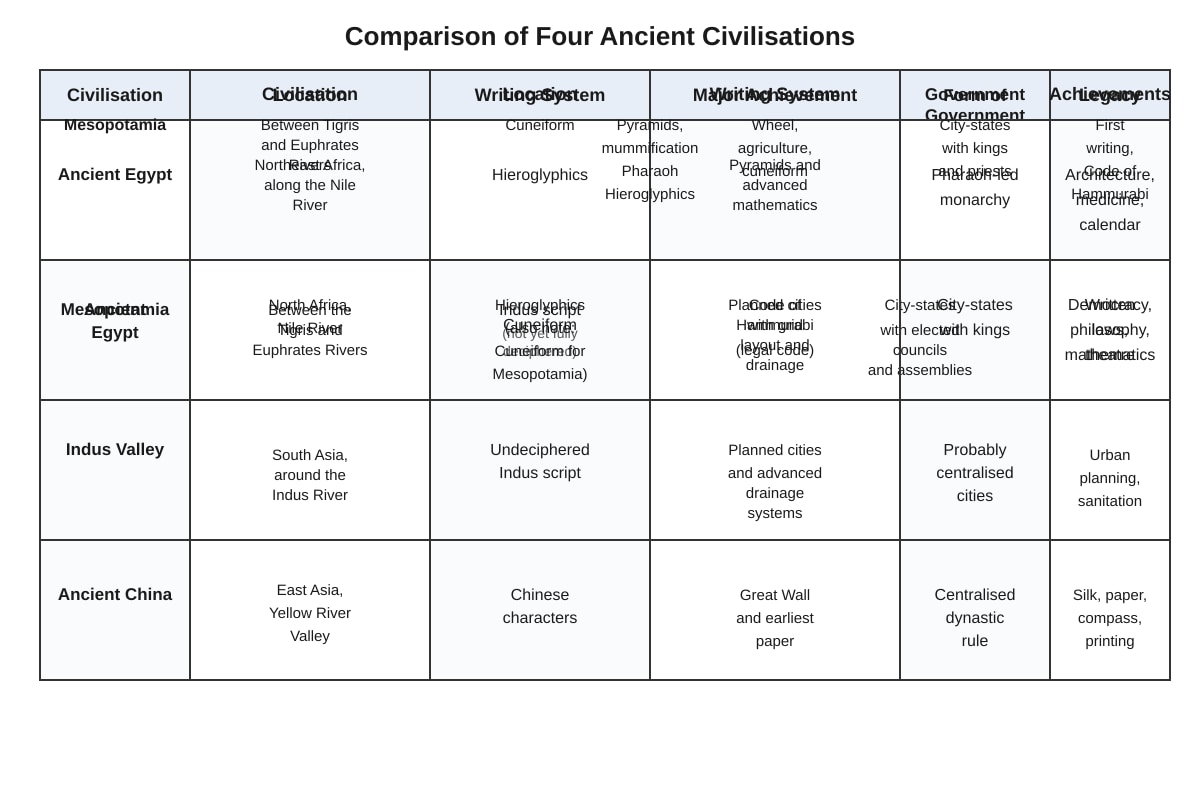
11. Based on the table, which civilisation developed the earliest known written legal code?
- Answer: Mesopotamia [1 mark]
- Explanation: The table shows that Mesopotamia's major achievement was the "Code of Hammurabi," which is one of the earliest known written legal codes. The "Legacy" column also lists "Legal codes" for Mesopotamia.
- Marking note: Award 1 mark for "Mesopotamia." Accept "Code of Hammurabi" as the civilisation is implied.
12. Using the table, compare the forms of government of Ancient Egypt and Ancient China.
- Answer: Both Ancient Egypt and Ancient China had forms of government where a single ruler held power, but the basis of their authority differed. [2 marks]
- Ancient Egypt was ruled by a Pharaoh who was considered a divine ruler (a god-king).
- Ancient China was ruled by a dynasty under the Mandate of Heaven, which was a philosophical concept that justified the ruler's authority as long as he governed justly.
- Explanation: The table shows "Pharaoh (divine ruler)" for Egypt and "Dynastic rule with Mandate of Heaven" for China. Both are forms of monarchy, but the justification for rule is different: divine status in Egypt versus a mandate based on just governance in China.
- Marking scheme:
- 1 mark: Identifies that both had a single ruler/monarchy.
- 1 mark: Explains the difference (divine ruler vs. Mandate of Heaven).
- Common mistakes: Students may simply list the information without comparing. The question asks to "compare," so students must identify similarities and/or differences.
13. The table shows that the Indus Valley civilisation had advanced urban planning. Suggest one reason why this achievement is significant.
- Answer: Any one of the following (2 marks):
- It shows that the Indus Valley civilisation had a high level of organisation and centralised planning, which required a sophisticated government or administrative system. [2 marks]
- The grid city layout and advanced drainage systems suggest that the Indus Valley people had knowledge of engineering and public health, which were advanced for their time. [2 marks]
- It indicates that the civilisation was able to coordinate large-scale construction projects, implying a strong economy and social organisation. [2 marks]
- Explanation: The significance of an achievement goes beyond just stating what it was. Students need to explain why it matters—what it tells us about the civilisation or how it influenced later developments. Urban planning suggests organisation, technology, and social coordination.
- Marking scheme:
- 1 mark: Identifies a valid reason for significance.
- 1 mark: Explains the reason clearly.
- Common mistakes: Students may simply restate that the Indus Valley had urban planning without explaining why this is significant.
14. From the table, identify one similarity between the writing systems of Mesopotamia and Ancient Egypt.
- Answer: Both Mesopotamia and Ancient Egypt developed writing systems (Cuneiform and Hieroglyphics respectively) that used symbols or pictures to represent words or sounds. [1 mark]
- Explanation: The table shows "Cuneiform" for Mesopotamia and "Hieroglyphics" for Egypt. Both are early writing systems that used pictorial symbols. The key similarity is that both were early forms of written communication.
- Marking note: Award 1 mark for any valid similarity. Accept "both used symbols/pictures" or "both were early writing systems."
15. Based on the information in the table, which ancient civilisation do you think has had the greatest impact on the modern world? Explain your answer using evidence from the table.
- Answer: Any reasoned answer is acceptable. Example: [3 marks]
- Ancient China: Ancient China has had the greatest impact because its inventions (silk, paper, compass) and its system of government (bureaucracy, Mandate of Heaven) have directly influenced the modern world. Paper and the compass were essential for communication and exploration, while the concept of a merit-based bureaucracy influenced modern civil service systems. [3 marks]
- Mesopotamia: Mesopotamia has had the greatest impact because its development of legal codes (Code of Hammurabi) laid the foundation for modern legal systems. The idea of written laws that apply to everyone is a cornerstone of modern justice. [3 marks]
- Ancient Egypt: Ancient Egypt has had the greatest impact through its architectural achievements (pyramids) and medical knowledge, which influenced later civilisations including the Greeks and Romans. [3 marks]
- Indus Valley: The Indus Valley's urban planning (grid cities, drainage) has influenced modern city planning and public health systems. [3 marks]
- Explanation: This is an evaluative question. Students must take a position and support it with evidence from the table. There is no single correct answer; the quality of reasoning and use of evidence is what matters.
- Marking scheme:
- 1 mark: States a clear choice of civilisation.
- 1 mark: Provides evidence from the table (e.g., specific achievement or legacy).
- 1 mark: Explains the link between the ancient achievement and its modern impact.
- Common mistakes: Students may state an opinion without using evidence from the table. They may also fail to explain how the ancient achievement impacted the modern world.
Section D: Essay Questions (Questions 16–20)
16. Explain two factors that contributed to the rise of ancient civilisations in river valleys.
- Answer: Any two of the following factors, each explained clearly (2 marks per factor, total 4 marks):
- Factor 1: Fertile soil for agriculture (2 marks): River valleys like the Nile, Tigris-Euphrates, Indus, and Yellow River had annual floods that deposited rich silt (fertile soil) on the floodplains. This allowed for reliable and productive agriculture, producing food surpluses that could support large populations and the development of cities, specialised labour, and complex societies.
- Factor 2: Water supply for irrigation and daily use (2 marks): Rivers provided a reliable source of water for drinking, cleaning, and irrigation. This allowed communities to grow crops even in dry seasons, supporting permanent settlements and population growth. The need to manage water through irrigation systems also encouraged the development of organised labour and centralised governance.
- Factor 3: Transportation and trade routes (2 marks): Rivers served as natural highways for transportation of goods and people. This facilitated trade between communities, the exchange of ideas and technologies, and the movement of resources. Trade helped cities grow and allowed civilisations to access resources they lacked locally.
- Factor 4: Natural protection (2 marks): River valleys were often surrounded by natural barriers such as deserts, mountains, or seas. For example, Egypt was protected by deserts on both sides of the Nile. This natural protection reduced the risk of invasion, allowing civilisations to develop with relative stability and continuity.
- Explanation: This question requires students to explain why river valleys were conducive to the rise of civilisations. The key is to show a cause-and-effect relationship: the geographical feature led to a specific benefit, which in turn enabled the development of civilisation.
- Marking scheme:
- 2 marks per factor: 1 mark for identifying the factor, 1 mark for explaining how it contributed to the rise of civilisation.
- Total: 4 marks for two well-explained factors.
- Common mistakes: Students may list factors without explaining them. They may also describe river valleys without linking them to the development of civilisation.
17. Describe one way in which the social structure of an ancient civilisation you have studied was organised.
- Answer: Any one example from a specific ancient civilisation (2 marks):
- Ancient Egypt: Egyptian society was organised like a pyramid. At the top was the Pharaoh, who was considered a living god. Below him were the priests and nobles, followed by scribes and soldiers. Merchants and artisans were in the middle, and at the bottom were farmers and slaves. This hierarchy meant that the Pharaoh had absolute power, and social mobility was limited. [2 marks]
- Ancient China: Ancient Chinese society was organised under a strict hierarchy with the emperor at the top, followed by the scholar-officials (who gained their positions through civil service exams), then farmers, artisans, and merchants at the bottom. The family was the basic unit, and Confucian values emphasised respect for authority and elders. [2 marks]
- Ancient Rome: Roman society was divided into patricians (wealthy aristocrats), plebeians (common citizens), and slaves. Patricians held most political power initially, but over time plebeians gained more rights through political struggles. The paterfamilias (male head of household) had authority over his family. [2 marks]
- Explanation: This question tests knowledge of social hierarchy in ancient civilisations. Students should name a specific civilisation and describe its social structure, including the main social classes and their roles.
- Marking scheme:
- 1 mark: Identifies a specific civilisation and its social structure.
- 1 mark: Provides details about the hierarchy or roles of different groups.
- Common mistakes: Students may describe social structure in general terms without referring to a specific civilisation. They may also confuse social structure with government structure.
18. How did the development of writing systems contribute to the administration and growth of ancient civilisations?
- Answer: Writing systems contributed to administration and growth in several ways (3 marks):
- Record-keeping (1 mark): Writing allowed for the recording of taxes, trade transactions, crop yields, and population censuses. This enabled governments to manage resources, collect taxes efficiently, and plan for the future.
- Communication and laws (1 mark): Writing allowed rulers to issue decrees, record laws (like the Code of Hammurabi), and communicate with distant parts of their territory. This helped maintain control over large empires and ensured consistent application of laws.
- Preservation of knowledge (1 mark): Writing allowed for the recording of religious texts, scientific knowledge, literature, and history. This knowledge could be passed down to future generations, allowing for cultural continuity and the accumulation of knowledge that supported further growth and innovation.
- Explanation: Writing was a transformative technology for ancient civilisations. It allowed for the storage and transmission of information beyond what human memory could manage. This was essential for managing complex societies with large populations, trade networks, and administrative systems.
- Marking scheme:
- 1 mark for each valid point, up to 3 marks. Each point should explain how writing contributed to administration or growth.
- Common mistakes: Students may simply state that writing was important without explaining how it helped. They may also focus only on one aspect (e.g., record-keeping) without covering the broader impact.
19. 'The legacy of ancient civilisations is more visible in law and government than in science and technology.' Using examples from at least two ancient civilisations, explain how far you agree with this statement.
- Answer: A balanced answer should discuss both sides of the argument and reach a reasoned conclusion. [5 marks]
- Introduction (1 mark): Restate the claim and signal a balanced approach. For example: "The statement suggests that ancient civilisations have had a greater impact on modern law and government than on science and technology. While there is evidence to support this view, I believe that the legacy is equally visible in both areas."
- Argument supporting the statement (2 marks): Provide examples of legal and governmental legacies.
- Example 1: Mesopotamia's Code of Hammurabi established the principle of written laws, which influenced later legal systems including Roman law and modern civil law.
- Example 2: Ancient Greece's concept of democracy, though limited, laid the foundation for modern democratic systems. The idea of citizen participation in governance is a direct legacy.
- Example 3: Rome's legal principles (innocent until proven guilty, rule of law) are still used in many modern legal systems.
- Argument against the statement (1 mark): Provide examples of scientific and technological legacies.
- Example 1: Ancient China's inventions of paper, the compass, and gunpowder revolutionised communication, navigation, and warfare, with lasting impacts on the modern world.
- Example 2: Ancient Egypt's medical knowledge and surgical techniques influenced Greek and Roman medicine, which in turn shaped modern medicine.
- Example 3: The Indus Valley's urban planning (grid cities, drainage systems) influenced modern city planning and public health.
- Conclusion (1 mark): Synthesise the arguments and state a clear position. For example: "While the legal and governmental legacies of ancient civilisations are indeed visible and important, I believe that the scientific and technological legacies are equally significant. The paper we write on, the compass that guided exploration, and the principles of urban planning all come from ancient civilisations. Therefore, I disagree with the statement to a large extent—the legacy is visible in both areas."
- Explanation: This is a "how far do you agree" essay question. Students must take a position and support it with evidence from at least two civilisations. The best answers will be balanced, acknowledging both sides of the argument before reaching a conclusion.
- Marking scheme:
- 1 mark: Clear introduction that restates the claim and signals a balanced approach.
- 2 marks: Provides at least two examples supporting the statement (law and government).
- 1 mark: Provides at least one example challenging the statement (science and technology).
- 1 mark: Clear conclusion that synthesises the arguments and states a justified position.
- Common mistakes: Students may argue only one side without acknowledging the other. They may also provide examples without explaining how they support or challenge the statement. Using only one civilisation when the question requires at least two will lose marks.
20. Explain one reason why the study of ancient civilisations remains relevant for citizens in a modern globalised world like Singapore.
- Answer: Any one of the following (2 marks):
- Understanding our shared heritage (2 marks): Studying ancient civilisations helps us understand that many of the foundations of modern society—law, government, writing, mathematics, science, and technology—have their roots in ancient cultures. This gives us a sense of shared human heritage and helps us appreciate the contributions of different cultures to our modern world, which is important in a diverse and globalised society like Singapore.
- Learning from past successes and failures (2 marks): Ancient civilisations faced challenges similar to ours, such as managing resources, organising societies, and dealing with conflict. By studying how they succeeded or failed, we can learn valuable lessons for addressing contemporary issues. For example, the collapse of some ancient civilisations due to environmental mismanagement offers lessons for modern sustainability efforts.
- Appreciating cultural diversity (2 marks): Singapore is a multi-ethnic society with roots in various ancient civilisations (Chinese, Indian, Malay, and Western). Studying these civilisations helps Singaporeans understand their own cultural heritage and the heritage of others, promoting mutual respect and social harmony.
- Explanation: This question asks students to connect the study of ancient history to contemporary relevance. The key is to show why this knowledge matters for citizens today, especially in a globalised context.
- Marking scheme:
- 1 mark: Identifies a valid reason for relevance.
- 1 mark: Explains the reason clearly, connecting the ancient to the modern.
- Common mistakes: Students may simply state that "it is important to learn history" without explaining why. They may also fail to connect their answer to the modern globalised world or to Singapore's context.
END OF ANSWER KEY