AI Generated Quiz
Secondary 4 Social Studies Ancient Civilisations Quiz
Free Sec 4 Social Studies Ancient Civilisations quiz, AI version, with questions, answers, and O Level-style practice for Singapore students.
These static practice materials are generated from the site's syllabus and paper-generation workflow, with source and model context shown so students and parents can evaluate the material before use.
Questions
Free quiz and exam paper access
Enter your details to view this paper
Your access is remembered on this device.
Answers
Secondary 4 Social Studies Quiz - Ancient Civilisations: Answer Key
Total Marks: 40
Section A: Understanding Ancient Civilisations (Questions 1–5)
Question 1 [2 marks]
Answer: An ancient civilisation is a complex human society that existed in the distant past, typically characterised by features such as organised government, a system of writing, advanced cities, specialised labour, social classes, and monumental architecture. It represents a stage of human development beyond simple farming villages or nomadic tribes.
Marking Scheme:
- 1 mark for a basic definition (e.g., "a complex society from the past")
- 1 mark for mentioning at least one characteristic (e.g., "with writing and government")
Teaching Note: The word "civilisation" comes from the Latin civitas, meaning "city." A civilisation is not just any old society—it is a society with cities, organised institutions, and complex cultural achievements. Think of it as a "step up" from earlier forms of human organisation.
Question 2 [2 marks]
Answer: Any two of the following:
- (a) A system of writing / record-keeping
- (b) Organised government / centralised authority
- (c) Advanced cities / urban centres
- (d) Specialisation of labour (people having different jobs)
- (e) Social classes / hierarchy
- (f) Monumental architecture (temples, pyramids, etc.)
- (g) A system of laws / legal code
Marking Scheme:
- 1 mark for each correct characteristic identified (max 2)
Common Mistake: Students sometimes list "farming" or "tools" as characteristics. While farming and tools existed, they are not unique to civilisations—simpler societies also had them. The key is to identify features that mark a more complex level of organisation.
Question 3 [2 marks]
Answer:
- Civilisation: Indus Valley Civilisation (also known as Harappan Civilisation)
- Achievement: Advanced urban planning with grid-like street layouts and sophisticated drainage systems / Standardised weights and measures / A writing system (still undeciphered) / Trade networks stretching to Mesopotamia
Alternative answers: Any other ancient civilisation from the Indus River Valley is acceptable, with a corresponding correct achievement.
Marking Scheme:
- 1 mark for correctly naming the civilisation
- 1 mark for stating a significant achievement
Teaching Note: The Indus Valley Civilisation (c. 2600–1900 BCE) was one of the three great early civilisations of the Old World, alongside Egypt and Mesopotamia. Its cities like Mohenjo-Daro and Harappa were remarkably well-planned, with advanced drainage systems that were not seen again until the Roman era.
Question 4 [2 marks]
Answer: Rivers were important because they provided:
- A reliable source of fresh water for drinking, irrigation, and agriculture
- Fertile soil through annual flooding (silt deposits), which allowed for surplus food production
- A means of transportation and trade
- A source of food (fish)
Marking Scheme:
- 1 mark for identifying a reason
- 1 mark for explaining why this was important to development
Teaching Note: The "river valley" civilisations—Egypt (Nile), Mesopotamia (Tigris/Euphrates), Indus Valley (Indus), and China (Yellow River)—all emerged along major rivers. This was not a coincidence. Rivers provided the agricultural surplus that allowed people to specialise in non-farming jobs, which is a key step toward civilisation.
Question 5 [2 marks]
Answer: False.
Correction: Many ancient civilisations did have contact with one another and exchanged ideas, goods, and technologies. For example, there is evidence of trade between the Indus Valley and Mesopotamia, and the Silk Road later connected China with the Mediterranean world.
Marking Scheme:
- 1 mark for identifying "False"
- 1 mark for a reasonable correction that shows understanding of interaction between civilisations
Common Mistake: Students may think civilisations were completely isolated. While travel was difficult, there is clear archaeological evidence of trade networks and cultural exchange. The statement is an overgeneralisation.
Section B: Comparing Ancient Civilisations (Questions 6–10)
Question 6 [4 marks]
Answer:
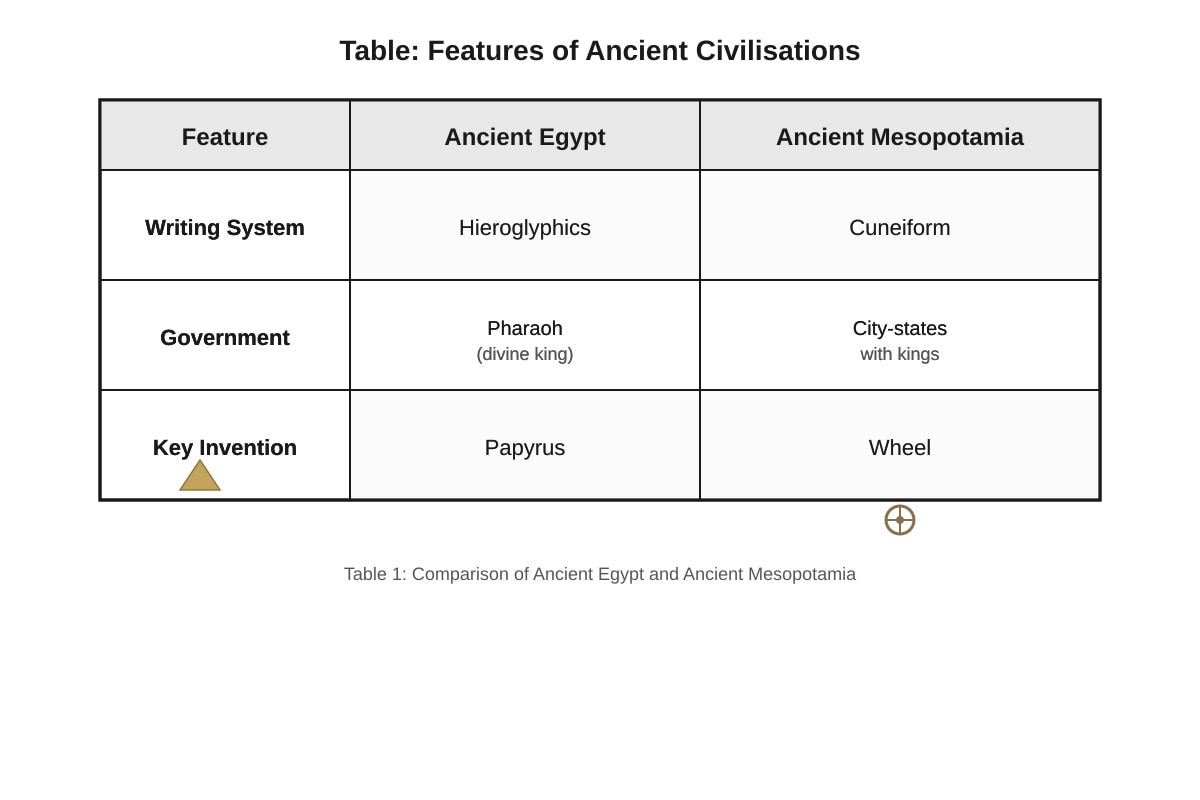
Similarity (2 marks): Both Ancient Egypt and Ancient Mesopotamia developed a system of writing (Egypt: hieroglyphics; Mesopotamia: cuneiform). This shows that both civilisations had reached a level of complexity where record-keeping was necessary for administration, trade, and cultural preservation.
Difference (2 marks): Ancient Egypt was a unified kingdom ruled by a Pharaoh, who was considered a divine king. In contrast, Ancient Mesopotamia was organised as a collection of independent city-states, each with its own king. This difference likely arose from Egypt's geography (the Nile provided natural unity) versus Mesopotamia's more open terrain.
Marking Scheme:
- 2 marks for a well-explained similarity with reference to the table
- 2 marks for a well-explained difference with reference to the table
- (1 mark each for basic identification without explanation)
Teaching Note: When comparing civilisations, look for patterns. Both Egypt and Mesopotamia had writing, but they developed different systems. Both had governments, but they were organised differently. The key is to explain why these similarities and differences existed, often by linking them to geography or other factors.
Question 7 [2 marks]
Answer: Egypt's geography—the Nile River Valley—was a long, narrow strip of fertile land surrounded by desert, which naturally unified the region and made centralised control easier. Mesopotamia, on the other hand, was a more open plain with no natural barriers, making it harder to unify and more vulnerable to invasion, leading to the development of independent city-states.
Marking Scheme:
- 1 mark for identifying a geographical reason
- 1 mark for explaining how it led to the difference in government
Teaching Note: This is a classic example of "geographic determinism"—how physical geography shapes political and social development. Egypt was "the gift of the Nile," and the river's predictable flooding and natural boundaries created conditions for a unified state. Mesopotamia's unpredictable rivers and open terrain created a more fragmented political landscape.
Question 8 [4 marks]
Answer:
Source A suggests that the Indus Valley Civilisation had a strong central authority capable of coordinating large-scale urban planning (standardised bricks, drainage systems), but unlike Egypt, this authority did not express itself through grand palaces or temples. In Ancient Egypt, the Pharaoh's power was visibly demonstrated through monumental architecture like pyramids and temples, which served both as tombs and as symbols of divine authority.
Comparison points:
- Both had strong central authority (Indus: urban planning; Egypt: Pharaoh)
- Egypt's authority was linked to religion and the divine status of the Pharaoh
- Indus Valley authority seems more practical/administrative, with less emphasis on personal glorification
Marking Scheme:
- 2 marks for correctly interpreting Source A's suggestion about the Indus Valley
- 2 marks for a meaningful comparison with Ancient Egypt
Teaching Note: Source A is interesting because it presents a puzzle: the Indus Valley had clear evidence of central planning (standardised bricks, grid streets, advanced drainage), but no obvious "ruler's palace" or religious monuments. This has led historians to debate whether the Indus Valley had a different kind of leadership—perhaps a council of priests or merchants, rather than a single divine king like the Pharaoh.
Question 9 [2 marks]
Answer: Ancient China developed along the Yellow River, which provided fertile soil for agriculture but also posed challenges with flooding. This led to the need for large-scale water control projects, which in turn required a strong centralised government. In contrast, Ancient Greece's mountainous geography and many islands led to the development of independent city-states (poleis) rather than a unified empire.
Alternative answer: China's relative isolation (surrounded by mountains, deserts, and ocean) allowed its civilisation to develop with a strong sense of cultural continuity. Greece's proximity to the Mediterranean Sea encouraged maritime trade and cultural exchange with other civilisations.
Marking Scheme:
- 1 mark for identifying a geographical feature of each civilisation
- 1 mark for explaining how it influenced development differently
Teaching Note: This question tests your ability to compare across civilisations. The key is to show how geography created different conditions, leading to different outcomes. China's geography favoured unity; Greece's geography favoured fragmentation.
Question 10 [4 marks]
Answer:
Agree (evidence supporting the statement):
- Writing allowed for the recording of laws (e.g., Hammurabi's Code), history, and literature
- It enabled complex administration of large empires (e.g., Chinese bureaucracy)
- It allowed knowledge to be preserved and passed down to future generations
Disagree (evidence against the statement):
- Other achievements were equally important, such as:
- The wheel (Mesopotamia) revolutionised transport and trade
- Mathematics and astronomy (Maya, Babylon) enabled agriculture and navigation
- Medicine (Egypt, Greece) improved human health and longevity
- Democratic government (Greece) shaped modern political systems
Balanced conclusion: While writing was undoubtedly transformative, it is difficult to rank achievements as "most important" because different civilisations made different contributions, and many achievements built upon one another.
Marking Scheme:
- 2 marks for a well-reasoned argument supporting the statement with reference to at least one civilisation
- 2 marks for a well-reasoned counter-argument with reference to at least one other civilisation
- (Award full marks for a balanced answer that engages with both sides, even if the student ultimately takes a position)
Teaching Note: This is a "how far do you agree" question—a common format in Secondary 4 Social Studies. The best answers are balanced, using evidence from multiple civilisations. Avoid taking an extreme position without acknowledging the other side.
Section C: Legacy and Impact of Ancient Civilisations (Questions 11–15)
Question 11 [2 marks]
Answer:
- Contribution: Democracy (specifically, the Athenian model of direct democracy)
- Significance: Ancient Athens introduced the idea that citizens (free adult males) could participate directly in decision-making through assemblies and juries. This concept influenced the development of democratic systems in the modern world, including representative democracy in Singapore, where citizens vote for their representatives in Parliament.
Alternative answers: Other contributions include philosophy (Socrates, Plato, Aristotle), the Olympic Games, theatre (tragedy and comedy), and the concept of citizenship.
Marking Scheme:
- 1 mark for naming a contribution
- 1 mark for explaining its significance
Teaching Note: The key word is "significance"—you need to explain why this contribution matters, not just state what it is. Connect the ancient contribution to its modern impact.
Question 12 [2 marks]
Answer: The Code of Hammurabi (c. 1754 BCE) was one of the earliest written legal codes. It established the principle that laws should be written down and publicly displayed, so that everyone knew the rules and the consequences of breaking them. This influenced the development of law by promoting the idea of justice based on written rules rather than the arbitrary will of a ruler. The principle of "an eye for an eye" (lex talionis) also influenced later legal systems, though modern law has moved toward more rehabilitative approaches.
Marking Scheme:
- 1 mark for identifying a key feature of Hammurabi's Code
- 1 mark for explaining its influence on law and justice
Teaching Note: Hammurabi's Code is significant not because it was "fair" by modern standards (it had different punishments for different social classes), but because it established the principle of written, public law. This is a foundation of the rule of law.
Question 13 [4 marks]
Answer:
Innovation 1: Concrete
- Impact: Roman concrete allowed for the construction of durable structures like the Pantheon's dome. Modern concrete is the most widely used building material in the world, used in everything from skyscrapers to bridges to roads.
Innovation 2: Aqueducts
- Impact: Roman aqueducts brought fresh water to cities, improving public health and sanitation. Modern water supply systems, while more advanced, follow the same basic principle of transporting water from a source to a population centre.
Marking Scheme:
- 1 mark for each innovation correctly identified (max 2)
- 1 mark for each impact explained (max 2)
Teaching Note: Source B provides the information directly—you need to extract it and then connect it to the modern world. The "impact" should be specific, not vague (e.g., "it helped people" is too vague; "it improved public health by providing clean water" is better).
Question 14 [2 marks]
Answer: In Ancient Athens, democracy was direct—citizens (free adult males) voted directly on laws and policies in the Assembly. In modern Singapore, democracy is representative—citizens vote for Members of Parliament (MPs) who then make laws on their behalf. Additionally, Athenian democracy excluded women, slaves, and foreigners, while Singapore's democracy grants voting rights to all citizens aged 21 and above regardless of gender or wealth.
Marking Scheme:
- 1 mark for identifying a difference
- 1 mark for explaining it clearly
Teaching Note: This question tests your understanding of how democratic concepts have evolved. The core idea of "rule by the people" remains, but the method has changed to suit larger, more complex societies.
Question 15 [4 marks]
Answer:
Agree (evidence supporting Asian civilisations' impact):
- Ancient China: Paper, printing, gunpowder, the compass (the "Four Great Inventions") fundamentally changed the world. The Chinese civil service examination system influenced modern bureaucracy.
- Ancient India: The concept of zero and the decimal system in mathematics, which are essential to modern science and technology. Religions like Buddhism and Hinduism have shaped billions of lives.
Disagree (evidence supporting Mediterranean civilisations' impact):
- Ancient Greece: Democracy, philosophy (logic, ethics, politics), theatre, and the scientific method form the foundation of Western civilisation.
- Ancient Rome: Law (Roman law influenced many modern legal systems), engineering (roads, aqueducts, concrete), language (Latin roots in many languages), and the concept of a republic.
Balanced conclusion: Both Asian and Mediterranean civilisations have had profound impacts, but in different areas. Asian civilisations contributed more to technology and mathematics, while Mediterranean civilisations contributed more to political and legal systems. It is difficult to say one had a "greater" impact overall, as the modern world draws from both traditions.
Marking Scheme:
- 2 marks for a well-reasoned argument supporting the statement with reference to at least one Asian civilisation
- 2 marks for a well-reasoned counter-argument with reference to at least one Mediterranean civilisation
- (Award full marks for a balanced answer that engages with both sides)
Teaching Note: This is another "how far do you agree" question. The best approach is to show you understand both sides of the argument before reaching a conclusion. Use specific examples—vague generalisations will not earn full marks.
Section D: Analysing Historical Sources on Ancient Civilisations (Questions 16–20)
Question 16 [2 marks]
Answer: Source C suggests that cultural change when civilisations interact can be superficial or motivated by practical concerns (such as gaining favour) rather than genuine understanding or appreciation. The Roman official observes that the Britons adopt Roman customs (togas, language, architecture) but questions whether this reflects true cultural adoption or merely strategic behaviour.
Marking Scheme:
- 1 mark for identifying what the source suggests about cultural change
- 1 mark for supporting the answer with evidence from the source
Teaching Note: When analysing a source, always ask: What is the author's perspective? The Roman official is sceptical—he sees the Britons' adoption of Roman ways as insincere. This tells us that cultural change is complex and can involve resistance, adaptation, and strategic behaviour, not just simple adoption.
Question 17 [2 marks]
Answer:
- Factor 1: Environmental changes—specifically, changes in the course of the Indus River leading to flooding and droughts
- Factor 2: Increased violence in the later periods
Marking Scheme:
- 1 mark for each factor correctly identified
Teaching Note: This is a straightforward comprehension question—the answer is directly stated in the source. The skill being tested is the ability to extract specific information from a text. Note that Source D says there is "no clear sign of a single invasion," so "invasion" would not be a correct answer.
Question 18 [3 marks]
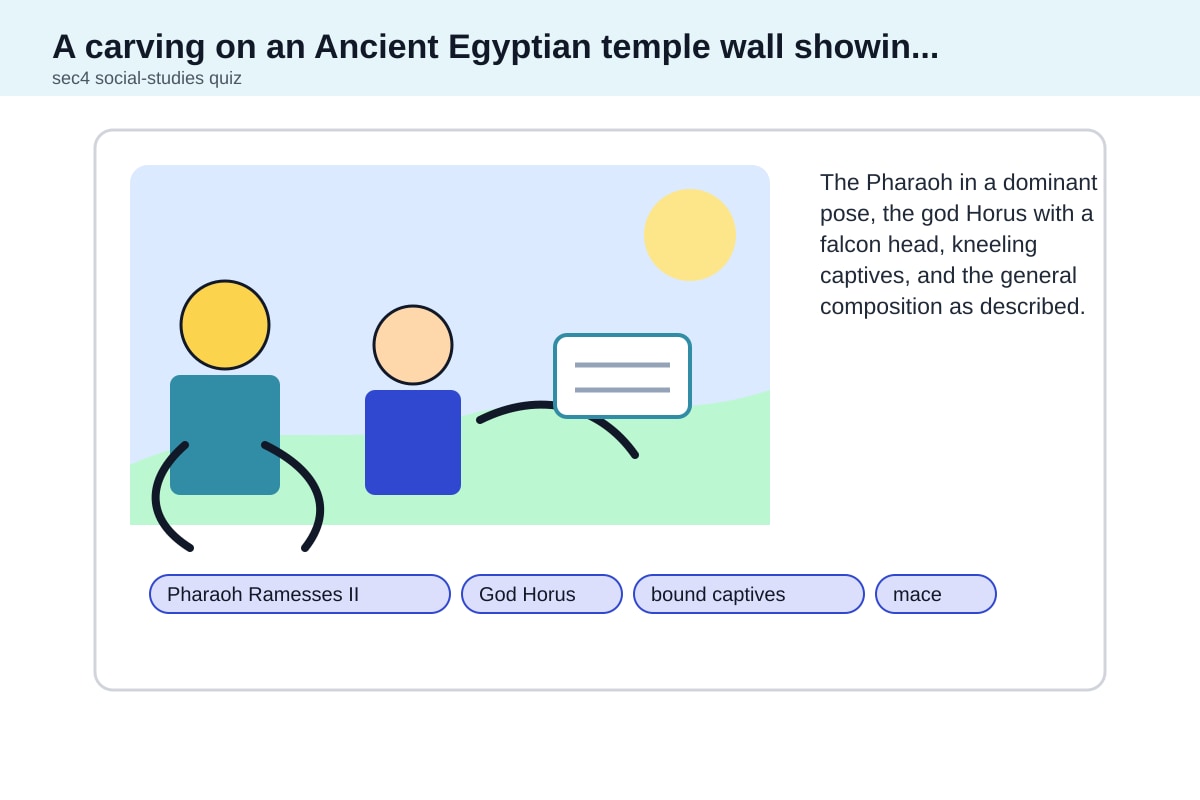
Answer: Source E suggests that the Pharaoh's authority in Ancient Egypt came from the gods. The carving shows the god Horus (a major Egyptian deity) standing behind Pharaoh Ramesses II and placing a hand on his shoulder, indicating divine support and approval. This visual representation communicates that the Pharaoh was not just a political leader but a divinely chosen ruler, acting with the backing of the gods. The act of smiting enemies further reinforces the Pharaoh's role as the protector of Egypt, a role given to him by the gods.
Marking Scheme:
- 1 mark for identifying that the source shows divine authority
- 1 mark for explaining the significance of Horus's presence
- 1 mark for linking this to the broader concept of Pharaoh's authority
Teaching Note: This is a visual source analysis question. When analysing a visual source, look at:
- What is shown? (Pharaoh, god, captives)
- How is it shown? (Horus's hand on Pharaoh's shoulder = support; Pharaoh's dominant pose = power)
- Why does it matter? (It communicates the divine basis of Pharaoh's authority)
Question 19 [1 mark]
Answer: The danger is that we risk imposing our own modern values on people from the past, rather than trying to understand their world on its own terms.
Marking Scheme:
- 1 mark for correctly identifying the danger as stated in the source
Teaching Note: This is a one-mark comprehension question. The answer is directly stated in Source F: "we risk imposing our own values on people who lived thousands of years ago." The historian argues for understanding rather than judging.
Question 20 [4 marks]
Answer:
Historians use different types of evidence to build a more complete understanding of ancient civilisations:
-
Written sources (like Source C): Letters, official documents, and literature provide insights into people's thoughts, attitudes, and daily life. However, they may be biased (Source C shows a Roman official's perspective, which may not reflect how Britons actually felt).
-
Archaeological evidence (like Source D): Geological data, artefacts, and settlement patterns provide physical evidence of what happened. Source D uses geological evidence to explain the decline of the Indus Valley.
-
Visual/artistic sources (like Source E): Carvings, paintings, and sculptures reveal cultural values, beliefs, and power structures. Source E shows the religious basis of Pharaoh's authority.
-
Modern scholarly analysis (like Source F): Historians today interpret evidence and provide frameworks for understanding the past. Source F reminds us to be careful about imposing modern values.
By combining these different types of evidence, historians can cross-check information, identify biases, and build a more nuanced understanding. For example, written sources might tell us what people said they did, while archaeological evidence shows what they actually did.
Marking Scheme:
- 1 mark for identifying different types of evidence (at least two)
- 1 mark for explaining how each type contributes to understanding
- 1 mark for using specific examples from the sources provided
- 1 mark for showing how different types of evidence can complement or challenge each other
Teaching Note: This is a synthesis question that requires you to draw on all the sources in Section D. The best answers will:
- Categorise the sources by type (written, visual, archaeological, scholarly)
- Explain what each type tells us
- Show awareness of the limitations of each type
- Explain how combining them gives a fuller picture
End of Answer Key