Secondary 4 Social Studies Quiz - Source Based Skills
Name: ___________________________
Class: ____________
Date: ____________
Score: ____________
Duration: 60 minutes
Total Marks: 40
Instructions:
- This quiz tests your source-based skills using extracts on Singapore's society and globalisation.
- Answer all 20 questions.
- Use the sources provided. Write your answers in the blank spaces.
- Marks for each question are shown in brackets.
Section A: Source Comprehension (Questions 1–5)
Source A (Newspaper article, The Straits Times, 2018):
"Community centres in Singapore have stepped up integration programmes. In 2017, over 200,000 residents joined racial harmony events. However, some neighbourhoods still report tension over shared facilities."
Source B (Government report, Ministry of Culture, 2018):
"Surveys show 85% of citizens feel a strong sense of belonging. The Ethnic Integration Policy ensures mixed communities in public housing. This prevents enclaves and builds daily interaction."
1. What does Source A say about community integration programmes? [1]
2. According to Source B, what policy helps prevent ethnic enclaves? [1]
3. Give one figure from Source A that shows participation in harmony events. [1]
4. What percentage of citizens feel a strong sense of belonging in Source B? [1]
5. State one difference in tone between Source A and Source B. [1]
Section B: Source Analysis Skills (Questions 6–15)
Source C (Blog post by a resident, 2018):
"I live in a mature estate. The new migrant families are noisy. We never had problems before. The government should limit newcomers."
Source D (Academic journal, 2018):
"Research in 5 housing estates found that regular intergenerational activities reduced friction by 40%. Policy should fund community bonding, not restrict movement."
6. Study Sources C and D. How far do the sources disagree? Explain your answer. [6]
7. Which source is more reliable as evidence that community activities reduce tension? Explain. [7]
8. Having read Source C, are you surprised by Source D? Explain. [7]
9. What is the purpose of Source C? [2]
10. Identify the perspective of Source D's author. [2]
11. Study the table below.
| Estate | Tension incidents 2016 | Tension incidents 2018 |
|---|
| A | 12 | 7 |
| B | 9 | 5 |
| C | 15 | 10 |
What trend does the table show? [2]
12. How useful is the table in Question 11 for showing integration success? [3]
13. Source E (Speech by Minister, 2018): "Singapore must stay open to global talent to grow our economy."
Source F (Forum letter, 2018): "Local graduates cannot find jobs because of foreigners."
How similar are Sources E and F in their view of global talent? [4]
14. Which of Source E or F is more useful to understand government policy? Explain. [3]
15.
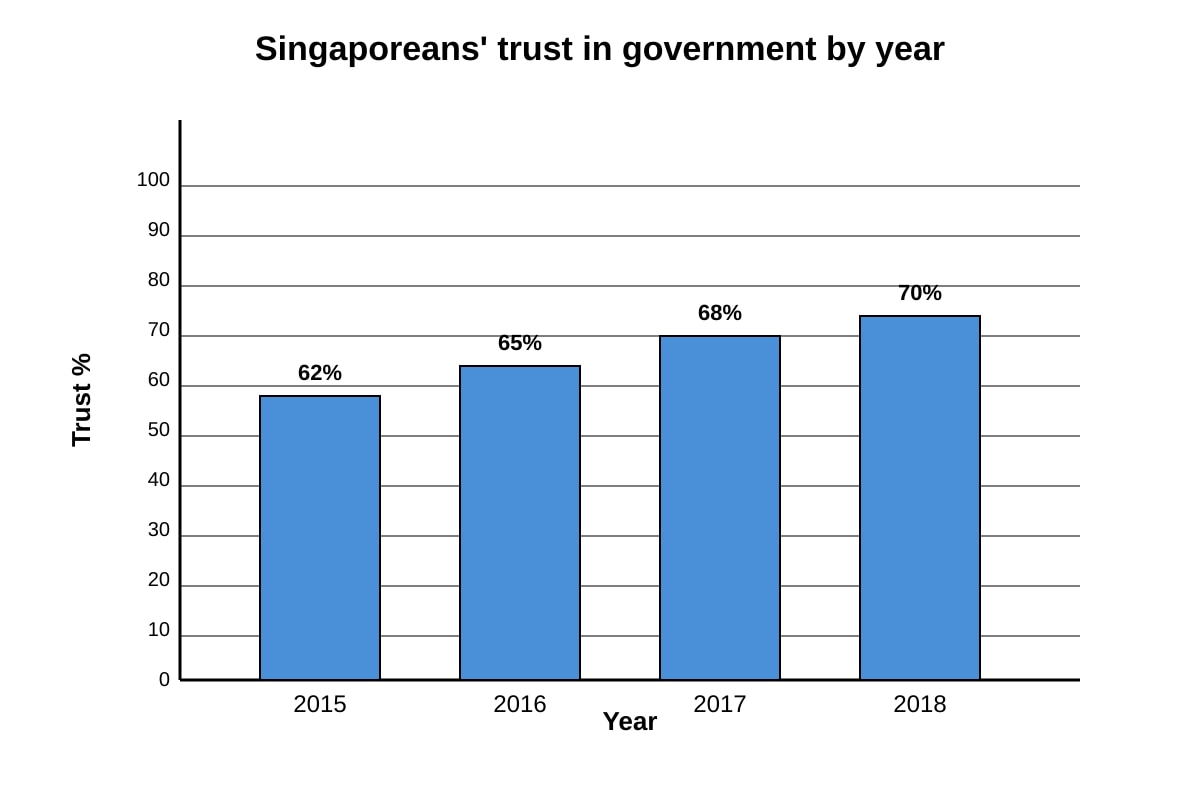
Generated chart for Q15.
Using the chart, what is the change in trust from 2015 to 2018? [2]
Section C: Application of Source Skills (Questions 16–20)
Source G (NGO report, 2018): "Low-income families receive ComCare aid. But application process is complex; 30% give up."
Source H (MOM data, 2018): "Real median income rose 3.2% in 2017. Unemployment stayed at 2.1%."
16. Study Sources G and H. How far do they agree that Singapore helps the poor? Explain. [6]
17. Which source is more useful for understanding challenges faced by the poor? Explain. [3]
18. Having read Source H, are you surprised by Source G? Explain. [3]
19. "Singapore government has provided enough help for the poor." Using Sources G and H, explain how far you agree. [8]
20. Identify one strength and one weakness of using Source G as evidence. [2]
</stage3_quiz_answers_md>
Secondary 4 Social Studies Quiz - Source Based Skills: Answer Key
Total Marks: 40
Topic: Source Based Skills
Section A: Source Comprehension (Q1–5)
1. [1 mark]
Answer: Source A says community centres stepped up integration programmes and over 200,000 joined racial harmony events in 2017, but some neighbourhoods still report tension.
Teaching note: Direct extraction from Source A. Student should identify both positive (programmes, participation) and negative (tension) points.
2. [1 mark]
Answer: Ethnic Integration Policy (EIP).
Teaching note: Source B explicitly names the policy that ensures mixed communities.
3. [1 mark]
Answer: Over 200,000 residents joined racial harmony events (or "200,000").
Teaching note: Any figure from Source A about participation is accepted.
4. [1 mark]
Answer: 85%.
Teaching note: Direct from Source B survey result.
5. [1 mark]
Answer: Source A highlights ongoing tension (cautionary tone); Source B is positive/official (promotional tone).
Teaching note: Difference in tone – A is critical/balanced, B is supportive of government.
Section B: Source Analysis Skills (Q6–15)
6. [6 marks] Study Sources C and D. How far do the sources disagree?
Marking: 3 points of comparison with evidence (2 marks each, max 6).
Answer:
- They disagree on cause of tension: C blames migrants; D shows activities reduce friction (evidence: C "new migrant families are noisy"; D "reduced friction by 40%").
- They disagree on solution: C wants limits; D wants funding bonding.
- Overall, largely disagree on both problem and policy.
Teaching note: Define disagreement by comparing claims. Use quotes/data.
7. [7 marks] Which source more reliable as evidence activities reduce tension?
Marking: Reliability criteria (3), application to D (2), application to C (1), conclusion (1).
Answer: Source D more reliable. It is academic journal with research in 5 estates (specific, peer context). Source C is blog, personal, biased. D has data (40% reduction).
Teaching note: Reliability = trustworthiness, author, method. Usefulness differs (relevance).
8. [7 marks] Having read C, surprised by D?
Marking: Expectation from C (2), content D (2), surprise reasoning (2), conclusion (1).
Answer: Not very surprised. C shows tension; D offers solution showing tension exists but manageable. D's 40% reduction aligns with need from C.
Teaching note: Show inference from C then compare.
9. [2 marks] Purpose of Source C: Express personal grievance; persuade for limits on migrants.
Teaching note: Blog purpose = opinion sharing.
10. [2 marks] Perspective of D: Researcher/academic favouring community programmes over restriction.
Teaching note: Journal = expert view.
11. [2 marks] Trend: Tension incidents decreased in all estates from 2016 to 2018.
Teaching note: Read table, state decline.
12. [3 marks] Usefulness: Useful shows quantitative drop; not enough alone as no cause, only numbers. (2 for useful, 1 for limitation)
Teaching note: Usefulness = relevance to claim.
13. [4 marks] Similarity: Both address global talent impact; E positive (economy), F negative (jobs). Not similar in judgement. (2 compare, 2 evidence)
Teaching note: Similar in topic, differ in view.
14. [3 marks] Source E more useful for policy: it is minister speech stating govt stance. F is forum letter opinion. (2 E, 1 F)
Teaching note: Official source = policy insight.
15. [2 marks] Change: 70% – 62% = 8 percentage point increase.
Teaching note: Chart shows rise. Must state direction and value.
Section C: Application (Q16–20)
16. [6 marks] Sources G and H on help poor:
- G: aid exists but complex, 30% give up (partial help).
- H: income rose, unemployment low (overall good).
- Agree help exists; disagree on adequacy. (3 compare points, 2 each)
Teaching note: Cross-reference.
17. [3 marks] G more useful for challenges: shows process barrier. H shows macro data not lived difficulty. (2 G, 1 H)
Teaching note: Usefulness to specific question.
18. [3 marks] Not surprised: H positive macro; G micro gap expected in any system. (1 expectation, 2 reason)
Teaching note: Inference.
19. [8 marks] "Enough help" evaluative:
Intro: Qualified agreement.
Para1: Agree – H income up, G ComCare exists.
Para2: Disagree – G 30% give up, process complex.
Conclusion: Partially, needs simplification.
Marking: Intro(1) + 2 paras evidence(3+3) + conclusion(1).
Teaching note: Use sources as evidence, balanced.
20. [2 marks] Strength: specific dropout %; Weakness: NGO may have advocacy bias.
Teaching note: Source evaluation.
</stage3_quiz_answers_md>
<stage3_quiz_md>
Secondary 4 Social Studies Quiz - Source Based Skills
Name: ___________________________
Class: ____________
Date: ____________
Score: ____________
Duration: 60 minutes
Total Marks: 40
Instructions:
- This quiz tests your source-based skills using extracts on Singapore's society and globalisation.
- Answer all 20 questions.
- Use the sources provided. Write your answers in the blank spaces.
- Marks for each question are shown in brackets.
Section A: Source Comprehension (Questions 1–5)
Source A (Newspaper article, The Straits Times, 2018):
"Community centres in Singapore have stepped up integration programmes. In 2017, over 200,000 residents joined racial harmony events. However, some neighbourhoods still report tension over shared facilities."
Source B (Government report, Ministry of Culture, 2018):
"Surveys show 85% of citizens feel a strong sense of belonging. The Ethnic Integration Policy ensures mixed communities in public housing. This prevents enclaves and builds daily interaction."
1. What does Source A say about community integration programmes? [1]
2. According to Source B, what policy helps prevent ethnic enclaves? [1]
3. Give one figure from Source A that shows participation in harmony events. [1]
4. What percentage of citizens feel a strong sense of belonging in Source B? [1]
5. State one difference in tone between Source A and Source B. [1]
Section B: Source Analysis Skills (Questions 6–15)
Source C (Blog post by a resident, 2018):
"I live in a mature estate. The new migrant families are noisy. We never had problems before. The government should limit newcomers."
Source D (Academic journal, 2018):
"Research in 5 housing estates found that regular intergenerational activities reduced friction by 40%. Policy should fund community bonding, not restrict movement."
6. Study Sources C and D. How far do the sources disagree? Explain your answer. [6]
7. Which source is more reliable as evidence that community activities reduce tension? Explain. [7]
8. Having read Source C, are you surprised by Source D? Explain. [7]
9. What is the purpose of Source C? [2]
10. Identify the perspective of Source D's author. [2]
11. Study the table below.
| Estate | Tension incidents 2016 | Tension incidents 2018 |
|---|
| A | 12 | 7 |
| B | 9 | 5 |
| C | 15 | 10 |
What trend does the table show? [2]
12. How useful is the table in Question 11 for showing integration success? [3]
13. Source E (Speech by Minister, 2018): "Singapore must stay open to global talent to grow our economy."
Source F (Forum letter, 2018): "Local graduates cannot find jobs because of foreigners."
How similar are Sources E and F in their view of global talent? [4]
14. Which of Source E or F is more useful to understand government policy? Explain. [3]
15.
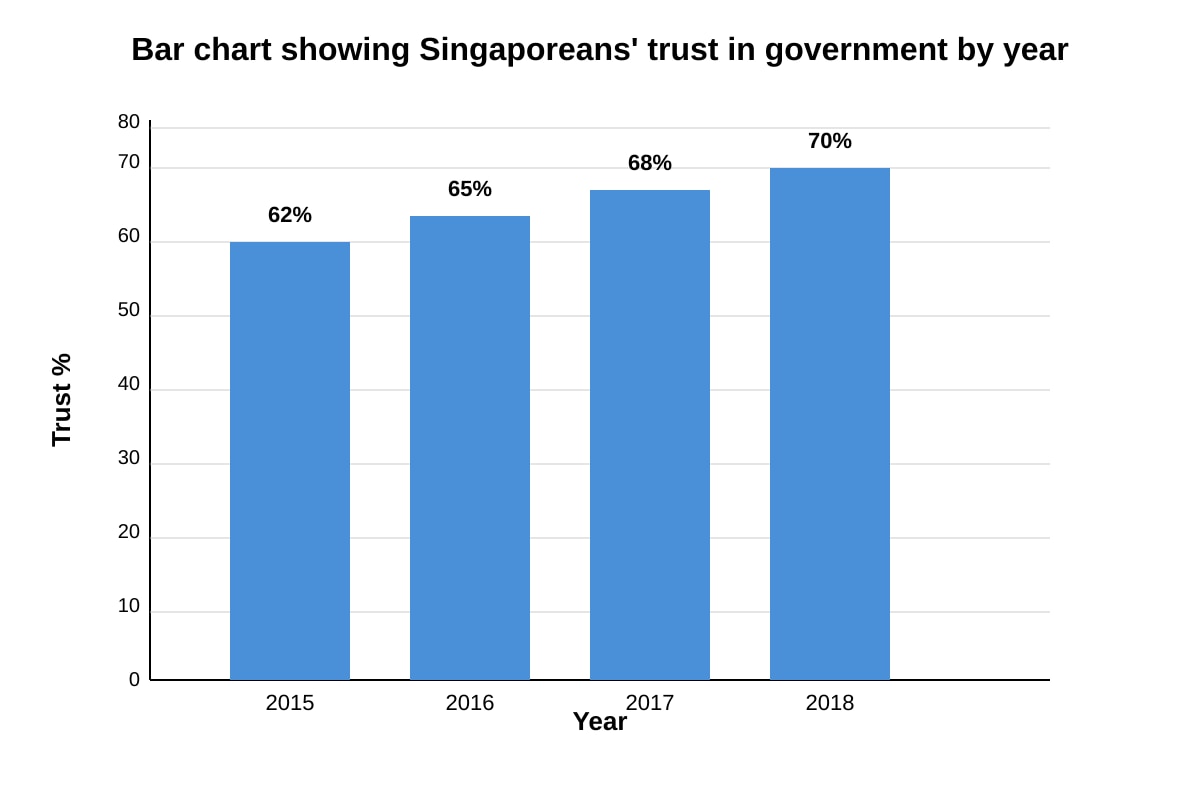
Generated chart for Q15.
Using the chart, what is the change in trust from 2015 to 2018? [2]
Section C: Application of Source Skills (Questions 16–20)
Source G (NGO report, 2018): "Low-income families receive ComCare aid. But application process is complex; 30% give up."
Source H (MOM data, 2018): "Real median income rose 3.2% in 2017. Unemployment stayed at 2.1%."
16. Study Sources G and H. How far do they agree that Singapore helps the poor? Explain. [6]
17. Which source is more useful for understanding challenges faced by the poor? Explain. [3]
18. Having read Source H, are you surprised by Source G? Explain. [3]
19. "Singapore government has provided enough help for the poor." Using Sources G and H, explain how far you agree. [8]
20. Identify one strength and one weakness of using Source G as evidence. [2]