From Real Exams Quiz
Secondary 4 Social Studies Singapore Southeast Asia Quiz
Free Sec 4 Social Studies Singapore SEA quiz, HY3 Exam version, with questions, answers, and O Level-style practice for Singapore students.
These static practice materials are generated from the site's syllabus and paper-generation workflow, with source and model context shown so students and parents can evaluate the material before use.
Questions
Secondary 4 Social Studies Quiz - Singapore Southeast Asia
Name: ___________________________
Class: ___________________________
Date: ___________________________
Score: ___________ / 40
Duration: 60 minutes
Total Marks: 40
Instructions:
- This quiz focuses on Singapore and Southeast Asia.
- Section A: 10 short source-based and recall questions (1 mark each).
- Section B: 6 source-based questions (2 marks each).
- Section C: 4 extended source-based questions (5 marks each).
- Use the provided sources and your own knowledge. Write clearly in the spaces provided.
Section A: Short Questions (1 mark each, Q1–Q10)
1. Which regional organisation was established in 1967 to promote economic and political cooperation among Southeast Asian countries?
2. Name one founding member of the Association of Southeast Asian Nations (ASEAN) other than Singapore.
3. What is the term used for the strategic waterway located between the Malay Peninsula and the Indonesian island of Sumatra that is vital to Singapore’s trade?
4. Which Southeast Asian country is Singapore’s largest trading partner within ASEAN as of recent years?
5. What is the name of the bilateral relationship framework that guides cooperation between Singapore and Indonesia?
6. Name one challenge that Southeast Asian nations face due to transnational pollution.
7. Which term describes the policy of Singapore working with neighbouring countries to maintain regional stability?
8. What is the primary purpose of the ASEAN Economic Community (AEC)?
9. Name one Southeast Asian country that is not a member of ASEAN.
10. What is the term for the movement of people across borders for work within Southeast Asia?
Section B: Source-Based Questions (2 marks each, Q11–Q16)
Study the following sources.
Source A (News report, 2023):
"Singapore and Malaysia have agreed to accelerate the RTS Link project connecting Woodlands to Johor Bahru, easing congestion and boosting daily cross-border commute for thousands of workers."
Source B (Government statement, 2022):
"Through ASEAN platforms, Singapore continues to advocate for a rules-based order in the South China Sea to ensure peace and stability for all Southeast Asian states."
11. Based on Source A, identify one benefit of the RTS Link for Singapore–Malaysia relations. (2m)
12. Using Source B, explain how Singapore works with Southeast Asia to address security concerns. (2m)
13. Study the table below.
| Country | GDP per capita (USD, 2022) |
|---|---|
| Singapore | 82,800 |
| Malaysia | 12,200 |
| Indonesia | 4,780 |
| Vietnam | 4,110 |
What does the table show about Singapore’s economic position in Southeast Asia? (2m)
14. Source C (Editorial, 2023): "Haze from land fires in a neighbouring Southeast Asian country has again affected Singapore, highlighting the limits of unilateral action."
What regional problem is described in Source C? (2m)
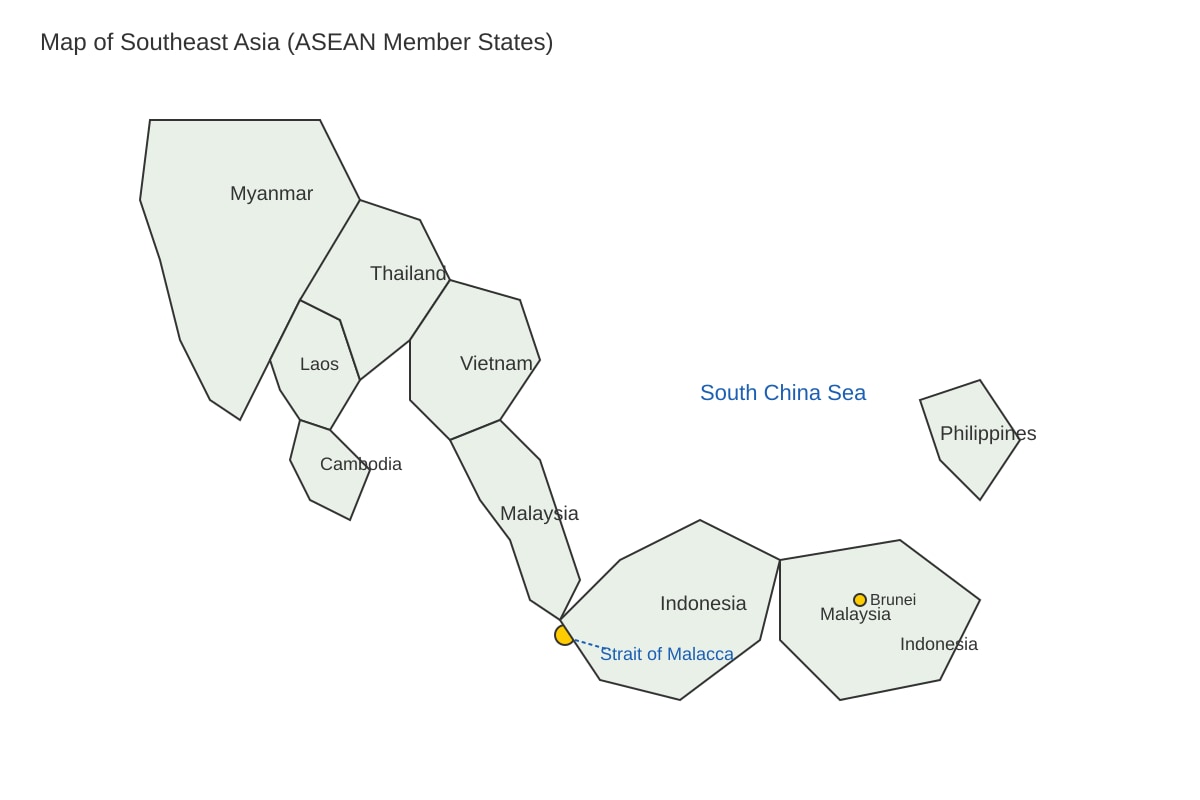
15.
Image pending generation: map for Q15.
Using the map above, name the waterway labelled between Malaysia and Sumatra that is important for Singapore’s shipping. (2m)
16. Source D (Speech by Singapore minister, 2023): "Our future is tied to Southeast Asia; we must help less developed neighbours grow so our region stays stable."
What role does Singapore see for itself in the region based on Source D? (2m)
Section C: Extended Source-Based Questions (5 marks each, Q17–Q20)
Source E (Report, 2023): "The ASEAN Power Grid aims to link electricity networks across Southeast Asia, allowing cross-border renewable energy trade. Singapore, lacking natural resources, sees this as a way to secure clean energy."
Source F (Commentary, 2023): "Critics argue that unequal development means Singapore gains more from regional integration than poorer neighbours, worsening the gap."
17. Study Sources E and F. How far do the sources disagree on the impact of regional integration on Southeast Asia? Explain your answer. (5m)
18. Source G (Data, 2022): "Intra-ASEAN trade made up 24% of Singapore’s total trade."
Source H (Interview, 2023): "Local firms say ASEAN market is crucial but non-tariff barriers still hurt small businesses."
Using Sources G and H, explain how Singapore benefits from and is challenged by Southeast Asian economic cooperation. (5m)
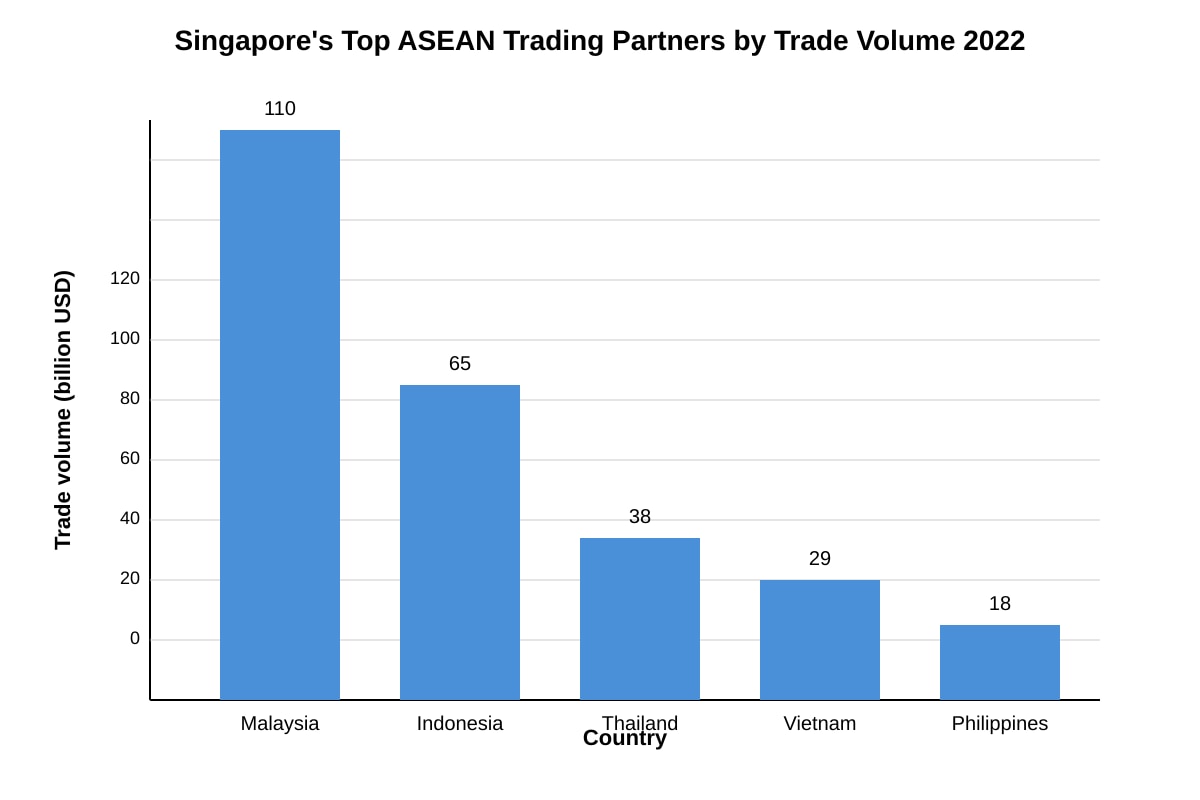
19.
Image pending generation: chart for Q19.
Using the chart, identify Singapore’s largest ASEAN trading partner and explain why close ties with this country matter to Singapore. (5m)
20. "Singapore’s engagement with Southeast Asia is mainly for its own economic benefit." Using the sources in this quiz and your knowledge, explain how far you agree with this statement. (5m)
Answers
Secondary 4 Social Studies Quiz - Answer Key (Singapore Southeast Asia)
Total Marks: 40
Duration: 60 minutes
Section A: Short Questions (1 mark each)
Q1. ASEAN (Association of Southeast Asian Nations)
Teaching note: ASEAN was formed on 8 Aug 1967 by Indonesia, Malaysia, Philippines, Singapore, and Thailand to promote regional cooperation.
Q2. Malaysia / Indonesia / Philippines / Thailand (any one founding member)
Teaching note: Founding members were the five named; Brunei joined in 1984, others later.
Q3. Strait of Malacca
Teaching note: A narrow passage carrying a large share of global shipping; vital for Singapore’s port.
Q4. Malaysia
Teaching note: Malaysia is consistently Singapore’s top ASEAN trade partner due to proximity and RTS link.
Q5. Bilateral relations / Indonesia–Singapore bilateral framework
Teaching note: They cooperate on defence, environment, and trade via regular leaders’ retreats.
Q6. Haze / transboundary haze pollution
Teaching note: Forest fires in neighbouring states cause haze in Singapore, a recurring regional challenge.
Q7. Regional diplomacy / constructive engagement
Teaching note: Singapore uses ASEAN and bilateral ties to build stability.
Q8. To create a single market and production base / promote free flow of goods, services, investment
Teaching note: AEC launched in 2015 to integrate ASEAN economies.
Q9. Timor-Leste (East Timor)
Teaching note: Timor-Leste is in Southeast Asia but not yet an ASEAN member (observer status).
Q10. Labour migration / migrant workers
Teaching note: Many Southeast Asians work in Singapore, a form of regional mobility.
Section B: Source-Based Questions (2 marks each)
Q11. Benefit: Eases congestion and boosts daily cross-border commute for workers (from Source A).
Marking: 1m identify benefit, 1m link to relations (e.g., improves connectivity).
Teaching: RTS Link shows practical cooperation with Malaysia.
Q12. Singapore advocates rules-based order in South China Sea via ASEAN (Source B) to ensure peace.
Marking: 1m mention ASEAN platform, 1m mention security aim.
Teaching: Multilateral approach addresses shared security.
Q13. Table shows Singapore has much higher GDP per capita than other listed ASEAN states (e.g., 82,800 vs Indonesia 4,780).
Marking: 1m state highest, 1m contrast with others.
Teaching: Highlights development gap in region.
Q14. Transboundary haze from land fires in neighbouring country affecting Singapore.
Marking: 1m haze, 1m cross-border nature.
Teaching: Source C shows limits of acting alone.
Q15. Strait of Malacca (from map labels).
Marking: 2m correct name and location.
Visual check: Map must show label between Malaysia and Sumatra.
Q16. Singapore sees role as helping less developed neighbours grow for regional stability (Source D).
Marking: 1m help neighbours, 1m stability reason.
Teaching: Reflects enlightened self-interest.
Section C: Extended Source-Based Questions (5 marks each)
Q17. Sources E and F partially disagree.
- Agree: Both note regional integration (power grid, cooperation).
- Disagree: E shows Singapore gains clean energy; F says richer Singapore gains more, worsening gap.
Marking: 1m identify partial disagreement, 2m evidence from E, 2m evidence from F, conclusion.
Teaching: Use both sources; show nuance not total conflict.
Q18. Benefits: 24% of trade is intra-ASEAN (G) → market access. Challenges: non-tariff barriers hurt SMEs (H).
Marking: 2m benefit with source, 2m challenge with source, 1m summary.
Teaching: Trade data + firm views show two sides.
Q19. Largest partner: Malaysia (110 billion USD per chart). Ties matter: proximity, RTS, labour, supply chains.
Marking: 1m Malaysia, 1m chart value, 3m explain importance.
Visual: Chart bars must match values.
Q20. Partially agree.
- For: Economic gain via trade (Q4, Q18, Q19), energy (E).
- Against: Helps neighbours for stability (D), regional peace (B).
Marking: 1m stance, 2m for points with evidence, 2m against points.
Teaching: Balanced use of sources and own knowledge.
Free quiz and exam paper access
Enter your details to view this paper
Your access is remembered on this device.