From Real Exams Quiz
Secondary 4 Social Studies Conflict International Relations Quiz
Free Sec 4 Social Studies Conflict IR quiz, HY3 Exam version, with questions, answers, and O Level-style practice for Singapore students.
These static practice materials are generated from the site's syllabus and paper-generation workflow, with source and model context shown so students and parents can evaluate the material before use.
Questions
Free quiz and exam paper access
Enter your details to view this paper
Your access is remembered on this device.
Answers
Secondary 4 Social Studies Quiz - Conflict International Relations: Answer Key
Total Marks: 40
Duration: 60 minutes
Section A: Source-Based Questions (20 marks)
1. What does Source A suggest about the role of the United Nations in the conflict? [2 marks]
- The UN acted as a mediator that helped the two countries sign a ceasefire agreement. (1 mark)
- It is seen as a positive force that can bring stability to a conflict region. (1 mark)
Teaching note: Source A shows the UN's role is not to fight but to facilitate peace through mediation.
2. According to Source B, what is the main purpose of military alliances like NATO? [2 marks]
- To deter aggression by making clear that an attack on one member is an attack on all. (1 mark)
- To protect small states from being left vulnerable. (1 mark)
Teaching note: Source B presents alliances as defensive tools that increase security through collective defence.
3. Study Source C. Describe the trend shown in the number of armed conflicts from 2010 to 2023. [2 marks]
- The number of armed conflicts increased steadily from 38 in 2010 to 52 in 2023. (1 mark)
- The trend shows a rising, not falling, global conflict level over the period. (1 mark)
Teaching note: Students should read the values correctly and state both direction and figures.
4. How does the experience in Source D contrast with the outcome described in Source A? [2 marks]
- Source A describes a successful ceasefire and peace deal, while Source D shows civilians still suffering with no end to fighting. (1 mark)
- Source D reveals that a ceasefire on paper may not stop local violence or help refugees immediately. (1 mark)
Teaching note: Contrast questions test ability to see different perspectives within sources.
5. Study Sources A and B. How far do the sources agree that international organisations help prevent conflict? Explain your answer. [6 marks]
Mark breakdown: Identification of view in A (1), view in B (1), comparison (2), conclusion (2).
- Source A shows the UN (an international organisation) successfully mediated a ceasefire, suggesting such bodies help prevent/end conflict. (1)
- Source B focuses on NATO (an alliance/organisation) as deterring aggression, implying organisations help prevent conflict through defence. (1)
- Both see international organisations as useful: A through mediation, B through deterrence. They agree organisations can help prevent conflict but differ on method (mediation vs military threat). (2)
- Conclusion: To a large extent they agree that organisations help prevent conflict, though A shows results while B shows prevention via threat. (2)
Common mistake: Stating they disagree fully; nuance is needed.
6. Which source is more useful in showing the human impact of conflict? Explain your answer. [7 marks]
Mark descriptors: Choice (1), reason from source (2), alternative source limitation (2), conclusion (2).
- Source D is more useful for human impact because it gives a personal refugee account of bombing and displacement. (1+2)
- Source A is about politics/peace deals, not ordinary people; Source C is numbers, not human stories. (2)
- Therefore D is best for showing real suffering and the gap between aid and safety. (2)
Teaching note: Usefulness depends on relevance to the question, not just reliability.
7. Having read Source C, are you surprised by the ceasefire mentioned in Source A? Explain your answer. [7 marks]
Mark descriptors: Expectation from C (2), comparison to A (2), surprise level justified (3).
- Source C shows conflicts rising to 52 by 2023, so one might expect more fighting, not less. (2)
- Source A's ceasefire in 2023 is therefore slightly surprising as it goes against the trend of increase. (2)
- However, a single ceasefire does not reverse the global trend, so not completely surprised; one case can happen amid many conflicts. (3)
Teaching note: Inference questions need clear link between data and specific event.
8. Study Sources A and D. How similar are these two sources in their view of international intervention? [6 marks]
Mark breakdown: A view (1), D view (1), similarity (2), difference (2).
- A views intervention (UN) positively as bringing peace. (1)
- D shows intervention (aid) as inadequate since fighting continued. (1)
- Both mention international action but A is positive, D is critical of its limits. (2)
- They are only partly similar: both note external help, but differ on whether it works. (2)
Common mistake: Ignoring that D is sceptical of intervention effectiveness.
9. "International cooperation is the only way to achieve lasting peace." Using Sources A and B, explain how far you agree with this statement. [8 marks]
Mark descriptors: Support from A (2), support from B (2), challenge/limit (2), conclusion (2).
- Agree: A shows UN cooperation ended a conflict; B shows alliance cooperation deters war. (2+2)
- However, B shows alliances are competitive blocs, not full global cooperation; D implies cooperation failed to stop local war. (2)
- Conclusion: To a large extent cooperation helps (sources support), but "only way" is too strong as conflicts rose despite organisations. (2)
Teaching note: "How far" requires balanced use of both sources and a qualified stand.
10. Source C shows an increase in conflicts. Suggest one reason why this trend may be happening, based on the sources. [2 marks]
- Possible: Weak mediation (A is one case) means many conflicts continue; or alliances divide world (B) causing more clashes. (2)
Accept any reasoned link to sources.
Section B: Short Answer Questions (10 marks)
11. Define "ceasefire" in context. [2 marks]
- A ceasefire is an agreement by fighting sides to stop hostilities temporarily or permanently. (1) In context, it is a UN-mediated pause to conflict. (1)
12. One regional organisation example. [1 mark]
- ASEAN / African Union / EU / UN (if accepted as regional) – any one correct. (1)
13. One reason countries form alliances. [2 marks]
- For collective defence/deterrence (B); or to share resources; or to increase political influence. (2)
14. Difference civil vs international war. [3 marks]
- Civil war: within one country between groups. (1) International war: between two or more countries. (1) Different in geography and actors. (1)
15. One refugee challenge. [2 marks]
- Lack of safety (D bombed); loss of home; food dependency; statelessness. (2)
Section C: Structured Response Questions (10 marks)
16. Two UN ways to reduce conflict. [4 marks]
(a) Mediation/peacekeeping (A). (2)
(b) Humanitarian aid / refugee support (D). (2)
Mark: 2 each.
17. Small states safer in alliances? [4 marks]
For: Deterrence protects them (B). (2)
Against: May be dragged into big wars; or dependence reduces own voice. (2)
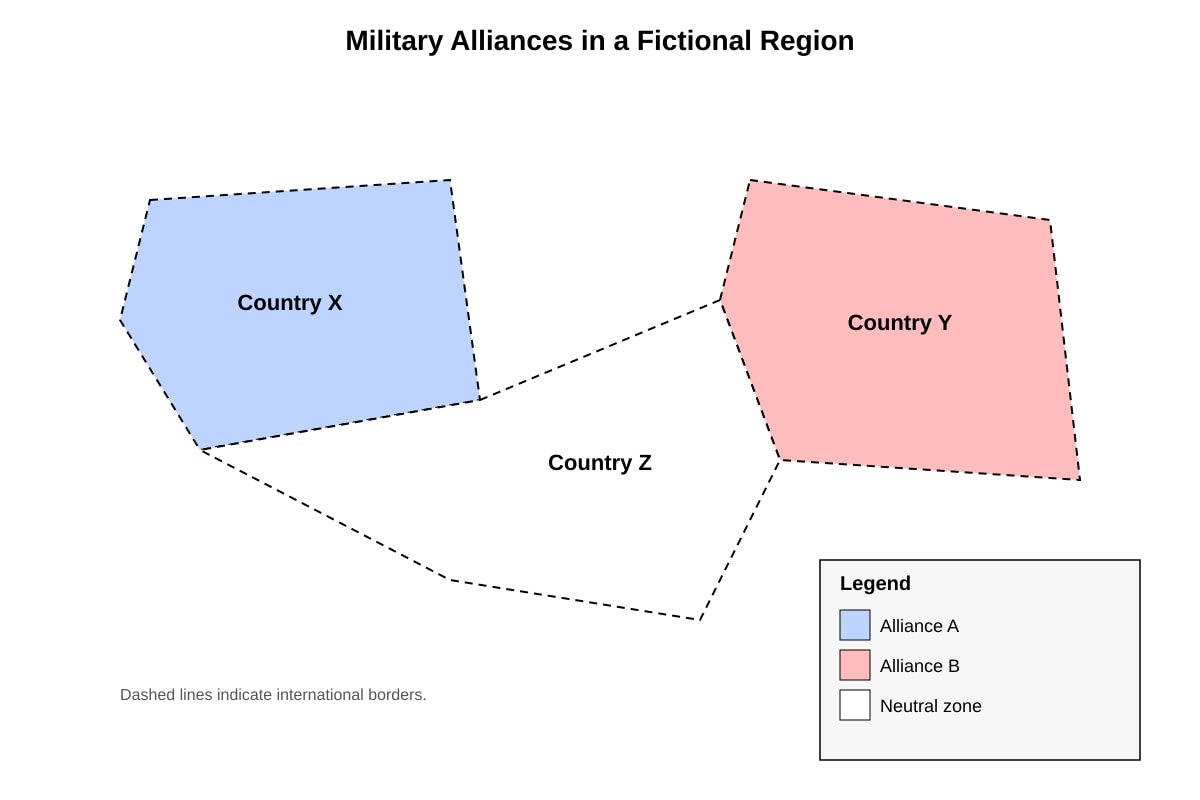
18. Map Q18-fig1 security of Z. [2 marks]
- Z is neutral, surrounded by alliance members; may feel threatened or pressured to join. (2)
Image note: Answer assumes map shows Z between A and B blocs.
19. Cause from sources + management. [4 marks]
Cause: Rising number of conflicts (C). (2)
Management: Strengthen UN mediation (A) or alliances (B). (2)
20. Singapore peacekeeping view + reason. [2 marks]
- Yes: builds stability, follows UN ideals (A). Or No: costs, neutrality. (2)