From Real Exams Quiz
Secondary 4 Social Studies Ancient Civilisations Quiz
Free Sec 4 Social Studies Ancient Civilisations quiz, Exam version, with questions, answers, and O Level-style practice for Singapore students.
These static practice materials are generated from the site's syllabus and paper-generation workflow, with source and model context shown so students and parents can evaluate the material before use.
Questions
Free quiz and exam paper access
Enter your details to view this paper
Your access is remembered on this device.
Answers
Secondary 4 Social Studies Quiz - Ancient Civilisations (Answer Key)
Name: _________________________ Class: _________________________ Date: _________________________ Score: ______ / 40 Duration: 40 minutes Total Marks: 40
Section A: Multiple Choice and Short Answer (Questions 1–5)
1. Which of the following is considered a key characteristic of a civilisation? [1] A) A nomadic lifestyle B) The development of writing systems C) The absence of social classes D) A reliance on hunting and gathering only
Answer: B) The development of writing systems
Teaching Note: A key characteristic (feature) that defines a civilisation is the development of writing systems for record-keeping, laws, and communication. Other key characteristics include cities, organised government, complex religion, social classes, and specialisation of labour. Options A and D describe pre-civilisation hunter-gatherer lifestyles; C is incorrect because social classes are a feature of civilisation.
Marking Note: 1 mark for correct option. No mark for explanation, as the question is a simple multiple choice.
2. Name one early river valley civilisation that emerged around the Indus River. [1]
Answer: Indus Valley Civilisation (also accept: Harappan Civilisation)
Teaching Note: The Indus Valley Civilisation (also called the Harappan Civilisation) was a Bronze Age civilisation in the northwestern regions of South Asia, centred around the Indus River. It existed from approximately 3300 BCE to 1300 BCE and was known for its advanced urban planning, drainage systems, and trade networks.
Marking Note: 1 mark for naming the Indus Valley Civilisation or Harappan Civilisation. Do not accept "Ancient India" as a general term; the specific civilisation name is required.
3. What is one way archaeologists use artefacts to learn about ancient civilisations? [1]
Answer: Accept any one of the following:
- They examine artefacts like tools, pottery, or jewellery to understand daily life and technology.
- They study written records (tablets, inscriptions) to learn about laws, trade, and beliefs.
- They analyse burial sites and grave goods to infer social hierarchy and religious beliefs.
Teaching Note: Artefacts are objects made or used by people in the past. Archaeologists study these objects to draw conclusions about how people lived, what they believed, what they valued, and how their societies were organised. For example, finding many weapons in a grave might suggest that person was a warrior or leader.
Marking Note: 1 mark for a valid and specific way. Generic answers like "they look at old things" are too vague and should not be awarded full marks.
4. Which ancient civilisation is known for creating a system of law known as the Code of Hammurabi? [1] A) Ancient Egypt B) Ancient Greece C) Mesopotamia D) Ancient China
Answer: C) Mesopotamia
Teaching Note: The Code of Hammurabi is one of the oldest deciphered writings of significant length in the world. It was created around 1754 BCE in ancient Mesopotamia (modern-day Iraq) by King Hammurabi of Babylon. It consists of 282 laws covering various aspects of daily life, trade, property, and justice, based on the principle of "an eye for an eye."
Marking Note: 1 mark for correct option.
5. State one reason why ancient civilisations often developed near rivers. [1]
Answer: Accept any one of the following:
- Rivers provided a reliable source of water for drinking and irrigation.
- The annual flooding of rivers deposited fertile silt, which was good for farming.
- Rivers allowed for transport of goods and people, facilitating trade.
- Rivers provided a source of food (fish) and water for domestic animals.
Teaching Note: Rivers were essential for the development of early civilisations because they solved the fundamental problems of water supply and food production. The fertile soil along riverbanks allowed for surplus agriculture, which in turn supported population growth, specialisation of labour, and the growth of cities.
Marking Note: 1 mark for one clear and correct reason. Vague reasons like "they were important" should not be awarded the mark.
Section B: Source-Based Questions (Questions 6–15)
6. According to Source 1, what was the main benefit of the Nile's annual flooding for ancient Egyptian farmers? [2]
Answer: The main benefit was that the floodwaters deposited fertile silt onto the riverbanks, which allowed farmers to grow surplus crops.
Teaching Note: This is a straightforward information retrieval question. The source explicitly states that the floodwaters "deposited rich, fertile silt onto the riverbanks" and this "allowed Egyptian farmers to grow surplus crops." A 2-mark answer requires both parts: identifying the process (deposit of fertile silt) and the outcome (surplus crops/agricultural wealth).
Marking Breakdown:
- 1 mark: Identifies that the flood deposited fertile silt/soil.
- 1 mark: Explains that this allowed for surplus crop growth/agricultural wealth.
Common Mistake: Stating only that the flood provided water, without mentioning the silt/fertility aspect.
7. What does Source 1 suggest was the relationship between the agricultural wealth of Egypt and its social structure? [2]
Answer: Source 1 suggests that agricultural wealth supported a complex social structure with specialised workers, a powerful pharaoh, and grand building projects. The relationship is that the surplus food from farming allowed some people to work in non-farming roles (specialisation), leading to a hierarchical society.
Teaching Note: This question requires inference from the source. The source says: "This agricultural wealth supported a complex society with specialised workers, a powerful pharaoh, and grand building projects like the pyramids." This implies a causal relationship: agricultural surplus → ability to support non-farmers → division of labour → social hierarchy → large projects.
Marking Breakdown:
- 1 mark: Identifies that agricultural wealth supported a complex society.
- 1 mark: Explains the causal link (surplus allows specialisation, which leads to hierarchy).
8. How far does Source 1 suggest that the Nile was the most important factor in the development of ancient Egyptian civilisation? Explain your answer. [3]
Answer: Source 1 strongly suggests that the Nile was the most important factor. The source calls the Nile "the lifeblood of ancient Egyptian civilisation" and argues that the annual flooding was "not a disaster but a gift" that directly enabled agricultural wealth. This wealth then "supported" all other aspects of the civilisation: a complex society, political structure (pharaoh), and monumental building (pyramids).
However, the source may also be overstating the case. It attributes everything to the Nile without mentioning other important factors such as the role of leadership, trade with other regions, or technological innovations. Therefore, while the source clearly views the Nile as the most important factor, a student could argue that it is only one factor among many.
Teaching Note: The phrase "how far" requires a balanced answer. Students should explain the evidence from the source that supports the idea (the Nile was crucial), but also consider whether the source is one-sided or exaggerated. A top-level answer will use direct quotations from the source and show some critical thinking about the author's perspective.
Marking Breakdown:
- Level 1 (1 mark): Simple statement that the source says the Nile was important.
- Level 2 (2 marks): Explains how the source links the Nile to civilisation development with evidence.
- Level 3 (3 marks): Provides a balanced evaluation, noting both the source's emphasis on the Nile AND recognising limitations (e.g., source ignores other factors, or the author may be exaggerating).
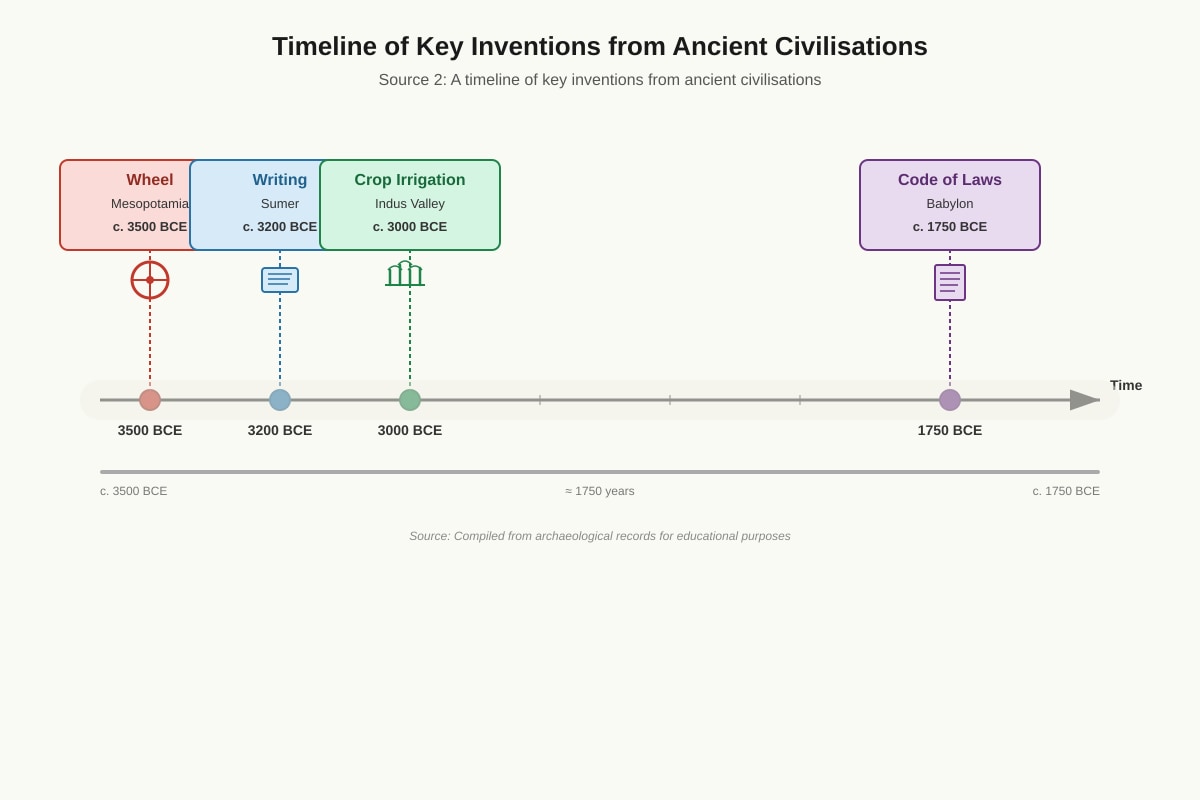
9. Based on Source 2, which invention is the oldest shown? [1]
Answer: The wheel (Mesopotamia, c. 3500 BCE)
Teaching Note: Source 2 is a timeline showing inventions in chronological order. The oldest date shown is "c. 3500 BCE" for the wheel in Mesopotamia. Students need to read the timeline correctly and identify that 3500 BCE is the earliest date (remember: BCE dates count down, so 3500 BCE is before 3200 BCE).
Marking Note: 1 mark for the correct answer (wheel or wheel in Mesopotamia). Accept "wheel of Mesopotamia."
10. Do you think Source 2 is useful as evidence of the technological achievements of ancient civilisations? Explain your answer. [3]
Answer: Yes, Source 2 is useful because it provides a clear, organised timeline showing specific inventions, their dates, and the civilisations that created them. This allows a student to quickly see the sequence of technological development and which civilisation contributed which innovation.
However, Source 2 has limitations. It only shows four inventions, which is a very small selection. Many important inventions (e.g., the plow, mathematics, paper, the calendar) are not included. Also, the timeline does not explain the impact of these inventions or how they were developed, so it only gives a partial picture of technological achievements. Finally, the dates are approximate ("c." = circa), so the timeline is not perfectly precise.
Teaching Note: The question asks about usefulness (not reliability). Usefulness is about how relevant and helpful the source is for answering a specific question. A source can be useful even if it has limitations, as long as a student explains both what it contributes and what it lacks.
Marking Breakdown:
- Level 1 (1 mark): Simple statement (useful or not useful) without explanation.
- Level 2 (2 marks): Explains one way the source is useful OR one limitation.
- Level 3 (3 marks): Provides a balanced assessment with at least one strength and one limitation of the source.
11. Based on Source 3, identify one group that was at the top of ancient Chinese society. [1]
Answer: The emperor (also accept: nobles and scholars, as they were also at the top tier)
Teaching Note: This is a simple retrieval question. Source 3 states: "At the top was the emperor, believed to have a divine mandate to rule. Below him were nobles and scholars..." Students can identify either the emperor or the nobles/scholars as being at the top.
Marking Note: 1 mark for correctly identifying a group named in Source 3 as being at the top. Accept: emperor, nobles, scholars.
12. According to Source 4, how did the government of Athens differ from typical rule by a single monarch? [2]
Answer: Athens had a form of democracy where citizens could participate in the assembly and vote on laws, instead of being ruled by a single monarch. The source states it was "a radical departure from the rule by a single monarch."
Teaching Note: The key contrast is between rule by one person (monarchy) and rule by citizens (democracy). Source 4 explicitly calls democracy a "radical departure." Students should identify that in Athens, decision-making power was distributed among citizens rather than concentrated in one ruler.
Marking Breakdown:
- 1 mark: States that Athens used democracy / citizens voted / citizens participated in the assembly.
- 1 mark: Explains that this was a departure from monarchy / rule by one person.
13. Compare Sources 3 and 4. How far do they agree on the role of common people in ancient societies? Explain your answer. [3]
Answer: The sources disagree significantly on the role of common people.
Source 3 describes ancient Chinese society as rigidly hierarchical, where common people (farmers and merchants) were at the bottom of the social order with little power or opportunity for social mobility. The structure "limited social mobility" and kept common people in subordinate roles.
Source 4, however, describes Athens where some common people (adult male citizens) could participate in government through voting in the assembly. This gave them a political role that common people in China did not have.
However, there is a minor point of agreement: neither source suggests that common people had full equality. In Athens, only free adult males could participate, excluding women, slaves, and foreigners. In China, the hierarchy clearly placed common people below the emperor and nobles.
So, while the sources mostly disagree about the political participation of common people, they implicitly agree that ancient societies were not fully egalitarian.
Teaching Note: This is a comparison question. The phrase "how far do they agree" means students should find both similarities AND differences, but usually the differences are more significant. A good answer will use specific evidence from each source.
Marking Breakdown:
- Level 1 (1 mark): States that the sources agree or disagree without explanation.
- Level 2 (2 marks): Identifies a point of agreement OR disagreement with evidence from both sources.
- Level 3 (3 marks): Provides a balanced comparison with at least one clear difference and one similarity or nuance.
14. Which source (Source 3 or Source 4) is more helpful in explaining the political structure of an ancient civilisation? Justify your choice. [3]
Answer: Source 4 is more helpful in explaining political structure because it directly describes the form of government (democracy) in Athens, explaining how citizens could participate in the assembly and vote on laws. It explicitly contrasts this with monarchy, helping the reader understand a key political concept.
Source 3 is less helpful for political structure because it focuses on social hierarchy rather than the actual political system. While it mentions the emperor, it does not explain how the government worked, how laws were made, or how power was exercised.
However, Source 3 is still somewhat helpful because it shows that political power was concentrated at the top of the social hierarchy, indicating a link between social class and political power in ancient China.
Teaching Note: This question asks students to evaluate which source is more useful for a specific purpose (explaining political structure). Students should compare both sources against the same criterion.
Marking Breakdown:
- Level 1 (1 mark): Chooses a source without justification.
- Level 2 (2 marks): Explains why one source is helpful with specific evidence.
- Level 3 (3 marks): Compares both sources and justifies the choice with reasoning.
15. "Ancient civilisations were all very similar in their social organisation." Using Sources 3 and 4 and your own knowledge, explain how far you agree with this statement. [4]
Answer: I partially agree with this statement.
Agree (similarities): Both ancient China (Source 3) and ancient Greece (Source 4) had hierarchical social structures. In China, the emperor was at the top, followed by nobles, and then common people. In Greece, while citizens had political rights, this still excluded women, slaves, and foreigners, showing that Greek society was also stratified and unequal. Many ancient civilisations shared this feature of hierarchy and inequality.
Disagree (differences): Despite their hierarchies, the two civilisations differed significantly. In China, social structure was rigid with very limited mobility, and the emperor held absolute power. In Athens, the invention of democracy gave some common people (citizens) a political voice, which was a radical departure from the norm. Additionally, my own knowledge tells me that ancient Egypt had a different class structure centred around the pharaoh as a god-king, while Mesopotamia had city-states with their own local rulers. These variations show that while ancient civilisations shared the concept of social hierarchy, the specific organisation and political participation differed greatly.
Overall: Ancient civilisations were similar in having hierarchical, unequal societies. However, the specific social organisation and degree of political participation varied significantly, especially with the Greek experiment in democracy.
Teaching Note: This is a mini-essay question (4 marks) requiring use of sources and own knowledge. The student must take a position and support it with evidence from both sources and their own knowledge.
Marking Breakdown:
- Level 1 (1 mark): Simple agree/disagree without evidence.
- Level 2 (2 marks): One-sided answer with one source used.
- Level 3 (3 marks): Balanced with evidence from both sources.
- Level 4 (4 marks): Balanced with evidence from both sources AND own knowledge, with a clear conclusion.
Section C: Essay Question (Questions 16–20)
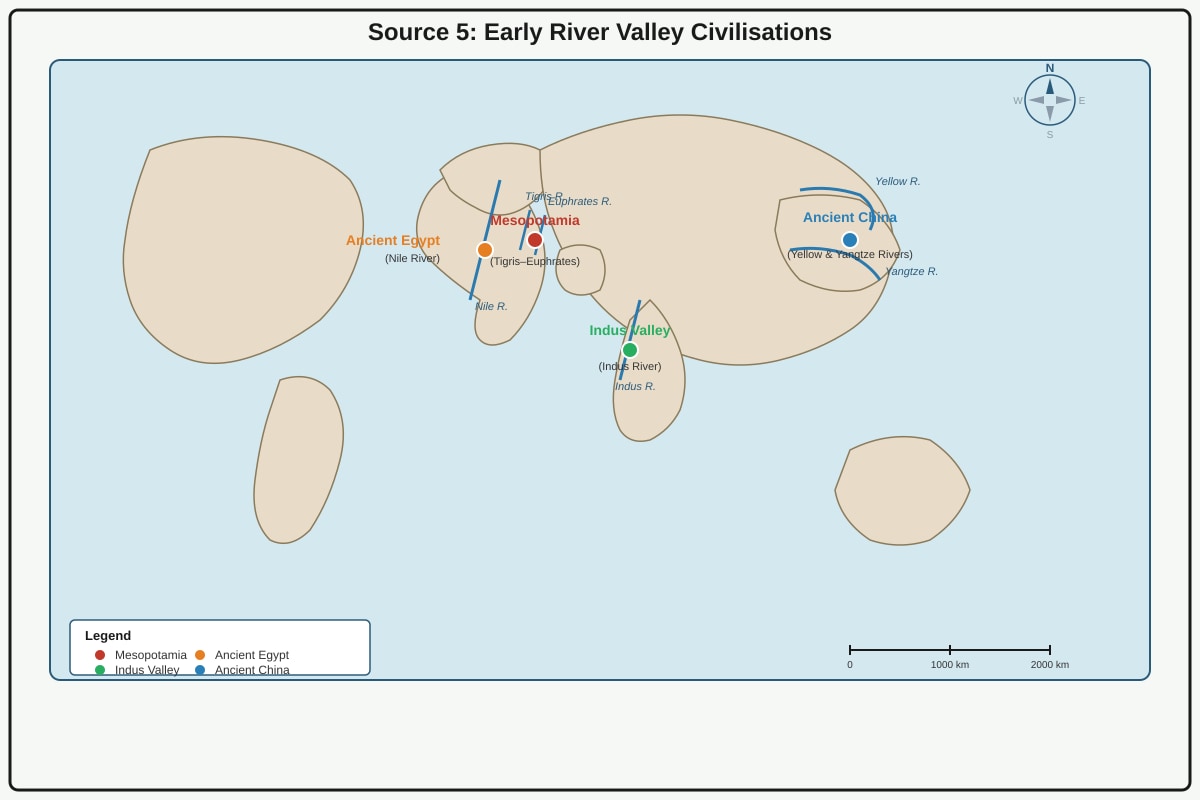
16. According to Source 5, what geographic feature did all four civilisations share? [1]
Answer: They all developed near/long rivers.
Teaching Note: Source 5 is a map showing four river valley civilisations. The common feature is their location along major rivers. Students should state: "They all developed near rivers" or "All four were river valley civilisations."
Marking Note: 1 mark for identifying that they all shared a location near rivers. Accept: rivers, river valleys, or similar phrasing.
17. Name one civilisation shown in Source 5 that developed in a region without a major river, if any. If not, explain why. [1]
Answer: None of the civilisations shown in Source 5 developed in a region without a major river. All four (Mesopotamia, Ancient Egypt, Indus Valley, Ancient China) were river valley civilisations located along major rivers.
Teaching Note: This question tests close observation of the source. The map shows four civilisations, and all four are explicitly associated with river systems. The question is designed to check whether students notice this pattern.
Marking Note: 1 mark for correctly stating that none developed without a river, or that all were river valley civilisations. Do not award a mark for naming a river, unless the student also makes clear that all had one.
18. Explain two ways that rivers were important for the development of the civilisations shown in Source 5. [4]
Answer: Way 1: Agriculture. Rivers provided water for irrigation and, in many cases, deposited fertile silt during annual floods. This allowed for surplus crop production, which supported population growth and the development of cities. For example, the Nile's annual flooding allowed Egyptian farmers to grow surplus wheat and barley.
Way 2: Transport and Trade. Rivers provided a means of transporting goods and people, facilitating trade within the civilisation and with other regions. For example, the Indus River and its tributaries allowed the Indus Valley Civilisation to trade with Mesopotamia.
Teaching Note: The question asks for "two ways," so both must be clearly explained. A simple list of ways without explanation will not score full marks. Students should explain the how and why, not just state the way.
Marking Breakdown:
- 1 mark per way identified (2 marks total)
- 1 mark per explanation/example (2 marks total)
- Total: 4 marks
19. "The biggest factor that led to the rise of civilisations was their location near a river." Using Source 5 and your own knowledge, explain how far you agree with this statement. [5]
Answer: I largely agree with this statement, but there were other important factors as well.
Agree (rivers were crucial): Source 5 clearly shows that all four major early civilisations—Mesopotamia, Ancient Egypt, Indus Valley, and Ancient China—developed along major rivers. This cannot be a coincidence. Rivers provided essential resources: water for drinking and irrigation, fertile soil for agriculture, a means of transport, and food from fishing. The agricultural surplus from river-based farming was necessary to support the population growth, specialisation of labour, and complex social structures that define civilisation. Without rivers, these early societies would not have been able to sustain large, settled populations.
Disagree (other factors were also important): However, location near a river alone was not enough. Other factors were equally important:
- Leadership and Organisation: Building and maintaining irrigation systems required organised leadership and cooperation, which led to the development of governments and social hierarchies.
- Technological Innovation: Civilisations developed technologies like the wheel, writing, and metallurgy, which allowed them to thrive beyond what rivers alone provided.
- Trade: Trade with other regions allowed for the exchange of ideas, resources, and technologies. For example, the Indus Valley Civilisation traded extensively with Mesopotamia.
- Defence and Security: Geographic features like mountains and deserts provided natural defences, which allowed civilisations to develop without constant invasion.
Conclusion: I agree that rivers were the most important single factor because they provided the essential conditions for settled agriculture and population growth. However, rivers alone were not sufficient; the rise of civilisations also depended on human factors like leadership, innovation, and trade.
Teaching Note: This is a full essay-style question (5 marks). Students should demonstrate a clear argument structure with an introduction, body paragraphs presenting both sides, and a conclusion. Use of the source (Source 5) and own knowledge are both required.
Marking Breakdown:
- Level 1 (1 mark): Simple agree/disagree with minimal or no explanation.
- Level 2 (2 marks): One-sided argument with limited evidence.
- Level 3 (3 marks): Two-sided argument but with limited development or own knowledge.
- Level 4 (4 marks): Balanced argument with use of both source and own knowledge.
- Level 5 (5 marks): Balanced, well-structured argument with clear conclusion, using source and own knowledge effectively.
20. Discuss the legacy of ancient civilisations. Which of the following has had the most enduring impact on the modern world: writing systems, legal codes, or forms of government? Use examples from your own knowledge to support your answer. [5]
Answer: This is an evaluative essay question. While all three have had a significant impact, writing systems have arguably had the most enduring impact.
Writing Systems: The invention of writing was transformative. The Sumerians developed cuneiform writing around 3200 BCE, while Egyptians developed hieroglyphs. Writing allowed for the recording of laws, trade transactions, history, literature, and religious texts. Most importantly, writing enabled knowledge to be passed down accurately across generations. Modern alphabets (including our Latin alphabet) are descended from ancient writing systems. Without writing, there would be no recorded history, no scientific progress, no laws, and no literature. Writing is the foundation of all subsequent human achievement.
Legal Codes: The Code of Hammurabi (c. 1754 BCE) established the principle that laws should be written down and applied consistently. This idea influenced later legal systems, including Roman law and eventually modern legal codes. The concept of justice, written laws, and consequences for breaking them are direct legacies of ancient legal codes. However, many aspects of ancient law (e.g., harsh punishments, class-based justice) have been abandoned or reformed.
Forms of Government: Ancient Greece's experiment with democracy was revolutionary and has had a profound impact on the modern world. The idea that citizens should participate in governing themselves influenced the development of modern democratic systems, including the United States and many other countries. However, ancient democracies were limited (only free men could participate) and many civilisations did not adopt democracy. The influence of monarchy, empire, and dictatorship has also been significant.
Conclusion: While all three have shaped the modern world, writing systems have had the most enduring impact because they provided the foundation for all other developments. Without writing, legal codes could not be recorded and passed down, and forms of government could not be documented, studied, and replicated. Writing is the technology that enables civilisation itself.
Teaching Note: This question requires students to evaluate and argue which of three options has the most enduring impact. A strong answer will:
- Show understanding of all three options
- Use specific examples from ancient civilisations
- Make a clear comparative argument
- Reach a justified conclusion
Marking Breakdown:
- Level 1 (1 mark): States a choice without justification.
- Level 2 (2 marks): Explains one option with a basic example.
- Level 3 (3 marks): Explains two or more options with examples.
- Level 4 (4 marks): Compares options and makes a case for one being most enduring.
- Level 5 (5 marks): Clear argument with specific examples, comparative analysis, and a well-justified conclusion.
— End of Answer Key —