AI Generated Exam Paper
Secondary 4 Social Studies Practice Paper 3
Free Sec 4 Social Studies Practice Paper 3, Qwen3.6 AI version, with questions, answers, and O Level-style practice for Singapore students.
These static practice materials are generated from the site's syllabus and paper-generation workflow, with source and model context shown so students and parents can evaluate the material before use.
Questions
Free quiz and exam paper access
Enter your details to view this paper
Your access is remembered on this device.
Answers
TuitionGoWhere Practice Paper - Social Studies Secondary 4
Answer Key and Marking Scheme (Version 3)
Note to Markers:
- Accept any valid point that is well-explained and supported by evidence or reasoning.
- Marks are awarded for the quality of explanation, not just the number of points.
- For evaluative questions, look for a balanced argument and a clear conclusion.
Section A: Source-Based Case Study
1. Study Source A. What does the Minister suggest is the key to Singapore’s economic survival? Explain your answer using evidence from the source. [3]
- Key Point: The Minister suggests that connectivity to the world (or remaining open to globalisation) is the key.
- Explanation: He states that Singapore has "no natural resources," so it must rely on being connected to attract MNCs, investment, and technology.
- Evidence: Quote: "Our survival depends on our connectivity to the world" or "We must remain open to remain relevant."
- Marking:
- 1 mark for identifying the key (connectivity/openness).
- 1 mark for explaining why (lack of resources/need for MNCs).
- 1 mark for using evidence from the source.
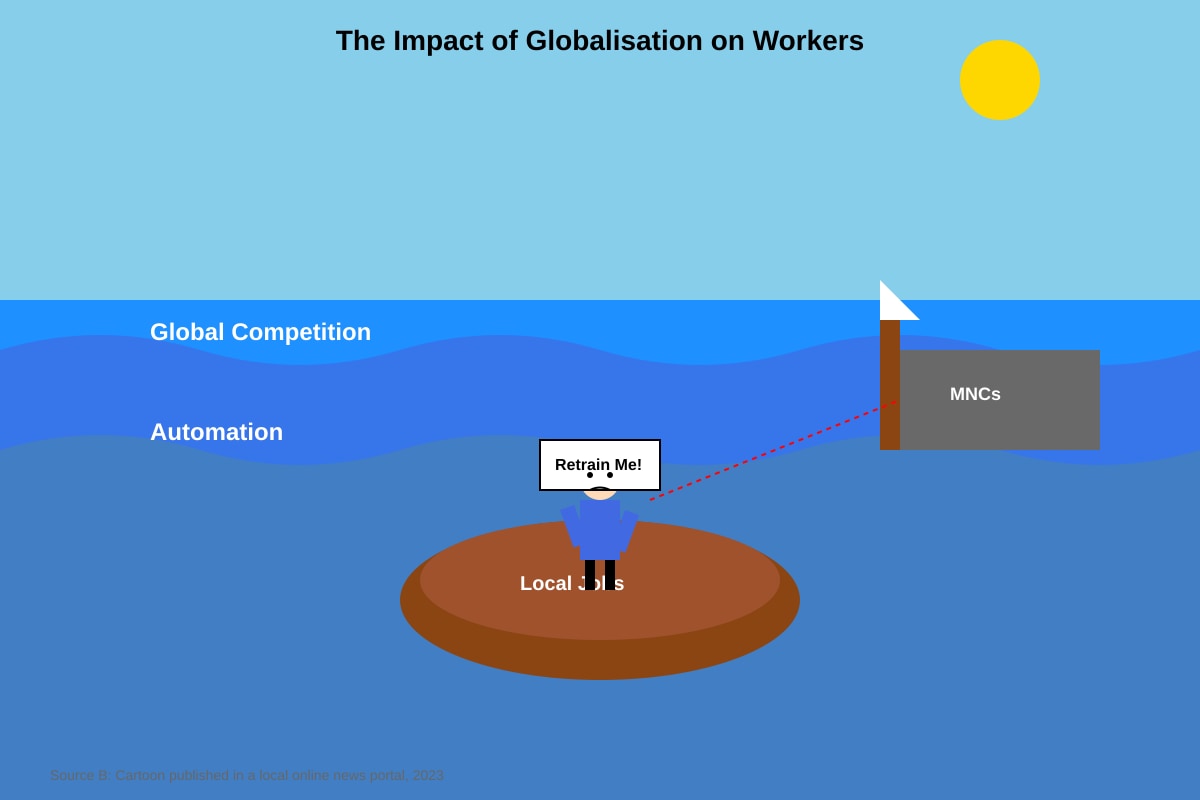
2. Study Source B. What message is the cartoonist trying to convey about the impact of globalisation on local workers? Explain your answer using details from the cartoon. [3]
- Key Point: The cartoonist conveys that local workers feel vulnerable, insecure, or threatened by globalisation.
- Explanation: The "waves" of global competition and automation are overwhelming the "island" of local jobs, suggesting that workers are at risk of being displaced. The worker’s anxiety and the sign "Retrain Me!" show a desperate need for help to stay relevant.
- Evidence: Reference to the "waves labeled 'Global Competition'", the "small island", or the worker's anxious expression/sign.
- Marking:
- 1 mark for identifying the message (vulnerability/insecurity).
- 1 mark for explaining the metaphor (waves vs. island).
- 1 mark for using details from the cartoon.
3. Study Sources A and C. How far does Source C contradict Source A’s view on the impact of globalisation on workers? Explain your answer. [4]
- Point of Contradiction: Source A claims globalisation creates "more opportunities than it destroys" and brings "high-quality jobs." Source C contradicts this by describing job loss and difficulty finding new employment due to global restructuring.
- Evidence from A: Minister says it "creates more opportunities" and "high-quality jobs."
- Evidence from C: Mr. Tan says he "lost my job" when production moved to Vietnam and feels "left behind."
- Nuance/Limitation: They do not completely contradict on the existence of change, but on the outcome for the individual. Source A looks at the macro/national level (GDP, sectors), while Source C looks at the micro/individual level (personal hardship).
- Marking:
- 1 mark for identifying a point of contradiction (opportunities vs. job loss).
- 1 mark for evidence from Source A.
- 1 mark for evidence from Source C.
- 1 mark for explaining the extent of contradiction (e.g., macro vs. micro perspective).
4. Study Sources A, B, and D. 'Globalisation has been more beneficial than harmful to Singapore’s employment landscape.' Using these sources, explain how far you agree with this statement. [6]
- Agree (Beneficial):
- Source A states that MNCs bring "investment, technology, and high-quality jobs," contributing to GDP.
- Source D shows that total employment has risen from 3,650,000 in 2018 to 3,780,000 in 2023, and job vacancies are high (105,000 in 2023), suggesting a robust job market.
- Source D shows unemployment rate dropped to 2.0% in 2023, indicating most people who want jobs can find them.
- Disagree (Harmful/Challenges):
- Source B illustrates the anxiety and vulnerability of workers facing "global competition" and "automation," suggesting harm in terms of job security.
- Source D shows a spike in unemployment to 4.5% in 2020 (likely due to pandemic/global shock), showing vulnerability to global events.
- Source B implies that without retraining, workers are left behind, which is a harmful social cost.
- Conclusion/Judgment:
- Overall, I agree to a large extent that it is beneficial because the data in Source D shows net job growth and low unemployment. However, the benefits are not evenly distributed, as shown by Source B’s depiction of worker anxiety. The government must manage the transition to ensure the "harm" of displacement is mitigated.
- Marking:
- 1-2 marks for using Source A to support benefits.
- 1-2 marks for using Source D to support benefits (data).
- 1 mark for using Source B to highlight harms/challenges.
- 1 mark for a balanced conclusion/judgment.
Section B: Structured Response Questions
5. Explain two challenges that arise from living in a diverse society with different religious beliefs. [4]
- Challenge 1: Misunderstanding and Conflict.
- Explanation: Different religious practices and values may lead to misunderstandings. For example, dietary restrictions or dress codes might be misinterpreted by others, leading to prejudice or social friction. If not managed, this can escalate into conflict.
- Challenge 2: Competition for Resources/Space.
- Explanation: Different religious groups may compete for limited public space for places of worship or for recognition during public holidays. This can create tensions if one group feels their needs are prioritized over others.
- Marking:
- 1 mark for identifying Challenge 1.
- 1 mark for explaining Challenge 1.
- 1 mark for identifying Challenge 2.
- 1 mark for explaining Challenge 2.
6. "Integration is more effective than assimilation in maintaining social harmony in Singapore." Do you agree? Explain your answer. [6]
- Agree (Integration is better):
- Integration allows different racial and religious groups to maintain their distinct cultural identities while interacting and sharing common spaces (e.g., HDB estates, schools). This reduces resentment because people do not feel forced to give up their heritage.
- It fosters mutual respect and understanding through interaction, rather than forcing uniformity. Singapore’s policy of multiculturalism (e.g., Racial Harmony Day, ethnic festivals) supports this.
- Counter-point (Assimilation has merits but is less suitable):
- Assimilation (where minorities adopt the majority culture) might create a superficial sense of unity, but it often leads to resistance and loss of identity, which can cause long-term tension. In a diverse society like Singapore, forcing assimilation would likely alienate minority groups.
- Conclusion:
- I agree that integration is more effective because it balances unity with diversity. It allows for a shared national identity (Singaporean) without erasing ethnic identities, which is crucial for long-term harmony in a multi-racial society.
- Marking:
- 1-2 marks for explaining why Integration is effective (maintains identity, mutual respect).
- 1-2 marks for explaining why Assimilation is less effective (resistance, loss of identity).
- 1-2 marks for a clear judgment/conclusion linking to social harmony.
7. In your opinion, suggest two ways the government can address socio-economic diversity to ensure a more inclusive society. Explain your answer. [6]
- Way 1: Progressive Wage Model (PWM) or Minimum Wage mechanisms.
- Explanation: The government can mandate higher wages for lower-income sectors (like cleaning, security, landscaping). This ensures that workers in these jobs earn a living wage, reducing the income gap and allowing them to afford basic necessities, thus promoting inclusion.
- Way 2: Targeted Financial Assistance and Subsidies (e.g., GST Vouchers, ComCare).
- Explanation: The government can provide direct financial support to low-income households to offset rising costs of living (e.g., utilities, education, healthcare). This helps level the playing field and ensures that poorer citizens can access essential services, preventing social exclusion.
- Marking:
- 1 mark for suggesting Way 1.
- 2 marks for explaining how Way 1 addresses socio-economic diversity/inclusion.
- 1 mark for suggesting Way 2.
- 2 marks for explaining how Way 2 addresses socio-economic diversity/inclusion.
- (Note: Other valid answers like "Education subsidies (Edusave)" or "Public Housing grants" are acceptable if well-explained.)
Section C: Essay Questions
8. "The government is solely responsible for solving societal problems in Singapore." Do you agree with this statement? Explain your answer. [10]
-
Introduction:
- Define the statement: It claims that only the government has the duty and capacity to fix issues like poverty, aging, or environmental concerns.
- Thesis: Disagree. While the government plays a leading role, citizens and community groups are also essential partners. It is a shared responsibility.
-
Point 1: The Government’s Role (Why it seems like they are solely responsible).
- The government has the power to make laws, allocate budgets, and implement large-scale policies (e.g., healthcare subsidies, public housing, national security).
- Example: During the pandemic, the government provided financial aid (Jobs Support Scheme) and managed health protocols, which individuals could not do alone.
- Explanation: Some problems are too large or complex for individuals to solve, requiring centralized coordination and resources.
-
Point 2: The Role of Citizens and Community Groups (Why it is NOT solely the government).
- Citizens can contribute through active participation, volunteering, and grassroots initiatives.
- Example: Community groups like the People’s Association or voluntary welfare organizations (VWOs) provide ground-level support, such as food distribution or elderly care, which complements government efforts.
- Explanation: Government resources are limited. Citizen action fosters social cohesion and ensures that help reaches those who might fall through the cracks. It also builds a sense of ownership and belonging.
-
Point 3: The Concept of Shared Responsibility (Synthesis).
- Many societal problems require a "many helping hands" approach.
- Example: In addressing an aging population, the government provides infrastructure (hospitals, senior centers), but families and neighbors provide daily care and emotional support.
- Explanation: If citizens rely solely on the government, it creates dependency and strains public finances. Active citizenship ensures sustainability.
-
Conclusion:
- I disagree with the statement. The government is the primary facilitator, but not the sole solver. Effective solutions require collaboration between the government, citizens, and the private sector. A strong society is built on mutual responsibility, where the government enables and citizens participate.
-
Marking Rubric:
- Level 3 (7-10 marks): Clear stance (Disagree). Well-developed arguments for both government and citizen roles. Good use of examples. Balanced evaluation of "shared responsibility." Clear conclusion.
- Level 2 (4-6 marks): Partial agreement or disagreement. Arguments are present but may be unbalanced (e.g., focuses only on government). Examples are generic. Limited evaluation of shared responsibility.
- Level 1 (1-3 marks): Weak or unclear stance. Minimal explanation. Little to no use of examples. Fails to address the "solely" aspect.