From Real Exams Exam Paper
Secondary 4 Social Studies Preliminary Examination Paper 5
Free Sec 4 Social Studies Prelim Paper 5, Qwen3.6 Exam version, with questions, answers, and O Level-style practice for Singapore students.
These static practice materials are generated from the site's syllabus and paper-generation workflow, with source and model context shown so students and parents can evaluate the material before use.
Questions
Free quiz and exam paper access
Enter your details to view this paper
Your access is remembered on this device.
Answers
TuitionGoWhere Practice Paper - Social Studies Secondary 4
Answer Key & Marking Scheme (Version 5)
Section A: Source-Based Case Study
1. Study Source A. What is the main challenge of globalisation identified by the government?
[1]
- Answer: Exposure to external shocks / volatility in global financial markets / job displacement due to shifting industries.
- Marking: 1 mark for any valid challenge mentioned in Source A.
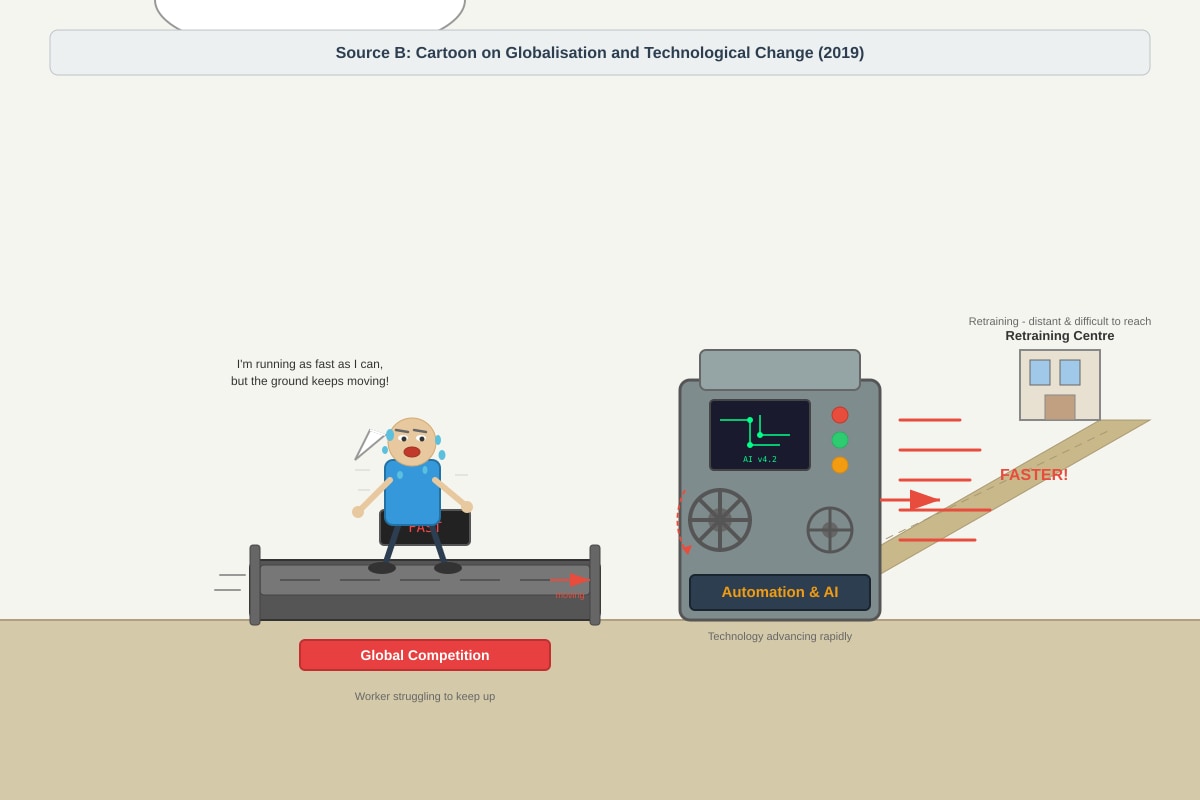
2. Study Source B. Explain why the cartoonist portrays the worker as 'exhausted'.
[2]
- Answer:
- The worker is on a treadmill labelled 'Global Competition', implying constant, unending pressure to keep up.
- The machine 'Automation & AI' is moving faster, suggesting that technological advances (driven by globalisation) are outpacing human effort, making it difficult for workers to stay relevant despite their best efforts.
- Marking:
- 1 mark for explaining the symbolism of the treadmill/competition.
- 1 mark for linking the exhaustion to the speed of automation/technology outpacing the worker.
3. Study Sources A and C. How far do these sources agree on the impact of globalisation on local workers?
[4]
- Answer:
- Agreement: Both sources acknowledge that globalisation brings changes to the job market. Source A mentions "jobs may be displaced," and Source C mentions MNCs retrenching local workers. Both imply that local workers face insecurity.
- Disagreement: Source A is optimistic, stating that "new opportunities... will emerge" and the government is supporting workers via SkillsFuture. It views the transition as manageable. Source C is pessimistic/critical, arguing that MNCs prioritize profits over locals, leaving them with "low-wage, routine jobs" and that the "trickle-down effect" is not working. Source C doubts the effectiveness of current measures.
- Conclusion: They agree on the existence of disruption but disagree on the outcome and the adequacy of the response.
- Marking:
- 1 mark for identifying a point of agreement (disruption/job insecurity).
- 1 mark for evidence from Source A.
- 1 mark for identifying a point of disagreement (optimism vs. pessimism / effectiveness of support).
- 1 mark for evidence from Source C.
- (Note: Max 3 marks if only one side is explained. 4 marks for balanced comparison.)
4. Study Source D. How useful is this source in evaluating the claim that 'globalisation creates more jobs than it destroys'?
[4]
- Answer:
- Useful: The table shows that "Total Employment Growth" is positive every year (0.8% to 1.5%), suggesting net job creation. It also shows significant growth in "High-Skill Jobs" (1.8% to 3.0%), supporting the idea that new, better jobs are being created.
- Limitations: The table does not show the total number of jobs destroyed (only retrenchment numbers, which are absolute figures, not rates). It does not specify if the job growth is directly caused by globalisation or other factors. It also shows a decline in "Low-Skill Jobs," which supports the counter-claim that globalisation destroys certain types of jobs. Without data on the quality of life or wage growth for the newly employed, it is incomplete.
- Marking:
- 1 mark for identifying useful aspect (net positive growth/high-skill growth).
- 1 mark for explanation of why it supports the claim.
- 1 mark for identifying limitation (doesn't show total destruction/cause/low-skill decline).
- 1 mark for explanation of why this limits the evaluation.
5. "Singaporeans are well-prepared to face the challenges of a globalised economy." Using Sources A–E, explain how far you agree with this statement.
[10]
-
Marking Rubric:
- Level 3 (7-10 marks): Balanced evaluation. Uses multiple sources to argue both sides (preparedness vs. vulnerabilities). Clear judgment with qualification.
- Level 2 (4-6 marks): Partially balanced. Uses sources but may lean heavily to one side. Explanation is present but may lack depth or synthesis.
- Level 1 (1-3 marks): One-sided or descriptive. Little use of sources. Weak or no judgment.
-
Indicative Content:
- Agree (Prepared):
- Source A: Government initiatives like SkillsFuture help workers upgrade skills for knowledge-intensive sectors.
- Source E: Young entrepreneurs are leveraging global platforms (e-commerce) to expand markets, showing adaptability and innovation. Government grants for digitalisation are effective.
- Source D: Growth in high-skill jobs suggests the workforce is transitioning successfully.
- Disagree (Not Prepared/Vulnerable):
- Source B: Workers feel overwhelmed by the pace of change (automation/AI), suggesting psychological and skill gaps. Retraining is seen as difficult ("uphill").
- Source C: MNCs may not prioritize locals, leading to job insecurity and low wages for some. The benefits of globalisation are unevenly distributed.
- Source D: Retrenchment numbers are significant (7,800–10,100), and low-skill jobs are shrinking, leaving some workers behind.
- Judgment: Singaporeans are partially prepared. The government and proactive individuals (Source E) are adapting well. However, structural vulnerabilities (Source C) and the rapid pace of technological change (Source B) mean that not everyone is equally prepared. Continuous support and inclusive policies are needed to ensure no one is left behind.
- Agree (Prepared):
Section B: Structured Response Questions
6. Explain two reasons why maintaining racial and religious harmony is crucial for Singapore’s survival.
[4]
- (a) Reason 1: Economic Stability. Investors seek stable environments. Racial/religious conflict would deter foreign investment, hurt tourism, and disrupt trade, damaging Singapore’s economy which relies on global connectivity. (2 marks: 1 for reason, 1 for explanation)
- (b) Reason 2: Social Cohesion/National Identity. Singapore is a multi-racial society. Conflict would fragment society, leading to violence and loss of trust among citizens. Unity is essential for national defense and collective resilience in times of crisis. (2 marks: 1 for reason, 1 for explanation)
7. "Integration is a better approach than assimilation for managing diversity in Singapore." Do you agree? Explain your answer.
[6]
-
Marking Rubric:
- Level 2 (4-6 marks): Clear stance with reasoned arguments. Acknowledges both concepts.
- Level 1 (1-3 marks): Simple statement or one-sided argument without depth.
-
Indicative Content:
- Agree (Integration is better):
- Assimilation forces minorities to give up their cultural identity, which can cause resentment and social tension.
- Integration allows different groups to maintain their distinct identities while sharing common spaces and values (e.g., National Pledge, public holidays). This fosters mutual respect and genuine harmony.
- Singapore’s policy of multiculturalism (CMIO model) supports integration, preserving heritage while building a shared Singaporean identity.
- Counter-point (Assimilation has merits):
- Assimilation could create a more uniform society with fewer cultural barriers, potentially reducing misunderstanding. However, this is unrealistic and undesirable in a diverse society like Singapore.
- Conclusion: Integration is better because it balances diversity with unity, respecting individual identities while fostering national cohesion. Assimilation is too coercive and ignores the value of diversity.
- Agree (Integration is better):
8. Describe one way the Singapore government manages socio-economic diversity to ensure a stake for everyone.
[2]
- Answer: Progressive Wage Model (PWM) / Workfare Income Supplement (WIS) / Subsidized Housing (HDB) / Healthcare subsidies (Medifund).
- Marking:
- 1 mark for identifying a valid policy.
- 1 mark for briefly describing how it helps (e.g., PWM ensures low-wage workers earn a living wage; WIS supplements income and CPF for older low-wage workers).
9. Explain two challenges the government faces when implementing policies to help the lower-income group.
[4]
- (a) Challenge 1: Fiscal Constraints/Budgetary Trade-offs. Extensive welfare requires high taxation or reallocation of funds from other areas (e.g., infrastructure, defense). The government must balance support with fiscal prudence to maintain economic competitiveness. (2 marks)
- (b) Challenge 2: Dependency Culture. Over-generous aid might discourage self-reliance and work effort. The government must design policies that encourage work (e.g., Workfare) rather than handouts, which is complex to implement effectively. (2 marks)
- Alternative Challenge: Defining "need" accurately. Ensuring aid reaches the truly needy without leakage or stigma.
10. "Citizens have a greater responsibility than the government in maintaining social cohesion." Do you agree? Explain your answer.
[8]
-
Marking Rubric:
- Level 3 (6-8 marks): Balanced evaluation. Discusses roles of both citizens and government. Clear judgment.
- Level 2 (3-5 marks): Discusses one side more strongly. Some reference to the other.
- Level 1 (1-2 marks): One-sided, descriptive, or weak argument.
-
Indicative Content:
- Role of Government:
- Creates the framework for cohesion through laws (e.g., Maintenance of Religious Harmony Act), policies (e.g., EIP in HDB), and education (e.g., CCE in schools).
- Provides public goods and ensures fair distribution of resources to reduce socio-economic tensions.
- Without government leadership, efforts may be fragmented or biased.
- Role of Citizens:
- Laws and policies are ineffective if citizens do not practice tolerance and respect in daily interactions.
- Citizens must actively engage in community building, bridge divides, and reject prejudice.
- Grassroots initiatives and interpersonal relationships build the "soft infrastructure" of trust that government cannot mandate.
- Judgment: Both are essential, but citizens have the greater responsibility in daily practice, while the government has the greater responsibility in setting the framework. Alternatively, one can argue the government’s role is foundational (greater) because it sets the rules of the game. A balanced view acknowledges interdependence: Government provides the stage, citizens perform the act of cohesion.
- Role of Government:
Section C: Essay Questions
11. "Globalisation is a force for good for Singapore." How far do you agree with this statement?
[15]
-
Marking Rubric:
- Level 4 (13-15 marks): Comprehensive, balanced, and well-substantiated argument. Deep understanding of complexities. Clear, nuanced judgment.
- Level 3 (10-12 marks): Good balance. Relevant examples. Clear judgment.
- Level 2 (7-9 marks): Partially balanced. Some relevant examples. Judgment present but may be simplistic.
- Level 1 (1-6 marks): One-sided or descriptive. Limited examples. Weak or no judgment.
-
Indicative Content:
- Arguments for "Force for Good":
- Economic Growth: Access to global markets allows Singapore to trade beyond its small domestic market. Attracts MNCs, creating jobs and transferring technology.
- Access to Resources: Singapore lacks natural resources; globalisation ensures steady supply of food, energy, and water technology.
- Cultural Exchange: Exposure to diverse ideas, arts, and cuisines enriches society and fosters cosmopolitanism.
- Innovation: Competition drives efficiency and innovation. Access to global talent pool.
- Arguments against "Force for Good" (Challenges):
- Economic Vulnerability: External shocks (e.g., financial crises, pandemics) spread quickly. Job insecurity due to outsourcing/automation.
- Social Inequality: Wealth gap may widen as high-skilled workers benefit more than low-skilled workers.
- Cultural Erosion: Risk of losing local identity/values due to dominance of Western/global culture.
- Security Threats: Transnational terrorism, cybercrime, and spread of diseases.
- Judgment: Globalisation is largely a force for good because it has enabled Singapore’s survival and prosperity. However, it is not unconditionally good. The benefits are contingent on effective government management (e.g., social safety nets, upskilling, security measures). Without such management, the negatives could outweigh the positives. Therefore, it is a force for good if managed well.
- Arguments for "Force for Good":
12. "The government is solely responsible for ensuring the well-being of its citizens." How far do you agree with this statement?
[15]
-
Marking Rubric:
- Level 4 (13-15 marks): Comprehensive, balanced, and well-substantiated argument. Deep understanding of the social compact. Clear, nuanced judgment.
- Level 3 (10-12 marks): Good balance. Relevant examples. Clear judgment.
- Level 2 (7-9 marks): Partially balanced. Some relevant examples. Judgment present but may be simplistic.
- Level 1 (1-6 marks): One-sided or descriptive. Limited examples. Weak or no judgment.
-
Indicative Content:
- Arguments for Government Responsibility:
- Public Goods: Only government can provide national defense, law and order, and large-scale infrastructure (transport, housing) efficiently.
- Redistribution: Government is needed to tax and redistribute wealth to help the vulnerable (e.g., healthcare subsidies, education grants).
- Regulation: Government must regulate markets to prevent exploitation and ensure fair play.
- Arguments against "Solely" (Role of Citizens/Community):
- Self-Reliance: Citizens must work hard, save, and upskill to secure their own well-being. Over-reliance on government leads to dependency and fiscal unsustainability.
- Community Support: Families, charities, and grassroots organizations provide emotional support, care for the elderly, and help the needy in ways government cannot (personal touch, immediacy).
- Civic Participation: Well-being includes social cohesion and mental health, which depend on citizen interactions, volunteerism, and mutual care.
- Judgment: The statement is incorrect. While the government has a primary role in creating the conditions for well-being (security, infrastructure, safety nets), it cannot be solely responsible. Well-being is a shared responsibility. Citizens must contribute through work, family care, and community engagement. The Singapore model emphasizes "many helping hands," recognizing that government, community, and individual efforts are complementary.
- Arguments for Government Responsibility: