From Real Exams Exam Paper
Secondary 4 Social Studies Preliminary Examination Paper 3
Free Sec 4 Social Studies Prelim Paper 3, HY3 Exam version, with questions, answers, and O Level-style practice for Singapore students.
These static practice materials are generated from the site's syllabus and paper-generation workflow, with source and model context shown so students and parents can evaluate the material before use.
Questions
Free quiz and exam paper access
Enter your details to view this paper
Your access is remembered on this device.
Answers
TuitionGoWhere Practice Paper – Social Studies Secondary 4 (PRELIM) Answer Key
Version 3 of 5
Total Marks: 60
Section A: Source Comprehension (10 marks)
Q1 [1 mark]
Answer: Forum letter / newspaper forum letter.
Teaching note: Source A is a forum letter published in The Straits Times. Identify source type by where it appears and purpose.
Q2 [1 mark]
Answer: A resident of Tampines.
Teaching note: The author is stated in the extract as a resident of Tampines writing to the forum.
Q3 [2 marks]
Answer: The government provided the funds for the void deck upgrade / community garden.
Marking: 1 mark for "funds", 1 mark for linking to void deck/community garden.
Teaching note: Source A says "The government provided the funds" for the upgrade.
Q4 [2 marks]
Answer: Citizen volunteers.
Marking: 2 marks for clear identification; if only "volunteers" 1 mark.
Teaching note: Last sentence states citizen volunteers ran the sessions.
Q5 [4 marks]
Answer: Most residents feel more connected / stronger community bonding.
Marking descriptors: 2 marks for identifying benefit from text (more connected), 2 marks for explaining why it matters (social cohesion, reduced isolation).
Teaching note: Source says "most residents now use the space and feel more connected" – this shows improved harmony, a key citizenship outcome.
Section B: Source-Based Skills (30 marks)
Q6 [6 marks]
Answer: They disagree to a large extent. Source B supports integration (mutual adaptation), Source C supports assimilation (same rules, efficiency).
Marking: 2 marks for stating disagreement + 2 marks evidence from B + 2 marks evidence from C.
Teaching note: Template 1 – compare claims. B: "integration seeks mutual adaptation"; C: "assimilation is faster… more efficient". They conflict on method.
Q7 [7 marks]
Answer: Source B is more useful as evidence of official policy.
Marking: 3 marks reason (MCCY report = official), 2 marks compare C (social media, personal view), 2 marks conclusion.
Teaching note: Template 2 – usefulness = relevance + authority. B is government report; C is individual opinion, not policy.
Q8 [7 marks]
Answer: Not surprised / somewhat surprised depending. Source B already notes assimilation tensions; C shows a student preferring it, which is a personal view not contradicting B's description.
Marking: 2 marks summary B, 2 marks expectation, 2 marks C content, 1 mark justified surprise level.
Teaching note: Template 3 – inference. B explains both policies; C's view is a real individual reaction, so not illogical.
Q9 [2 marks]
Answer: Assimilation.
Teaching note: B states assimilation = minorities lose identity.
Q10 [2 marks]
Answer: English.
Teaching note: C says "everyone speak English".
Q11 [3 marks]
Answer: Integration requires mutual adaptation which takes time / potential tension as both sides adjust.
Marking: 1 mark concept, 2 marks explanation from source.
Teaching note: B implies challenge is balancing customs without forcing loss of identity.
Q12 [3 marks]
Answer: More efficient / faster; no separate cultures.
Marking: 1 mark efficiency, 2 marks elaboration.
Teaching note: C values speed and uniformity.
Q13 [3 marks]
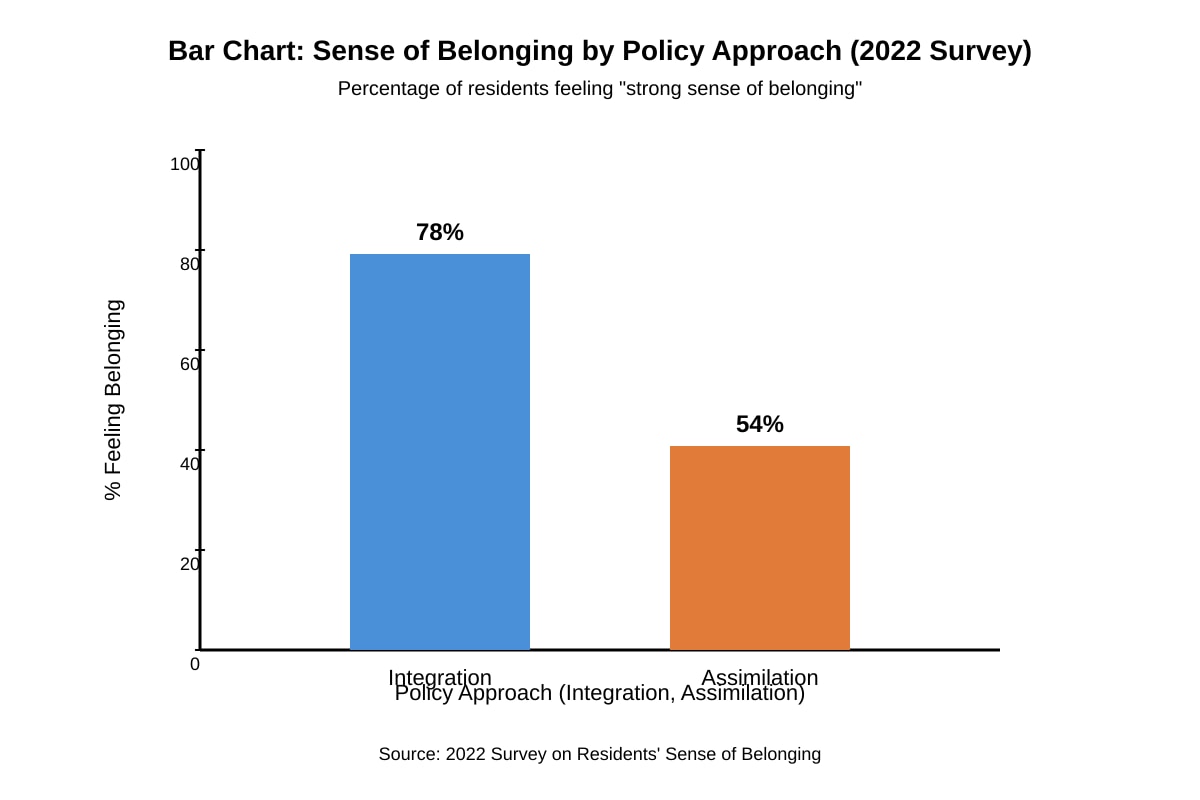
Answer: Integration (78%) shows stronger belonging than Assimilation (54%); 24% difference.
Marking: 1 mark each value + 1 mark comparison.
Visual features: Bar chart with labelled axes; Integration bar at 78%, Assimilation at 54%.
Q14 [4 marks]
Answer: Agree. B is official MCCY report (reliable provenance); C is social media post (bias, unverified).
Marking: 2 marks provenance B, 2 marks provenance C.
Teaching note: Reliability = source origin and accuracy.
Q15 [3 marks]
Answer: Citizens can appreciate diverse backgrounds / learn local customs (if immigrant).
Marking: 1 mark action, 2 marks link to B.
Teaching note: B says both sides adapt.
Section C: Essay Explanation (20 marks)
Q16 [10 marks]
Answer: Agree to large extent with sources.
Marking descriptors: Intro (1), For (3: B integration avoids identity loss, Q13 belonging higher), Against (3: C shows some prefer assimilation, efficiency), Conclusion (3: qualified agreement).
Teaching note: Template 4 – use sources, balanced, conclude with "to a large extent".
Q17 [8 marks]
Answer: Both important; government sets policy (B), citizens execute (A, C).
Marking: Govt role (3), Citizen role (3), Synthesis (2).
Teaching note: Template 5 – role comparison. A shows citizens ran activities; B shows govt framework.
Q18 [4 marks]
Answer: Trade-off: slower adaptation vs identity loss.
Marking: 2 marks trade-off stated, 2 marks explain.
Teaching note: Syllabus concept trade-offs in governance.
Q19 [4 marks]
Answer: Partially agree. Globalisation brings diverse influx (B context), but SG policies manage (B integration).
Marking: 2 marks knowledge, 2 marks source use.
Teaching note: Issue 3 + Issue 2 link.
Q20 [4 marks]
Answer: E.g., join CCA with diverse members; builds respect.
Marking: 2 marks action, 2 marks reason.
Teaching note: Active citizenship at student level.
End of Answer Key