From Real Exams Exam Paper
Secondary 4 Social Studies Preliminary Examination Paper 2
Free Sec 4 Social Studies Prelim Paper 2, DeepSeek Exam version, with questions, answers, and O Level-style practice for Singapore students.
These static practice materials are generated from the site's syllabus and paper-generation workflow, with source and model context shown so students and parents can evaluate the material before use.
Questions
Free quiz and exam paper access
Enter your details to view this paper
Your access is remembered on this device.
Answers
TuitionGoWhere Practice Paper - Social Studies Secondary 4
PRELIMINARY EXAMINATION — Version 2: ANSWER KEY & MARKING SCHEME
TuitionGoWhere Secondary School (AI)
Question 1 — Source A and Source C Agreement [6 marks]
Question: How far do these sources agree on what is needed to support lower-income groups in Singapore?
Marking Scheme
| Level | Marks | Descriptor |
|---|---|---|
| L1 | 1–2 | Identifies basic similarity or difference without explanation or evidence |
| L2 | 3–4 | Identifies agreement OR disagreement with some evidence from sources |
| L3 | 5–6 | Balanced analysis of both agreement and disagreement, with specific evidence from both sources and a justified conclusion on "how far" |
Model Answer Framework
Areas of Agreement:
- Both sources acknowledge that government financial assistance exists and is important (Source A: ComCare, Workfare, PWM; Source C: "government financial assistance was appreciated")
- Both sources recognise that government support alone is insufficient (Source A: "The government cannot solve this alone"; Source C: 68% valued community support more than cash transfers)
- Both sources highlight the importance of community involvement (Source A: "community partners, employers, and individuals"; Source C: befriending programmes, volunteers)
Areas of Disagreement/Emphasis:
- Source A emphasises government programmes as the primary response, with community as supplementary; Source C suggests community support is valued MORE than government cash transfers
- Source A focuses on structural/policy solutions (ComCare, Workfare, PWM); Source C focuses on relational/emotional support (befriending, mentorship)
- Source A presents an official, policy-oriented perspective; Source C presents ground-level, recipient perspectives
Conclusion: The sources largely agree that both government and community support are needed, but differ in emphasis — Source A sees government as primary with community as partner, while Source C suggests community support may be equally or more valued by recipients. They agree on the "what" (both are needed) but differ on the "how much" and "which matters more."
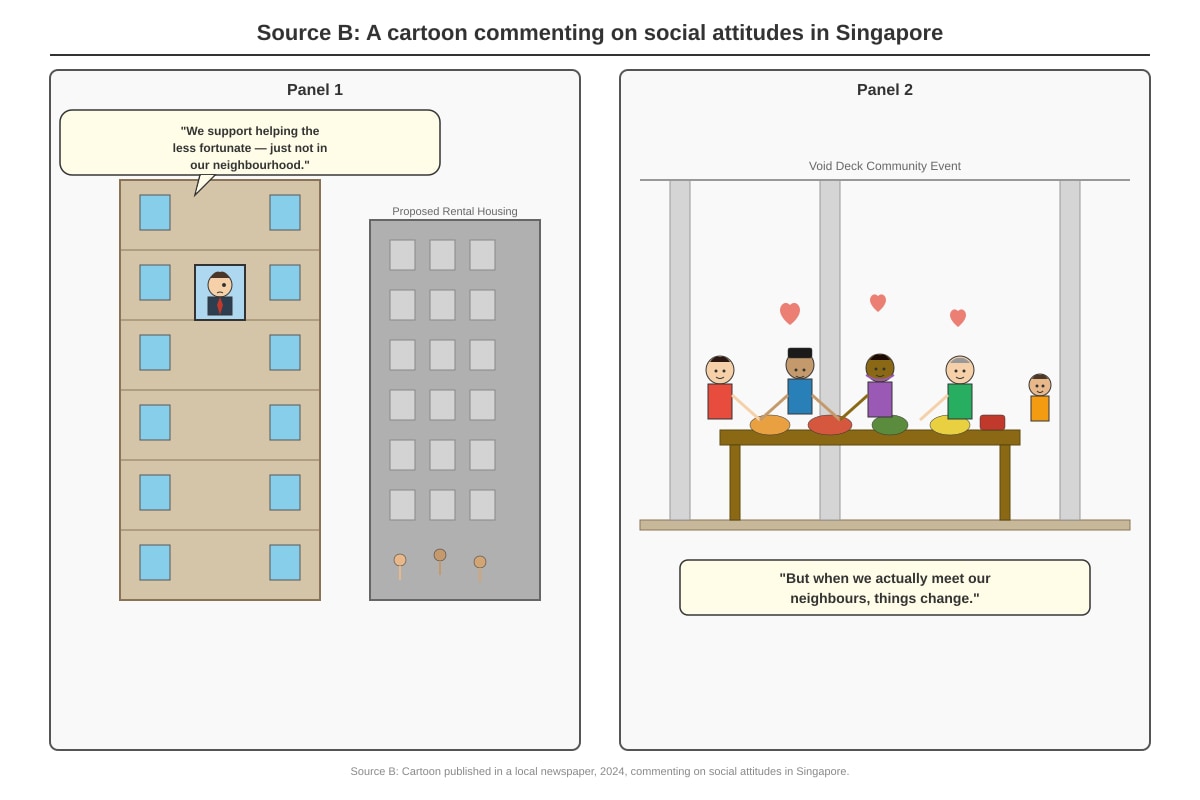
Question 2 — Source B Message [7 marks]
Question: What is the message of this source?
Marking Scheme
| Level | Marks | Descriptor |
|---|---|---|
| L1 | 1–2 | Describes the source without identifying message |
| L2 | 3–4 | Identifies message with some evidence from source |
| L3 | 5–6 | Explains message with specific evidence and identifies purpose/audience |
| L4 | 7 | Comprehensive explanation of message, purpose, and intended effect on audience, with detailed source evidence |
Model Answer Framework
Message: The cartoon conveys that while Singaporeans may express NIMBY (Not In My Backyard) attitudes — supporting help for the less fortunate in principle but opposing it in their own neighbourhoods — actual interaction and familiarity with people from different backgrounds can change these attitudes positively.
Evidence:
- Panel 1: The condominium resident says "We support helping the less fortunate — just not in our neighbourhood" — showing the contradiction between stated values and actual behaviour
- Panel 2: The void deck gathering shows "when we actually meet our neighbours, things change" — suggesting that direct contact reduces prejudice
- Visual contrast: Condominium (exclusive, private) vs. void deck (shared, community space)
Purpose: The cartoonist aims to critique NIMBY attitudes while offering hope that community interaction can overcome prejudice. The intended audience is the general Singaporean public, encouraging them to examine their own attitudes.
Conclusion: The message is that stated support for inclusivity is meaningless without acceptance in one's own community, but that genuine interaction can bridge social divides.
Question 3 — Surprise: Source A vs. Source D [7 marks]
Question: Having read Source A, are you surprised by Source D?
Marking Scheme
| Level | Marks | Descriptor |
|---|---|---|
| L1 | 1–2 | States surprised/not surprised without explanation |
| L2 | 3–4 | Explains expectation from Source A with some reference to Source D |
| L3 | 5–6 | Explains both expectation from Source A and content of Source D, with reasoning for degree of surprise |
| L4 | 7 | Comprehensive explanation of expectation, reality, and nuanced judgment on degree of surprise |
Model Answer Framework
Expectation from Source A:
- Source A acknowledges income inequality and challenges faced by specific groups (single-parent families, elderly living alone)
- Source A focuses on lower-income groups and government support for them
- Source A presents an official perspective that government is doing much but more is needed
Content of Source D:
- Source D expresses frustration from a middle-class perspective
- The commenter feels neglected — "just above the cut-off for most subsidies" but still struggling
- Argues government focuses too much on lowest-income groups at expense of middle class
Analysis of Surprise:
- Partially surprising: Source A does not address middle-class concerns at all, so Source D introduces a perspective absent from Source A
- Not entirely surprising: Source A acknowledges "competing demands" and "differing needs" implicitly; the middle-class frustration is a logical extension of resource allocation challenges
- The surprise is moderate — Source A's focus on the poor creates an expectation that they are the primary concern, but Source D reveals that other groups also feel underserved
Conclusion: I am somewhat surprised because Source A's exclusive focus on lower-income groups creates an expectation that they are the main group needing support, whereas Source D reveals middle-class resentment that complicates the picture of "who needs help."
Question 4 — "Enough help for the poor" [10 marks]
Question: "The Singapore government has provided enough help for the poor." Using Sources A, C, E, and F, explain how far you would agree with this statement.
Marking Scheme
| Level | Marks | Descriptor |
|---|---|---|
| L1 | 1–3 | One-sided answer or uses only one source |
| L2 | 4–6 | Uses multiple sources but lacks balance or depth |
| L3 | 7–8 | Balanced argument using multiple sources with evidence, but conclusion may be weak |
| L4 | 9–10 | Comprehensive, balanced evaluation using all four sources, with specific evidence and a well-justified conclusion |
Model Answer Framework
Evidence that government has provided enough help:
Source A:
- ComCare supports 80,000+ households annually
- Workfare supplements nearly 400,000 lower-wage workers
- Progressive Wage Model lifts wages in key sectors
- Government actively addressing inequality through multiple programmes
Source F:
- Gini coefficient after government transfers has improved from 0.39 (2013) to 0.37 (2023)
- Government transfers significantly reduce inequality (from 0.45 to 0.37)
- Volunteer participation rising (18% to 25%), suggesting growing community support complementing government efforts
- ComCare coverage increasing (4.2% to 5.1%), showing expanding reach
Evidence that government has NOT provided enough help:
Source C:
- 68% of low-income residents valued community support MORE than cash transfers
- Suggests government financial help addresses material needs but not emotional/social needs
- Uneven volunteer distribution — some areas have waiting lists
- Government programmes may not reach all who need non-financial support
Source E:
- Singapore's social welfare spending is only ~4% of GDP — low compared to other developed nations
- "Trampoline" model assumes family and community support exists
- Those without strong family networks may "fall through the cracks"
- Reliance on self-reliance may leave the most vulnerable unprotected
Balanced Conclusion: I agree to a moderate extent. The government has provided substantial financial support that measurably reduces inequality (Source F), and has multiple programmes targeting different groups (Source A). However, "enough" is questionable because: (1) financial help alone does not address social isolation (Source C), (2) the model assumes support systems that not everyone has (Source E), and (3) spending remains low by international standards. The government has provided enough in terms of financial transfers but not enough in terms of holistic support for the most vulnerable.
Question 5 — Responsibility for Inclusive Society [20 marks]
Question: "The responsibility for building an inclusive society in Singapore lies primarily with the government." Using all sources, explain how far you agree.
Marking Scheme
| Level | Marks | Descriptor |
|---|---|---|
| L1 | 1–5 | Describes sources without addressing the statement; one-sided or lacks structure |
| L2 | 6–10 | Addresses statement but uses limited sources; may lack balance or depth |
| L3 | 11–15 | Balanced argument using multiple sources with evidence; addresses both government and citizen roles; structured response |
| L4 | 16–20 | Comprehensive, well-structured evaluation using all sources; addresses government roles, citizen/community roles, and challenges; nuanced conclusion with clear justification |
Model Answer Framework
Introduction: The statement claims that government bears primary responsibility for building an inclusive society. While the government plays a crucial role through policy and resources, the sources suggest that citizens, community organisations, and individual attitudes are equally important. This essay will evaluate the extent of government responsibility versus shared responsibility.
Arguments that government has primary responsibility:
Source A (Government programmes):
- Government has the resources and mandate to implement large-scale programmes (ComCare, Workfare, PWM)
- Government can set national policy direction and coordinate across sectors
- Minister acknowledges government role but also calls for community partnership
Source E (Structural role):
- Government designs the overall social welfare model ("trampoline" approach)
- Government determines spending levels and eligibility criteria
- Only government can redistribute resources through taxation and transfers
Source F (Measurable impact):
- Government transfers demonstrably reduce inequality (Gini from 0.45 to 0.37)
- Government programmes reach millions (400,000 Workfare recipients)
- Systematic approach allows monitoring and adjustment
Arguments that responsibility is shared with citizens and community:
Source B (Community attitudes):
- NIMBY attitudes show that government policy alone cannot create inclusivity
- Real inclusion happens at community level (void deck gatherings)
- Citizens must choose to accept and interact with diverse neighbours
Source C (Community support valued):
- 68% of low-income residents valued community support more than cash transfers
- Volunteers provide emotional and social support that government programmes cannot
- Uneven volunteer distribution shows community engagement is variable — government cannot mandate caring
Source D (Diverse needs and perspectives):
- Middle-class frustration shows that defining "inclusive" is contested
- Different groups have competing claims on resources
- Government cannot satisfy everyone; citizens must also show understanding and compromise
Challenges in building an inclusive society:
- Competing needs: Source D shows that helping one group may alienate another
- Implementation gaps: Source C shows uneven volunteer distribution despite government encouragement
- Attitude barriers: Source B shows that stated support does not always translate to behaviour
- Structural limitations: Source E shows that the "trampoline" model may not work for those without family support
- Resource constraints: Source F shows incremental progress but persistent inequality (Gini still 0.37)
Conclusion:
I disagree that responsibility lies primarily with the government. The sources demonstrate that building an inclusive society requires a partnership between government, community, and individuals:
- Government provides the framework, resources, and policy direction (Sources A, E, F)
- Community organisations and volunteers provide the human connection that makes inclusion real (Source C)
- Individual citizens must choose to overcome prejudice and accept diversity in their own neighbourhoods (Source B)
- All stakeholders must navigate competing needs and limited resources (Source D)
Government action alone cannot create an inclusive society because inclusion is fundamentally about human relationships and attitudes. However, government has an essential enabling role that no other actor can fulfil. The responsibility is shared, with government as a crucial but not sufficient partner. I agree with the statement only to a small extent.
Marking Notes:
- Award marks for: use of all sources, balanced argument, specific evidence, addressing the three bullet points, logical structure, justified conclusion
- Deduct marks for: one-sided argument, ignoring sources, vague claims without evidence, weak or absent conclusion
- L4 responses must demonstrate synthesis across sources and nuanced judgment
— END OF ANSWER KEY —