AI Generated Quiz
Secondary 4 Pure Physics Waves Sound Light Quiz
Free Sec 4 Pure Physics Waves Sound Light quiz, HY3 AI version, with questions, answers, and O Level-style practice for Singapore students.
These static practice materials are generated from the site's syllabus and paper-generation workflow, with source and model context shown so students and parents can evaluate the material before use.
Questions
Secondary 4 Pure Physics Quiz - Waves Sound Light
Name: ___________________________
Class: ___________________________
Date: ___________________________
Score: _______ / 40
Duration: 50 minutes
Total Marks: 40
Topic: Waves, Sound & Light (waves-sound-light)
Version: 1 of 5 (Practice Quiz, AI-generated from syllabus-first templates)
Instructions:
- Answer all 20 questions.
- Section A: Multiple-choice style short items (1 mark each).
- Section B: Structured short answers (2 marks each).
- Section C: Extended calculations and explanations (3–4 marks each).
- Show all working for calculation questions.
- Use c=3.0×10⁸ m/s for speed of light in air/vacuum, vsound≈340 m/s in air unless stated.
Section A (Questions 1–5, 1 mark each)
1. A transverse wave is characterised by the direction of vibration being ______ to the direction of energy transfer.
2. The frequency of a wave is defined as the number of ______ passing a fixed point per second.
3. State the approximate speed of sound in dry air at room temperature.
4. In the electromagnetic spectrum, which type of wave has the longest wavelength: radio waves, X-rays, or ultraviolet?
5. Refraction of light occurs because the ______ of light changes when it enters a different medium.
Section B (Questions 6–10, 2 marks each)
6. A water wave has a wavelength of 0.50 m and frequency 4.0 Hz. Calculate its speed. Show your working.
7. A student places a tuning fork near a tube and hears resonance. State what is meant by resonance in sound.
8. Light travels from air into glass of refractive index 1.50. If the angle of incidence is 30∘, calculate the angle of refraction. (Use n=sinrsini)
9. State two properties of a sound wave that determine its loudness and pitch respectively.
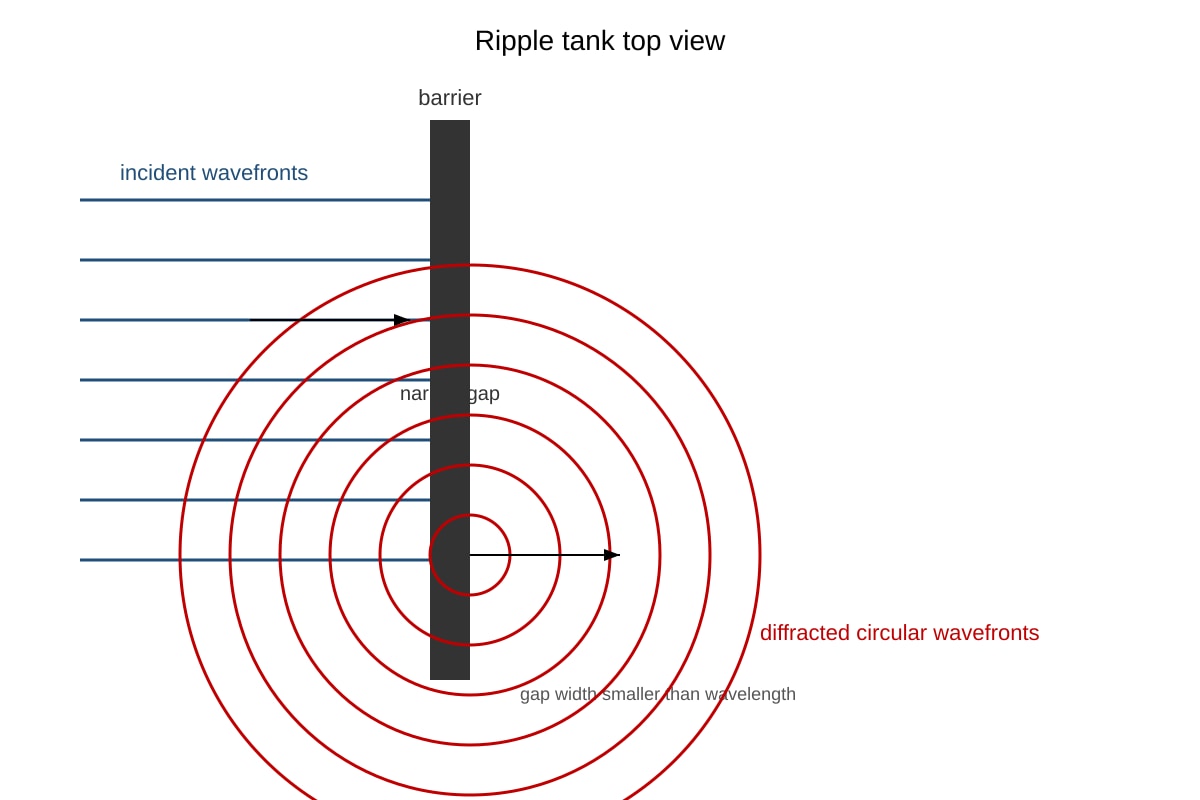
10. A ripple tank diagram shows wavefronts spreading out after passing through a narrow gap. Name this wave phenomenon.
Image pending generation: diagram for Q10.
Section C (Questions 11–20, 3–4 marks each)
11. A sound wave of frequency 680 Hz is emitted by a stationary loudspeaker. The speed of sound is 340 m/s.
(a) Calculate the wavelength of the sound. [2]
(b) State what happens to the wavelength if the frequency is doubled but speed remains the same. [1]
12. A student observes a straw appearing bent in a glass of water.
(a) Explain why this happens using the term refraction. [2]
(b) State whether light speeds up or slows down entering water from air. [1]
13. A string is plucked to form a standing wave with 3 loops. The length of the string is 0.90 m.
(a) Find the wavelength of the standing wave. [2]
(b) If the wave speed on the string is 120 m/s, calculate the frequency. [2]
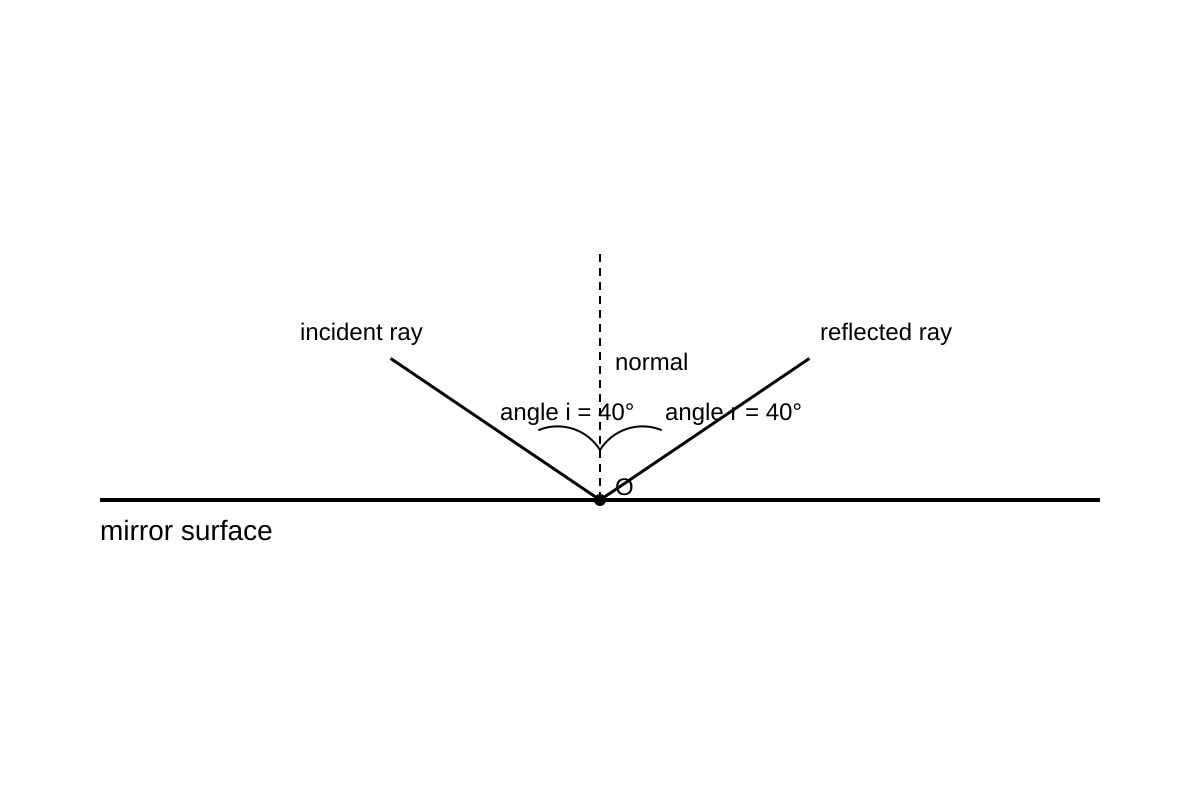
14. The diagram shows a plane mirror and an incident ray.
Image pending generation: diagram for Q14.
(a) State the law of reflection. [1]
(b) Calculate the angle of reflection and the angle between incident and reflected rays. [3]
15. A bat emits an ultrasonic pulse of frequency 40 kHz. It receives the echo 0.10 s later from a wall. Speed of sound = 340 m/s.
(a) Calculate the distance of the wall from the bat. [3]
(b) State one reason bats use ultrasound rather than audible sound. [1]
16. A convex lens of focal length 10 cm forms an image of an object placed 15 cm from the lens.
(a) Use the lens formula f1=u1+v1 to find the image distance v. [3]
(b) State whether the image is real or virtual. [1]
17. The electromagnetic spectrum is listed from longest to shortest wavelength.
(a) Name the two missing types between radio waves and visible light: ______ and ______. [2]
(b) State one use of infrared waves. [1]
(c) Explain why X-rays are dangerous to living cells. [1]
18. A rope of length 2.0 m is fixed at both ends and shaken to produce a wave speed of 8.0 m/s. The fundamental frequency shows one antinode.
(a) State the wavelength of the fundamental mode. [1]
(b) Calculate the fundamental frequency. [2]
(c) State how the frequency changes if the rope length is halved. [1]
19. A student measures the time for 20 crests of a water wave to pass a marker as 8.0 s. The distance between adjacent crests is 0.40 m.
(a) Calculate the frequency. [2]
(b) Calculate the wave speed. [2]
20. A ray of light in air strikes a semicircular glass block at the centre of the flat side with angle of incidence 45∘. Refractive index of glass = 1.52.
(a) Calculate the angle of refraction at the air–glass boundary. [2]
(b) State whether the ray will undergo total internal reflection at the curved glass–air boundary if it strikes normally. [1]
(c) Explain your answer in (b). [1]
Answers
Secondary 4 Pure Physics Quiz - Waves Sound Light (Answer Key)
Topic: Waves, Sound & Light
Version: 1 of 5
Total Marks: 40
Section A Answers (1 mark each)
1. perpendicular
Teaching note: Transverse waves (e.g. water, light) have vibrations at right angles to the direction of travel. Longitudinal waves (e.g. sound) are parallel.
2. waves (or complete oscillations/cycles)
Teaching note: Frequency f is measured in hertz (Hz) = cycles per second.
3. 340 m/s (approx)
Teaching note: Standard classroom value for sound in air at 20∘C.
4. radio waves
Teaching note: EM spectrum order from long to short wavelength: radio → microwave → infrared → visible → UV → X-ray → gamma. Radio has longest λ.
5. speed
Teaching note: Refraction is due to change in speed causing change in direction (except at normal incidence).
Section B Answers (2 marks each)
6. Speed =fλ=4.0×0.50=2.0 m/s [2]
Working: v=fλ. Substitution and unit gain full marks. Common mistake: using v=λ/f.
7. Resonance is when a system is made to vibrate at its natural frequency by a driving force, producing a large amplitude. [2]
Teaching note: In sound, matching frequencies from fork and air column cause loud sound.
8. n=sinrsini⇒sinr=1.50sin30∘=1.500.5=0.333; r=sin−1(0.333)≈19.5∘ [2]
Marking: 1 mark formula/substitution, 1 mark answer.
9. Loudness → amplitude; Pitch → frequency [2]
Teaching note: Larger amplitude = louder; higher frequency = higher pitch.
10. Diffraction [2]
Note on image: The <image_placeholder> Q10-fig1 must show straight waves hitting a barrier with a narrow slit and circular waves spreading out beyond. This confirms diffraction (bending around obstacle / through gap).
Section C Answers (3–4 marks each)
11. (a) λ=v/f=340/680=0.50 m [2]
(b) Wavelength is halved to 0.25 m [1]
Teaching note: Since v=fλ and v constant, doubling f halves λ.
12. (a) Light from the straw changes speed entering water, bends at the surface (refraction), so the submerged part appears at a different position. [2]
(b) Slows down [1]
13. (a) 3 loops on 0.90 m: each loop = λ/2, so 3×λ/2=0.90⇒λ=0.60 m [2]
(b) f=v/λ=120/0.60=200 Hz [2]
14. (a) Angle of incidence = angle of reflection [1]
(b) Angle of reflection = 40∘ [1]; angle between incident and reflected = 40+40=80∘ [2]
Image note: Q14-fig1 shows normal at 90∘ to mirror, i=40∘, so r=40∘ by law.
15. (a) Total distance = v×t=340×0.10=34 m; wall distance = 34/2=17 m [3]
(b) Ultrasound has shorter wavelength, better for locating small objects / not heard by prey [1]
16. (a) 1/10=1/15+1/v⇒1/v=0.100−0.0667=0.0333⇒v=30 cm [3]
(b) Real (since v positive, opposite side of lens) [1]
17. (a) microwaves, infrared [2]
(b) e.g. remote controls, thermal imaging [1]
(c) High energy can ionise/damage cells [1]
18. (a) λ=2×2.0=4.0 m [1]
(b) f=v/λ=8.0/4.0=2.0 Hz [2]
(c) Frequency doubles [1]
19. (a) T=8.0/20=0.40 s; f=1/T=2.5 Hz [2]
(b) v=fλ=2.5×0.40=1.0 m/s [2]
20. (a) sinr=sin45∘/1.52=0.707/1.52=0.465; r=27.7∘ [2]
(b) No [1]
(c) Ray strikes curved boundary normally so no refraction/reflection angle issue; TIR needs angle > critical [1]
Free quiz and exam paper access
Enter your details to view this paper
Your access is remembered on this device.