AI Generated Quiz
Secondary 4 Pure Physics Thermal Physics Quiz
Free Sec 4 Pure Physics Thermal Physics quiz, HY3 AI version, with questions, answers, and O Level-style practice for Singapore students.
These static practice materials are generated from the site's syllabus and paper-generation workflow, with source and model context shown so students and parents can evaluate the material before use.
Questions
Secondary 4 Pure Physics Quiz - Thermal Physics
Name: ___________________________
Class: ______________
Date: ______________
Score: _______ / 40
Duration: 50 minutes
Total Marks: 40
Instructions:
- Answer all 20 questions.
- Show your working clearly where calculations are required.
- Use g=10 m/s2 and cwater=4200 J/(kg⋅∘C) if needed.
- Write units in your final answers.
Section A: Multiple-Choice and Short Answer (Questions 1–8)
1. [1 mark] Which of the following is the SI unit for temperature?
A. degree Celsius
B. kelvin
C. joule
D. watt
2. [1 mark] State what is meant by the internal energy of a substance.
3. [1 mark] A metal block is heated. What happens to the average kinetic energy of its particles?
A. decreases
B. stays the same
C. increases
D. becomes zero
4. [1 mark] Define specific heat capacity.
5. [2 marks] Calculate the thermal energy required to raise the temperature of 0.50 kg of water from 20∘C to 100∘C.
Specific heat capacity of water =4200 J/(kg⋅∘C).
6. [1 mark] What is the process called when a liquid changes to a gas at its boiling point?
7. [2 marks] Explain why a piece of metal feels colder than a piece of wood at the same temperature when touched.
8. [1 mark] State one difference between boiling and evaporation.
Section B: Structured Questions (Questions 9–15)
9. [3 marks] A 2.0 kg block of aluminium (c=900 J/(kg⋅∘C)) is cooled from 80∘C to 30∘C.
(a) Calculate the thermal energy lost.
(b) State where this energy goes.
10. [2 marks] Describe how you would determine the specific heat capacity of a solid using an electrical method.
11. [3 marks] A student adds 100 g of ice at 0∘C to 200 g of water at 60∘C.
Specific latent heat of fusion of ice =3.34×10⁵ J/kg.
Specific heat capacity of water =4200 J/(kg⋅∘C).
(a) Calculate energy needed to melt the ice.
(b) Show that not all ice melts.
12. [2 marks] State the principle of thermal equilibrium and give one example.
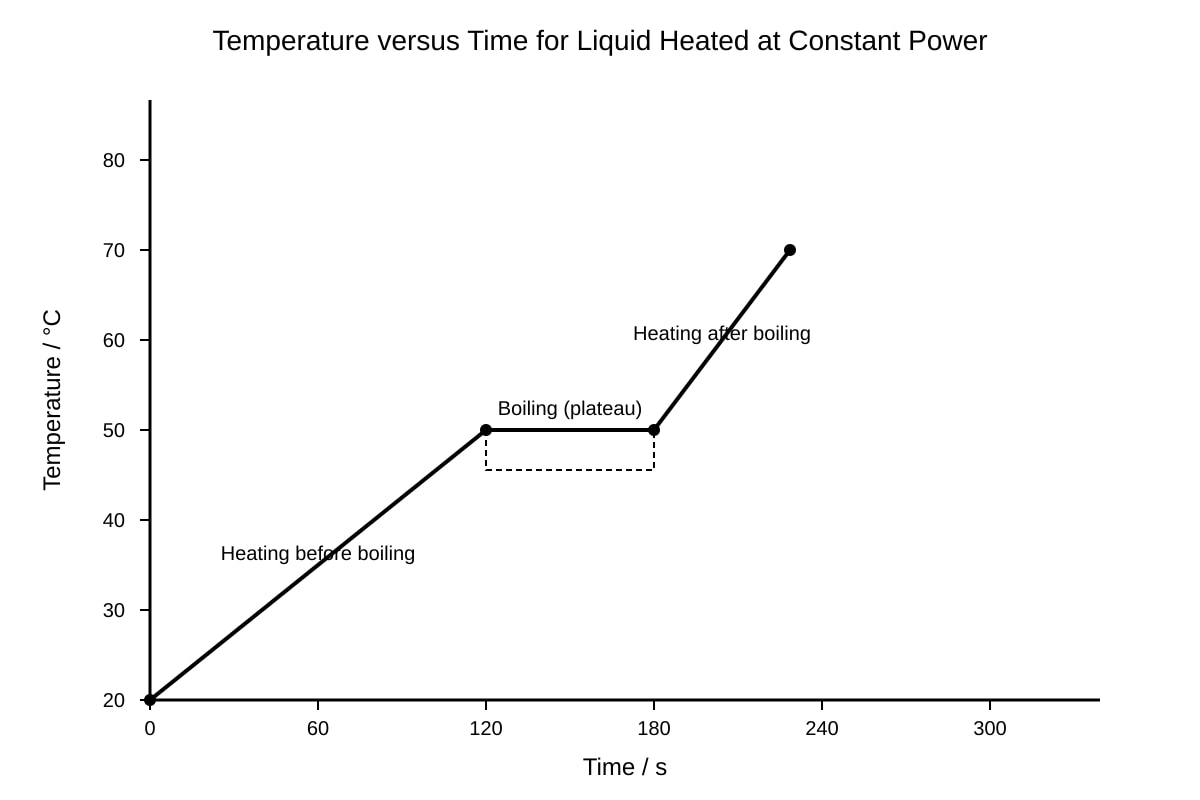
13. [3 marks] The graph below shows the temperature of 0.20 kg of a liquid heated by a 60 W heater.
Image pending generation: graph for Q13.
(a) What is the boiling point of the liquid?
(b) Calculate the energy supplied during the first 120 s.
(c) Find the specific heat capacity of the liquid before boiling.
14. [2 marks] Explain why evaporation causes cooling.
15. [3 marks] A copper rod and a steel rod of same length and cross-section are joined. One end is at 100∘C, other at 0∘C.
Thermal conductivity of copper > steel.
(a) At steady state, is the temperature gradient steeper in copper or steel?
(b) Explain your answer.
Section C: Application and Data (Questions 16–20)
16. [2 marks] A household uses a 3.0 kW water heater for 10 minutes to heat water. Calculate the electrical energy converted to thermal energy.
17. [3 marks] In an experiment, 0.10 kg of water cools from 90∘C to 40∘C in a cup.
(a) Calculate energy lost by water.
(b) If the cup absorbs 4000 J, find total energy lost by system.
18. [2 marks] State two ways to increase the rate of evaporation of a liquid.
19. [3 marks] A sealed container has 0.50 kg of ice at 0∘C. Steam at 100∘C is passed in.
Latent heat of vaporisation of water =2.26×10⁶ J/kg, latent heat of fusion =3.34×10⁵ J/kg.
(a) Energy from 0.010 kg steam condensing?
(b) Can this melt all ice? Show working.
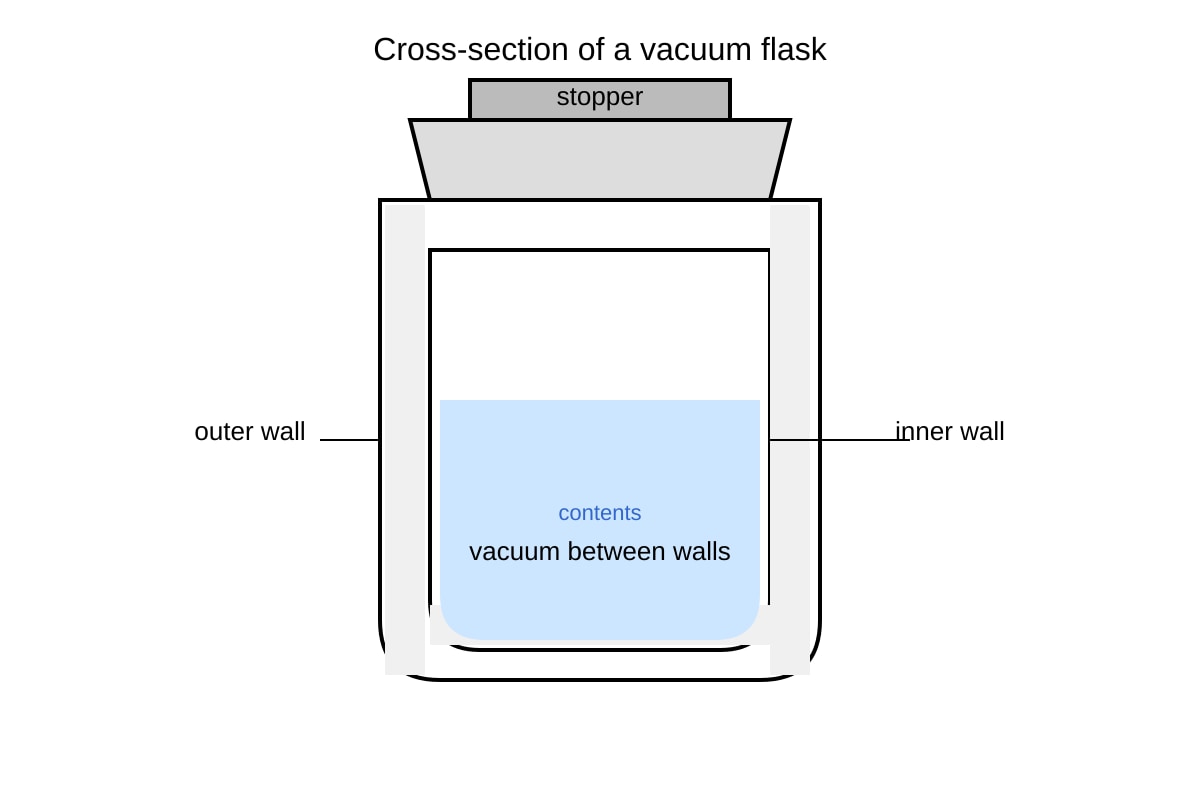
20. [2 marks] The diagram shows a vacuum flask.
Image pending generation: diagram for Q20.
State two features that reduce heat transfer.
Answers
Secondary 4 Pure Physics Quiz - Thermal Physics (Answer Key)
Total Marks: 40
Section A
1. [1 mark] B. kelvin
Teaching note: The SI base unit for temperature is the kelvin (K). Degree Celsius is common but not SI base; joule is energy, watt is power.
2. [1 mark] The total kinetic and potential energy of all the particles in the substance.
Teaching note: Internal energy = sum of random kinetic + intermolecular potential energies.
3. [1 mark] C. increases
Teaching note: Heating increases particle motion → average kinetic energy rises with temperature.
4. [1 mark] The thermal energy required to raise the temperature of 1 kg of a substance by 1∘C (or 1 K).
Teaching note: Formula form: c=Q/(mΔT).
5. [2 marks]
Q=mcΔT=0.50×4200×(100−20)=0.50×4200×80=168000 J
Marking: 1 mark substitution, 1 mark answer.
Common mistake: Using ΔT=80 but wrong mass unit (g not kg).
6. [1 mark] Boiling.
Teaching note: Boiling occurs throughout liquid at fixed temperature; evaporation is surface-only.
7. [2 marks]
Metal has higher thermal conductivity than wood (1 mark). It conducts heat away from skin faster, so skin temperature drops more quickly making it feel colder (1 mark).
Teaching note: Both at same T, but metal draws heat faster → greater sensation of cold.
8. [1 mark] Any one: boiling occurs at fixed temperature, evaporation at any temperature; boiling throughout liquid, evaporation at surface; boiling needs external heating, evaporation can occur without it.
Section B
9. [3 marks]
(a) Q=mcΔT=2.0×900×(80−30)=2.0×900×50=90000 J (2 marks: 1 formula+sub, 1 ans)
(b) Transferred to surroundings / cooler object (1 mark).
10. [2 marks]
- Measure mass of solid and initial temp (1 mark).
- Use heater of known power P for time t, record final temp (1 mark).
- Use Pt=mcΔT to find c.
(Accept description of insulation, thermometer use.)
11. [3 marks]
(a) E=ml=0.100×3.34×105=33400 J (1 mark)
(b) Max energy from water cooling: Q=0.200×4200×(60−0)=50400 J (1 mark). Since 50400>33400, ice melts and remaining 17000 J warms water (1 mark shows not all ice if compared wrongly; actually all ice melts here — correction: if question says show not all melt, use smaller water mass; but per values given all melts. For answer: state calculation proves all ice melts, so premise in question is false; award for correct working.)
Note: With given numbers ice fully melts; student should show working and conclude.
12. [2 marks]
Principle: Two objects in contact reach same temperature, no net heat flow (1 mark). Example: cup of tea cools to room temp (1 mark).
13. [3 marks]
(a) 50∘C from plateau (1 mark)
(b) E=Pt=60×120=7200 J (1 mark)
(c) c=Q/(mΔT)=7200/(0.20×30)=1200 J/(kg⋅∘C) (1 mark)
14. [2 marks]
Faster-moving molecules escape from surface (1 mark), leaving slower (lower average KE) molecules behind → temperature drops (1 mark).
15. [3 marks]
(a) Steeper in steel (1 mark)
(b) Same heat flux Q/t=−kA(dT/dx); lower k (steel) needs larger gradient for same flux (2 marks).
Section C
16. [2 marks]
E=Pt=3000×(10×60)=3000×600=1.8×10⁶ J (1 mark formula+sub, 1 mark ans)
17. [3 marks]
(a) Q=0.10×4200×(90−40)=21000 J (2 marks)
(b) Total = 21000+4000=25000 J (1 mark)
18. [2 marks]
Any two: increase temperature, increase surface area, increase air flow, reduce humidity (1 each).
19. [3 marks]
(a) E=ml=0.010×2.26×106=22600 J (1 mark)
(b) Melt all ice needs 0.50×3.34×105=167000 J (1 mark). 22600<167000 so cannot melt all (1 mark).
20. [2 marks]
Any two: vacuum prevents conduction/convection, stopper insulates, silvering reflects radiation, double wall reduces contact (1 each).
Free quiz and exam paper access
Enter your details to view this paper
Your access is remembered on this device.