AI Generated Quiz

Secondary 4 Pure Physics Energy Power Quiz

Free Sec 4 Pure Physics Energy Power quiz with questions, answers, and O Level-style practice for Singapore students preparing for school assessments.

These static practice materials are generated from the site's syllabus and paper-generation workflow, with source and model context shown so students and parents can evaluate the material before use.

Secondary 4 Pure Physics AI Generated Generated by Kimi K2.6 Free Updated 2026-06-12

Questions

<!-- TuitionGoWhere generation metadata: stage=5-1; model=moonshotai/kimi-k2.6:free; model_label=Kimi K2.6 Free; generated=2026-06-10; Sources: Stage 4-0 LLM templates, syllabus context, and Stage 2 evidence where available. -->

Secondary 4 Pure Physics Quiz - Energy Power

Name: __________________________________
Class: __________________________________
Date: __________________________________
Score: ________ / 40

Duration: 35 minutes
Total Marks: 40 marks

Instructions:

  • Answer ALL questions.
  • Write your answers in the spaces provided.
  • Show all working clearly for calculation questions.
  • Take g=10 N/kgg = 10 \text{ N/kg} where required.

Section A: Multiple Choice and Short Response (Questions 1–8)

[16 marks]


1. State the principle of conservation of energy.
[2 marks]

____________________________________________________________________________________________________________________________________________________________________________________________________________________________________________________________________________________________________________________


2. A 2.0 kg object is lifted vertically through a height of 3.0 m at constant speed. Calculate the gravitational potential energy gained by the object.
[2 marks]

____________________________________________________________________________________________________________________________________________________________________________________________________________________________________________________________________________________________________________________


3. Which of the following is a renewable energy source?

A. Natural gas
B. Nuclear fuel
C. Solar energy
D. Coal

[1 mark]

Answer: ________________


4. A car of mass 800 kg accelerates from rest to a speed of 20 m/s20 \text{ m/s}. Calculate its kinetic energy at this speed.
[2 marks]

___________________________________________________________________________________________________________________________________________________________________________________________________________________________________________________________________________________________________


5. Define power and state its SI unit.
[2 marks]

____________________________________________________________________________________________________________________________________________________________________________________________________________________________________________________________________________________________________________________


6. An electric motor lifts a load of 500 N through a vertical height of 4.0 m in 8.0 s. Calculate the power output of the motor, assuming 100% efficiency.
[2 marks]

____________________________________________________________________________________________________________________________________________________________________________________________________________________________________________________________________________________________________________________


7. Explain why a hydroelectric power station is more efficient than a coal-fired power station at converting energy into electrical energy.
[3 marks]

____________________________________________________________________________________________________________________________________________________________________________________________________________________________________________________________________________________________________________________


8. A student claims that "energy is lost when a bouncing ball eventually comes to rest." Explain why this statement is incorrect in terms of energy conservation, and describe what actually happens to the energy.
[2 marks]

____________________________________________________________________________________________________________________________________________________________________________________________________________________________________________________________________________________________________________________


Section B: Structured Problem Solving (Questions 9–14)

[16 marks]


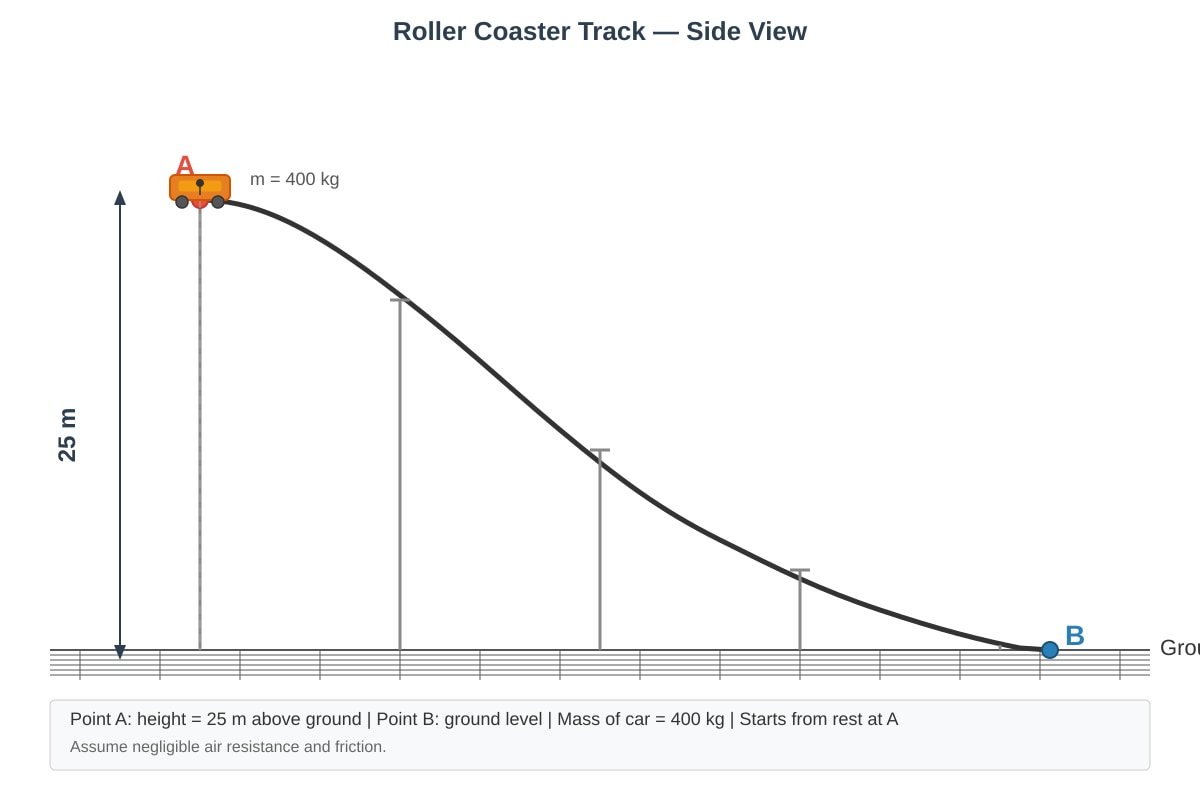
9. The diagram below shows a roller coaster car moving along a track. Point A is at a height of 25 m, and point B is at ground level. The car has a mass of 400 kg and starts from rest at point A. Assume negligible air resistance and friction.

<image_placeholder> id: Q9-fig1 type: diagram linked_question: Q9 description: Side view of a roller coaster track showing two points A and B. Point A is at the top left at height 25 m above ground. Point B is at ground level to the right. The track curves downward from A to B. A roller coaster car is shown at point A. labels: A (top left, height 25 m), B (ground level), ground level reference line, height arrow showing 25 m values: height at A = 25 m, mass of car = 400 kg must_show: relative heights of A and B, smooth curved track, labelled points, ground reference </image_placeholder>

(a) Calculate the gravitational potential energy of the car at point A.
[2 marks]

____________________________________________________________________________________________________________________________________________________________________________________________________________________________________________________________________________________________________________________

(b) Calculate the speed of the car at point B using energy conservation.
[3 marks]

____________________________________________________________________________________________________________________________________________________________________________________________________________________________________________________________________________________________________________________


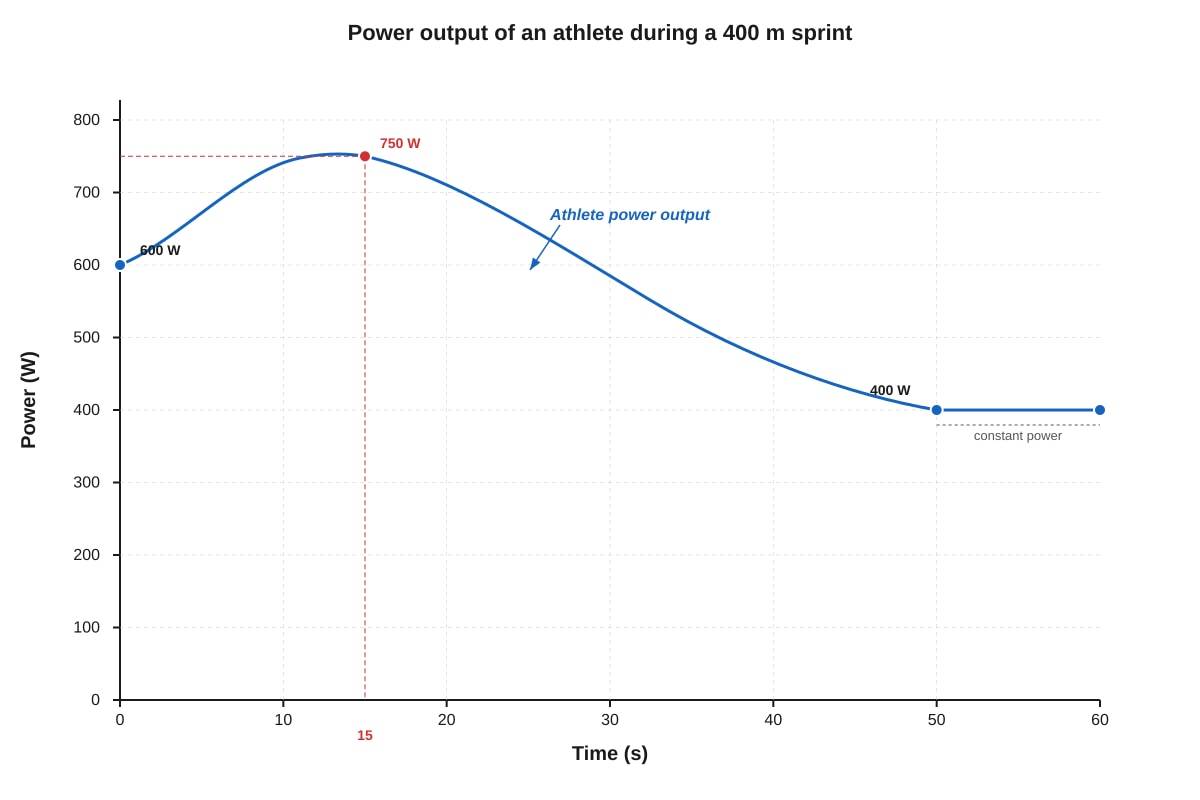
10. The graph below shows how the power output of an athlete varies with time during a 400 m sprint.

<image_placeholder> id: Q10-fig1 type: graph linked_question: Q10 description: Power-time graph for an athlete during a 400 m sprint. The x-axis shows time from 0 to 60 seconds. The y-axis shows power from 0 to 800 W. The curve starts at 600 W at t=0, rises to a peak of 750 W at t=15 s, then gradually decreases to 400 W at t=50 s, remaining constant until t=60 s. labels: Power (W) on y-axis, Time (s) on x-axis, curve labelled "Athlete power output" values: initial power = 600 W, peak power = 750 W at t=15 s, final power = 400 W from t=50 s to t=60 s, total time = 60 s must_show: axes with correct scales and units, labelled curve, key values marked, smooth curve shape </image_placeholder>

(a) State the maximum power output of the athlete.
[1 mark]

____________________________________________________________________________________________________________________________________________________________________________________________________________________________________________________________________________________________________________________

(b) Explain why the power output decreases after 15 seconds even though the athlete continues running.
[2 marks]

____________________________________________________________________________________________________________________________________________________________________________________________________________________________________________________________________________________________________________________


11. A petrol engine has an efficiency of 30%. The input power from burning petrol is 60 kW.

(a) Calculate the useful power output of the engine.
[2 marks]

____________________________________________________________________________________________________________________________________________________________________________________________________________________________________________________________________________________________________________________

(b) The engine runs for 2 hours. Calculate the total energy input from the petrol in kilowatt-hours.
[2 marks]

____________________________________________________________________________________________________________________________________________________________________________________________________________________________________________________________________________________________________________________


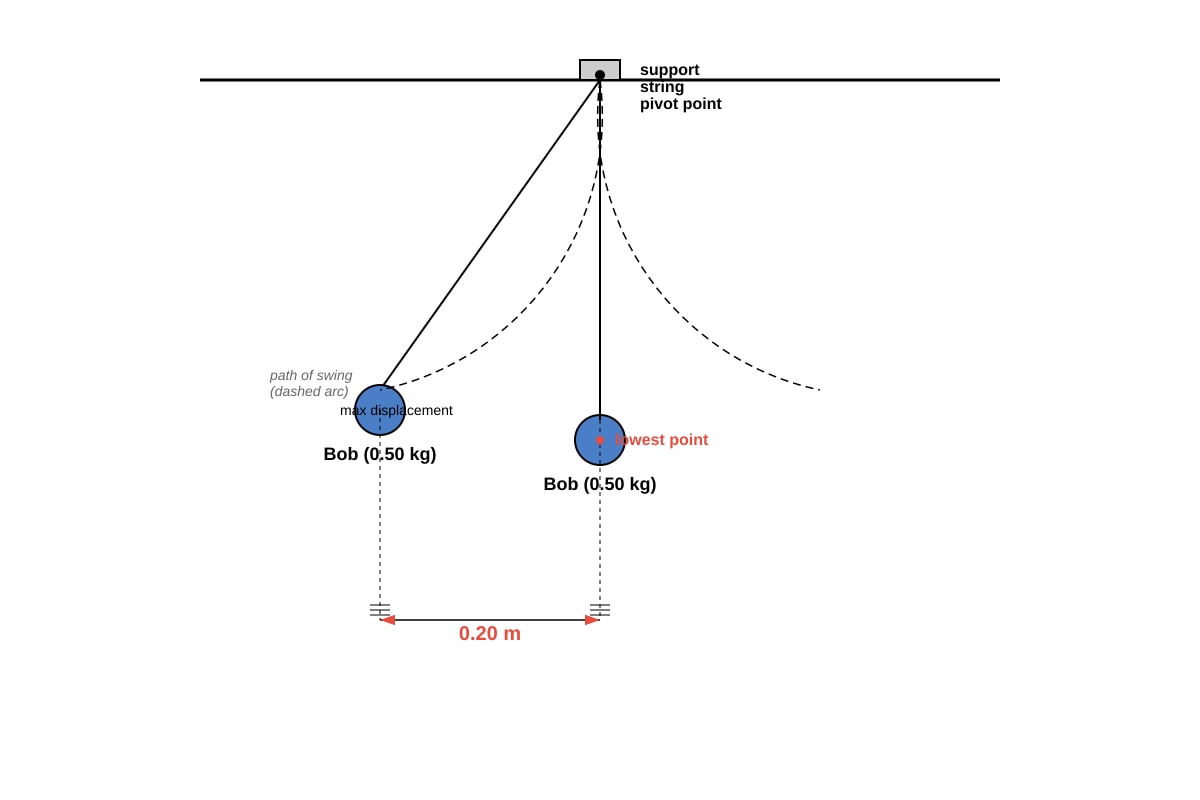
12. The diagram shows a simple pendulum. The bob has a mass of 0.50 kg and is released from rest at a height of 0.20 m above its lowest point.

<image_placeholder> id: Q12-fig1 type: diagram linked_question: Q12 description: Side view of a simple pendulum. A bob is shown at its maximum displacement to the left, at height 0.20 m above the lowest point of the swing. The lowest point is marked. A dashed arc shows the path of the bob. labels: Bob (0.50 kg), support string pivot point, height arrow showing 0.20 m, lowest point, path of swing shown as dashed arc values: mass = 0.50 kg, height = 0.20 m must_show: bob at maximum displacement, vertical reference for height measurement, lowest point clearly marked, string and pivot </image_placeholder>

Calculate the maximum speed of the bob at the lowest point of its swing.
[3 marks]

____________________________________________________________________________________________________________________________________________________________________________________________________________________________________________________________________________________________________________________


13. A 60 kg student climbs a staircase of vertical height 12 m in 20 s.

(a) Calculate the work done against gravity.
[2 marks]

____________________________________________________________________________________________________________________________________________________________________________________________________________________________________________________________________________________________________________________

(b) Calculate the average power developed by the student.
[1 mark]

____________________________________________________________________________________________________________________________________________________________________________________________________________________________________________________________________________________________________________________


14. Explain two advantages and two disadvantages of using wind turbines to generate electricity compared to using fossil fuel power stations.
[4 marks]

____________________________________________________________________________________________________________________________________________________________________________________________________________________________________________________________________________________________________________________


Section C: Extended Analysis (Questions 15–20)

[8 marks]


15. An electric kettle rated at 2.0 kW is used to heat 1.5 kg of water from 20C20^{\circ}\text{C} to 100C100^{\circ}\text{C}. The specific heat capacity of water is 4200 J/(kgC)4200 \text{ J/(kg}\cdot^{\circ}\text{C)}.

(a) Calculate the energy required to heat the water.
[2 marks]

____________________________________________________________________________________________________________________________________________________________________________________________________________________________________________________________________________________________________________________

(b) Calculate the minimum time needed if all electrical energy is transferred to thermal energy in the water.
[2 marks]

____________________________________________________________________________________________________________________________________________________________________________________________________________________________________________________________________________________________________________________


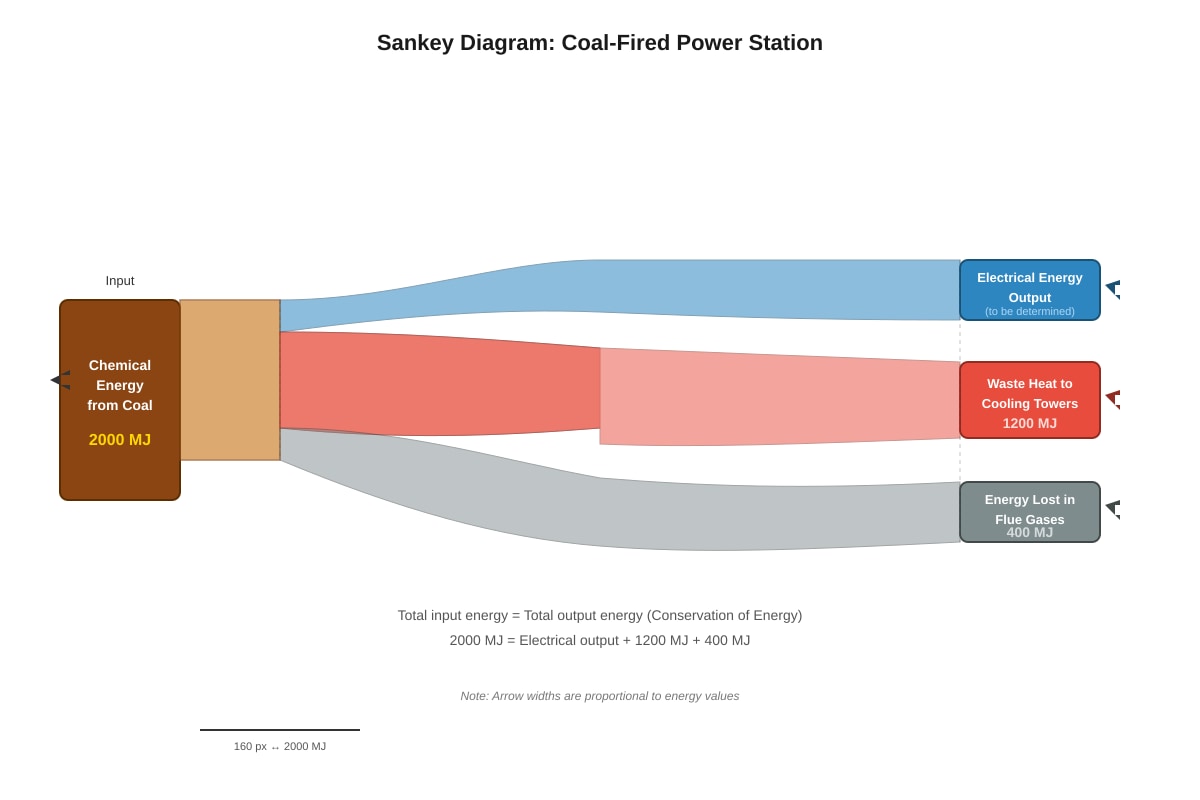
16. The Sankey diagram below represents the energy transfers in a coal-fired power station.

<image_placeholder> id: Q16-fig1 type: diagram linked_question: Q16 description: Sankey diagram for a coal-fired power station showing energy flow. Input arrow from left labelled "Chemical energy from coal 2000 MJ". Three output arrows to right: "Electrical energy output" (narrower arrow), "Waste heat to cooling towers" (widest arrow), "Energy lost in flue gases" (medium arrow). Arrow widths proportional to energy values. labels: Chemical energy from coal = 2000 MJ; Electrical energy output (to be determined); Waste heat to cooling towers = 1200 MJ; Energy lost in flue gases = 400 MJ values: Input = 2000 MJ; Waste heat = 1200 MJ; Flue gas loss = 400 MJ must_show: Horizontal flow left to right, arrow widths proportional to energy, all labels with values, three distinct output branches </image_placeholder>

(a) Determine the electrical energy output from the power station.
[1 mark]

____________________________________________________________________________________________________________________________________________________________________________________________________________________________________________________________________________________________________________________

(b) Calculate the efficiency of this power station.
[2 marks]

____________________________________________________________________________________________________________________________________________________________________________________________________________________________________________________________________________________________________________________


17. A spring is compressed by 0.10 m to store elastic potential energy. When released, this energy is used to launch a 0.20 kg ball vertically upward. The spring constant is 500 N/m500 \text{ N/m}.

(a) Calculate the elastic potential energy stored in the compressed spring. Use E=12kx2E = \frac{1}{2}kx^2.
[2 marks]

____________________________________________________________________________________________________________________________________________________________________________________________________________________________________________________________________________________________________________________

(b) Assuming all elastic potential energy is converted to gravitational potential energy, calculate the maximum height reached by the ball.
[2 marks]

____________________________________________________________________________________________________________________________________________________________________________________________________________________________________________________________________________________________________________________


18. Distinguish between kinetic energy and momentum in terms of their definitions and how each quantity changes when an object's speed doubles.
[3 marks]

____________________________________________________________________________________________________________________________________________________________________________________________________________________________________________________________________________________________________________________


19. State and explain one practical method to improve the energy efficiency of a typical Singapore household.
[2 marks]

____________________________________________________________________________________________________________________________________________________________________________________________________________________________________________________________________________________________________________________


20. A satellite of mass 200 kg orbits Earth at a constant height where its gravitational potential energy is 4.0×10⁹ J-4.0 \times 10^9 \text{ J} relative to an infinite distance away. The satellite moves at a constant orbital speed of 7.5×10³ m/s7.5 \times 10^3 \text{ m/s}.

(a) Calculate the kinetic energy of the satellite.
[2 marks]

____________________________________________________________________________________________________________________________________________________________________________________________________________________________________________________________________________________________________________________

(b) Calculate the total energy of the satellite in this orbit.
[1 mark]

____________________________________________________________________________________________________________________________________________________________________________________________________________________________________________________________________________________________________________________


END OF QUIZ

Answers

<!-- TuitionGoWhere generation metadata: stage=5-1; model=moonshotai/kimi-k2.6:free; model_label=Kimi K2.6 Free; generated=2026-06-10; Sources: Stage 4-0 LLM templates, syllabus context, and Stage 2 evidence where available. -->

Secondary 4 Pure Physics Quiz - Energy Power: Answer Key

Total Marks: 40 marks


Section A: Multiple Choice and Short Response

[16 marks]


1. State the principle of conservation of energy. [2 marks]

Answer: Energy cannot be created or destroyed, but can only be converted from one form to another. The total energy of an isolated system remains constant.

Marking scheme: [1 mark] for stating energy cannot be created/destroyed; [1 mark] for stating energy can only be converted/changed from one form to another.

Teaching note: This is one of the most important principles in physics. It means that whenever you "lose" energy in one form, you gain exactly that amount in another form (or forms). For example, when a ball bounces and eventually stops, its kinetic energy isn't destroyed—it's converted to heat and sound.


2. A 2.0 kg object is lifted vertically through a height of 3.0 m at constant speed. Calculate the gravitational potential energy gained by the object. [2 marks]

Answer: GPE=mgh=2.0×10×3.0=60 JGPE = mgh = 2.0 \times 10 \times 3.0 = 60 \text{ J}

Step-by-step working:

  • Formula: GPE=mghGPE = mgh [0.5 mark]
  • Substitution: GPE=2.0×10×3.0GPE = 2.0 \times 10 \times 3.0 [0.5 mark]
  • Final answer: GPE=60 JGPE = 60 \text{ J} [1 mark]

Teaching note: Gravitational potential energy depends on three things: mass (mm), gravitational field strength (g=10 N/kgg = 10 \text{ N/kg} near Earth's surface), and vertical height (hh). The object moves at constant speed, which tells us kinetic energy doesn't change—all the work done goes into GPE.

Common mistake: Using g=9.8 N/kgg = 9.8 \text{ N/kg} or 9.81 N/kg9.81 \text{ N/kg} without checking whether the question specifies. For Singapore O-Level, g=10 N/kgg = 10 \text{ N/kg} unless otherwise stated.


3. Which of the following is a renewable energy source? [1 mark]

Answer: C. Solar energy

Teaching note: Renewable energy sources can be replenished naturally in a short time scale. Solar energy comes from the Sun, which will continue radiating for billions of years. Natural gas, nuclear fuel, and coal are all non-renewable—they exist in finite quantities or take extremely long times to form.


4. A car of mass 800 kg accelerates from rest to a speed of 20 m/s20 \text{ m/s}. Calculate its kinetic energy at this speed. [2 marks]

Answer: KE=12mv2=12×800×(20)2=12×800×400=160000 J=1.6×10⁵ JKE = \frac{1}{2}mv^2 = \frac{1}{2} \times 800 \times (20)^2 = \frac{1}{2} \times 800 \times 400 = 160\,000 \text{ J} = 1.6 \times 10^5 \text{ J}

Step-by-step working:

  • Formula: KE=12mv2KE = \frac{1}{2}mv^2 [0.5 mark]
  • Substitution: KE=12×800×400KE = \frac{1}{2} \times 800 \times 400 [0.5 mark]
  • Final answer: 1.6×10⁵ J1.6 \times 10^5 \text{ J} (or 160000 J160\,000 \text{ J}) [1 mark]

Teaching note: Kinetic energy is the energy of motion. Notice how it depends on v2v^2—this means doubling speed quadruples kinetic energy. The car starts from rest, but the question only asks for KE at 20 m/s20 \text{ m/s}, so we don't need to calculate work done or change in KE.

Common mistake: Forgetting to square the velocity, or calculating 12×800×20=8000 J\frac{1}{2} \times 800 \times 20 = 8000 \text{ J} (incorrect).


5. Define power and state its SI unit. [2 marks]

Answer: Power is the rate of doing work or the rate of energy transfer. The SI unit is the watt (W), where 1 W=1 J/s1 \text{ W} = 1 \text{ J/s}.

Marking scheme: [1 mark] for correct definition (rate of work done / rate of energy transfer); [1 mark] for correct SI unit (watt/W/J s1^{-1}).

Teaching note: Power measures how fast energy is transferred, not just how much. A powerful machine does the same work as a less powerful one, but faster. The watt is named after James Watt, who improved the steam engine.

Common mistake: Confusing power with energy. Energy is total amount (joules); power is rate (joules per second).


6. An electric motor lifts a load of 500 N through a vertical height of 4.0 m in 8.0 s. Calculate the power output of the motor, assuming 100% efficiency. [2 marks]

Answer:

  • Work done =F×d=500×4.0=2000 J= F \times d = 500 \times 4.0 = 2000 \text{ J}
  • Power =20008.0=250 W= \frac{2000}{8.0} = 250 \text{ W}

Step-by-step working:

  • Work done: W=F×d=500×4.0=2000 JW = F \times d = 500 \times 4.0 = 2000 \text{ J} [0.5 mark]
  • Formula: P=WtP = \frac{W}{t} [0.5 mark]
  • Substitution and answer: P=20008.0=250 WP = \frac{2000}{8.0} = 250 \text{ W} [1 mark]

Teaching note: Since the load is given as weight (500 N) and not mass, we use W=F×dW = F \times d directly. If mass were given, we'd need W=mghW = mgh first. The 100% efficiency assumption means electrical input power equals mechanical output power.


7. Explain why a hydroelectric power station is more efficient than a coal-fired power station at converting energy into electrical energy. [3 marks]

Answer:

  • Hydroelectric: converts gravitational potential energy of water → kinetic energy of water → kinetic energy of turbine → electrical energy [1 mark]
  • Coal-fired: converts chemical energy → thermal energy → kinetic energy of steam → kinetic energy of turbine → electrical energy [1 mark]
  • Hydroelectric has fewer energy conversion steps / less thermal energy is wasted / no combustion losses / no heat loss to surroundings in the same way [1 mark]

Teaching note: Every energy conversion has some inefficiency, usually with waste heat. Coal-fired stations burn fuel, creating heat where much energy escapes. Hydroelectric uses direct mechanical energy transfer—water moving turbines directly—so there are fewer stages where energy can be "lost" as unwanted heat.


8. A student claims that "energy is lost when a bouncing ball eventually comes to rest." Explain why this statement is incorrect in terms of energy conservation, and describe what actually happens to the energy. [2 marks]

Answer:

  • The statement is incorrect because energy is conserved, not destroyed [1 mark]
  • The kinetic energy is converted to thermal energy (heat) in the ball and ground, and sound energy [1 mark]

Teaching note: This tests understanding of conservation of energy. The ball stops bouncing not because energy disappears, but because its kinetic energy transforms into other forms—mainly thermal energy through deformation and friction, plus some sound. The total energy remains constant; it just becomes spread out as less useful forms.


Section B: Structured Problem Solving

[16 marks]


9. Roller coaster energy problem.

(a) Calculate the gravitational potential energy of the car at point A. [2 marks]

Answer: GPE=mgh=400×10×25=100000 J=1.0×10⁵ JGPE = mgh = 400 \times 10 \times 25 = 100\,000 \text{ J} = 1.0 \times 10^5 \text{ J}

Step-by-step working:

  • Formula: GPE=mghGPE = mgh [0.5 mark]
  • Substitution: 400×10×25400 \times 10 \times 25 [0.5 mark]
  • Final answer with unit: 1.0×10⁵ J1.0 \times 10^5 \text{ J} or 100000 J100\,000 \text{ J} [1 mark]

Teaching note: At point A, the car is at rest (starts from rest), so all its energy is gravitational potential energy. The height is measured from the ground level (point B).


(b) Calculate the speed of the car at point B using energy conservation. [3 marks]

Answer: v=22.4 m/sv = 22.4 \text{ m/s} (accept 22 m/s22 \text{ m/s} or 22.36 m/s22.36 \text{ m/s})

Step-by-step working:

  • By conservation of energy: GPEA=KEBGPE_A = KE_B (since starts from rest, and hB=0h_B = 0) [1 mark]
  • mgh=12mv2mgh = \frac{1}{2}mv^2 [0.5 mark]
  • Mass cancels: gh=12v2gh = \frac{1}{2}v^2 [0.5 mark]
  • v=2gh=2×10×25=500=22.36... m/sv = \sqrt{2gh} = \sqrt{2 \times 10 \times 25} = \sqrt{500} = 22.36... \text{ m/s} [1 mark]

Teaching note: This is a classic energy conservation problem. The GPE at the top completely converts to KE at the bottom (no friction, no air resistance). Notice mass cancels out—so all objects, regardless of mass, reach the same speed when falling from the same height (in vacuum/neglecting air resistance).

Common mistake: Using v=ghv = \sqrt{gh} instead of 2gh\sqrt{2gh}, or forgetting that the factor of 12\frac{1}{2} means we multiply by 2 when rearranging.


10. Athlete power output graph.

(a) State the maximum power output of the athlete. [1 mark]

Answer: 750 W750 \text{ W} (at t=15 st = 15 \text{ s})

Teaching note: Simply read the peak value from the graph description. The highest point on the power-time curve is 750 W at 15 seconds.


(b) Explain why the power output decreases after 15 seconds even though the athlete continues running. [2 marks]

Answer:

  • The athlete's muscles are using anaerobic respiration initially, then switching to aerobic respiration [1 mark]
  • Lactic acid builds up / fatigue sets in / oxygen debt occurs, reducing the rate at which muscles can do work [1 mark]
  • OR: The athlete cannot sustain maximum effort due to physiological limitations / energy stores deplete [alternative 1 mark]

Teaching note: This connects physics to biology. Power is rate of doing work. After sprinting initially, the body cannot maintain the same rate of energy conversion. The chemical energy from food cannot be converted to mechanical work fast enough to sustain 750 W. This is why the power curve declines even though the athlete is still running (doing work, but at a lower rate).


11. Petrol engine efficiency.

(a) Calculate the useful power output of the engine. [2 marks]

Answer: Puseful=0.30×60=18 kWP_{useful} = 0.30 \times 60 = 18 \text{ kW}

Step-by-step working:

  • Formula: η=PusefulPinput\eta = \frac{P_{useful}}{P_{input}} or Puseful=η×PinputP_{useful} = \eta \times P_{input} [1 mark]
  • Substitution: Puseful=0.30×60P_{useful} = 0.30 \times 60 [0.5 mark]
  • Answer: 18 kW18 \text{ kW} [0.5 mark]

Teaching note: Efficiency is always a ratio of useful output to total input, expressed as a decimal (0.30) or percentage (30%). The remaining 70% (42 kW) is waste energy—mostly heat lost to the surroundings and exhaust gases.


(b) The engine runs for 2 hours. Calculate the total energy input from the petrol in kilowatt-hours. [2 marks]

Answer: E=60 kW×2 h=120 kWhE = 60 \text{ kW} \times 2 \text{ h} = 120 \text{ kWh}

Step-by-step working:

  • Formula: E=P×tE = P \times t [1 mark]
  • Substitution: E=60×2E = 60 \times 2 [0.5 mark]
  • Answer: 120 kWh120 \text{ kWh} [0.5 mark]

Teaching note: Kilowatt-hours are units of energy used in electricity billing. 1 kWh=3.6×10⁶ J1 \text{ kWh} = 3.6 \times 10^6 \text{ J}. The question specifically asks for kWh, so no unit conversion to joules is needed.


12. Simple pendulum maximum speed. [3 marks]

Answer: v=2.0 m/sv = 2.0 \text{ m/s} (accept 2.8 m/s2.8 \text{ m/s} if using g=9.8g = 9.8, but g=10g = 10 gives 2.0 m/s2.0 \text{ m/s})

Step-by-step working:

  • Height lost =0.20 m= 0.20 \text{ m}, so GPElost=mgh=0.50×10×0.20=1.0 JGPE_{lost} = mgh = 0.50 \times 10 \times 0.20 = 1.0 \text{ J} [1 mark]
  • By energy conservation: GPElost=KEgainedGPE_{lost} = KE_{gained} [0.5 mark]
  • 12mv2=1.0\frac{1}{2}mv^2 = 1.0
  • v=2×1.00.50=4.0=2.0 m/sv = \sqrt{\frac{2 \times 1.0}{0.50}} = \sqrt{4.0} = 2.0 \text{ m/s} [1.5 marks]

Teaching note: At maximum displacement, the bob has maximum GPE and zero KE. At the lowest point, it has maximum KE and minimum GPE (taking lowest point as reference). The conversion is clean because we assume no air resistance. The mass cancels out, as in the roller coaster problem.

Common mistake: Double-counting or using total height incorrectly. The height lost is 0.20 m, not the length of the string.


13. Student climbing staircase.

(a) Calculate the work done against gravity. [2 marks]

Answer: W=mgh=60×10×12=7200 JW = mgh = 60 \times 10 \times 12 = 7200 \text{ J}

Step-by-step working:

  • Formula: W=mghW = mgh or W=F×dW = F \times d where F=mgF = mg [1 mark]
  • Substitution: 60×10×1260 \times 10 \times 12 or 600×12600 \times 12 [0.5 mark]
  • Answer: 7200 J7200 \text{ J} [0.5 mark]

(b) Calculate the average power developed by the student. [1 mark]

Answer: P=720020=360 WP = \frac{7200}{20} = 360 \text{ W}

Teaching note: Average power is total work divided by total time. Notice this is a substantial power output—compare to typical adult power outputs of 50-100 W for sustained activity, and 300-400 W for vigorous exercise.


14. Explain two advantages and two disadvantages of using wind turbines to generate electricity compared to using fossil fuel power stations. [4 marks]

Answer:

Advantages (any two, 1 mark each):

  • Renewable / wind will not run out (unlike coal/natural gas)
  • No greenhouse gas emissions / no CO₂ produced during operation / does not contribute to climate change
  • No air pollutants (SO₂, NOₓ, particulates) that cause acid rain or health problems
  • Low running costs once constructed / no fuel costs

Disadvantages (any two, 1 mark each):

  • Intermittent / unreliable—wind doesn't always blow when electricity is needed
  • Large land area required for wind farms
  • Visual pollution / noise pollution for nearby residents
  • Threat to wildlife (bird/bat collisions)
  • High initial construction costs
  • Energy output depends on wind speed (cube relationship means low winds give very little power)

Teaching note: Wind power is increasingly important in Singapore's context even though Singapore has limited wind resources. Understanding the trade-offs between renewable and fossil fuel sources is essential for evaluating energy policy and making informed decisions.


Section C: Extended Analysis

[8 marks]


15. Electric kettle heating water.

(a) Calculate the energy required to heat the water. [2 marks]

Answer: E=mcΔθ=1.5×4200×(10020)=1.5×4200×80=504000 JE = mc\Delta\theta = 1.5 \times 4200 \times (100-20) = 1.5 \times 4200 \times 80 = 504\,000 \text{ J}

Step-by-step working:

  • Formula: E=mcΔθE = mc\Delta\theta [0.5 mark]
  • Correct temperature change: Δθ=80C\Delta\theta = 80^{\circ}\text{C} [0.5 mark]
  • Substitution and answer: 1.5×4200×80=504000 J1.5 \times 4200 \times 80 = 504\,000 \text{ J} or 5.04×10⁵ J5.04 \times 10^5 \text{ J} [1 mark]

Teaching note: This uses thermal physics (specific heat capacity) within an energy context. The energy required depends on how much water (mass), what substance (specific heat capacity of water is high—4200 J/(kg·°C), meaning water needs lots of energy to change temperature), and how much temperature change is needed.


(b) Calculate the minimum time needed if all electrical energy is transferred to thermal energy in the water. [2 marks]

Answer: t=5040002000=252 s=4.2 minutest = \frac{504\,000}{2000} = 252 \text{ s} = 4.2 \text{ minutes}

Step-by-step working:

  • Power of kettle =2.0 kW=2000 W= 2.0 \text{ kW} = 2000 \text{ W} [0.5 mark]
  • Formula: t=EPt = \frac{E}{P} or E=PtE = Pt [0.5 mark]
  • Substitution: t=5040002000=252 st = \frac{504\,000}{2000} = 252 \text{ s} [0.5 mark]
  • Answer in appropriate units: 252 s or 4.2 min [0.5 mark]

Teaching note: "Minimum time" assumes 100% efficiency—no heat lost to kettle body, surroundings, or steam. Real kettles take longer. This is a common real-world physics problem: knowing power rating lets you calculate time for heating, or vice versa.


16. Sankey diagram for coal-fired power station.

(a) Determine the electrical energy output from the power station. [1 mark]

Answer: Electrical output =20001200400=400 MJ= 2000 - 1200 - 400 = 400 \text{ MJ}

Teaching note: Sankey diagrams conserve energy visually and numerically. The input must equal the sum of all outputs. Arrow width is proportional to energy, so the electrical output arrow should be the narrowest (20% of input).


(b) Calculate the efficiency of this power station. [2 marks]

Answer: η=4002000×100%=20%\eta = \frac{400}{2000} \times 100\% = 20\%

Step-by-step working:

  • Formula: η=useful outputtotal input×100%\eta = \frac{\text{useful output}}{\text{total input}} \times 100\% [1 mark]
  • Substitution: 4002000×100%\frac{400}{2000} \times 100\% [0.5 mark]
  • Answer: 20%20\% [0.5 mark]

Teaching note: This is typical efficiency for older coal-fired stations. Modern stations achieve 35-40%. The 80% waste is enormous—1200 MJ to cooling water, 400 MJ up the chimney. This explains why electricity generation is a major source of thermal pollution and why improving efficiency or switching to renewables matters.


17. Spring-launched ball.

(a) Calculate the elastic potential energy stored in the compressed spring. [2 marks]

Answer: E=12kx2=12×500×(0.10)2=12×500×0.01=2.5 JE = \frac{1}{2}kx^2 = \frac{1}{2} \times 500 \times (0.10)^2 = \frac{1}{2} \times 500 \times 0.01 = 2.5 \text{ J}

Step-by-step working:

  • Formula: E=12kx2E = \frac{1}{2}kx^2 [0.5 mark]
  • Substitution: 12×500×0.01\frac{1}{2} \times 500 \times 0.01 [0.5 mark]
  • Answer: 2.5 J2.5 \text{ J} [1 mark]

(b) Assuming all elastic potential energy is converted to gravitational potential energy, calculate the maximum height reached by the ball. [2 marks]

Answer: h=2.50.20×10=2.52.0=1.25 mh = \frac{2.5}{0.20 \times 10} = \frac{2.5}{2.0} = 1.25 \text{ m}

Step-by-step working:

  • Energy conservation: 12kx2=mgh\frac{1}{2}kx^2 = mgh [0.5 mark]
  • Substitution: 2.5=0.20×10×h2.5 = 0.20 \times 10 \times h [0.5 mark]
  • Solving: h=2.52.0=1.25 mh = \frac{2.5}{2.0} = 1.25 \text{ m} [1 mark]

Teaching note: This is a multi-step energy conversion: elastic → kinetic (instant at launch) → gravitational potential (at peak height). The assumption of energy conservation lets us skip the intermediate kinetic energy and equate initial elastic PE directly to final GPE. In reality, air resistance would reduce the height.

Common mistake: Forgetting to square the compression xx in part (a), or using m=0.20 kgm = 0.20 \text{ kg} as 0.20 N0.20 \text{ N} (weight is already mg, not m).


18. Distinguish between kinetic energy and momentum in terms of their definitions and how each quantity changes when an object's speed doubles. [3 marks]

Answer:

AspectKinetic EnergyMomentum
DefinitionEnergy possessed by a moving object due to its motion; KE=12mv2KE = \frac{1}{2}mv^2Product of mass and velocity; p=mvp = mv
Scalar or vector?Scalar quantity (has magnitude only)Vector quantity (has magnitude and direction)
When speed doublesKEKE becomes 4×4 \times original (since KEv2KE \propto v^2)pp becomes 2×2 \times original (since pvp \propto v)

Marking scheme:

  • Correct definitions (both): [1 mark]
  • Scalar vs vector distinction: [1 mark]
  • Correct behavior when speed doubles (4×4\times vs 2×2\times): [1 mark]

Teaching note: This tests deep understanding of two fundamental quantities. Both depend on mass and velocity, but differently. KE measures "energy of motion" relevant to work and energy transfer; momentum measures "quantity of motion" relevant to collisions and Newton's second law. The v2v^2 vs vv relationship is crucial—speed changes affect KE much more dramatically.


19. State and explain one practical method to improve the energy efficiency of a typical Singapore household. [2 marks]

Answer (any valid method with explanation):

Example 1: Use LED light bulbs instead of incandescent bulbs.

  • Explanation: LEDs convert more electrical energy to light energy and less to thermal energy (heat), so for the same light output, less electrical power is consumed.

Example 2: Set air-conditioner temperature to 25C25^{\circ}\text{C} instead of lower.

  • Explanation: Smaller temperature difference between indoors and outdoors means less heat transfer, so the air-conditioner compressor runs less often, using less electrical energy.

Example 3: Use a fan instead of air-conditioning when possible.

  • Explanation: Fans use much less power (typically 50-100 W vs 1000-3000 W for air-conditioning) to create comfort through air circulation rather than cooling.

Marking scheme: [1 mark] for valid method; [1 mark] for correct physics explanation linking to reduced energy consumption or improved efficiency.


20. Satellite orbital energy.

(a) Calculate the kinetic energy of the satellite. [2 marks]

Answer: KE=12mv2=12×200×(7.5×103)2=12×200×5.625×107=5.625×10⁹ JKE = \frac{1}{2}mv^2 = \frac{1}{2} \times 200 \times (7.5 \times 10^3)^2 = \frac{1}{2} \times 200 \times 5.625 \times 10^7 = 5.625 \times 10^9 \text{ J}

Step-by-step working:

  • Formula: KE=12mv2KE = \frac{1}{2}mv^2 [0.5 mark]
  • Substitution: 12×200×(7.5×103)2\frac{1}{2} \times 200 \times (7.5 \times 10^3)^2 [0.5 mark]
  • Correct squaring: (7.5×10³)2=56.25×106=5.625×10⁷(7.5 \times 10^3)^2 = 56.25 \times 10^6 = 5.625 \times 10^7 [0.5 mark]
  • Final answer: 5.625×10⁹ J5.625 \times 10^9 \text{ J} or 5.63×10⁹ J5.63 \times 10^9 \text{ J} [0.5 mark]

(b) Calculate the total energy of the satellite in this orbit. [1 mark]

Answer: Etotal=KE+GPE=5.625×10⁹+(4.0×10⁹)=1.625×10⁹ JE_{total} = KE + GPE = 5.625 \times 10^9 + (-4.0 \times 10^9) = 1.625 \times 10^9 \text{ J}

Teaching note: Total mechanical energy in orbit is the sum of kinetic and gravitational potential energy. The negative GPE indicates the satellite is gravitationally bound to Earth. A positive total energy would mean the satellite would escape. Bound orbits have negative total energy. This is advanced but within upper secondary's gravitational potential energy treatment.

Common mistake: Adding magnitudes incorrectly (getting 9.625×10⁹ J9.625 \times 10^9 \text{ J}) or not understanding that +(negative)+ (negative) gives subtraction.


END OF ANSWER KEY