AI Generated Quiz
Secondary 4 Pure Physics Electricity Magnetism Quiz
Free Sec 4 Pure Physics Electricity Magnetism quiz, HY3 AI version, with questions, answers, and O Level-style practice for Singapore students.
These static practice materials are generated from the site's syllabus and paper-generation workflow, with source and model context shown so students and parents can evaluate the material before use.
Questions
Secondary 4 Pure Physics Quiz - Electricity Magnetism
Name: ___________________________
Class: ___________________________
Date: ___________________________
Score: _______ / 40
Duration: 50 minutes
Total Marks: 40
Instructions:
- Answer all 20 questions.
- Show your working clearly where calculation is required.
- Use the spaces provided.
- Section A: Multiple-choice style short responses. Section B: Structured calculations. Section C: Applied reasoning.
Section A: Basic Concepts (Questions 1–5)
1. [1 mark] State the function of the neutral wire in a 230 V AC household circuit.
2. [1 mark] State one advantage of a circuit breaker over a fuse in protecting an electrical appliance.
3. [1 mark] A magnet is moved quickly away from a coil connected to a galvanometer. State what is observed on the galvanometer.
4. [1 mark] What is the unit of magnetic flux density?
5. [1 mark] An ideal transformer has 100 turns on the primary and 200 turns on the secondary. Is this a step-up or step-down transformer?
Section B: Calculations and Data (Questions 6–15)
6. [2 marks] A transformer has an efficiency of 80%. The secondary coil delivers 12 V at 2.0 A. The primary coil is connected to a 24 V supply. Calculate the current in the primary coil.
Working:
Answer: _______________________ A
7. [2 marks] An ideal transformer has 50 turns on the primary and 250 turns on the secondary. The primary current is 5.0 A. Calculate the secondary current.
Working:
Answer: _______________________ A
8. [2 marks] A household uses a 2000 W heater, a 1500 W kettle, and an 800 W fan on a 230 V supply protected by a 13 A fuse. Calculate the total current drawn when all operate together.
Working:
Answer: _______________________ A
9. [2 marks] Using the data in Q8, state whether the 13 A fuse will blow. Explain your answer.
10. [3 marks] A coil of 200 turns and area 10 cm2 is in a magnetic field of 0.05 T. The magnet is withdrawn so the field through the coil drops to zero in 0.10 s. Calculate the induced EMF. (Use Area=10×10−4 m2)
Working:
Answer: _______________________ V
11. [2 marks] A wire carries 3.0 A perpendicular to a magnetic field of 0.20 T. The length of wire in the field is 0.15 m. Calculate the force acting on the wire.
Working:
Answer: _______________________ N
12. [2 marks] The primary of an ideal transformer has 120 turns and the secondary has 30 turns. If the primary voltage is 240 V, calculate the secondary voltage.
Working:
Answer: _______________________ V
13. [3 marks] A d.c. motor has an armature resistance of 4.0 Ω and is connected to a 12 V supply. The back EMF is 7.0 V when running. Calculate the current flowing through the armature.
Working:
Answer: _______________________ A
14. [2 marks] A solenoid has 400 turns and length 0.20 m. It carries 2.0 A. Calculate the magnetic field strength H inside (use H=LNI).
Working:
Answer: _______________________ A/m
15. [3 marks] A generator coil rotates in a magnetic field. The maximum EMF is 18 V and the coil has 150 turns, area 0.02 m2, field 0.30 T. Calculate the angular speed ω using Emax=NBAω.
Working:
Answer: _______________________ rad/s
Section C: Applied Reasoning (Questions 16–20)
16. [3 marks] A student investigates electromagnetic induction with a coil, magnet, and galvanometer. (a) State Faraday’s law of electromagnetic induction. [1] (b) Predict the galvanometer reading if the magnet is reversed and moved at the same speed. [1] (c) Explain your answer in (b) using Lenz’s law. [1]
(a) _______________________________________________________
(b) _______________________________________________________
(c) _______________________________________________________
17. [4 marks] A household circuit has a 230 V supply and a 30 A circuit breaker. Appliance A is 3000 W, B is 2000 W, C is 1000 W. (a) Calculate total current when all on. [2] (b) Determine if breaker trips. [1] (c) Suggest one safety improvement. [1]
(a) Working: _______________________________________________
(b) _______________________________________________________
(c) _______________________________________________________
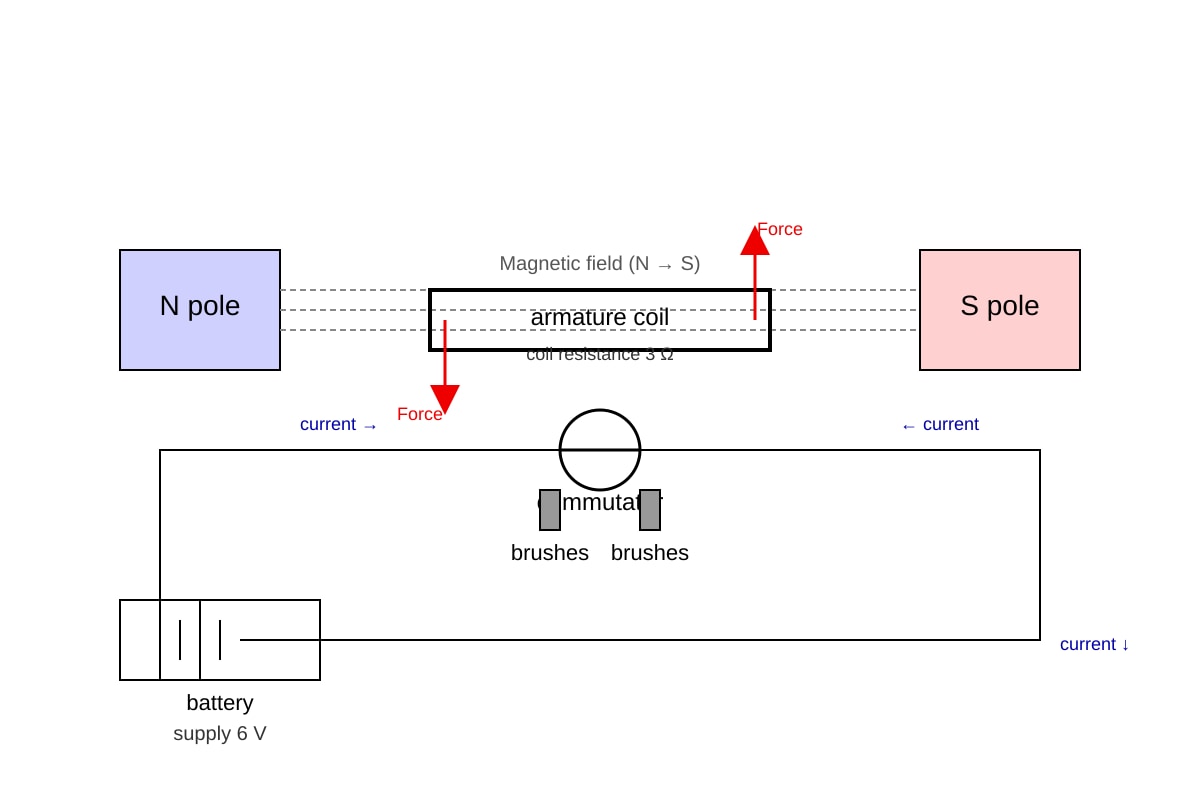
18. [3 marks] The diagram shows a simple d.c. motor.
Image pending generation: diagram for 18.
(a) State the purpose of the split-ring commutator. [1] (b) Explain why the coil rotates continuously. [2]
(a) _______________________________________________________
(b) _______________________________________________________
19. [3 marks] A transformer is not 100% efficient. List two energy losses that reduce its efficiency and state one way to reduce each.
- ___________________________ Reduce by: ___________________________
20. [4 marks] A transmission line carries P=5000 W at 250 V over 2.0 Ω resistance. (a) Calculate the current. [1] (b) Calculate power loss as heat. [2] (c) State one reason why high voltage is used for long-distance transmission. [1]
(a) _______________________ A
(b) Working: _______________________________________________
(c) _______________________________________________________
Answers
Secondary 4 Pure Physics Quiz - Electricity Magnetism (Answer Key)
Total Marks: 40
Topic: Electricity & Magnetism
Note: Content generated from LLM-inferred Stage 4 templates; not claimed as past-year extracted.
Section A
1. [1 mark]
Answer: The neutral wire provides the return path for current to the supply and is at approximately zero potential.
Teaching note: In an AC household circuit, the live wire brings current in, the neutral returns it. Neutral is kept near 0 V by the supply.
2. [1 mark]
Answer: A circuit breaker can be reset and reused; a fuse must be replaced after blowing. (Or: faster response to overcurrent.)
Teaching note: Circuit breakers trip mechanically and can be switched on again; fuses melt and need replacement.
3. [1 mark]
Answer: The galvanometer needle deflects momentarily in the opposite direction to when the magnet approached.
Teaching note: Removing the magnet changes flux; induced EMF drives current briefly (Lenz’s law).
4. [1 mark]
Answer: Tesla (T).
Teaching note: Magnetic flux density B is measured in tesla, where 1 T=1 N A−1m−1.
5. [1 mark]
Answer: Step-up transformer.
Teaching note: Ns>Np so Vs>Vp; secondary voltage is increased.
Section B
6. [2 marks]
η=VpIpVsIs⇒Ip=ηVpVsIs
Ip=0.80×2412×2.0=19.224=1.25 A
Answer: 1.25 A
Marking: 1 for correct formula, 1 for answer with unit.
7. [2 marks]
Ideal: NsNp=IpIs⇒Is=IpNsNp=5.0×25050=1.0 A
Answer: 1.0 A
Marking: 1 formula, 1 answer.
8. [2 marks]
Ptot=2000+1500+800=4300 W
I=P/V=4300/230=18.7 A
Answer: 18.7 A
Marking: 1 total power, 1 current.
9. [2 marks]
Yes, the fuse will blow because 18.7 A > 13 A.
Marking: 1 correct comparison, 1 reason.
10. [3 marks]
ΔΦ=BA=0.05×10×10−4=5×10⁻⁵ Wb
EMF=NΔtΔΦ=200×0.105×10−5=0.10 V
Answer: 0.10 V
Marking: 1 area conversion, 1 flux change, 1 EMF.
11. [2 marks]
F=BIL=0.20×3.0×0.15=0.090 N
Answer: 0.090 N
Marking: 1 formula, 1 answer.
12. [2 marks]
VsVp=NsNp⇒Vs=240×12030=60 V
Answer: 60 V
13. [3 marks]
Net voltage = 12−7.0=5.0 V
I=V/R=5.0/4.0=1.25 A
Answer: 1.25 A
Marking: 1 back EMF concept, 1 calc, 1 unit.
14. [2 marks]
H=NI/L=(400×2.0)/0.20=4000 A/m
Answer: 4000 A/m
15. [3 marks]
ω=NBAEmax=150×0.30×0.0218=0.9018=20 rad/s
Answer: 20 rad/s
Section C
16. [3 marks]
(a) Induced EMF is proportional to rate of change of magnetic flux. [1]
(b) Deflects opposite to original direction. [1]
(c) Lenz’s law: induced current opposes change; reversing magnet reverses flux change direction. [1]
17. [4 marks]
(a) I=(3000+2000+1000)/230=6000/230=26.1 A [2]
(b) No trip (26.1 < 30). [1]
(c) Use separate circuits or lower-power appliances. [1]
18. [3 marks]
(a) Reverses current direction every half-turn to keep torque one-way. [1]
(b) Current in field experiences force; commutator flips current so coil keeps turning. [2]
19. [3 marks]
- Heating (copper loss) – use thicker wire.
- Eddy currents – use laminated core.
20. [4 marks]
(a) I=P/V=5000/250=20 A [1]
(b) Ploss=I2R=202×2.0=800 W [2]
(c) High voltage lowers current, reducing I2R loss. [1]
Free quiz and exam paper access
Enter your details to view this paper
Your access is remembered on this device.