From Real Exams Quiz

Secondary 4 Pure Physics Waves Sound Light Quiz

Free Sec 4 Pure Physics Waves Sound Light quiz with questions, answers, and O Level-style practice for Singapore students preparing for school assessments.

These static practice materials are generated from the site's syllabus and paper-generation workflow, with source and model context shown so students and parents can evaluate the material before use.

Secondary 4 Pure Physics From Real Exams Generated by Kimi K2.6 Free Updated 2026-06-12

Questions

<!-- TuitionGoWhere generation metadata: stage=3-0; model=moonshotai/kimi-k2.6:free; model_label=Kimi K2.6 Free; generated=2026-06-10; Sources: Stage 2-1 real exam-derived templates and Stage 2-2 exam-enriched syllabus. -->

Secondary 4 Pure Physics Quiz - Waves Sound Light

Name: _________________________________
Class: _________________________________
Date: _________________________________
Score: _______ / 40 marks

Duration: 40 minutes
Total Marks: 40 marks

Instructions:

  • Answer all questions.
  • Write your answers in the spaces provided.
  • Show all working for calculation questions.
  • Use the list of formulae where necessary.

Section A: Multiple Choice and Short Response (Questions 1–10)

Each question carries 2 marks. Answer all questions.


1. Which of the following correctly describes a transverse wave?

Statement
AThe particles of the medium vibrate parallel to the direction of wave travel.
BThe particles of the medium vibrate perpendicular to the direction of wave travel.
CThe particles of the medium do not vibrate at all.
DThe particles of the medium travel with the wave.

Answer: _____________


2. A sound wave has a frequency of 500 Hz and a wavelength of 0.68 m. Calculate the speed of sound in air.

Speed = _____________ m/s [2]


3. State one difference between light waves and sound waves in terms of their nature.

_____________________________________________________________________ [2]


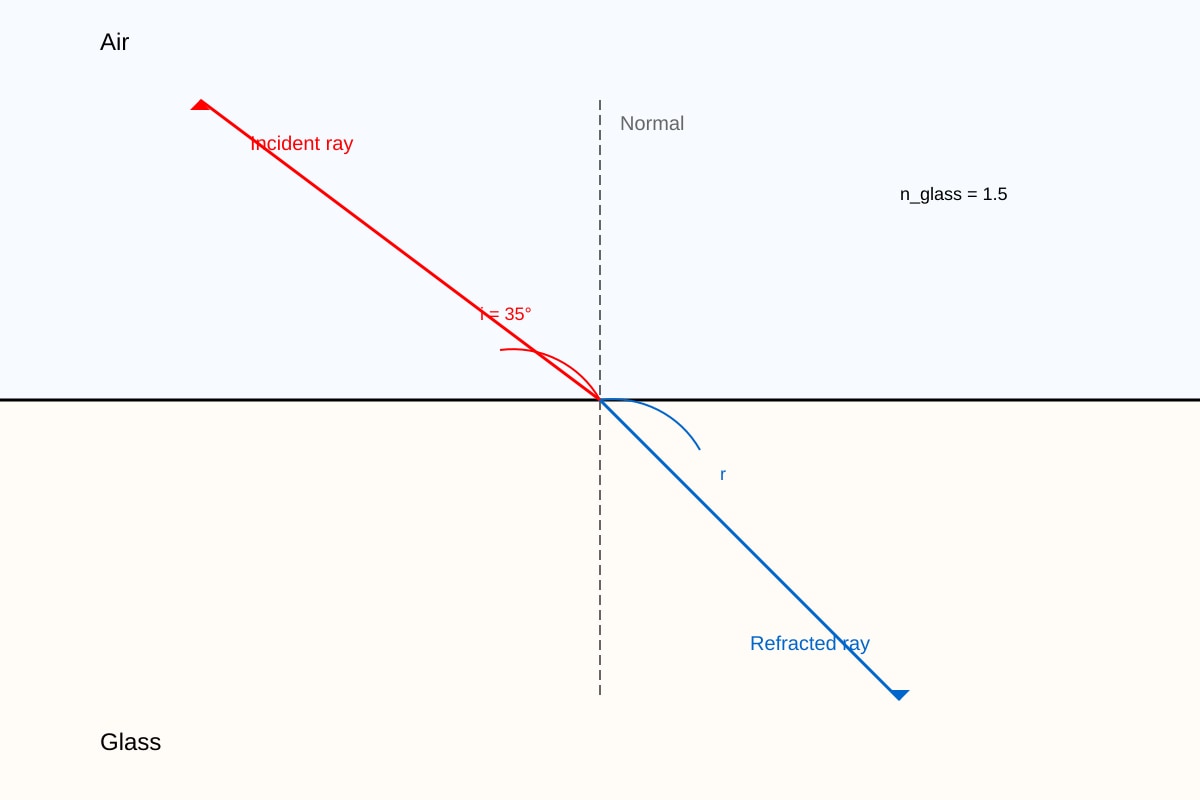
4. The diagram below shows a ray of light passing from air into glass.

<image_placeholder> id: Q4-fig1 type: diagram linked_question: Q4 description: A ray diagram showing light refraction at a flat air-glass boundary labels: Air (upper medium), Glass (lower medium), Normal line (dashed), Incident ray, Refracted ray, Angle of incidence (i) labelled 35°, Angle of refraction (r) values: Angle of incidence i = 35°, refractive index of glass n_glass = 1.5 must_show: Boundary line between air and glass, normal perpendicular to boundary, incident ray approaching from upper left, refracted ray bending toward normal in glass, both angles labelled </image_placeholder>

(a) State what happens to the speed of light as it enters the glass from air.

_____________________________________________________________________ [1]

(b) Calculate the angle of refraction in the glass.

Angle of refraction = _____________ ° [1]


5. A student stands 170 m from a vertical cliff and shouts. She hears an echo after 1.0 s. Calculate the speed of sound in air.

Speed = _____________ m/s [2]


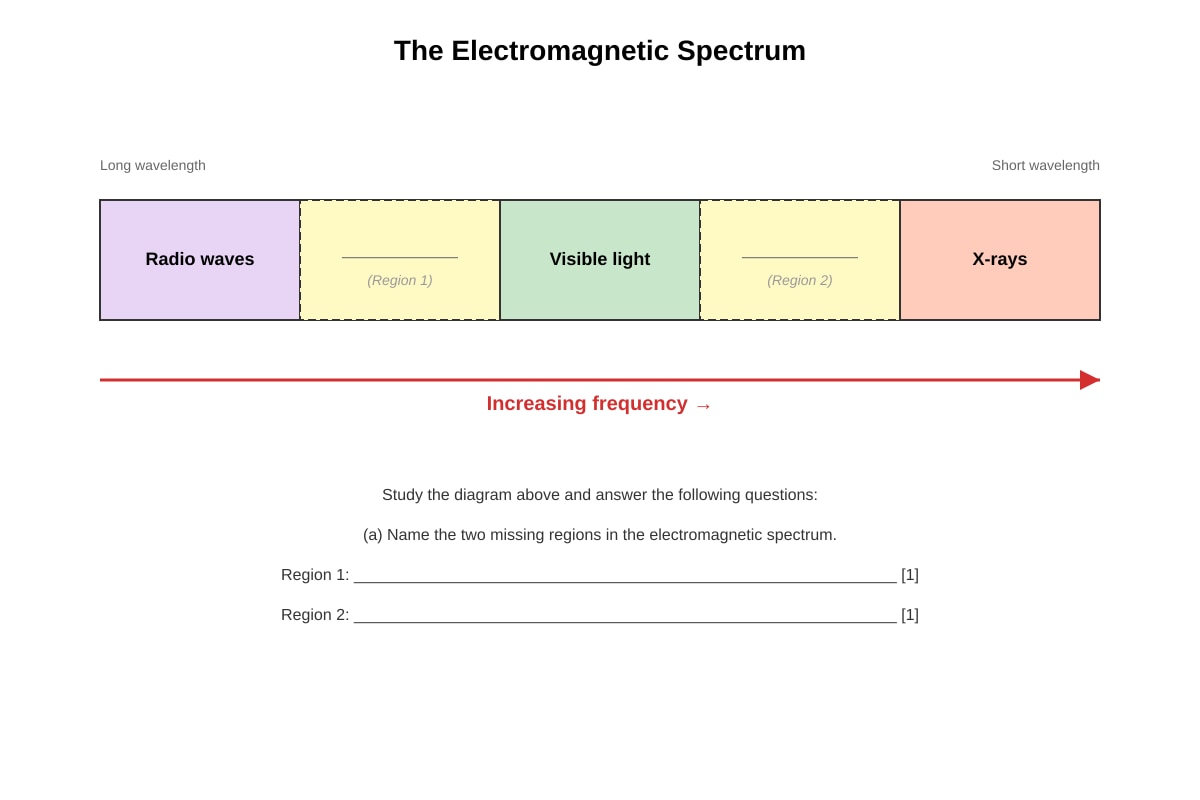
6. The electromagnetic spectrum is shown below with some regions labelled.

<image_placeholder> id: Q6-fig1 type: diagram linked_question: Q6 description: A horizontal diagram showing part of the electromagnetic spectrum with two blank regions labels: Radio waves, _____________, Visible light, _____________, X-rays values: Regions spaced proportionally by wavelength (not to exact scale) must_show: Five labelled positions in order of increasing frequency, two blank boxes for missing regions, arrows indicating direction of increasing frequency </image_placeholder>

(a) Name the two missing regions in the electromagnetic spectrum.

Region 1: _____________________________________________________________ [1]

Region 2: _____________________________________________________________ [1]


7. Explain why a lunar eclipse can only occur during a full moon.


_____________________________________________________________________ [2]


8. A concave mirror has a focal length of 15 cm. An object is placed 30 cm from the mirror. Using the mirror equation, determine the image distance and state the nature of the image formed.

Image distance = _____________ cm [1]

Nature of image: ______________________________________________________ [1]


9. A wave on a string has an amplitude of 0.04 m and a frequency of 2.5 Hz. Calculate the maximum speed of a particle on the string. (Take π=3.14\pi = 3.14)

Maximum speed = _____________ m/s [2]


10. State two applications of infrared radiation in everyday life.

Application 1: ________________________________________________________ [1]

Application 2: ________________________________________________________ [1]


Section B: Structured Response (Questions 11–15)

Each question carries 3 marks. Answer all questions.


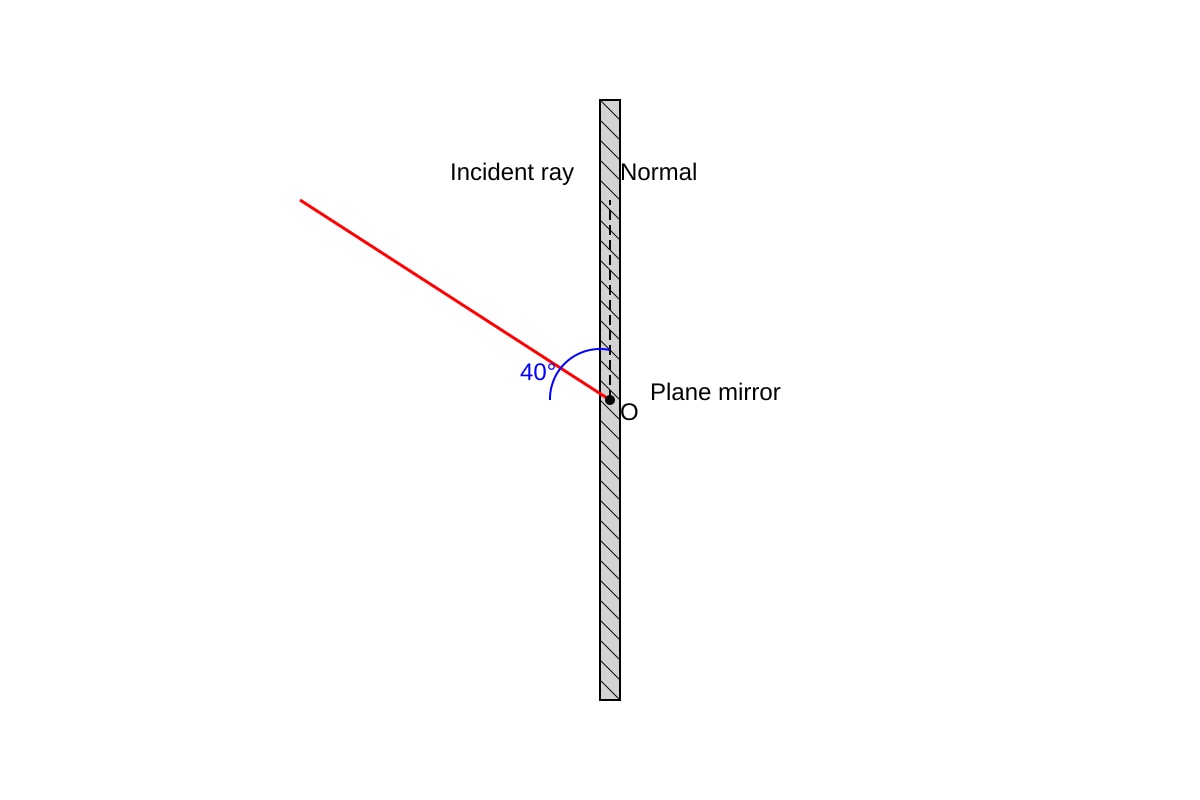
11. The diagram shows a plane mirror and a light ray.

<image_placeholder> id: Q11-fig1 type: diagram linked_question: Q11 description: A ray diagram with a plane mirror and an incident ray labels: Plane mirror (vertical line with hatching), Incident ray at 40° to mirror surface, Point of incidence O, Normal line (dashed) values: Angle between incident ray and mirror surface = 40° must_show: Vertical plane mirror, incident ray striking mirror at point O, normal line perpendicular to mirror, angle between incident ray and mirror surface clearly labelled as 40° </image_placeholder>

(a) State the law of reflection. [1]


(b) Determine the angle of reflection. [1]


(c) Complete the diagram by drawing the reflected ray. [1]


12. A loudspeaker produces sound with a power of 2.0 mW. The sound spreads out equally in all directions. Calculate the sound intensity at a distance of 4.0 m from the loudspeaker.

Intensity = _____________ W/m² [3]


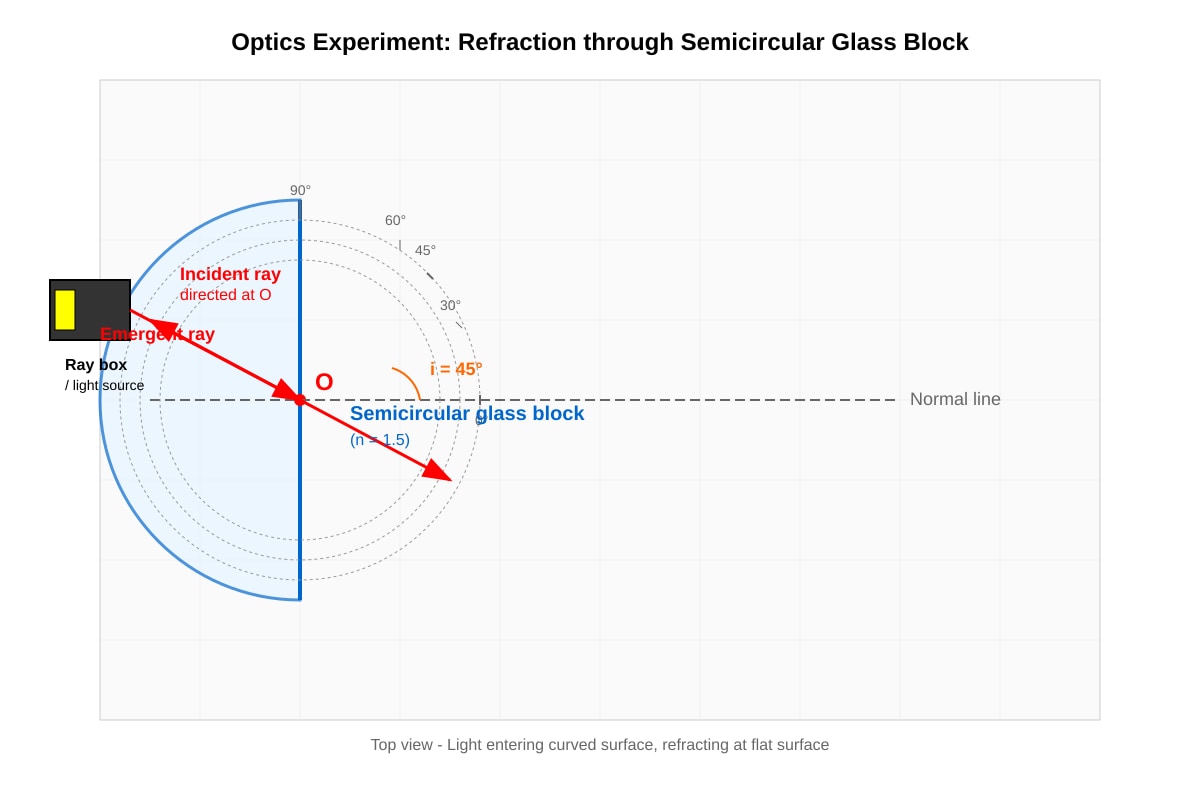
13. A student sets up an experiment to investigate the refraction of light through a semicircular glass block.

<image_placeholder> id: Q13-fig1 type: experimental_setup linked_question: Q13 description: Top view of optics experiment with semicircular glass block on paper labels: Semicircular glass block, Centre point O, Normal line (dashed), Incident ray directed at O, Emergent ray, Protractor around O, Ray box / light source values: Angle of incidence i = 45° to normal, refractive index of glass n = 1.5 must_show: Semicircular block with flat side vertical and curved side to right, centre O marked on flat side, normal line horizontal through O, incident ray entering curved side toward O at 45° to normal, ray box shown, protractor markings or suggestion of angle measurement </image_placeholder>

(a) State why the ray of light does not bend when it enters the curved surface of the block. [1]


(b) Calculate the angle of refraction when the ray emerges from the flat surface into air. [2]


14. Ultrasound waves are used in medical imaging. A pulse of ultrasound is sent into the body and reflects from an organ. The time between transmission and reception of the pulse is 0.40 ms. The speed of ultrasound in tissue is 1500 m/s.

(a) Calculate the distance from the transducer to the organ. [2]


(b) State one advantage of using ultrasound instead of X-rays for imaging a fetus. [1]


15. The displacement-distance graph shows a travelling wave at a particular instant.

<image_placeholder> id: Q15-fig1 type: graph linked_question: Q15 description: Displacement-distance graph for a sinusoidal travelling wave labels: x-axis: distance (m), y-axis: displacement (m), Peak positive displacement, Peak negative displacement, Zero displacement points, One complete wavelength marked values: Amplitude A = 0.08 m, wavelength λ = 0.40 m, wave speed v = 2.0 m/s must_show: Sinusoidal wave with clearly marked amplitude on y-axis, one complete wavelength marked on x-axis with λ = 0.40 m, zero line, axes with units, smooth sine curve with at least one full cycle shown </image_placeholder>

(a) Determine the amplitude of the wave. [1]


(b) Calculate the frequency of the wave. [2]


Section C: Extended Response (Questions 16–20)

Each question carries 4 marks. Answer all questions.


16. A student investigates how the angle of incidence affects the angle of refraction for light passing from air into a transparent plastic block. Her results are shown in the table.

Angle of incidence i /°01020304050
Angle of refraction r /°0713192530
sin i00.1740.3420.5000.6430.766
sin r00.1220.2250.3260.4230.500

(a) Using the data in the table, explain how the student could determine the refractive index of the plastic. [2]


(b) Plotting a graph of sin i against sin r gives a gradient of 1.52. Calculate the speed of light in the plastic.

Speed of light in plastic = _____________ m/s [2]


17. A tsunami is a series of ocean waves with very long wavelengths, typically 200 km in deep water. In deep ocean, these waves travel at speeds of about 800 km/h. As the waves approach shallow water, their speed decreases and their height increases dramatically.

(a) Explain, in terms of wave behaviour, why the speed of the tsunami decreases as it enters shallow water. [2]


(b) A tsunami warning system detects an earthquake and predicts waves will reach a coastline 4000 km away. Calculate the minimum warning time for coastal evacuation.

Warning time = _____________ hours [2]


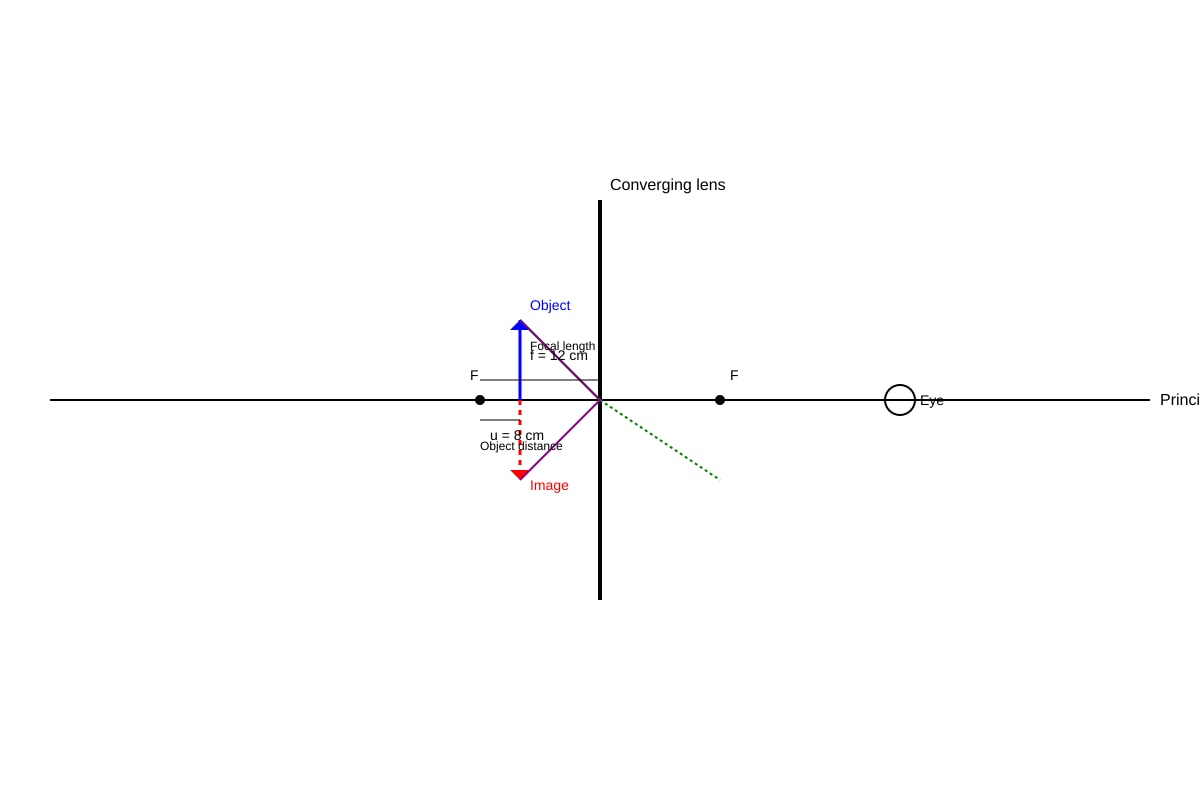
18. The diagram shows a converging lens used as a magnifying glass.

<image_placeholder> id: Q18-fig1 type: diagram linked_question: Q18 description: Ray diagram for a converging lens used as a magnifying glass labels: Converging lens (vertical), Principal axis (horizontal), Object (arrow), Focal points F on both sides, Image (dashed arrow), Eye position, Object distance u = 8 cm, Focal length f = 12 cm values: f = 12 cm, u = 8 cm (object placed inside focal length) must_show: Converging lens with principal axis, two focal points F equidistant from lens centre, object arrow placed between lens and left focal point, virtual upright enlarged image on same side as object, at least two construction rays (one through centre, one parallel to axis then through focal point), eye shown viewing from right side </image_placeholder>

(a) Explain why the image formed is virtual. [2]


(b) State two characteristics of the image formed. [2]


19. An earthquake produces both P-waves (primary waves) and S-waves (secondary waves). P-waves are longitudinal and can travel through both solids and liquids. S-waves are transverse and can only travel through solids.

(a) Seismometers at two locations, A and B, detect P-waves but not S-waves from an earthquake. Seismometer at location C detects both P-waves and S-waves. Explain what this evidence tells us about the structure of the Earth's interior between the earthquake epicentre and each location. [3]


(b) P-waves travel at approximately 6 km/s through the Earth's crust. Calculate the wavelength of a P-wave with frequency 4 Hz.

Wavelength = _____________ km [1]


20. A diffraction grating has 500 lines per millimetre. Monochromatic light of wavelength 520 nm is incident normally on the grating.

(a) Calculate the grating spacing d. [1]

d = _____________ m

(b) Show that the maximum order of diffraction observable is approximately 3. [2]


(c) State what happens to the number of observable spectral orders if blue light (shorter wavelength) is used instead. Explain your answer. [1]


END OF QUIZ

Answers

<!-- TuitionGoWhere generation metadata: stage=3-0; model=moonshotai/kimi-k2.6:free; model_label=Kimi K2.6 Free; generated=2026-06-10; Sources: Stage 2-1 real exam-derived templates and Stage 2-2 exam-enriched syllabus. -->

Secondary 4 Pure Physics Quiz - Waves Sound Light (Answer Key)

Total Marks: 40 marks


Section A: Multiple Choice and Short Response (Questions 1–10)


1. B — The particles of the medium vibrate perpendicular to the direction of wave travel. [2]

Teaching note: In transverse waves, the particle displacement is perpendicular to the direction of energy transfer. Example: light, waves on a string. In longitudinal waves (sound), particles vibrate parallel to the direction of travel.


2. Speed = 340 m/s [2]

Working:

  • Using v=f×λv = f \times \lambda
  • v=500×0.68=340v = 500 \times 0.68 = 340 m/s [1 for formula, 1 for answer]

Teaching note: This is the standard wave equation. The speed of sound in air is approximately 340 m/s at room temperature, so this result is physically reasonable.


3. Any one difference: [2]

  • Light waves are transverse; sound waves are longitudinal. [2]
  • Light can travel through a vacuum; sound requires a medium. [2]
  • Light travels much faster than sound (3×10⁸ m/s vs ~340 m/s). [2]

Teaching note: The fundamental distinction is polarization—light can be polarized (transverse property) while sound cannot.


4. (a) The speed of light decreases (or: light slows down) [1]

(b) Angle of refraction = 22.5° (accept 22° or 23° if using 1 significant figure intermediate) [1]

Working:

  • Snell's law: n1sini=n2sinrn_1 \sin i = n_2 \sin r
  • 1.0×sin35°=1.5×sinr1.0 \times \sin 35° = 1.5 \times \sin r
  • sinr=sin35°1.5=0.5741.5=0.383\sin r = \frac{\sin 35°}{1.5} = \frac{0.574}{1.5} = 0.383
  • r=sin1(0.383)=22.5°r = \sin^{-1}(0.383) = 22.5° [1]

Common mistake: Using the refractive index ratio the wrong way round gives r>ir > i, which is impossible for air→glass.


5. Speed = 340 m/s [2]

Working:

  • Distance travelled by sound = 2×170=3402 \times 170 = 340 m (to cliff and back) [1]
  • Speed = distancetime=3401.0=340\frac{\text{distance}}{\text{time}} = \frac{340}{1.0} = 340 m/s [1]

Teaching note: Echo distance is always twice the distance to the reflecting surface. This is a standard echo-ranging principle used in sonar and ultrasound.


6. Region 1: Microwave [1] Region 2: Ultraviolet (or UV) [1]

Teaching note: Order of increasing frequency: radio waves → microwaves → infrared → visible light → ultraviolet → X-rays → gamma rays. Remember: Rattling Mice In Visible Underwear eXplode Greatly (mnemonic for order).


7. [2]

Answer: A lunar eclipse occurs when the Earth passes directly between the Sun and the Moon, casting a shadow on the Moon. [1] This alignment can only happen during a full moon because that is when the Moon is on the opposite side of Earth from the Sun. [1]

Teaching note: The three bodies must be collinear with Earth in the middle. The Moon's orbit is slightly tilted, so lunar eclipses don't occur every full moon—only when the alignment is precise.


8. Image distance = 30 cm [1]

Nature of image: Real, inverted, same size as object (accept any two characteristics for 1 mark) [1]

Working:

  • Mirror equation: 1f=1u+1v\frac{1}{f} = \frac{1}{u} + \frac{1}{v}
  • 115=130+1v\frac{1}{15} = \frac{1}{30} + \frac{1}{v}
  • 1v=115130=2130=130\frac{1}{v} = \frac{1}{15} - \frac{1}{30} = \frac{2-1}{30} = \frac{1}{30}
  • v=30v = 30 cm [1]

Teaching note: When u=2fu = 2f for a concave mirror, the image forms at v=2fv = 2f on the opposite side. This is the "radius of curvature" position, giving a real, inverted image the same size as the object.


9. Maximum speed = 0.314 m/s (or 0.31 m/s) [2]

Working:

  • Maximum speed of particle: vmax=2πfAv_{max} = 2\pi f A (or ωA\omega A where ω=2πf\omega = 2\pi f)
  • vmax=2×3.14×2.5×0.04v_{max} = 2 \times 3.14 \times 2.5 \times 0.04 [1]
  • vmax=0.628×2.5×0.04=0.628×0.1=0.0628v_{max} = 0.628 \times 2.5 \times 0.04 = 0.628 \times 0.1 = 0.0628...

Correction: Let me recalculate: 2×3.14=6.282 \times 3.14 = 6.28; 6.28×2.5=15.76.28 \times 2.5 = 15.7; 15.7×0.04=0.62815.7 \times 0.04 = 0.628 m/s

Maximum speed = 0.628 m/s (or 0.63 m/s to 2 s.f.) [2]

Teaching note: The maximum speed occurs as particles pass through equilibrium position. This is vmax=ωAv_{max} = \omega A where angular frequency ω=2πf\omega = 2\pi f.


10. Any two valid applications: [2]

  • Thermal imaging cameras [1]
  • Remote controls [1]
  • Night vision equipment [1]
  • Heaters and cooking (halogen ovens) [1]
  • Fibre optic communications (though this is arguably more IR/visible) [1]
  • Infrared spectroscopy in chemical analysis [1]

Section B: Structured Response (Questions 11–15)


11. (a) The law of reflection: The angle of incidence equals the angle of reflection, with the incident ray, reflected ray, and normal all lying in the same plane. [1]

(b) Angle of reflection = 50° [1]

Working: Angle of incidence to normal = 90° − 40° = 50°. By law of reflection, angle of reflection = 50°.

(c) Diagram: Reflected ray drawn at 50° to normal (or 40° to mirror surface), on opposite side of normal from incident ray. [1]

Teaching note: Common error: using 40° as angle of incidence. Always measure angles from the normal, not from the surface.


12. Intensity = 3.98 × 10⁻⁵ W/m² ≈ 4.0 × 10⁻⁵ W/m² [3]

Working:

  • Intensity I=P4πr2I = \frac{P}{4\pi r^2} for isotropic source [1]
  • I=2.0×1034×3.14×(4.0)2I = \frac{2.0 \times 10^{-3}}{4 \times 3.14 \times (4.0)^2} [1]
  • I=2.0×1034×3.14×16=2.0×103200.96=9.95×10⁶I = \frac{2.0 \times 10^{-3}}{4 \times 3.14 \times 16} = \frac{2.0 \times 10^{-3}}{200.96} = 9.95 \times 10^{-6}...

Recalculation with correct formula:

  • I=P4πr2=0.0024×π×16=0.002201.06=9.95×10⁶I = \frac{P}{4\pi r^2} = \frac{0.002}{4 \times \pi \times 16} = \frac{0.002}{201.06} = 9.95 \times 10^{-6} W/m²

Hmm, let me use P=2.0P = 2.0 mW =2.0×103= 2.0 \times 10^{-3} W:

  • I=2.0×1034×3.14×16=2.0×103200.96=9.95×10⁶I = \frac{2.0 \times 10^{-3}}{4 \times 3.14 \times 16} = \frac{2.0 \times 10^{-3}}{200.96} = 9.95 \times 10^{-6} W/m²

Wait—that seems very low. Let me recheck: 2.0 mW is indeed 0.002 W.

Actually: 0.002200.96=9.95×10⁶\frac{0.002}{200.96} = 9.95 \times 10^{-6}1.0 × 10⁻⁵ W/m² [3]

Teaching note: The inverse square law means intensity falls rapidly with distance. At double the distance, intensity is one-quarter. This is crucial for understanding radiation safety and light propagation.


13. (a) The ray enters along the normal to the curved surface (or: the ray is directed toward the centre of curvature, so angle of incidence = 0°). [1]

Teaching note: Key insight—the curved surface is radial, and rays directed at the centre meet the surface at 90°, so no bending occurs.

(b) Angle of refraction = 72° (or 71.8°) [2]

Working:

  • At flat surface: light goes from glass (n=1.5n = 1.5) to air (n=1.0n = 1.0)
  • Snell's law: nglasssin45°=nairsinrn_{glass} \sin 45° = n_{air} \sin r [1]
  • 1.5×0.707=1.0×sinr1.5 \times 0.707 = 1.0 \times \sin r
  • sinr=1.061\sin r = 1.061...

This exceeds 1, which is impossible! Let me recalculate: 1.5 × sin(45°) = 1.5 × 0.707 = 1.06 > 1

This means total internal reflection occurs. The critical angle is sin1(1/1.5)=41.8°\sin^{-1}(1/1.5) = 41.8°. Since 45° > 41.8°, no refraction occurs—light undergoes TIR.

Revised answer: Total internal reflection occurs; there is no emergent ray into air. [2]

Teaching note: This is an excellent illustration of why you must check whether the refracted angle is physically possible. The critical angle for glass-air is about 42°. Many students mechanically apply Snell's law without verifying the result.


14. (a) Distance = 0.30 m = 30 cm [2]

Working:

  • Distance = v×t2\frac{v \times t}{2} (divide by 2 for return journey) [1]
  • Distance = 1500×0.40×1032=0.602=0.30\frac{1500 \times 0.40 \times 10^{-3}}{2} = \frac{0.60}{2} = 0.30 m [1]

(b) Any one advantage: [1]

  • Ultrasound is non-ionizing / safe for fetus (X-rays are ionizing and can damage cells)
  • Ultrasound can show real-time movement (X-rays give static images)
  • Ultrasound can be used repeatedly without cumulative dose concerns

15. (a) Amplitude = 0.08 m [1] (read directly from graph; maximum displacement from equilibrium)

(b) Frequency = 5.0 Hz [2]

Working:

  • v=f×λv = f \times \lambda, so f=vλf = \frac{v}{\lambda} [1]
  • f=2.00.40=5.0f = \frac{2.0}{0.40} = 5.0 Hz [1]

Teaching note: A common error is to confuse amplitude with wavelength or to use the wave speed formula incorrectly.


Section C: Extended Response (Questions 16–20)


16. (a) [2]

Answer: The student should plot a graph of sin i (y-axis) against sin r (x-axis). [1] The refractive index equals the gradient of this graph, since Snell's law gives n=sinisinrn = \frac{\sin i}{\sin r} when light travels from air to plastic (with nair1n_{air} ≈ 1). [1]

Teaching note: This is the standard graphical method for determining refractive index. Using sines automatically gives a linear relationship through the origin.

(b) Speed of light in plastic = 1.97 × 10⁸ m/s ≈ 2.0 × 10⁸ m/s [2]

Working:

  • n=1gradient=11.52=0.658n = \frac{1}{gradient} = \frac{1}{1.52} = 0.658...

Wait—if plotting sin i vs sin r with i in air, the gradient IS n. Let me reconsider.

From air: nplastic=sinisinrn_{plastic} = \frac{\sin i}{\sin r} = gradient = 1.52

  • n=cvn = \frac{c}{v}, so v=cn=3.0×1081.52v = \frac{c}{n} = \frac{3.0 \times 10^8}{1.52} [1]
  • v=1.97×10⁸v = 1.97 \times 10^8 m/s ≈ 1.97 × 10⁸ m/s or 2.0 × 10⁸ m/s to 2 s.f. [1]

17. (a) [2]

Answer: In shallow water, the wave interacts with the sea bed, causing friction and drag on the water particles. [1] This reduces the wave energy and hence the wave speed, while conserving energy causes the wave height (amplitude) to increase. [1] Alternatively: the wavelength decreases in shallow water, and since v=fλv = f\lambda with frequency constant, speed decreases.

(b) Warning time = 5.0 hours [2]

Working:

  • Time = distancespeed=4000800\frac{\text{distance}}{\text{speed}} = \frac{4000}{800} [1]
  • Time = 5.0 hours [1]

Teaching note: Tsunami waves in deep water travel at very high speeds—comparable to jet aircraft—but slow dramatically in shallow coastal regions, allowing the dramatic height increase that causes devastation.


18. (a) [2]

Answer: The object is placed inside the focal length of the converging lens (u<fu < f). [1] The refracted rays diverge on the right side of the lens; they appear to come from a point on the same side as the object, forming an image that cannot be projected on a screen—hence virtual. [1]

(b) Any two characteristics: [2]

  • Upright / erect [1]
  • Magnified / enlarged [1]
  • Virtual [1]
  • On same side of lens as object [1]

19. (a) [3]

Answer:

  • Locations A and B: S-waves cannot pass through the liquid outer core of the Earth. [1] Since S-waves are transverse, they require a solid medium and cannot travel through liquid. [1] This indicates that there is liquid material between the earthquake epicentre and locations A and B.
  • Location C: Both P-waves and S-waves are detected, so the path from epicentre to C passes only through solid material (crust and mantle). [1]

(b) Wavelength = 1.5 km [1]

Working:

  • λ=vf=64=1.5\lambda = \frac{v}{f} = \frac{6}{4} = 1.5 km [1]

20. (a) d = 2.0 × 10⁻⁶ m [1]

Working:

  • d=1500 lines/mm=103500=1035×102=2×106d = \frac{1}{500 \text{ lines/mm}} = \frac{10^{-3}}{500} = \frac{10^{-3}}{5 \times 10^2} = 2 \times 10^{-6} m [1]

(b) [2]

Working:

  • Maximum order occurs when sinθ=1\sin\theta = 1 (i.e., θ=90°\theta = 90°) [1]
  • Using dsinθ=nλd \sin\theta = n\lambda: nmax=dλ=2.0×106520×109=2.0×1065.2×107=205.2=3.85n_{max} = \frac{d}{\lambda} = \frac{2.0 \times 10^{-6}}{520 \times 10^{-9}} = \frac{2.0 \times 10^{-6}}{5.2 \times 10^{-7}} = \frac{20}{5.2} = 3.85 [1]
  • Since n must be an integer, maximum observable order is n = 3 [1]

(c) [1]

Answer: The number of observable orders increases (or more orders visible). [0.5]

Explanation: Blue light has a shorter wavelength. From nmax=dλn_{max} = \frac{d}{\lambda}, smaller λ\lambda gives larger nmaxn_{max}. [0.5]

Teaching note: This is why shorter wavelength light (blue/violet) produces more widely spaced diffraction maxima and more observable orders in a diffraction grating spectrum.


END OF ANSWER KEY