From Real Exams Quiz
Secondary 4 Pure Physics Waves Sound Light Quiz
Free Sec 4 Pure Physics Waves Sound Light quiz, HY3 Exam version, with questions, answers, and O Level-style practice for Singapore students.
These static practice materials are generated from the site's syllabus and paper-generation workflow, with source and model context shown so students and parents can evaluate the material before use.
Questions
Secondary 4 Pure Physics Quiz - Waves Sound Light
Name: ______________________
Class: _________
Date: ___________
Score: _______ / 40
Duration: 60 minutes
Total Marks: 40
Instructions:
- Answer all 20 questions.
- Show your working clearly where calculations are required.
- Use the spaces provided for your answers.
- Section A: Short answer (1-5). Section B: Structured questions (6-15). Section C: Data and diagram interpretation (16-20).
Section A: Short Answer (1–5)
1. State what is meant by a transverse wave. [1]
2. A sound wave of frequency 512 Hz travels in air at 340 m s−1. Calculate its wavelength. [2]
3. State one property of light that shows it behaves as a wave. [1]
4. Explain why sound cannot travel through a vacuum. [2]
5. A ray of light enters glass from air at an angle of incidence 40∘. State whether the ray bends towards or away from the normal. [1]
Section B: Structured Questions (6–15)
6. A student plucks a string of length 0.80 m fixed at both ends. The wave speed on the string is 320 m s−1.
(a) Calculate the wavelength of the fundamental mode. [1]
(b) Hence calculate the fundamental frequency. [2]
7. (a) Define refraction. [1]
(b) State Snell’s law in words. [1]
(c) Light passes from air (n=1.00) to water (n=1.33) with angle of incidence 30∘. Calculate the angle of refraction. [2]
8. A bat emits an ultrasonic pulse of frequency 40 kHz. The pulse reflects from a wall and returns to the bat 0.020 s later. Speed of sound in air is 340 m s−1.
(a) Calculate the distance of the wall from the bat. [2]
(b) State one reason why bats use ultrasound rather than audible sound for echolocation. [1]
9. (a) What is the electromagnetic spectrum? [1]
(b) Name the region of the electromagnetic spectrum used in remote controls. [1]
(c) State one difference between X-rays and radio waves. [1]
10. A ripple tank shows two coherent sources producing interference.
(a) State the condition for constructive interference. [1]
(b) The two sources are 4.0 cm apart and produce maxima 2.0 cm apart on a screen 20 cm away. Wavelength is 0.40 cm. Calculate the fringe spacing using λ=Dax and verify. [2]
11. A convex lens of focal length 10 cm forms an image of an object placed 15 cm from the lens.
(a) Use the lens equation f1=u1+v1 to calculate the image distance v. [2]
(b) State whether the image is real or virtual. [1]
12. (a) State the speed of light in a vacuum. [1]
(b) Calculate the refractive index of a material in which light travels at 2.0×10⁸ m s−1. [2]
13. A guitar string has a fundamental frequency of 196 Hz.
(a) State what happens to the frequency if the tension is increased. [1]
(b) The string length is halved while tension stays constant. Calculate the new fundamental frequency. [2]
14. (a) Explain how a prism disperses white light. [2]
(b) State the colour with the longest wavelength in visible light. [1]
15. A ship sends a sonar pulse to the seabed 150 m below. Speed of sound in water is 1500 m s−1.
(a) Calculate the time taken for the pulse to reach the seabed. [2]
(b) Calculate the total time for the echo to return. [1]
Section C: Data and Diagram Interpretation (16–20)
16. The diagram below shows a wave profile at a certain instant.
Image pending generation: graph for Q16.
(a) Determine the amplitude from the graph. [1]
(b) Determine the period. [1]
(c) Calculate the frequency. [1]
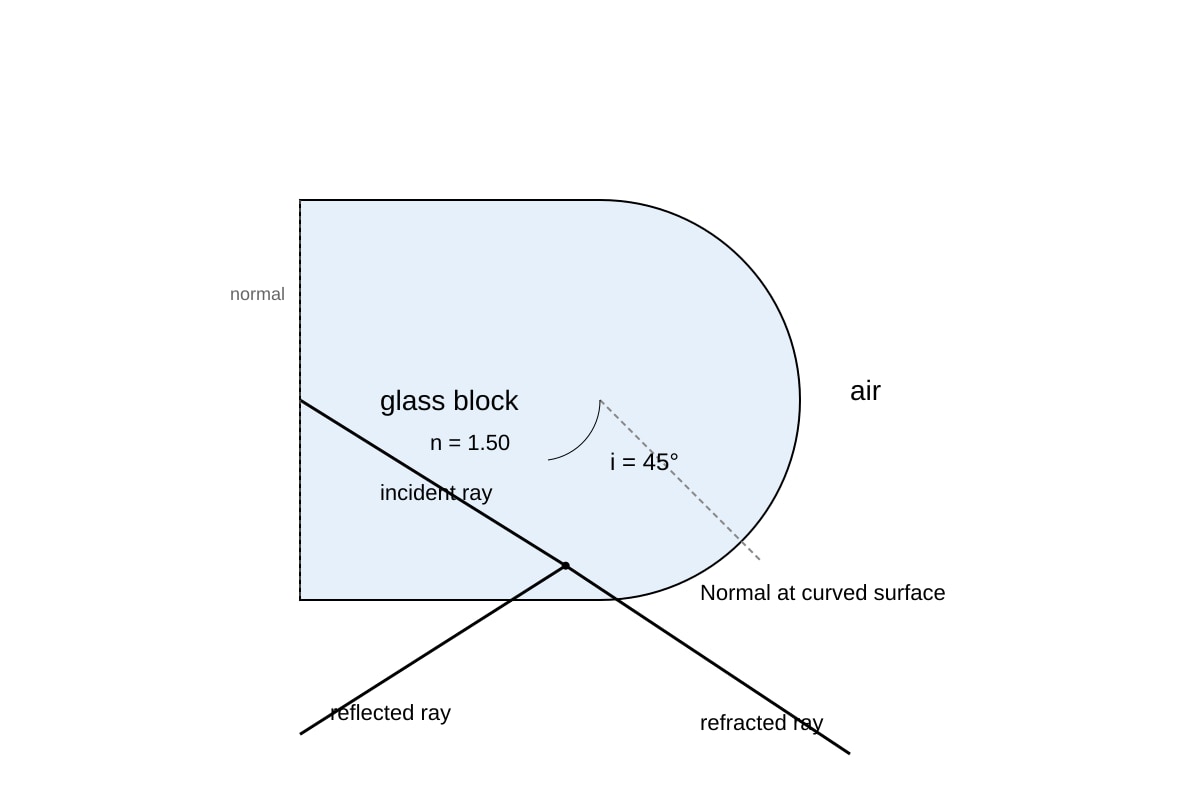
17. The diagram shows a ray of light passing through a semicircular glass block.
Image pending generation: diagram for Q17.
(a) Calculate the critical angle for glass of refractive index 1.50. [2]
(b) State what happens at the curved surface when incidence is 45∘. [1]
18. The table shows depths of water and corresponding wave speeds.
| Depth (m) | Speed (m s⁻¹) |
|---|---|
| 2.0 | 4.4 |
| 4.0 | 6.2 |
| 6.0 | 7.6 |
(a) Describe the relationship between depth and wave speed. [1]
(b) A wave of frequency 0.50 Hz travels at 6.2 m s⁻¹. Calculate its wavelength. [2]
19. The diagram shows a standing wave on a string.
Image pending generation: diagram for Q19.
(a) State the number of nodes shown. [1]
(b) Calculate the wavelength of the standing wave. [2]
(c) If wave speed is 240 m s−1, calculate the frequency. [1]
20. The diagram shows a water wave entering a shallower region.
Image pending generation: diagram for Q20.
(a) State what happens to the wave speed in the shallower region. [1]
(b) State what happens to the wavelength. [1]
(c) Explain why the wave changes direction. [2]
Answers
Secondary 4 Pure Physics Quiz - Waves Sound Light: Answer Key
Total Marks: 40
Topic: Waves, Sound & Light
Section A
Q1 [1 mark]
Answer: A transverse wave is one in which the particles of the medium vibrate perpendicular to the direction of energy transfer / wave propagation.
Teaching note: Contrast with longitudinal (parallel vibration). Key idea: displacement ⊥ direction of travel.
Q2 [2 marks]
Formula: v=fλ⇒λ=fv
Substitute: λ=512340=0.664 m (3 s.f.)
Marking: 1 mark for correct formula/rearrangement, 1 mark for answer with unit.
Common mistake: using f=vλ.
Q3 [1 mark]
Answer: Interference / diffraction / refraction / reflection (any one wave property).
Teaching note: These phenomena cannot be explained by particle model alone.
Q4 [2 marks]
Answer: Sound is a mechanical wave that requires a medium (particles) to vibrate and transfer energy. A vacuum has no particles, so no vibrations can be passed on.
Marking: 1 mark for "needs medium", 1 mark for "no particles in vacuum".
Q5 [1 mark]
Answer: Towards the normal.
Teaching note: Glass is denser (higher n) than air; light slows and bends towards normal.
Section B
Q6 [3 marks]
(a) [1] Fundamental mode: length L=2λ⇒λ=2L=2×0.80=1.60 m.
(b) [2] f=λv=1.60320=200 Hz.
Marking: (a) 1 mark; (b) 1 for formula, 1 for answer.
Q7 [4 marks]
(a) [1] Refraction is the change in direction of a wave as it crosses a boundary between two media of different densities/speeds.
(b) [1] Snell’s law: sinrsini=n1n2 (ratio of sines of angles equals ratio of refractive indices).
(c) [2] sinrsin30∘=1.001.33⇒sinr=1.330.5=0.376⇒r=22.1∘.
Marking: 1 for substitution, 1 for answer.
Q8 [3 marks]
(a) [2] Total travel = 0.020 s for there-and-back, so one-way time = 0.010 s. Distance = vt=340×0.010=3.4 m.
(b) [1] Ultrasound has shorter wavelength → better resolution for small objects / less diffraction.
Common mistake: forgetting echo is return trip.
Q9 [3 marks]
(a) [1] Range of electromagnetic waves arranged by frequency/wavelength.
(b) [1] Infrared.
(c) [1] X-rays have higher frequency / shorter wavelength / more energy than radio waves.
Q10 [3 marks]
(a) [1] Path difference = nλ (whole number of wavelengths).
(b) [2] Given λ=Dax with a=4.0, x=2.0, D=20: λ=204.0×2.0=0.40 cm — matches stated.
Marking: 1 substitution, 1 verification statement.
Q11 [3 marks]
(a) [2] 101=151+v1⇒v1=0.100−0.0667=0.0333⇒v=30 cm.
(b) [1] Real (since v positive for convex lens with object beyond f).
Q12 [3 marks]
(a) [1] 3.0×10⁸ m s−1.
(b) [2] n=vc=2.0×1083.0×108=1.5.
Marking: 1 formula, 1 answer.
Q13 [3 marks]
(a) [1] Frequency increases.
(b) [2] f∝L1 (fixed tension). Halving L doubles f: 196×2=392 Hz.
Q14 [3 marks]
(a) [2] Different colours have different refractive indices in glass; prism bends shorter wavelengths (violet) more than longer (red), separating white light.
(b) [1] Red.
Q15 [3 marks]
(a) [2] t=vd=1500150=0.10 s.
(b) [1] Total echo time = 0.20 s.
Section C
Q16 [3 marks]
(a) [1] Amplitude = 5.0 cm.
(b) [1] Period = 20 ms=0.020 s.
(c) [1] f=T1=0.0201=50 Hz.
Image note: graph shows peak 5 cm, full cycle in 20 ms.
Q17 [3 marks]
(a) [2] sinc=n1=1.501=0.667⇒c=41.8∘.
(b) [1] Since 45∘>c, total internal reflection occurs (no refraction out).
Q18 [3 marks]
(a) [1] Speed increases with depth.
(b) [2] λ=fv=0.506.2=12.4 m.
Q19 [4 marks]
(a) [1] 4 nodes (ends + 2 interior).
(b) [2] L=3×2λ⇒λ=32L=32×1.20=0.80 m.
(c) [1] f=λv=0.80240=300 Hz.
Q20 [4 marks]
(a) [1] Decreases.
(b) [1] Decreases (since v=fλ, f constant).
(c) [2] Wave slows in shallow water; part of wavefront entering first slows first, causing whole front to pivot/bend towards normal (refraction due to speed change).
Free quiz and exam paper access
Enter your details to view this paper
Your access is remembered on this device.