From Real Exams Quiz

Secondary 4 Pure Physics Thermal Physics Quiz

Free Sec 4 Pure Physics Thermal Physics quiz with questions, answers, and O Level-style practice for Singapore students preparing for school assessments.

These static practice materials are generated from the site's syllabus and paper-generation workflow, with source and model context shown so students and parents can evaluate the material before use.

Secondary 4 Pure Physics From Real Exams Generated by Kimi K2.6 Free Updated 2026-06-12

Questions

<!-- TuitionGoWhere generation metadata: stage=3-0; model=moonshotai/kimi-k2.6:free; model_label=Kimi K2.6 Free; generated=2026-06-10; Sources: Stage 2-1 real exam-derived templates and Stage 2-2 exam-enriched syllabus. -->

Secondary 4 Pure Physics Quiz - Thermal Physics

Name: _________________________ Class: __________ Date: __________

Score: ________/50

Duration: 50 minutes

Instructions: Answer all questions. Write your answers in the spaces provided. Show all working for calculation questions. Use of scientific calculator is allowed.


Section A: Multiple Choice (Questions 1–5)

Choose the correct answer. Each question carries 2 marks.

1. Which statement correctly describes the internal energy of a solid?

  • A) It is the total kinetic energy of all molecules only
  • B) It is the total potential energy of all molecules only
  • C) It is the sum of kinetic energy and potential energy of all molecules
  • D) It is the thermal energy transferred from a hotter body to a colder body

Answer: _________________


2. A metal block has a mass of 2.0 kg and specific heat capacity of 900 J kg⁻¹ °C⁻¹. It is heated from 20°C to 80°C. The energy supplied is:

  • A) 54 000 J
  • B) 108 000 J
  • C) 144 000 J
  • D) 180 000 J

Answer: _________________


3. During the melting of ice at 0°C, which statement is true?

  • A) The temperature increases as energy is supplied
  • B) The average kinetic energy of molecules increases
  • C) The potential energy of molecules increases while kinetic energy stays constant
  • D) Both kinetic and potential energy of molecules decrease

Answer: _________________


4. A thermos flask reduces heat loss by:

  • A) Conduction and convection only
  • B) Radiation and conduction only
  • C) Convection and radiation only
  • D) Conduction, convection, and radiation

Answer: _________________


5. The specific latent heat of vaporisation of water is 2260 kJ kg⁻¹. This means:

  • A) 2260 kJ is needed to raise 1 kg of water by 1°C
  • B) 2260 kJ is needed to boil 1 kg of water at 100°C completely into steam at 100°C
  • C) 2260 kJ is needed to melt 1 kg of ice at 0°C completely into water at 0°C
  • D) 2260 kJ is released when 1 kg of steam condenses to water at any temperature

Answer: _________________


Section B: Short Answer and Structured Questions (Questions 6–15)

6. [2 marks] State the difference between heat and temperature.


7. [3 marks] Explain why a metal spoon in a hot cup of soup feels hotter than a plastic spoon, even though both have been in the soup for the same time.


8. [3 marks] Calculate the energy required to raise the temperature of 0.50 kg of aluminium from 25°C to 55°C. The specific heat capacity of aluminium is 900 J kg⁻¹ °C⁻¹.

Working:


9. [3 marks] Describe an experiment to determine the specific heat capacity of a metal block using an electrical method. State the measurements you would need to take.


10. [3 marks]

<image_placeholder> id: Q10-fig1 type: graph linked_question: 10 description: Temperature-time graph for heating ice from -10°C to 110°C at constant rate of energy supply labels: Temperature (°C) on y-axis; Time (min) on x-axis; plateaus at 0°C and 100°C; regions labeled solid, melting, liquid, boiling, gas values: Start at (-10°C, 0 min), linear rise to (0°C, 2 min), plateau to (0°C, 8 min), linear rise to (100°C, 14 min), plateau to (100°C, 22 min), linear rise to (110°C, 24 min) must_show: Two horizontal plateaus at melting and boiling points; steeper slope in gas region than liquid region; labeled state changes </image_placeholder>

Refer to the graph above. Explain why the temperature stays constant at 0°C between 2 minutes and 8 minutes even though energy is continuously supplied.


11. [4 marks] 0.20 kg of ice at 0°C is added to 0.80 kg of water at 40°C in an insulated container. The specific latent heat of fusion of ice is 334 kJ kg⁻¹. The specific heat capacity of water is 4200 J kg⁻¹ °C⁻¹.

(a) Calculate the energy needed to melt all the ice completely. [2 marks]

Working:


(b) Determine the final temperature of the mixture, assuming all ice melts. [2 marks]

Working:


12. [4 marks]

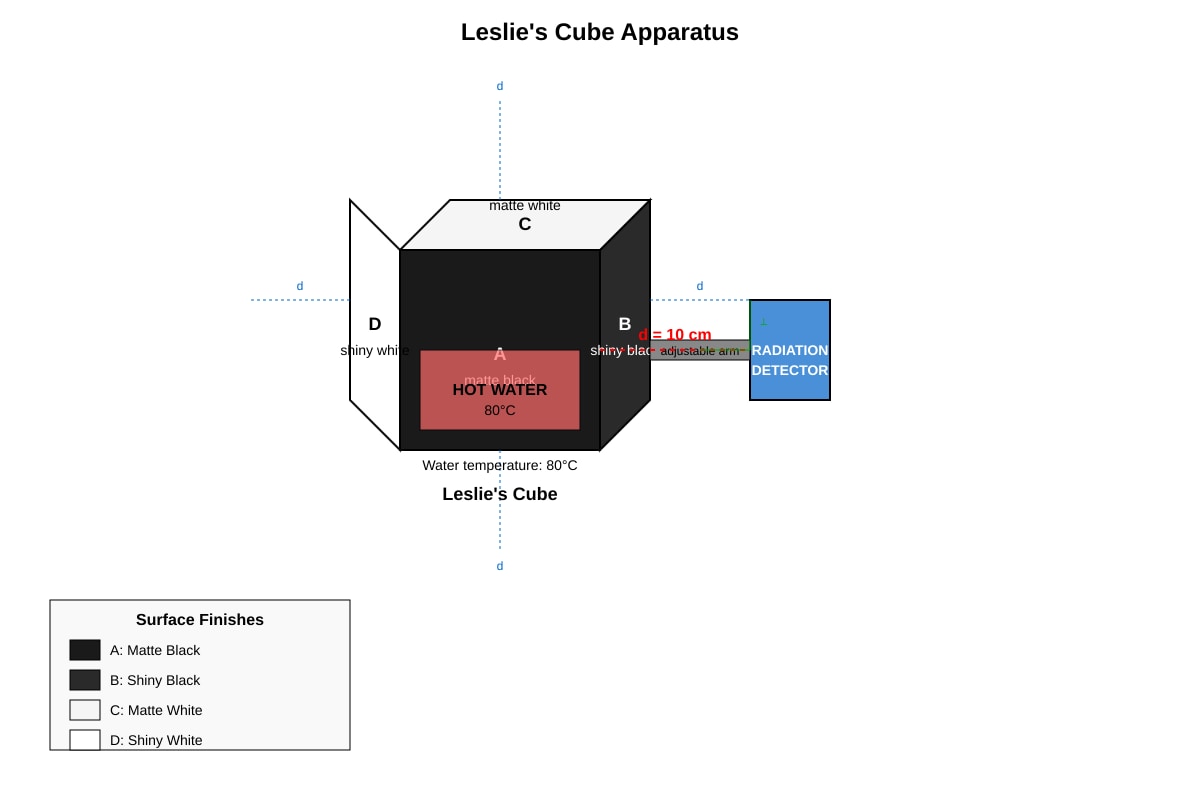
<image_placeholder> id: Q12-fig1 type: experimental_setup linked_question: 12 description: Leslie's cube apparatus with four different surfaces (matte black, shiny black, matte white, shiny white) and a radiation detector placed at equal distance from each face labels: Leslie's cube; hot water inside; four faces labeled A (matte black), B (shiny black), C (matte white), D (shiny white); radiation detector on adjustable arm; distance d marked equal for all measurements values: Water temperature maintained at 80°C; detector distance 10 cm must_show: Cube filled with hot water; four distinct surface finishes; detector positioned perpendicular to each face; equal distance measurement indicated </image_placeholder>

The apparatus shown is used to investigate how surface properties affect thermal radiation emission. The cube is filled with hot water and the detector reading is recorded for each face.

(a) State which face should give the highest detector reading when all other conditions remain constant. [1 mark]


(b) Explain your answer in terms of surface properties and emission of infrared radiation. [3 marks]


13. [4 marks] A kettle heats 1.5 kg of water from 20°C to boiling point in 5 minutes. The kettle is rated at 2.2 kW.

(a) Calculate the energy supplied by the kettle in 5 minutes. [2 marks]

Working:


(b) Calculate the efficiency of the kettle. [2 marks]

(Specific heat capacity of water = 4200 J kg⁻¹ °C⁻¹)

Working:


14. [4 marks] Explain each of the following using kinetic theory of matter:

(a) A liquid evaporates at any temperature, but boils only at one specific temperature. [2 marks]


(b) Evaporation causes cooling of the liquid. [2 marks]


15. [3 marks] A gas is contained in a cylinder with a movable piston. The gas is compressed slowly, and at the same time, thermal energy is allowed to escape so that the temperature of the gas remains constant. Explain, using kinetic theory, why the pressure of the gas increases.


Section C: Data Analysis and Extended Response (Questions 16–20)

16. [4 marks]

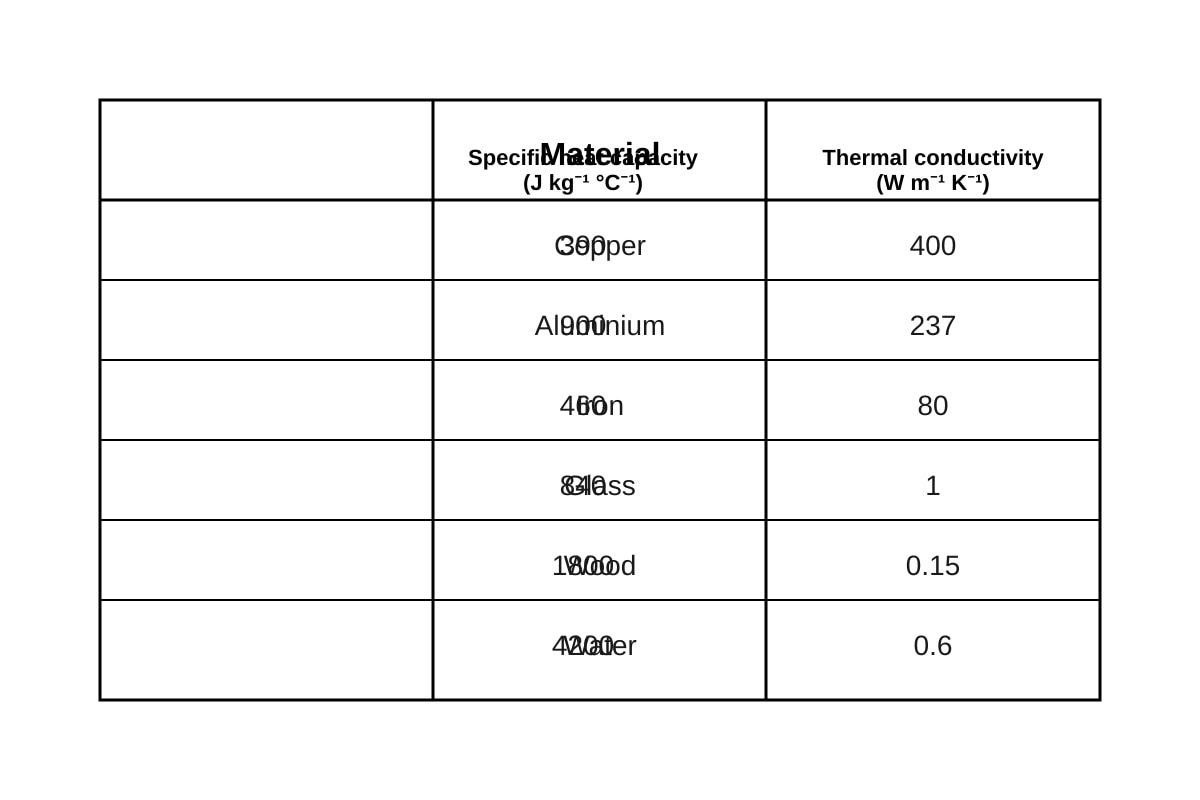
<image_placeholder> id: Q16-fig1 type: table linked_question: 16 description: Table showing specific heat capacities and thermal conductivities of various materials labels: Material; Specific heat capacity (J kg⁻¹ °C⁻¹); Thermal conductivity (W m⁻¹ K⁻¹) values: Copper: 390, 400; Aluminium: 900, 237; Iron: 460, 80; Glass: 840, 1; Wood: 1800, 0.15; Water: 4200, 0.6 must_show: All six materials with both numerical values; clear column headers; consistent units </image_placeholder>

Using data from the table, explain why:

(a) aluminium is preferred over copper for making cooking pots despite copper's higher thermal conductivity. [2 marks]


(b) wooden handles are fitted to metal cooking pots. [2 marks]


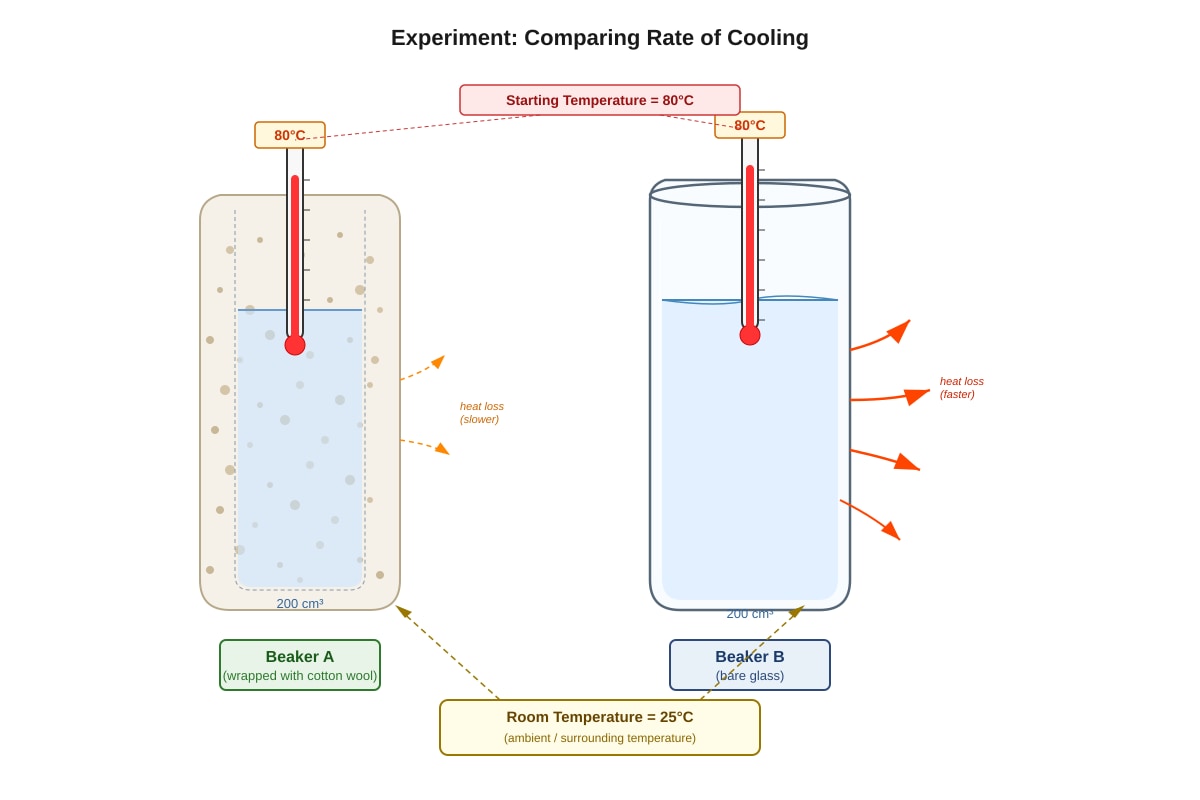
17. [4 marks] A student designs an experiment to compare the rate of cooling of water in two different containers.

<image_placeholder> id: Q17-fig1 type: experimental_setup linked_question: 17 description: Two identical beakers, one wrapped with cotton wool and one bare, each containing 200 cm³ of hot water at 80°C, with thermometers inserted labels: Beaker A (wrapped with cotton wool); Beaker B (bare glass); thermometer in each; starting temperature 80°C; room temperature 25°C indicated values: Volume 200 cm³; initial temperature 80°C; ambient 25°C must_show: Two identical beakers side by side; one with insulating layer; thermometers at same immersion depth; temperature readings visible </image_placeholder>

(a) State two factors that must be kept constant to ensure a fair comparison. [2 marks]


(b) Sketch and label the expected temperature-time graphs for both beakers on the same axes. [2 marks]


18. [4 marks] 0.10 kg of steam at 100°C is condensed to water at 100°C, then cooled to 20°C. Calculate the total energy released.

(Specific latent heat of vaporisation of water = 2260 kJ kg⁻¹; specific heat capacity of water = 4200 J kg⁻¹ °C⁻¹)

Working:


19. [4 marks] Describe the processes by which thermal energy is transferred from the Sun to the Earth, and explain why there is no conduction or convection through space.


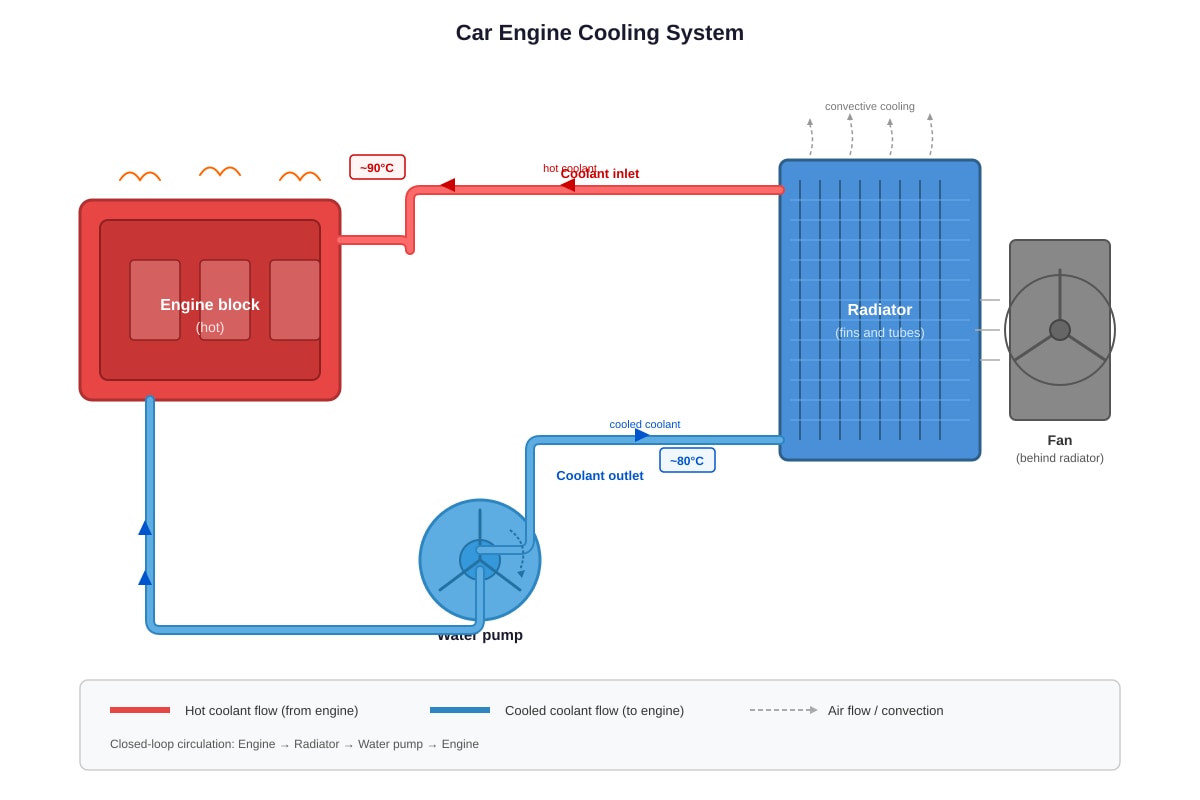
20. [5 marks] A car engine cooling system uses a mixture of water and ethylene glycol (antifreeze).

<image_placeholder> id: Q20-fig1 type: diagram linked_question: 20 description: Simplified car engine cooling system showing engine block, radiator, water pump, and coolant flow labels: Engine block (hot); Radiator (fins and tubes); Water pump; Coolant inlet and outlet; Fan behind radiator; Flow arrows must_show: Closed loop circulation; hot coolant from engine to top of radiator; cooled coolant returned to engine; radiator fins for convective cooling </image_placeholder>

(a) Explain why water is a suitable coolant, referring to its specific heat capacity. [2 marks]


(b) The cooling system contains 4.0 kg of coolant (water). The engine operates at 90°C and the radiator cools the water to 80°C before it returns to the engine. Calculate the rate at which thermal energy must be removed by the radiator if the coolant circulates completely every 30 seconds. [3 marks]

Working:


END OF QUIZ

Answers

<!-- TuitionGoWhere generation metadata: stage=3-0; model=moonshotai/kimi-k2.6:free; model_label=Kimi K2.6 Free; generated=2026-06-10; Sources: Stage 2-1 real exam-derived templates and Stage 2-2 exam-enriched syllabus. -->

Secondary 4 Pure Physics Quiz - Thermal Physics (Answer Key)

Total Marks: 50


Section A: Multiple Choice (Questions 1–5)

1. C [2 marks]

Teaching note: Internal energy is the sum of kinetic energy and potential energy of all molecules in a system. Temperature relates only to average kinetic energy. Heat refers to energy transfer, not stored energy.

Common mistake: Confusing heat (energy in transit) with internal energy (energy stored).


2. B [2 marks]

Working: Q=mcΔθ=2.0×900×(8020)=2.0×900×60=108000Q = mc\Delta\theta = 2.0 \times 900 \times (80-20) = 2.0 \times 900 \times 60 = 108\,000 J

Teaching note: Use Δθ\Delta\theta = final temperature − initial temperature. Always include units in calculation.


3. C [2 marks]

Teaching note: During melting, energy supplied breaks intermolecular bonds (increases potential energy) without changing average kinetic energy. Since temperature is proportional to average kinetic energy, temperature stays constant at the melting point.

Common mistake: Thinking temperature rise means kinetic energy increases — during phase change, this is not true.


4. D [2 marks]

Teaching note: A thermos flask minimizes all three heat transfer mechanisms: conduction (by vacuum/glass walls), convection (by preventing fluid movement), and radiation (by silvered surfaces that reflect infrared).


5. B [2 marks]

Teaching note: Specific latent heat of vaporisation is the energy required to change 1 kg of liquid to gas at constant temperature (boiling point). The value is for the phase change only, not for heating.


Section B: Short Answer and Structured Questions (Questions 6–15)

6. [2 marks]

HeatTemperature
Energy transferred between bodies due to temperature differenceMeasure of hotness/coldness; proportional to average kinetic energy of molecules
Measured in joules (J)Measured in °C or K
Depends on mass, material, and temperature changeIndependent of mass

Marking scheme: Any two distinct valid differences — 1 mark each.


7. [3 marks]

Metal is a good thermal conductor [1], while plastic is a poor thermal conductor/thermal insulator [1]. When the metal spoon is in hot soup, heat energy is quickly conducted from the soup through the metal to the handle, making it feel hot [1]. In the plastic spoon, heat transfer is slow, so the handle remains cooler.

Key concept: Thermal conductivity determines rate of heat transfer. Metals have free electrons that efficiently transfer kinetic energy.


8. [3 marks]

Q=mcΔθQ = mc\Delta\theta [1]

Q=0.50×900×(5525)Q = 0.50 \times 900 \times (55-25) [1]

Q=0.50×900×30=13500Q = 0.50 \times 900 \times 30 = 13\,500 J [1]

Teaching note: Always write the formula first, then substitute with units, then calculate.


9. [3 marks]

Method: Electrical heating method

Measurements needed:

  • Mass of metal block, mm (using balance) [1]
  • Initial and final temperatures, using thermometer (or temperature change Δθ\Delta\theta) [1]
  • Current II and potential difference VV of heater, and heating time tt [1]

Formula: Electrical energy supplied = thermal energy gained (assuming no heat loss) VIt=mcΔθVIt = mc\Delta\theta

Therefore: c=VItmΔθc = \frac{VIt}{m\Delta\theta}

Common improvement: Insulate the block; use lid to minimize heat loss to surroundings.


10. [3 marks]

The horizontal plateau at 0°C represents melting (solid to liquid phase change) [1]. During melting, the energy supplied is used to break intermolecular bonds and increase the potential energy of molecules [1], not to increase their kinetic energy. Since temperature is proportional to average kinetic energy, the temperature remains constant [1].

Key concept: Latent heat — energy for phase change without temperature change.


11. [4 marks]

(a) Energy to melt ice: Q=mLf=0.20×334000=66800 JQ = mL_f = 0.20 \times 334\,000 = 66\,800 \text{ J} [2]

(If using 334 kJ kg⁻¹: Q = 0.20 × 334 = 66.8 kJ = 66 800 J)

(b) Heat lost by warm water = heat gained by ice (to melt) + heat gained by melted ice (to warm up)

Let final temperature be TT: 0.80×4200×(40T)=66800+0.20×4200×(T0)0.80 \times 4200 \times (40-T) = 66\,800 + 0.20 \times 4200 \times (T-0) [1]

1344×(40T)=66800+840T1344 \times (40-T) = 66\,800 + 840T

537601344T=66800+840T53\,760 - 1344T = 66\,800 + 840T

5376066800=1344T+840T53\,760 - 66\,800 = 1344T + 840T

13040=2184T-13\,040 = 2184T

This gives negative TT, which is impossible. [1]

Interpretation: The water does not have enough energy to melt all the ice. Final temperature will be 0°C with some ice remaining unmelted.

Alternative correct answer: If student identifies that not all ice melts, award marks for correct reasoning.


12. [4 marks]

(a) Face A (matte black) [1]

(b) Matte black surfaces are good emitters of infrared radiation [1]. Shiny or light surfaces are poor emitters as they reflect radiation rather than absorb and re-emit it [1]. At the same temperature, a matte black surface emits thermal radiation at a higher rate than shiny or white surfaces [1], so the detector records a higher reading.

Key concept: Surface color and texture affect emissivity. Dark, rough surfaces ≈ black body (good emitter/absorber). Shiny/metallic surfaces = poor emitter, good reflector.


13. [4 marks]

(a) Energy supplied: E=P×t=2200×(5×60)=2200×300=660000 JE = P \times t = 2200 \times (5 \times 60) = 2200 \times 300 = 660\,000 \text{ J} [2]

(Or 660 kJ)

(b) Energy required to heat water: Q=mcΔθ=1.5×4200×(10020)=1.5×4200×80=504000 JQ = mc\Delta\theta = 1.5 \times 4200 \times (100-20) = 1.5 \times 4200 \times 80 = 504\,000 \text{ J} [1]

Efficiency=useful energy outputtotal energy input×100%=504000660000×100%=76.4%\text{Efficiency} = \frac{\text{useful energy output}}{\text{total energy input}} \times 100\% = \frac{504\,000}{660\,000} \times 100\% = 76.4\% [1]

Or accept 76% to 77% depending on rounding.


14. [4 marks]

(a) Evaporation occurs at the surface when faster-moving molecules escape [1]; it can happen at any temperature because there are always some molecules with enough energy [1]. Boiling occurs throughout the liquid at one specific temperature (boiling point) when the vapour pressure equals atmospheric pressure [1].

(Max 2 marks as allocated)

(b) During evaporation, the fastest-moving molecules escape from the surface [1]. This removes the molecules with highest kinetic energy, so the average kinetic energy of remaining molecules decreases [1], causing cooling.


15. [3 marks]

When the piston compresses the gas, the volume decreases so molecules are closer together [1]. The frequency of collisions with the walls increases [1]. Since temperature is constant, average molecular speed stays the same, but more frequent collisions means greater rate of momentum change on walls, hence higher pressure [1].

Key concept: Pressure = force/area; force arises from rate of change of momentum from molecular collisions.


Section C: Data Analysis and Extended Response (Questions 16–20)

16. [4 marks]

(a) Aluminium has a higher specific heat capacity (900 vs 390 J kg⁻¹ °C⁻¹) [1]. This means it can store more thermal energy for the same temperature rise, providing more even and sustained heating of food [1]. While copper conducts faster, aluminium's lower density and better heat storage make it practical for cookware.

(b) Wood has very low thermal conductivity (0.15 W m⁻¹ K⁻¹) [1], making it a good thermal insulator. It minimizes heat conduction from the hot pot to the hand, preventing burns and allowing safe handling [1].


17. [4 marks]

(a) Two factors to keep constant:

  • Initial temperature of hot water [1]
  • Volume/mass of water in each beaker [1]

(Other valid answers: room temperature, surface area exposed, type of container material if not the variable being tested, starting time)

(b) Sketch should show:

  • Both curves starting at 80°C and decreasing exponentially to approach 25°C [1]
  • Curve for Beaker B (bare) falling more steeply than Beaker A (wrapped) at all times [1]
  • Both curves asymptotic to room temperature line

<image_placeholder> id: Q17-ans-fig1 type: graph linked_question: 17 description: Two temperature-time curves for cooling water, showing bare beaker cooling faster than insulated beaker labels: Temperature (°C) on y-axis; Time (min) on x-axis; room temperature 25°C dotted line; Curve A (insulated, slower cooling); Curve B (bare, faster cooling) values: Both start at 80°C, asymptote to 25°C; Curve B below Curve A at all t > 0 must_show: Initial common point; Curve B steeper initial slope; both approaching ambient temperature; clear labeling of which curve is which </image_placeholder>


18. [4 marks]

Energy released in condensation: Q1=mLv=0.10×2260000=226000 JQ_1 = mL_v = 0.10 \times 2260\,000 = 226\,000 \text{ J} [1]

Energy released in cooling water: Q2=mcΔθ=0.10×4200×(10020)=0.10×4200×80=33600 JQ_2 = mc\Delta\theta = 0.10 \times 4200 \times (100-20) = 0.10 \times 4200 \times 80 = 33\,600 \text{ J} [1]

Total energy released: Qtotal=Q1+Q2=226000+33600=259600 JQ_{\text{total}} = Q_1 + Q_2 = 226\,000 + 33\,600 = 259\,600 \text{ J} [1]

Or 260 kJ or 2.60 × 10⁵ J (to 3 sig fig) [1]

Teaching note: Two separate calculations needed — condensation is a large energy contribution. Don't forget the temperature change of the resulting water.


19. [4 marks]

Energy transfers from Sun to Earth by radiation (electromagnetic waves/infrared radiation) [1]. This is the only mechanism possible because space is a vacuum [1]. Conduction requires a medium with particles to transfer kinetic energy through collisions [1]. Convection requires a fluid medium where heated particles can move and carry energy [1]. Neither can occur in the vacuum of space.


20. [5 marks]

(a) Water has a high specific heat capacity (4200 J kg⁻¹ °C⁻¹) [1]. This means it can absorb large amounts of thermal energy with only a small temperature rise, making it effective at removing heat from the engine without boiling [1].

(b) Temperature drop of coolant: Δθ=9080=10\Delta\theta = 90 - 80 = 10°C [1]

Energy to be removed per cycle: Q=mcΔθ=4.0×4200×10=168000 JQ = mc\Delta\theta = 4.0 \times 4200 \times 10 = 168\,000 \text{ J} [1]

Rate of heat removal (power): P=Qt=16800030=5600 W=5.6 kWP = \frac{Q}{t} = \frac{168\,000}{30} = 5600 \text{ W} = 5.6 \text{ kW} [1]


END OF ANSWER KEY