Secondary 4 Pure Physics Quiz - Thermal Physics
Name: ___________________________
Class: ___________________________
Date: ___________________________
Score: ___________ / 40
Duration: 50 minutes
Total Marks: 40
Instructions:
- Answer all 20 questions.
- Section A: Multiple-choice style short responses (1 mark each).
- Section B: Structured short answers (2 marks each).
- Section C: Calculation and explanation questions (3–4 marks each).
- Show all working for calculation questions.
- Use c=4200 J kg−1K−1 for water unless stated.
Section A: Multiple-Choice Style Short Responses (Questions 1–5, 1 mark each)
-
State the SI unit of temperature used in scientific measurements.
-
What is the process called when a liquid changes to a gas at temperatures below its boiling point?
-
Name the instrument used to measure atmospheric pressure.
-
State the term for the amount of thermal energy required to raise the temperature of 1 kg of a substance by 1 K.
-
At which temperature on the Kelvin scale does water freeze?
Section B: Structured Short Answers (Questions 6–10, 2 marks each)
-
(a) State what is meant by the term "specific heat capacity".
(b) Give the unit of specific heat capacity.
-
A metal block is heated and its temperature rises. Explain, in terms of particles, why the internal energy of the block increases.
-
State two differences between boiling and evaporation.
-
The reading on a mercury thermometer is 25∘C. Convert this temperature to Kelvin. Show your working.
-
A closed flask of gas is placed in hot water. State and explain what happens to the pressure of the gas inside the flask.
Section C: Calculation and Explanation (Questions 11–20)
-
Calculate the thermal energy needed to raise the temperature of 0.50 kg of water from 20∘C to 100∘C.
[3 marks]
-
A 2.0 kg aluminium block (c=900 J kg−1K−1) cools from 80∘C to 30∘C. Calculate the thermal energy lost.
[3 marks]
-
A heater of power 100 W is used to heat 0.40 kg of oil of specific heat capacity 2000 J kg−1K−1 for 5.0 minutes. The temperature rises from 25∘C to 55∘C. Calculate the efficiency of the heater.
[4 marks]
-
Explain why a desert cools rapidly at night using the concept of specific heat capacity of sand and air.
[3 marks]
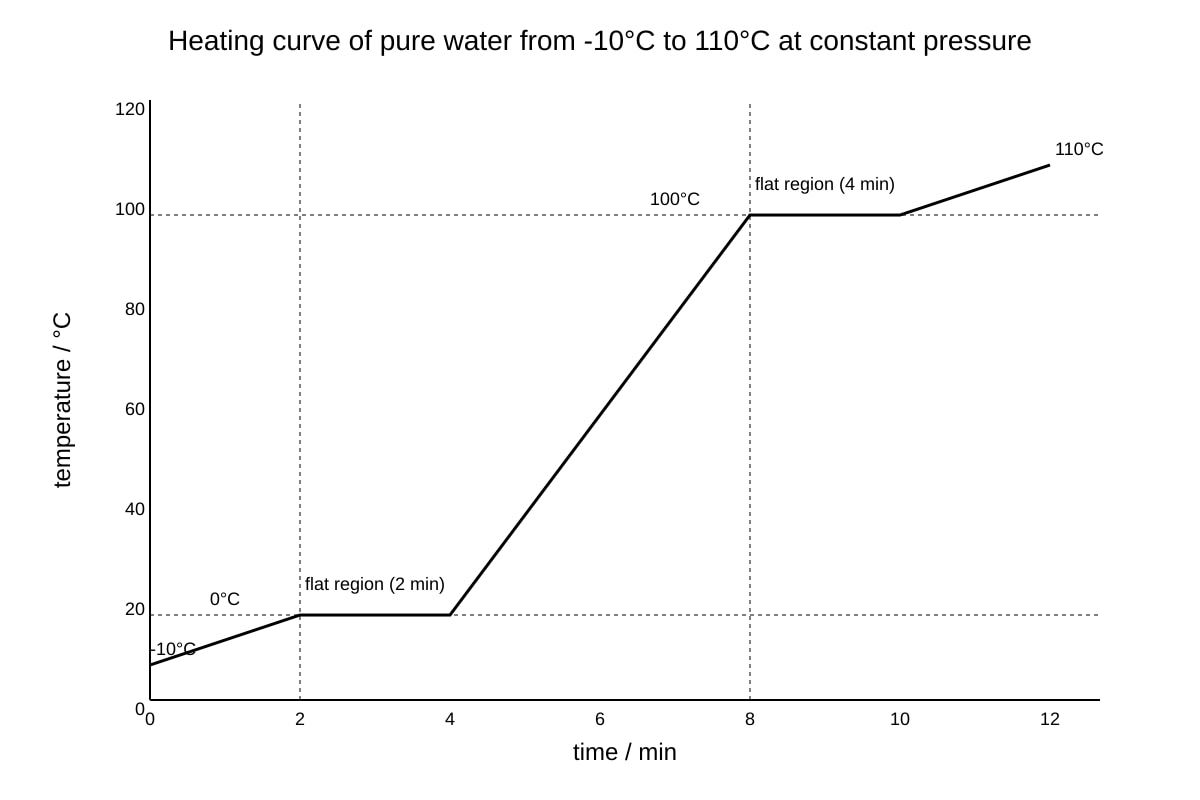
Generated graph for 15.
The graph shows the heating curve of ice warming to steam. State the physical state of the substance at (a) 0∘C during the first flat region, and (b) 100∘C during the second flat region. Explain your answer.
[3 marks]
-
A student claims that "temperature is a measure of the total kinetic energy of all particles in a body." State whether this is correct. Explain your answer.
[2 marks]
-
1.2 kg of water at 90∘C is mixed with 0.80 kg of water at 20∘C in a container of negligible heat capacity. Calculate the final temperature of the mixture.
[4 marks]
-
Describe an experiment to determine the specific heat capacity of a solid metal using an electrical method. Include the measurements needed.
[4 marks]
-
A liquid at 30∘C is placed in a vacuum. It begins to boil at 30∘C. Explain why this happens using the concept of atmospheric pressure and boiling point.
[3 marks]
-
A car engine releases 6.0×10⁶ J of thermal energy per minute. Only 1.5×10⁶ J is converted to useful kinetic energy. Calculate the efficiency of the engine as a percentage.
[3 marks]
</stage3_quiz_answers_md>
<stage3_quiz_answers_md>
Secondary 4 Pure Physics Quiz - Thermal Physics: Answer Key
Total Marks: 40
Topic: Thermal Physics
Section A (1 mark each)
Q1. Kelvin (K)
Teaching note: The SI base unit for thermodynamic temperature is the kelvin (K), not °C which is a derived scale.
Q2. Evaporation
Teaching note: Evaporation occurs at the surface and below boiling point; boiling occurs at a fixed temperature throughout the liquid.
Q3. Barometer
Teaching note: A barometer (e.g. mercury barometer) measures atmospheric pressure; a manometer measures pressure difference.
Q4. Specific heat capacity
Teaching note: This is the defined quantity; unit is J kg−1K−1.
Q5. 273 K
Teaching note: Water freezes at 0∘C=273 K (using T/K=θ/∘C+273).
Section B (2 marks each)
Q6.
(a) Specific heat capacity is the thermal energy required to raise the temperature of 1 kg of a substance by 1 K (or 1∘C). [1]
(b) J kg−1K−1 [1]
Q7. [2]
- Heating increases particle vibration/kinetic energy. [1]
- Internal energy = sum of kinetic + potential energy of particles; rising temperature means greater average KE, so internal energy increases. [1]
Q8. [2] – any two:
- Boiling occurs at fixed temperature; evaporation occurs at any temperature below boiling. [1]
- Boiling happens throughout liquid; evaporation only at surface. [1]
(Other valid: boiling needs external energy source at BP; evaporation is surface-only cooling process.
Q9. [2]
T=25+273=298 K [1 for working, 1 for answer]
Q10. [2]
- Pressure increases. [1]
- Gas molecules gain KE, hit walls more frequently/harder; volume fixed so pressure rises (Gay-Lussac’s law). [1]
Section C
Q11. [3]
E=mcΔθ=0.50×4200×(100−20)
=0.50×4200×80=168000 J [1 formula, 1 substitution, 1 answer]
Answer: 1.68×10⁵ J
Q12. [3]
Δθ=80−30=50 K
E=mcΔθ=2.0×900×50=90000 J lost [1 formula, 1 calc, 1 unit]
Answer: 9.0×10⁴ J
Q13. [4]
Energy supplied =Pt=100×(5×60)=30000 J [1]
Useful energy =mcΔθ=0.40×2000×(55−25)=0.40×2000×30=24000 J [1]
Efficiency =3000024000×100%=80% [1 calc, 1 %]
Answer: 80%
Q14. [3]
- Sand has low specific heat capacity, so it loses heat quickly at night. [1]
- Air also cools rapidly as little energy needed to change its temperature. [1]
- Hence temperature drops fast compared to regions near water (high c). [1]
Q15. [3]
(a) Mixture of ice and water. [1]
(b) Mixture of water and steam. [1]
Explanation: flat regions = phase change at constant temp; 0∘C melt, 100∘C boil. [1]
Q16. [2]
Incorrect. [1] Temperature relates to average KE per particle, not total KE (total depends on mass). [1]
Q17. [4]
Heat lost by hot = heat gained by cold:
1.2×4200×(90−T)=0.80×4200×(T−20) [1]
Cancel 4200: 1.2(90−T)=0.80(T−20)
108−1.2T=0.8T−16
124=2.0T → T=62∘C [2 calc]
Answer 62∘C [1]
Q18. [4]
- Use immersion heater, thermometer, insulation. [1]
- Measure mass m, power P, time t, initial & final temp. [1]
- Energy supplied = Pt; temp rise = Δθ. [1]
- c=Pt/(mΔθ). [1]
Q19. [3]
- Boiling point drops when external pressure drops. [1]
- In vacuum, atmospheric pressure ≈ 0, so BP falls to 30∘C. [1]
- Liquid boils at room temp in vacuum. [1]
Q20. [3]
Efficiency =6.0×1061.5×106×100%=25% [1 formula, 1 calc, 1 %]
Answer: 25%
</stage3_quiz_answers_md>
<stage3_quiz_md>
Secondary 4 Pure Physics Quiz - Thermal Physics
Name: ___________________________
Class: ___________________________
Date: ___________________________
Score: ___________ / 40
Duration: 50 minutes
Total Marks: 40
Instructions:
- Answer all 20 questions.
- Section A: Multiple-choice style short responses (1 mark each).
- Section B: Structured short answers (2 marks each).
- Section C: Calculation and explanation questions (3–4 marks each).
- Show all working for calculation questions.
- Use c=4200 J kg−1K−1 for water unless stated.
Section A: Multiple-Choice Style Short Responses (Questions 1–5, 1 mark each)
-
State the SI unit of temperature used in scientific measurements.
-
What is the process called when a liquid changes to a gas at temperatures below its boiling point?
-
Name the instrument used to measure atmospheric pressure.
-
State the term for the amount of thermal energy required to raise the temperature of 1 kg of a substance by 1 K.
-
At which temperature on the Kelvin scale does water freeze?
Section B: Structured Short Answers (Questions 6–10, 2 marks each)
-
(a) State what is meant by the term "specific heat capacity".
(b) Give the unit of specific heat capacity.
-
A metal block is heated and its temperature rises. Explain, in terms of particles, why the internal energy of the block increases.
-
State two differences between boiling and evaporation.
-
The reading on a mercury thermometer is 25∘C. Convert this temperature to Kelvin. Show your working.
-
A closed flask of gas is placed in hot water. State and explain what happens to the pressure of the gas inside the flask.
Section C: Calculation and Explanation (Questions 11–20)
-
Calculate the thermal energy needed to raise the temperature of 0.50 kg of water from 20∘C to 100∘C.
[3 marks]
-
A 2.0 kg aluminium block (c=900 J kg−1K−1) cools from 80∘C to 30∘C. Calculate the thermal energy lost.
[3 marks]
-
A heater of power 100 W is used to heat 0.40 kg of oil of specific heat capacity 2000 J kg−1K−1 for 5.0 minutes. The temperature rises from 25∘C to 55∘C. Calculate the efficiency of the heater.
[4 marks]
-
Explain why a desert cools rapidly at night using the concept of specific heat capacity of sand and air.
[3 marks]
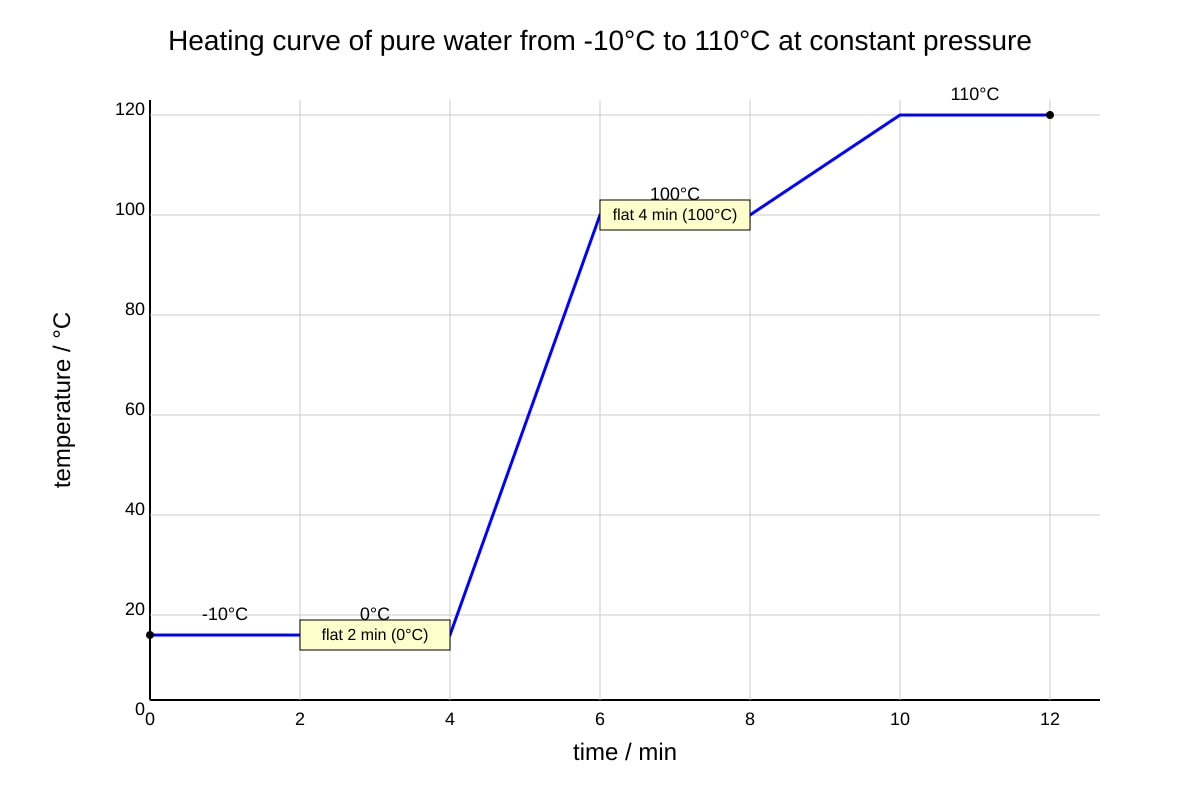
Generated graph for 15.
The graph shows the heating curve of ice warming to steam. State the physical state of the substance at (a) 0∘C during the first flat region, and (b) 100∘C during the second flat region. Explain your answer.
[3 marks]
-
A student claims that "temperature is a measure of the total kinetic energy of all particles in a body." State whether this is correct. Explain your answer.
[2 marks]
-
1.2 kg of water at 90∘C is mixed with 0.80 kg of water at 20∘C in a container of negligible heat capacity. Calculate the final temperature of the mixture.
[4 marks]
-
Describe an experiment to determine the specific heat capacity of a solid metal using an electrical method. Include the measurements needed.
[4 marks]
-
A liquid at 30∘C is placed in a vacuum. It begins to boil at 30∘C. Explain why this happens using the concept of atmospheric pressure and boiling point.
[3 marks]
-
A car engine releases 6.0×10⁶ J of thermal energy per minute. Only 1.5×10⁶ J is converted to useful kinetic energy. Calculate the efficiency of the engine as a percentage.
[3 marks]