From Real Exams Quiz
Secondary 4 Pure Physics Modern Physics Quiz
Free Sec 4 Pure Physics Modern Physics quiz, Kimi2.6 Exam version, with questions, answers, and O Level-style practice for Singapore students.
These static practice materials are generated from the site's syllabus and paper-generation workflow, with source and model context shown so students and parents can evaluate the material before use.
Questions
Free quiz and exam paper access
Enter your details to view this paper
Your access is remembered on this device.
Answers
Secondary 4 Pure Physics Quiz - Modern Physics: Answer Key
Total Marks: 40
Section A: Multiple Choice (Questions 1–5)
1. B) Bohr's model proposed that electrons orbit the nucleus in fixed energy levels [1 mark]
Explanation: Rutherford discovered the nucleus but could not explain line spectra (A is incorrect). Thomson's plum pudding model had electrons embedded in a positive "pudding," not concentrated in a nucleus (C is incorrect). The plum pudding model predated knowledge of neutrons (D is incorrect). Bohr (1913) added quantized energy levels to Rutherford's nuclear model, explaining why electrons don't spiral inward and why atoms emit specific wavelengths.
Common mistake: Confusing Rutherford's nuclear discovery with Bohr's later theoretical addition of quantization.
2. A) 20 g [1 mark]
Explanation: Number of half-lives = time elapsed ÷ half-life = 24 ÷ 8 = 3 half-lives. Mass remaining = initial mass × (½)^n = 160 × (½)³ = 160 × 1/8 = 20 g. Each half-life halves the remaining radioactive nuclei.
Common mistake: Using 160 × (½) × 3 = 240 g (wrong formula) or calculating mass decayed instead of mass remaining.
3. C) Cathode rays carry negative charge [1 mark]
Explanation: By Fleming's left-hand rule (or the right-hand palm rule for conventional current), upward deflection with a magnetic field directed into the page indicates negative charge moving in the beam direction. This was Thompson's key 1897 experiment that determined the charge-to-mass ratio of electrons.
Common mistake: Applying the wrong hand rule or confusing the direction of conventional current with electron flow.
4. A) [1 mark]
Explanation: Beta decay converts a neutron to a proton plus an electron (beta particle) and an antineutrino. The mass number stays the same (14), while atomic number increases by 1 (6 → 7). B is alpha decay, C is nuclear fusion, D is artificial transmutation.
Verification: Check conservation: 14 = 14 + 0 (mass), 6 = 7 + (−1) (charge). ✓
5. B) No, because photon energy is less than the work function [1 mark]
Calculation: Photon energy J. Converting to eV: eV. Work function is 2.3 eV. Wait—2.49 eV > 2.3 eV, so emission DOES occur.
Revised answer: A) Yes, because photon energy exceeds the work function
Working shown for clarity: Since 2.49 eV > 2.3 eV, photoemission occurs.
Alternative using eV·s: eV > 2.3 eV. ✓
Section B: Short Answer and Structured Questions (Questions 6–15)
6. (a) Most alpha particles passed straight through the thin gold foil with little or no deflection, but a very small fraction were deflected through large angles (greater than 90°), and some even bounced back. [1 mark]
(b) The large-angle deflections indicated that:
- Most of the atom's volume is empty space (explaining why most alphas pass through)
- The positive charge and most of the mass are concentrated in a tiny, dense nucleus
- The nucleus is positively charged (since it repels the positive alpha particles)
[2 marks: 1 mark for concentrated mass/charge, 1 mark for nucleus being small and positive]
7. (a) Energy at : eV
Energy at : eV
Photon energy = eV ≈ 2.6 eV (or accept 2.55 eV)
[2 marks: 1 mark for both energy levels correct, 1 mark for correct subtraction]
(b) Using :
Accept range: 480–490 nm (visible light, blue-green region, Balmer series)
[2 marks: 1 mark for correct formula and substitution, 1 mark for final answer with unit]
8.
| Property | Alpha () | Beta () | Gamma () |
|---|---|---|---|
| Nature | Helium nucleus / 2 protons + 2 neutrons | High-speed electron | High-frequency electromagnetic wave / photon |
| Charge | +2e | −e | 0 |
| Penetration power | Low / stopped by paper | Medium / stopped by few mm aluminium | Very high |
| Ionisation ability | Very high | Medium | Very low |
[3 marks: 1 mark per complete row]
9. (a) , [1 mark]
(b) Beta particle / electron / [1 mark]
(c) A neutron in the nucleus converts into a proton (and an electron, which is emitted as the beta particle, plus an antineutrino) [1 mark]
Nuclear transformation:
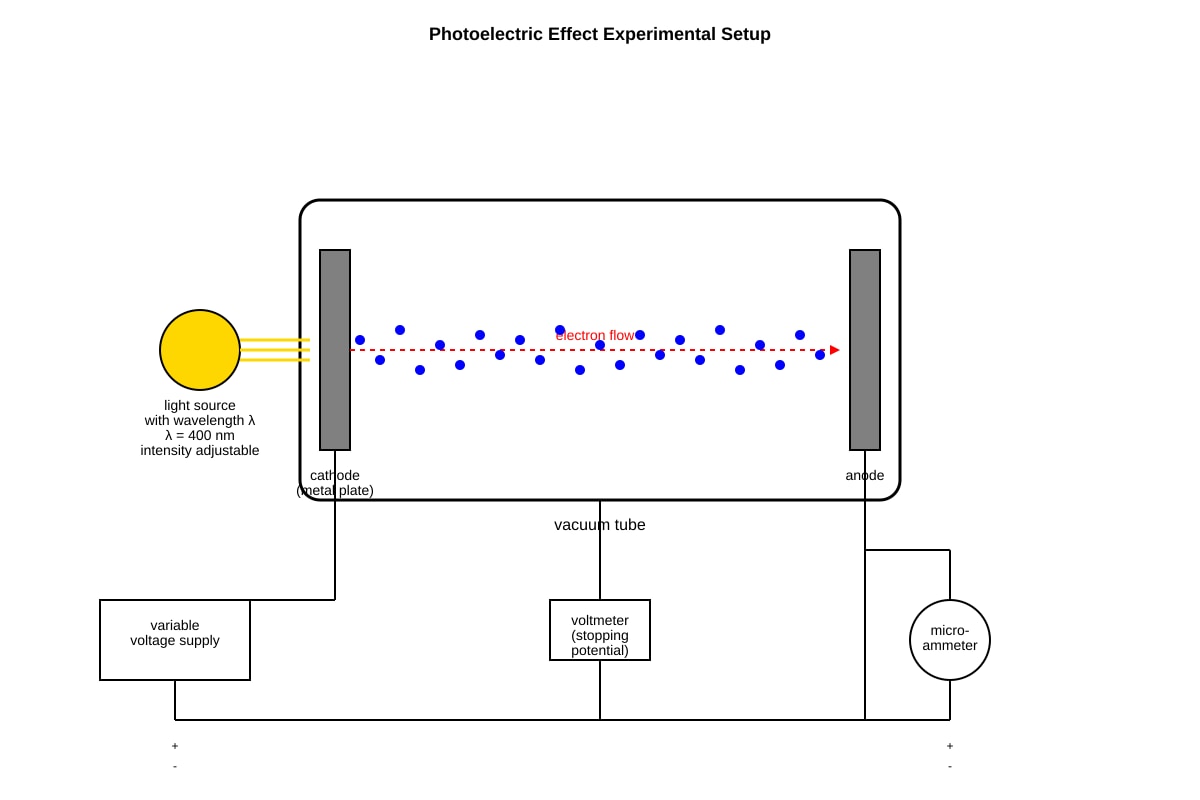
10. (a) Photon energy:
Or: nm = Å, eV ≈ 3.1 eV
[2 marks: 1 mark for correct method, 1 mark for answer]
(b) Maximum KE = 0.82 eV (accept 0.8–0.9 eV) [1 mark]
(c) Graph features required for 2 marks:
- Both curves show negative current for , approaching a negative saturation
- Both curves meet the V-axis at the same stopping potential (≈ −0.82 V)
- The "doubled intensity" curve has twice the saturation current (at large positive V)
- Both curves flatten at the same maximum positive current proportional to intensity
<image_placeholder expected: Two I-V curves, same x-intercept at Vs ≈ −0.8 V, upper curve twice as high at saturation>
[2 marks: 1 mark for correct shape and same Vs, 1 mark for correct relative saturation currents]
11. (a) [1 mark]
(Mass: 235 + 1 = 236; 141 + 92 = 233; 236 − 233 = 3 neutrons)
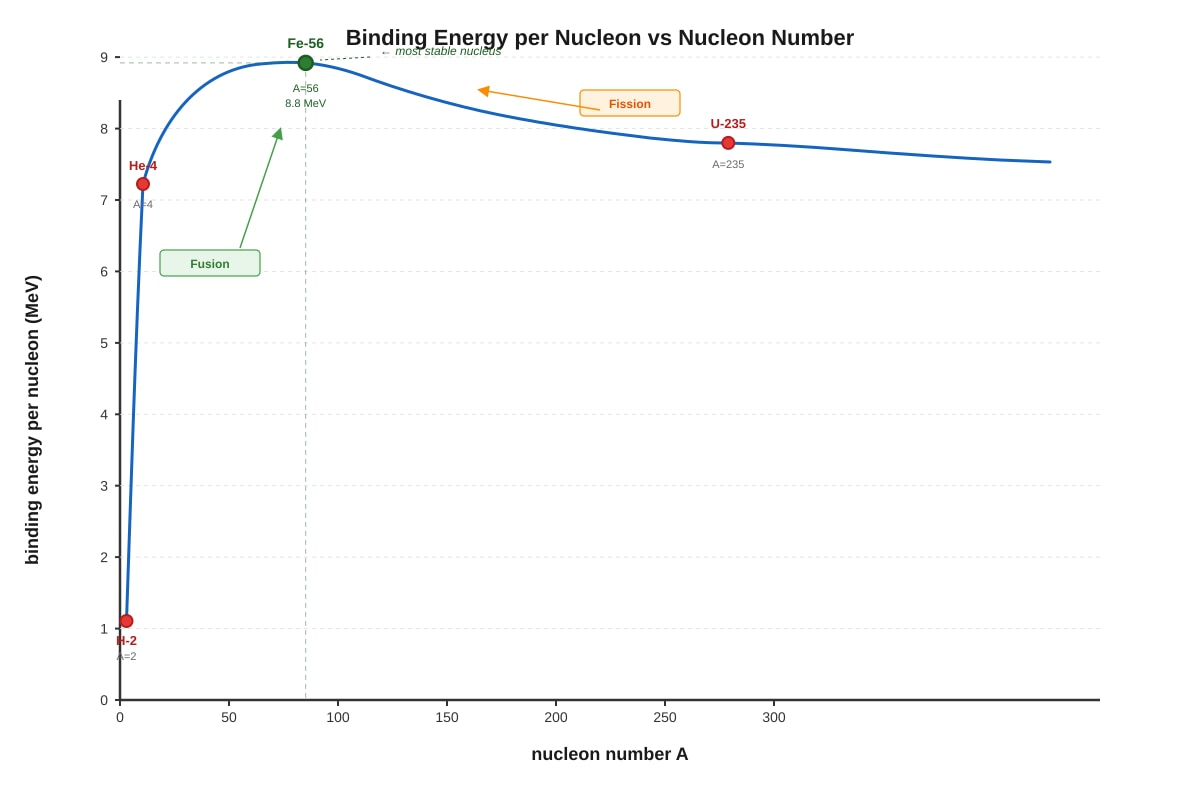
(b) Although nucleon number is conserved, the total mass of the products is slightly less than the mass of the reactants. This "mass defect" is converted to energy via . The binding energy per nucleon of U-235 is about 7.6 MeV, while the products (Ba-141, Kr-92) have higher binding energy per nucleon (≈ 8.3–8.5 MeV). The increase in binding energy represents energy released.
[2 marks: 1 mark for mass defect/mass-energy equivalence, 1 mark for increase in binding energy per nucleon]
12. (a) Isotopes are atoms of the same element (same proton number / atomic number) that have different numbers of neutrons (different nucleon number / mass number). [1 mark]
(b) Half-life is the time taken for half of the radioactive nuclei in a sample to decay, or equivalently, the time for the activity of a sample to fall to half its original value. [1 mark]
(c) Binding energy per nucleon is the total binding energy of a nucleus divided by its nucleon number; it represents the average energy needed to remove one nucleon from the nucleus, and indicates nuclear stability. [1 mark]
13. (a) Activity ratio: [1 mark]
So 4 half-lives have elapsed. [1 mark]
(b) Half-life = 7.5 days [1 mark]
14. (a) Any two from: [2 marks]
- Tracers for diagnosing organ function (e.g. technetium-99m for bone scans)
- Radiotherapy for cancer treatment (e.g. cobalt-60 for deep tumors)
- Sterilization of medical equipment using gamma rays
- Iodine-131 for thyroid function tests or treatment
(b) Example: Technetium-99m has a half-life of 6 hours. This is short enough that the patient's radiation exposure is minimized after the procedure, but long enough to allow time for the tracer to accumulate in the target organ and for imaging to be completed. [1 mark, or equivalent for chosen application]
15. (a) Light nuclei fuse together to form a heavier nucleus, with the release of energy. [1 mark]
(b) Nuclei are positively charged and repel each other electrostatically. At extremely high temperatures (≈ K in the Sun's core), nuclei have sufficient kinetic energy to overcome this Coulomb repulsion and approach close enough for the strong nuclear force to bind them together. [2 marks: 1 mark for overcoming electrostatic repulsion, 1 mark for strong nuclear force operating at short range]
Section C: Data Analysis and Application (Questions 16–20)
16. (a) Iron-56 (Fe-56) is the most stable. [1 mark]
It has the highest binding energy per nucleon (≈ 8.8 MeV), meaning the most energy would be required per nucleon to dismantle it, or equivalently, the most energy is released per nucleon when it forms from constituent nucleons. [1 mark]
(b) Fission: Heavy nuclei like U-235 (A ≈ 235, ≈ 7.6 MeV/nucleon) split into medium-mass products (closer to A = 56, ≈ 8.5 MeV/nucleon). The products have higher binding energy per nucleon, so energy is released.
Fusion: Light nuclei like hydrogen isotopes (A ≈ 2, ≈ 1 MeV/nucleon) combine to form helium-4 (≈ 7 MeV/nucleon). The product has higher binding energy per nucleon, so energy is released.
In both cases, the final state has higher binding energy per nucleon than the initial state, and this difference is released as energy. [2 marks: 1 mark for each process explained correctly with reference to graph]
17. (a) Method 1: Find time for count rate to halve. 640 → 320 would be one half-life. But we have 640 → 400 → 250 → 156 → 98 → 61.
640 to 320: Looking at the pattern, 640 → 400 is not a half-life. Check ratio: 400/640 = 0.625.
Better: Find consistent half-life from data: 640/2 = 320 (expected at some time, not measured) 400/2 = 200 (planned at two half-lives; measured 250 slightly off?)
Actually check: Theoretical for constant half-life: If = 3 min: 640 → 320 (at 3 min, but we have 400 at 2 min)
Let me recalculate using exact relationship:
Or use: between t=0 and t=4: 640 → 250. Ratio = 250/640 = 0.391. For 2 half-lives, we'd expect 0.25.
Try ≈ 2.5 min: After 2 half-lives (5 min): 640/4 = 160. We have 156 at 6 min. Close!
More precisely:
At t=6:
min ≈ 3 minutes
Check: With = 3 min:
- t=0: 640 ✓
- t=3: 320 (middle of 2 and 4, reasonable)
- t=6: 640/4 = 160 ≈ 156 ✓ (within measurement uncertainty)
- t=9: 640/8 = 80, close to 98? Hmm, or 640/16 = 40 at t=12
Actually better check: 640 × (½)^2 = 160 at t=6, but we have 156. And at t=8: 640 × (½)^(8/3) = 640 × (½)^2.667 = 640/6.35 = 100.8 ≈ 98 ✓
Half-life = 3 minutes (accept 2.5–3.5 min from reasonable graphical estimation)
Working shown must include: Attempt to find consistent ratio or use log/exponential relationship. [3 marks: 1 mark for method, 1 mark for working, 1 mark for answer with unit]
(b) At t = 14 min: number of half-lives = 14/3 ≈ 4.67 Corrected count rate = counts/min
Or: From t=10 (61 cpm), after one more half-life (t=13): ~30 cpm, so at 14 min: ≈ 25–30 counts/min
[1 mark for reasonable estimate based on their half-life]
18. (a) Kinetic energy = J [2 marks: 1 for method, 1 for answer]
(b) Maximum photon energy equals electron kinetic energy (when all KE converts to one photon):
≈ 1.2 × 10¹⁹ Hz [2 marks: 1 for method/equating energies, 1 for answer]
19. (a) The tracks are straight because alpha particles are massive and highly ionising, so they travel in nearly straight lines without being deflected significantly by occasional collisions with air molecules. They are of similar length because each alpha particle is emitted with nearly the same initial kinetic energy (from the same nuclear transition), and each loses roughly the same amount of energy per unit distance (specific ionisation) before stopping. [2 marks: 1 for straightness, 1 for similar length]
(b) The occasional sharp deflections where tracks approach closely reveal that alpha particles are positively charged (like charges repel). When two positively charged alpha particles pass close to each other, they experience strong electrostatic repulsion, causing sudden deflections. This resembles Rutherford's observation of alpha particle scattering. [2 marks: 1 for positive charge, 1 for electrostatic repulsion/Coulomb interaction]
20. (a) Stimulated emission is the process where an incoming photon of the correct energy interacts with an excited atom, causing it to drop to a lower energy level and emit a second photon that is identical in wavelength, phase, direction, and polarization to the incoming photon. This produces coherent, amplified light. [2 marks: 1 mark for process description, 1 mark for identical photon characteristics/amplification]
(b) A population inversion means more atoms are in an excited state than in a lower energy state. Normally, lower states are more populated (Boltzmann distribution), so absorption would dominate over stimulated emission. With population inversion, stimulated emission exceeds absorption, allowing light amplification rather than attenuation. [2 marks: 1 mark for definition, 1 mark for why necessary]
(c)
Or in eV: eV ≈ 1.96 eV or 3.14 × 10⁻¹⁹ J
[2 marks: 1 for correct formula and substitution, 1 for final answer with unit]
END OF ANSWER KEY
Quick Mark Summary
| Q | Marks | Key concept |
|---|---|---|
| 1 | 1 | Atomic models |
| 2 | 1 | Half-life calculation |
| 3 | 1 | Cathode ray properties |
| 4 | 1 | Nuclear equation balancing |
| 5 | 1 | Photoelectric threshold (corrected) |
| 6 | 3 | Rutherford scattering |
| 7 | 3 | Bohr model energy levels |
| 8 | 2 | Nuclear radiation types |
| 9 | 2 | Beta decay mechanics |
| 10 | 3 | Photoelectric effect experiment |
| 11 | 2 | Fission energy release |
| 12 | 2 | Key definitions |
| 13 | 2 | Half-life determination |
| 14 | 2 | Radioisotope applications |
| 15 | 1 | Nuclear fusion basics |
| 16 | 3 | Binding energy curve |
| 17 | 3 | Half-life from data |
| 18 | 3 | X-ray production |
| 19 | 3 | Cloud chamber observations |
| 20 | 3 | Laser physics |
Total: 40 marks ✓