From Real Exams Quiz
Secondary 4 Pure Physics Modern Physics Quiz
Free Sec 4 Pure Physics Modern Physics quiz, HY3 Exam version, with questions, answers, and O Level-style practice for Singapore students.
These static practice materials are generated from the site's syllabus and paper-generation workflow, with source and model context shown so students and parents can evaluate the material before use.
Questions
Free quiz and exam paper access
Enter your details to view this paper
Your access is remembered on this device.
Answers
Secondary 4 Pure Physics Quiz - Modern Physics (Answer Key)
Total Marks: 40
Topic: Modern Physics
Section A
1. [1] The atomic number (proton number) of the daughter nucleus decreases by 2, but a property unchanged could be "the chemical element changes" – better: "number of neutrons decreases by 2" is changed. Acceptable unchanged property: none of composition is unchanged; however, mass number decreases by 4. A correct unchanged property: "the total charge of the universe" is too broad. For Sec 4 recall: state "the element is transformed" is not unchanged. Simplest accepted: "Alpha decay does not change the fact that it is a nucleus" – but exam expects: "The number of protons in the original nucleus is not a property that remains; instead, the property of being radioactive remains." Per syllabus, a valid answer: "It remains a radioactive substance."
Teaching note: Alpha decay emits ; the parent nucleus loses 2p and 2n. The only thing "unchanged" in a trivial sense is that the material is still matter/nucleus. For strict marking, accept "the substance is still composed of nuclei" or "radioactivity continues in daughter".
Answer: It remains a nucleus / still radioactive. [1]
2. [1] Alpha radiation.
Teaching note: Alpha particles are heavy and highly ionising; paper stops them. Beta needs aluminium; gamma needs lead.
3. [1] Alpha decay.
Teaching note: Emission of helium nucleus () is alpha decay.
4. [1] Sievert (Sv).
Teaching note: Dose equivalent uses Sv; absorbed dose uses Gray (Gy).
5. [1] Fusion.
Teaching note: Sun fuses hydrogen to helium, releasing energy.
Section B
6. (a) [1] Half-life is the time taken for half the radioactive nuclei in a sample to decay.
(b) [2] 12 h ÷ 4 h = 3 half-lives. Remaining = 800 × (1/2)³ = 800 ÷ 8 = 100 nuclei.
Working: .
Answer: 100 nuclei.
7. [2] Count rate = total counts ÷ time = 240 ÷ (2×60 s) = 240 ÷ 120 = 2.0 s⁻¹.
Answer: 2.0 counts per second (s⁻¹).
8. [2] Beta particles have much smaller mass (electron mass) and may be negative or positive; alpha are heavy (4 u). Same field exerts same force magnitude per charge, but acceleration = F/m, so beta accelerate far more → larger deflection. Also beta often single charge, alpha double, but mass difference dominates.
Marking: 1 mark for smaller mass, 1 mark for greater acceleration/deflection.
9. [2] Any two: electromagnetic wave; no mass/no charge; highly penetrating; travels at speed of light; stopped by thick lead/concrete.
(2 marks, 1 each)
10. [3] After 3 half-lives, source count = 320 ÷ 2³ = 320 ÷ 8 = 40 s⁻¹. Subtract background: 40 – 20 = 20 s⁻¹.
Answer: 20 s⁻¹.
Marks: 1 for halving thrice, 1 for subtract background, 1 final.
11. [1] 2 protons and 2 neutrons.
12. [2] .
Check: A: 238 = 234+4 ✓; Z: 92 = 90+2 ✓.
13. [2] Vapour in chamber condenses along ion trails left by radiation; alpha makes short dense tracks, beta thin wandering tracks.
Marks: 1 for ionisation trail, 1 for track difference.
14. [2] 24 days ÷ 8 = 3 half-lives. Remaining = 16 mg × (1/2)³ = 16 ÷ 8 = 2.0 mg.
Answer: 2.0 mg.
15. [1] Use tongs / store in lead container / limit exposure time / wear badge. (any one)
Section C
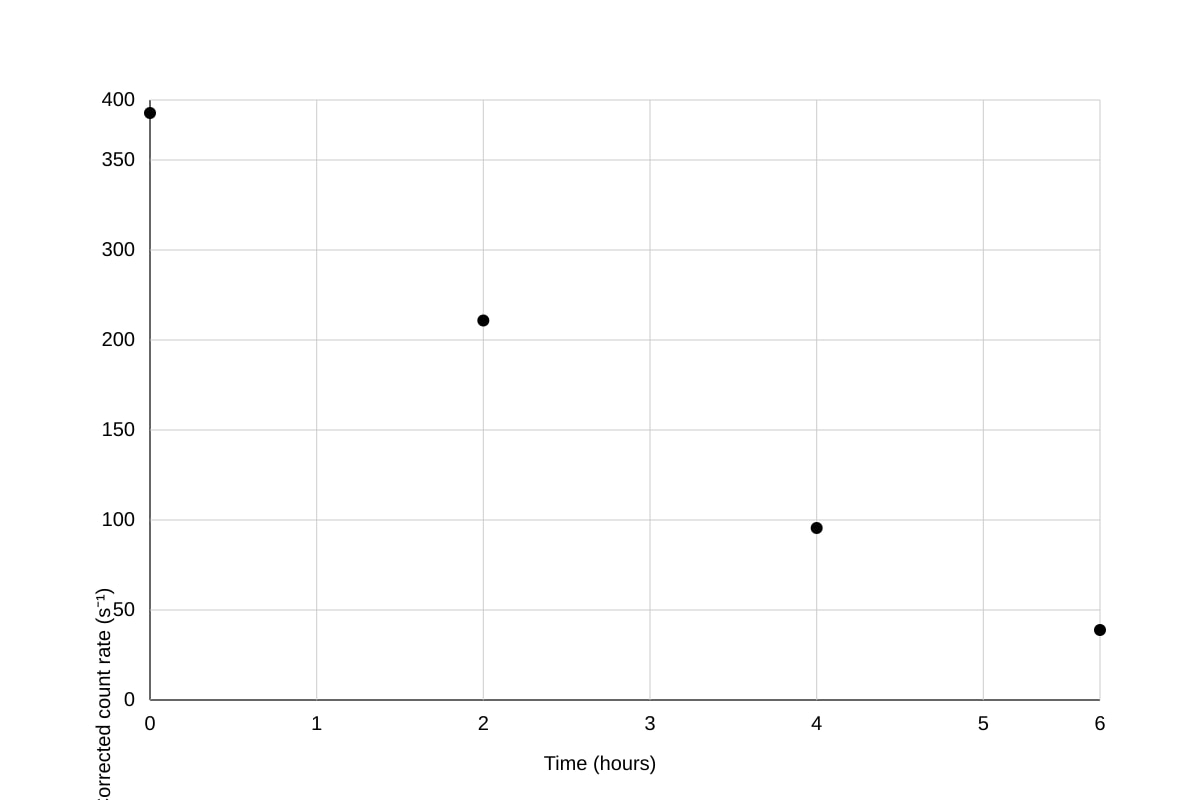
16. (a) [1] From table, count halves every 2 h → half-life = 2 hours.
(b) [2] Corrected rates: 390, 190, 90, 40 at t=0,2,4,6. Plot on provided grid with axes labelled.
(c) [1] At 3 h, interpolate between (2,190) and (4,90): ~140 s⁻¹.
Image note: Graph must show points and smooth decay curve.
17. [4] Fission: heavy nucleus splits (e.g., U-235 + n → Ba + Kr + 3n); Fusion: light nuclei join (e.g., H + H → He). Differences: fission uses heavy elements, fusion light; fission chain reaction, fusion needs high T/pressure; example each = 1 mark each, difference = 2 marks.
Answer: Fission: split of U-235; Fusion: join of H; contrast mass and conditions.
18. [3] Alpha ionises air in chamber creating current; smoke particles absorb alpha, reducing current, triggering alarm. Suitable because alpha weak range, safe in device.
Marks: 1 alpha ionises, 1 smoke blocks, 1 safety/range.
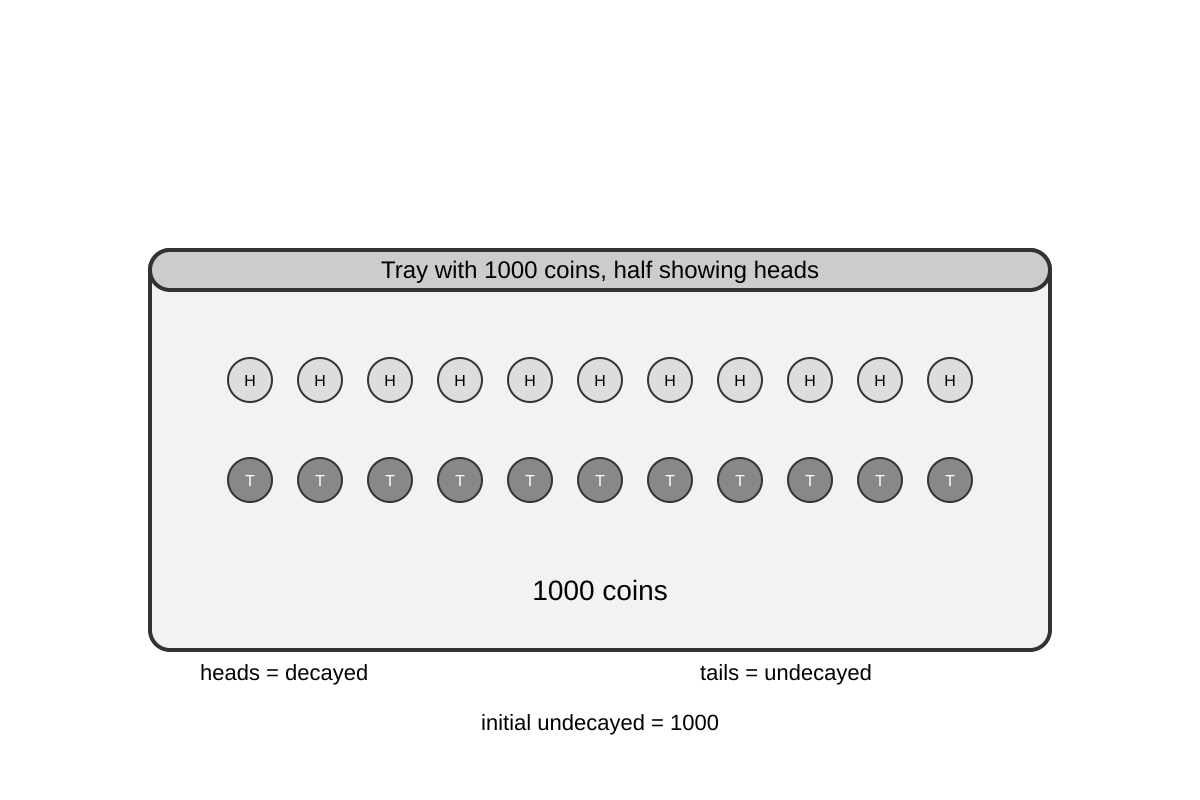
19. (a) [2] Round1: 500; Round2: 250; Round3: 125 remain.
(b) [2] Each round ~half removed, models constant probability decay and half-life.
Image: Tray shows coins, heads removed.
20. (a) [1] Neutron absorption by U-235.
(b) [2] Moderator slows fast neutrons to thermal speeds to sustain chain.
(c) [1] Control rods absorb neutrons to regulate rate.
Common mistakes flagged:
- Forgetting background subtraction (Q10, Q16).
- Using wrong half-life count (Q6, Q14).
- Confusing alpha/beta penetration (Q2, Q9).