From Real Exams Quiz
Secondary 4 Pure Physics Mechanics Quiz
Free Sec 4 Pure Physics Mechanics quiz, HY3 Exam version, with questions, answers, and O Level-style practice for Singapore students.
These static practice materials are generated from the site's syllabus and paper-generation workflow, with source and model context shown so students and parents can evaluate the material before use.
Questions
Secondary 4 Pure Physics Quiz - Mechanics
Name: ___________________________
Class: ______________
Date: ______________
Score: ______________ / 40
Duration: 60 minutes
Total Marks: 40
Instructions:
- Answer all 20 questions.
- Show your working clearly where calculations are required.
- Use g=10 m/s2 unless stated otherwise.
- Section A: Multiple-choice style short responses (1 mark each).
- Section B: Structured short answers (2 marks each).
- Section C: Extended calculations and explanations (3 marks each).
Section A (Questions 1–5, 1 mark each)
1. A scalar quantity has only magnitude. Which of the following is a scalar quantity?
______ (write one: velocity / speed / force / displacement)
2. A car travels 100 m in 20 s at constant speed. What is its average speed?
______ m/s
3. State the SI unit for force.
4. What is the moment of a force about a pivot?
______ (write: turning effect / linear push / energy / mass)
5. Pressure is defined as force per unit ______.
______ (write: area / volume / time / mass)
Section B (Questions 6–10, 2 marks each)
6. A boy of mass 50 kg stands on a weighing scale. Calculate his weight.
Weight = ______ N
[Show space: _______________]
7. A object accelerates from 4 m/s to 10 m/s in 3 s. Calculate its acceleration.
Acceleration = ______ m/s2
[Show space: _______________]
8. State the principle of moments for a body in equilibrium.
9. A hydraulic press has input area 0.02 m2 and output area 0.20 m2. A force of 50 N is applied at the input. Calculate the output force.
Output force = ______ N
[Show space: _______________]
10. A block is at rest on a table. Draw a free-body diagram description: name the two forces acting and their direction.
Section C (Questions 11–20, 3 marks each)
11. A car accelerates uniformly from rest to 20 m/s in 10 s.
(a) Calculate its acceleration.
(b) Calculate the distance travelled.
[Show space: _______________]
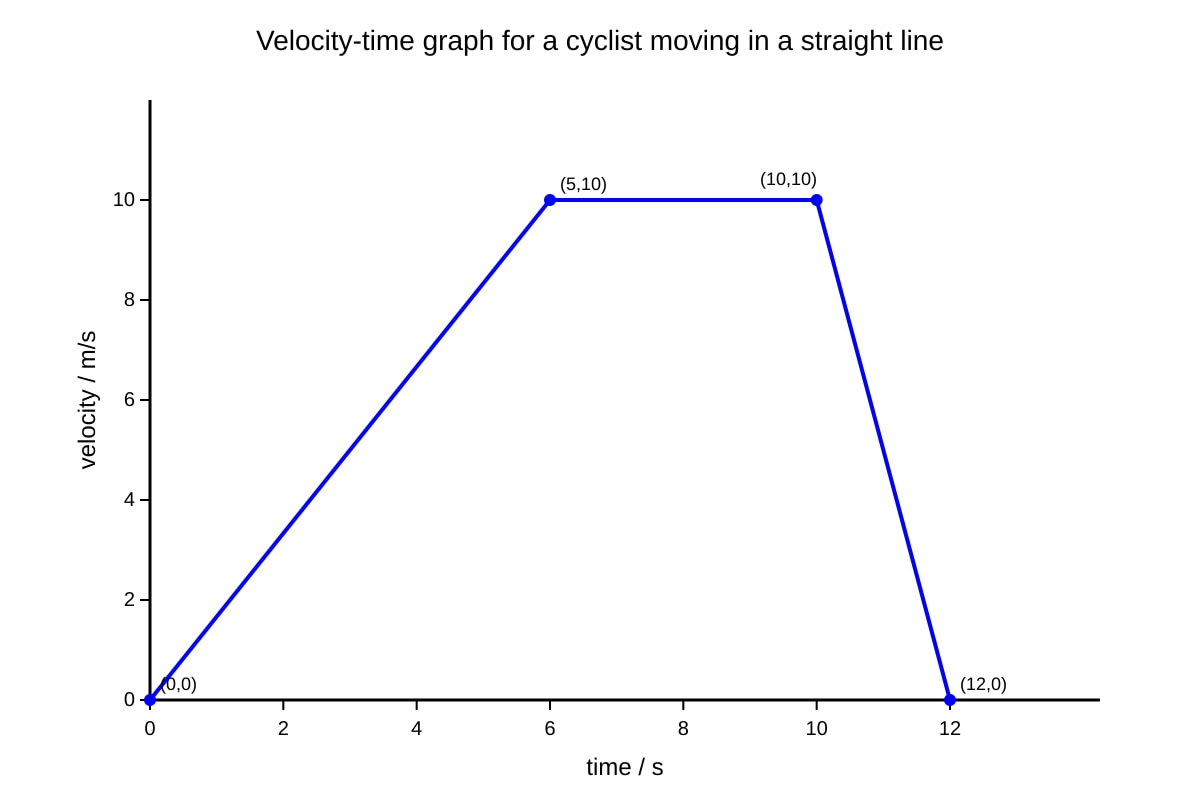
12.
Image pending generation: graph for Q12.
Using the graph, calculate the total displacement of the cyclist from t=0 to t=12 s.
13. A 2 kg object is acted on by a net force of 6 N. Calculate its acceleration and explain how Newton’s second law applies.
[Show space: _______________]
14. A uniform rod of length 2.0 m and weight 20 N is pivoted at its centre. A 10 N force is applied at one end downwards. Calculate the force needed at the other end to balance it.
[Show space: _______________]
15. Explain why a skydiver reaches terminal velocity during free fall. Include forces in your answer.
16. A liquid column of height 5 m has density 800 kg/m3. Calculate the pressure at the bottom due to the liquid. (g=10 m/s2)
[Show space: _______________]
17. A ball of mass 0.5 kg is dropped from height 20 m. Calculate its gravitational potential energy at the top and its speed just before hitting the ground (ignore air resistance).
[Show space: _______________]
18. A man pushes a box with 40 N across a rough floor at constant speed. State the frictional force and explain using Newton’s first law.
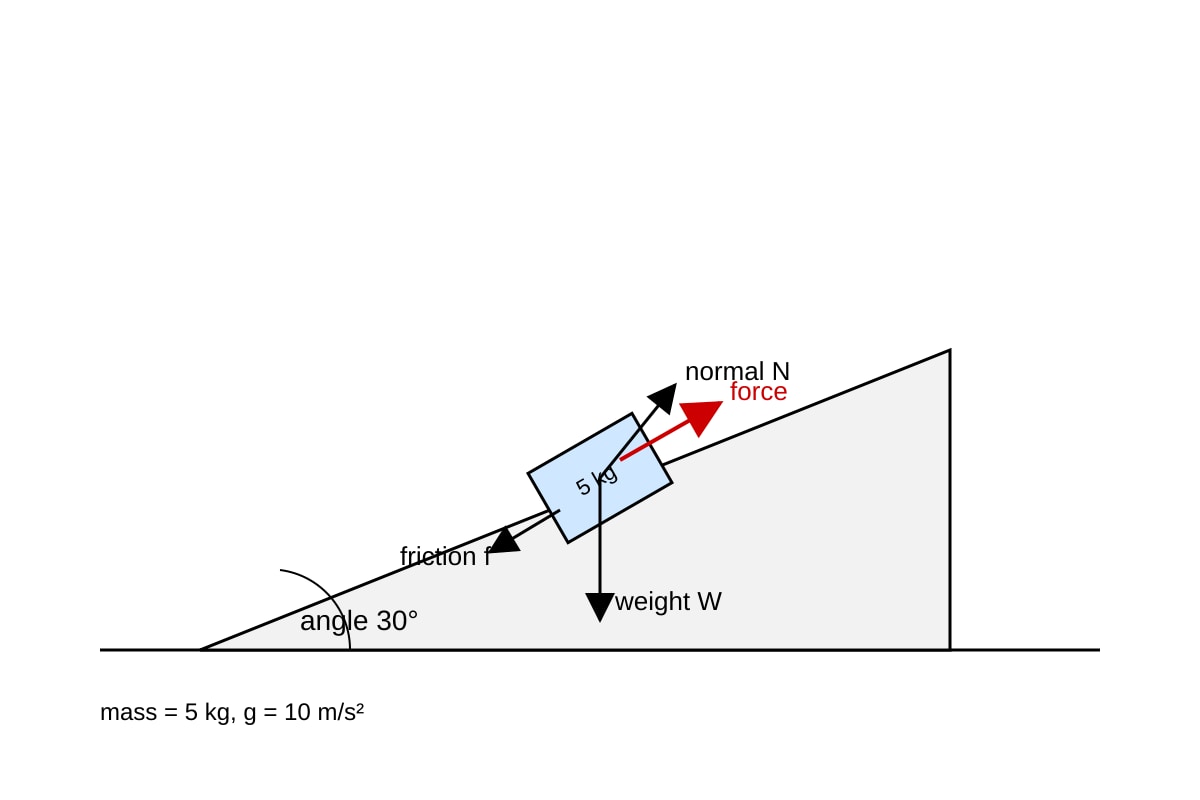
19.
Image pending generation: experimental_setup for Q19.
Calculate the component of weight parallel to the slope. Hence state what minimum force up the slope is needed to hold it at rest if friction is ignored.
20. A crane lifts a 200 kg load by 15 m in 10 s. Calculate the work done and the power output.
[Show space: _______________]
Answers
Secondary 4 Pure Physics Quiz - Mechanics: Answer Key
Total Marks: 40
Topic: Mechanics
Level: Secondary 4 Pure Physics
Section A (1 mark each)
1. speed
Teaching note: Scalar quantities have magnitude only. Speed = distance/time, no direction. Velocity, force, displacement are vectors.
2. 5
Working: average speed = distance / time = 100/20=5 m/s.
3. newton (N)
Teaching note: Force is measured in newtons, symbol N.
4. turning effect
Teaching note: Moment = turning effect of a force about a pivot.
5. area
Teaching note: Pressure P=F/A, so force per unit area.
Section B (2 marks each)
6. Weight = 500 N
Working: W=mg=50×10=500 N.
Marking: 1 mark formula, 1 mark answer with unit.
7. Acceleration = 2 m/s²
Working: a=(v−u)/t=(10−4)/3=6/3=2 m/s2.
Marking: 1 mark substitution, 1 mark answer.
8. Principle of moments: For a body in equilibrium, sum of clockwise moments about a pivot equals sum of anticlockwise moments.
Marking: 1 mark equilibrium, 1 mark equality of moments.
9. Output force = 500 N
Working: Pascal’s principle: F1/A1=F2/A2 → F2=F1×A2/A1=50×0.20/0.02=50×10=500 N.
Marking: 1 mark method, 1 mark answer.
10. Forces: Weight (downwards), Normal reaction (upwards).
Marking: 1 mark each force named and direction correct.
Section C (3 marks each)
11. (a) a=2 m/s2 (b) s=100 m
Working:
(a) a=(20−0)/10=2 m/s2
(b) s=ut+21at2=0+0.5×2×102=100 m (or area under v-t graph)
Marking: 1 mark (a), 2 marks (b) with formula and substitution.
12. Displacement = 95 m
Working: Area = triangle (0–5s): 0.5×5×10=25; rectangle (5–10s): 5×10=50; triangle (10–12s): 0.5×2×10=10; total = 85? Wait recalc: 25+50+10=85 m. Correction: total = 85 m.
(Note: graph values given: 0–5 line to 10, 5–10 flat, 10–12 down. Areas: 25+50+10=85.)
Answer: 85 m.
Marking: 1 mark reading graph, 2 marks area calculation.
13. a = 3 m/s²
Working: F=ma → a=F/m=6/2=3 m/s2.
Explanation: Newton’s second law states net force equals mass times acceleration; larger force or smaller mass gives greater acceleration.
Marking: 1 mark calc, 2 marks explanation.
14. 10 N
Working: Pivot at centre, each end 1.0 m from pivot. Clockwise moment = 10×1=10 Nm. For balance, anticlockwise = F×1=10 → F=10 N.
Marking: 1 mark distances, 1 mark moments eqn, 1 mark answer.
15. Terminal velocity explanation
At start, weight > air resistance, accelerates. As speed increases, drag increases until drag = weight. Net force zero, constant velocity (terminal).
Marking: 1 mark forces identified, 1 mark drag increase, 1 mark equilibrium constant v.
16. Pressure = 40 000 Pa
Working: P=hρg=5×800×10=40000 Pa.
Marking: 1 mark formula, 1 mark sub, 1 mark answer.
17. GPE = 100 J, speed = 20 m/s
Working: GPE = mgh=0.5×10×20=100 J. KE at bottom = 100 J = 21mv2 → v=2×100/0.5=400=20 m/s.
Marking: 1 mark GPE, 2 marks speed with energy conservation.
18. Friction = 40 N
Explanation: Constant speed → net force zero (Newton’s first law). Applied force balanced by friction, so friction = 40 N opposite direction.
Marking: 1 mark value, 2 marks law explanation.
19. Parallel component = 25 N, min force = 25 N
Working: W=mg=5×10=50 N. Parallel = Wsin30∘=50×0.5=25 N. To hold at rest, up-slope force = 25 N.
Marking: 1 mark weight, 1 mark component, 1 mark force.
20. Work = 30 000 J, Power = 3000 W
Working: W=mgh=200×10×15=30000 J. P=W/t=30000/10=3000 W.
Marking: 1 mark work, 2 marks power with unit.
Free quiz and exam paper access
Enter your details to view this paper
Your access is remembered on this device.