From Real Exams Quiz
Secondary 4 Pure Physics Energy Power Quiz
Free Sec 4 Pure Physics Energy Power quiz, HY3 Exam version, with questions, answers, and O Level-style practice for Singapore students.
These static practice materials are generated from the site's syllabus and paper-generation workflow, with source and model context shown so students and parents can evaluate the material before use.
Questions
Free quiz and exam paper access
Enter your details to view this paper
Your access is remembered on this device.
Answers
Secondary 4 Pure Physics Quiz - Energy Power (Answer Key)
Total Marks: 40
Topic: Energy Power
Section A: Short Answer
1. [1 mark]
Energy cannot be created or destroyed; it can only be transferred from one store to another or transformed from one form to another.
Teaching note: Conservation of energy is a fundamental law. Total energy in a closed system stays constant.
2. [1 mark]
Power is the rate of doing work, , where is work done and is time.
Teaching note: Power measures how fast energy is transferred; unit is watt (W) = J/s.
3. [1 mark]
Gravitational potential energy store.
Teaching note: Object above ground has GPE due to Earth's gravitational field.
4. [1 mark]
Teaching note: Kinetic energy depends on mass and square of speed.
5. [1 mark]
Watt (W).
Teaching note: 1 W = 1 J/s.
Section B: Structured Response
6. [2 marks]
The lamp transfers 12 J of electrical energy per second into light and heat (1 mark for 12 J/s, 1 mark for energy transfer context).
Teaching note: 12 W means 12 J of energy converted each second.
7. [2 marks]
(1 mark formula, 1 mark answer).
Teaching note: GPE increases with height; use .
8. [2 marks]
Example: Reduce friction by lubrication (1 mark method, 1 mark explanation: less energy wasted as heat).
Accept other valid answers.
9. [2 marks]
(1 mark working, 1 mark answer).
Teaching note: Square the velocity first.
10. [2 marks]
Electrical energy → chemical energy in battery (1 mark); chemical → internal/thermal eventually (1 mark).
Accept: electrical to chemical, then chemical to other forms.
11. [2 marks]
Efficiency (1 mark working, 1 mark answer).
Teaching note: Useful output / total input × 100%.
12. [2 marks]
Renewable does not deplete (1 mark); lower carbon emissions (1 mark).
Accept any valid environmental/sustainability point.
13. [3 marks]
(a) (1 mark)
(b) Electrical → kinetic + internal/heat (2 marks for stating transfers).
Teaching note: Power = energy/time.
14. [2 marks]
Weight pulls down, air resistance increases with speed (1 mark); at terminal velocity resistive force = weight, no net force, GPE → KE + heat balanced (1 mark).
15. [2 marks]
100 W bulb transfers more.
Energy difference: (1 mark identification, 1 mark calculation).
Teaching note: , 1 h = 3600 s.
Section C: Calculation & Interpretation
16. [3 marks]
(a) Work (1 mark)
(b) Power (1 mark working, 1 mark answer).
Teaching note: Useful power = work/time.
17. [3 marks]
(a) Efficiency (1 mark working, 1 mark answer)
(b) Friction/heat/sound loss in turbine (1 mark).
Teaching note: Not all GPE becomes electrical.
18. [3 marks]
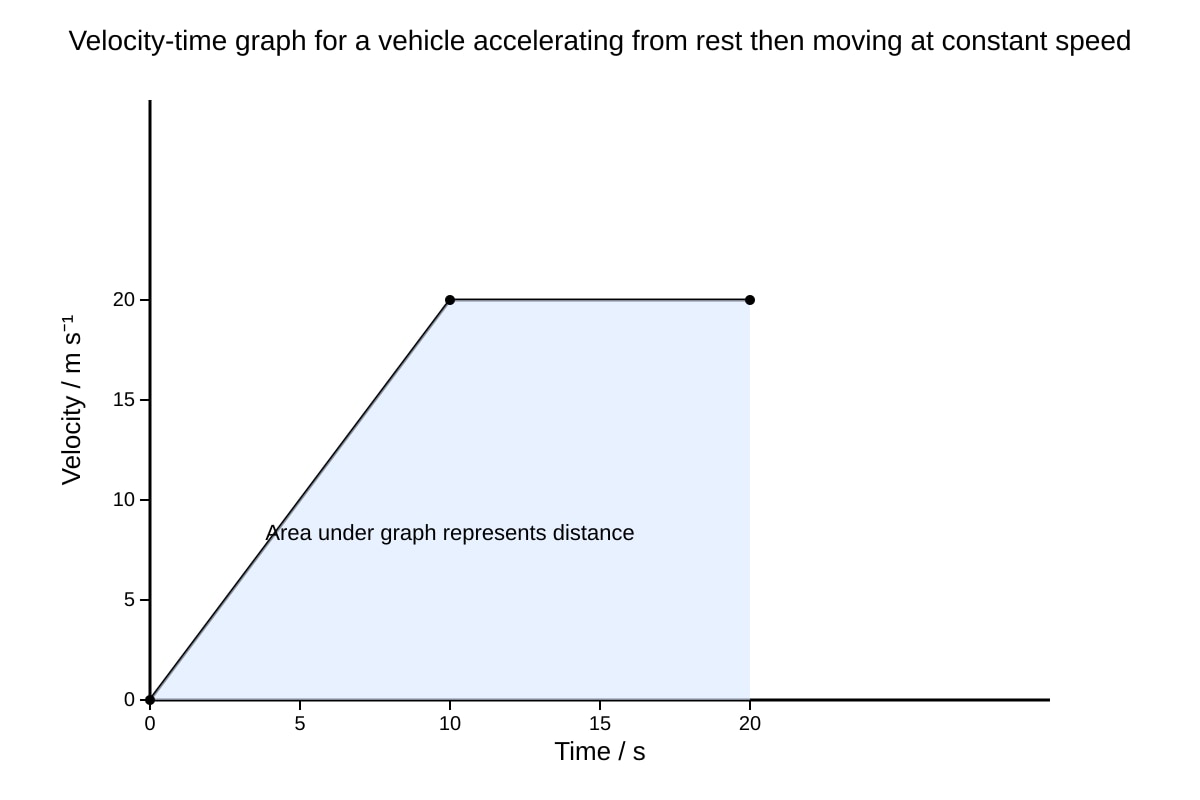
(a) Distance = area under graph = triangle + rectangle = (1 mark area method, 1 mark answer)
(b) At s, , (1 mark).
Image note: Graph must show (0,0)-(10,20)-(20,20). Area = 300 m.
19. [3 marks]
(a) (1 mark)
(b) Water energy (1 mark working, 1 mark answer).
Teaching note: Convert minutes to seconds.
20. [3 marks]
(a) Efficiency (1 mark working, 1 mark answer)
(b) Dust on panel, angle of sun, temperature (1 mark).
Teaching note: Solar panels rarely exceed ~20% in exams.