From Real Exams Quiz
Secondary 4 Pure Physics Electricity Magnetism Quiz
Free Sec 4 Pure Physics Electricity Magnetism quiz with questions, answers, and O Level-style practice for Singapore students preparing for school assessments.
These static practice materials are generated from the site's syllabus and paper-generation workflow, with source and model context shown so students and parents can evaluate the material before use.
Questions
Secondary 4 Pure Physics Quiz - Electricity Magnetism
Name: _________________________ Class: __________ Date: __________
Duration: 50 minutes Total Marks: 40 marks
Instructions:
- Answer all questions.
- Write your answers in the spaces provided.
- Show all working for calculation questions.
- Use g = 10 N/kg where required.
Section A: Multiple Choice (Questions 1–5)
Choose the correct answer. Each question carries 2 marks.
1. Which of the following correctly describes the direction of conventional current?
A. Flow of electrons from negative to positive terminal B. Flow of positive charge from positive to negative terminal C. Flow of electrons from positive to negative terminal D. Flow of negative charge from negative to positive terminal
Answer: __________ (2 marks)
2. A transformer has 200 turns on the primary coil and 800 turns on the secondary coil. If the input voltage is 240 V, what is the output voltage? (Assume 100% efficiency)
A. 60 V B. 480 V C. 960 V D. 1920 V
Answer: __________ (2 marks)
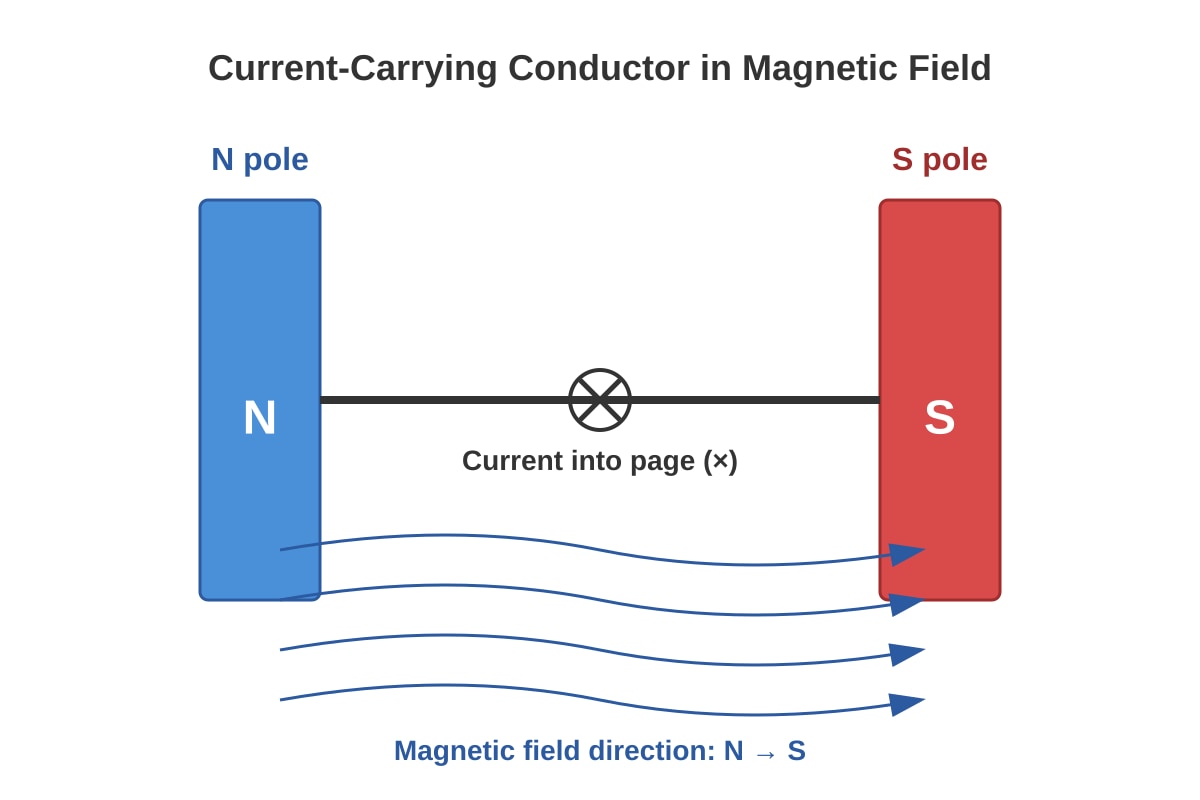
3. A current-carrying conductor is placed between the poles of a magnet as shown below.
<image_placeholder> id: Q3-fig1 type: diagram linked_question: Q3 description: A straight wire carrying current placed horizontally between N and S poles of a horseshoe magnet, with magnetic field lines from N to S below the wire labels: N pole (left), S pole (right), wire with current direction into page (marked with ×), magnetic field direction shown by arrows from N to S values: none must_show: Direction of magnetic field (N to S), current direction into page (× symbol), force direction to be determined by student </image_placeholder>
In which direction does the wire experience a force?
A. Vertically upward B. Vertically downward C. Horizontally to the left D. Horizontally to the right
Answer: __________ (2 marks)
4. Three identical resistors, each of resistance , are connected in parallel. What is the effective resistance of the combination?
A. B. C. D.
Answer: __________ (2 marks)
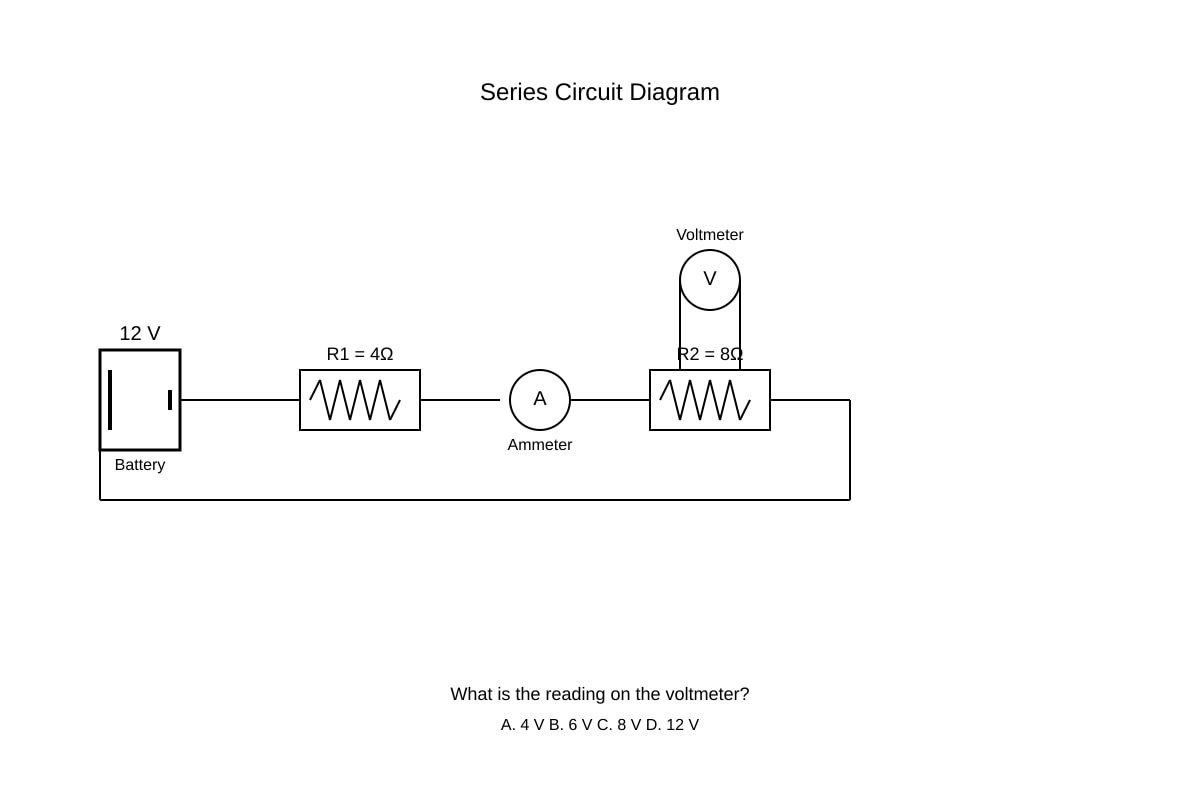
5. The diagram shows a circuit with two resistors in series connected to a 12 V battery.
<image_placeholder> id: Q5-fig1 type: diagram linked_question: Q5 description: Simple series circuit with 12 V battery, resistor R1 = 4Ω, resistor R2 = 8Ω, ammeter in series, voltmeter across R2 labels: 12 V battery, R1 = 4Ω, R2 = 8Ω, ammeter (A), voltmeter (V) across R2 values: Battery voltage 12 V, R1 = 4Ω, R2 = 8Ω must_show: Complete circuit with all components labeled, clear indication of series connection </image_placeholder>
What is the reading on the voltmeter?
A. 4 V B. 6 V C. 8 V D. 12 V
Answer: __________ (2 marks)
Section B: Structured Response I (Questions 6–10)
Answer in the spaces provided. Show all working.
6. (a) State the relationship between potential difference (), current (), and resistance (). (1 mark)
(b) A wire has a resistance of 2.5 Ω. Calculate the current through the wire when a potential difference of 10 V is applied across it. (2 marks)
Total for Q6: __________ (3 marks)
7. A student sets up an experiment to investigate electromagnetic induction using a solenoid connected to a sensitive galvanometer, and a bar magnet.
(a) Describe what happens to the galvanometer needle when: (i) The N-pole of the bar magnet is moved quickly into the solenoid. (1 mark)
(ii) The magnet is held stationary inside the solenoid. (1 mark)
(iii) The N-pole is then pulled quickly out of the solenoid. (1 mark)
(b) State two ways to increase the magnitude of the induced e.m.f. when moving the magnet into the solenoid. (2 marks)
Total for Q7: __________ (5 marks)
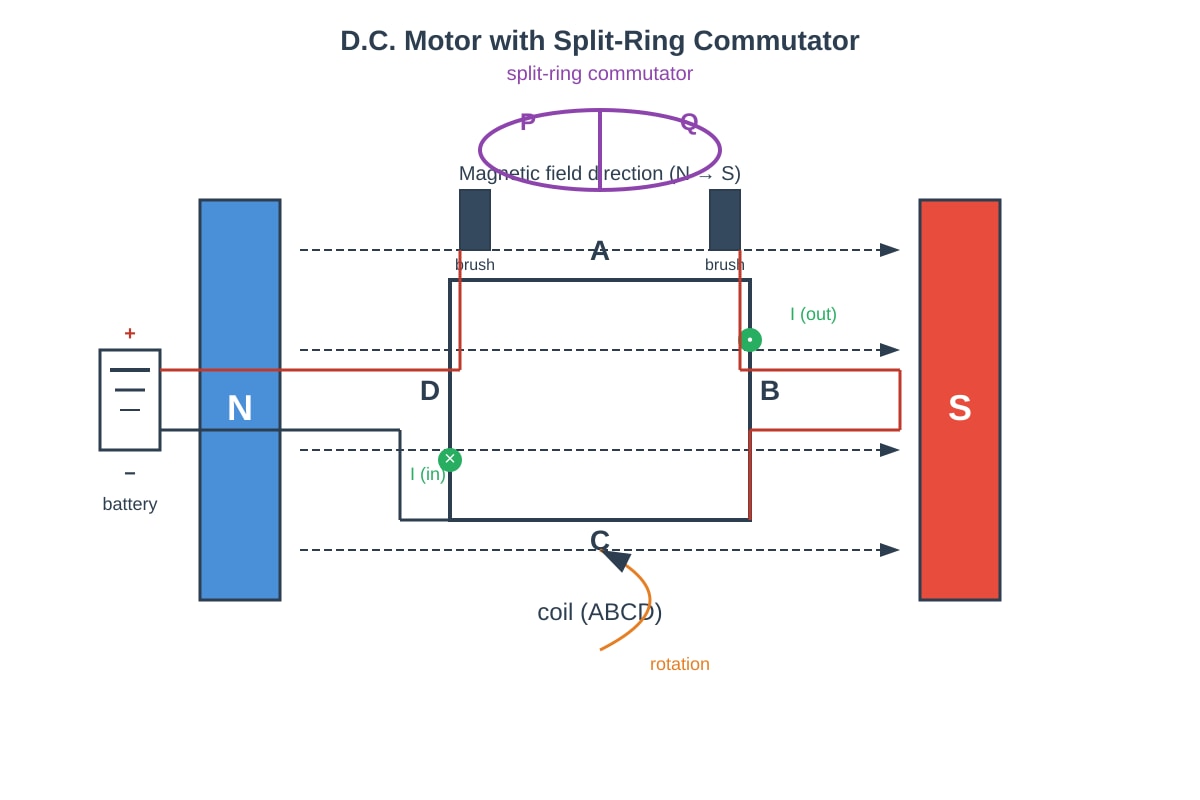
8. The diagram shows a d.c. motor with a split-ring commutator.
<image_placeholder> id: Q8-fig1 type: diagram linked_question: Q8 description: Simple d.c. motor with rectangular coil between permanent magnets, split-ring commutator, and battery connections with brushes labels: N pole, S pole, coil (ABCD), split-ring commutator (two halves P and Q), carbon brushes, battery with positive and negative terminals values: none must_show: Clear labeling of coil sides AB and CD, direction of current in coil sides, split-ring commutator segments P and Q, brush contacts, magnetic field direction N to S </image_placeholder>
(a) Explain why the split-ring commutator is necessary for continuous rotation of the coil. (2 marks)
(b) State two ways to increase the speed of rotation of the motor. (2 marks)
Total for Q8: __________ (4 marks)
9. A house has an electric kettle rated at 2.0 kW, 240 V.
(a) Calculate the current drawn by the kettle when operating normally. (2 marks)
(b) The kettle is used for 5 minutes to boil water. Calculate the electrical energy converted in kilowatt-hours (kWh). (2 marks)
Total for Q9: __________ (4 marks)
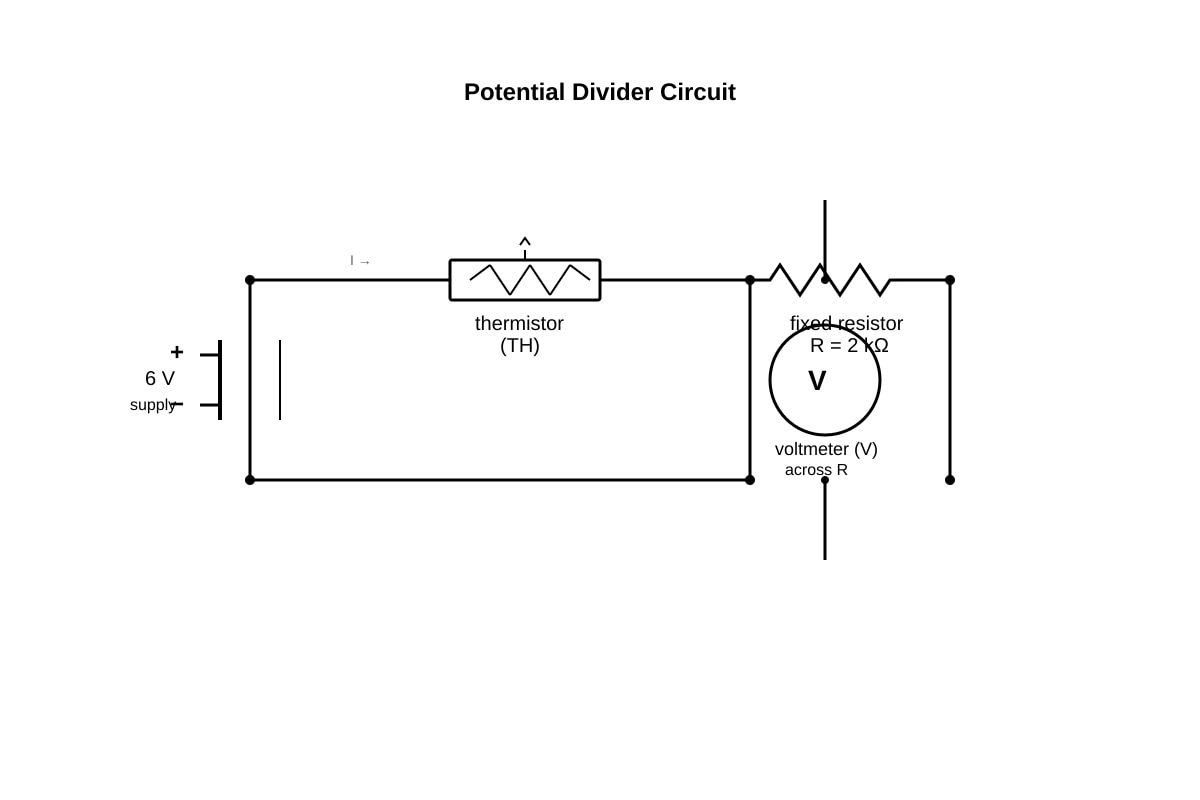
10. The diagram shows a circuit with a thermistor and a fixed resistor in a potential divider arrangement.
<image_placeholder> id: Q10-fig1 type: diagram linked_question: Q10 description: Potential divider circuit with 6 V battery, thermistor and fixed resistor R (2 kΩ) in series, voltmeter across fixed resistor labels: 6 V supply, thermistor (TH), fixed resistor R = 2 kΩ, voltmeter (V) across R values: Supply voltage = 6 V, R = 2 kΩ must_show: Clear series connection, voltmeter position across R only, labels for all components </image_placeholder>
At a certain temperature, the resistance of the thermistor is 4 kΩ.
(a) Calculate the potential difference across the fixed resistor R. (3 marks)
(b) The temperature of the thermistor increases. State and explain what happens to the potential difference across the fixed resistor. (2 marks)
Total for Q10: __________ (5 marks)
Section C: Structured Response II (Questions 11–15)
Answer in the spaces provided. Show all working clearly.
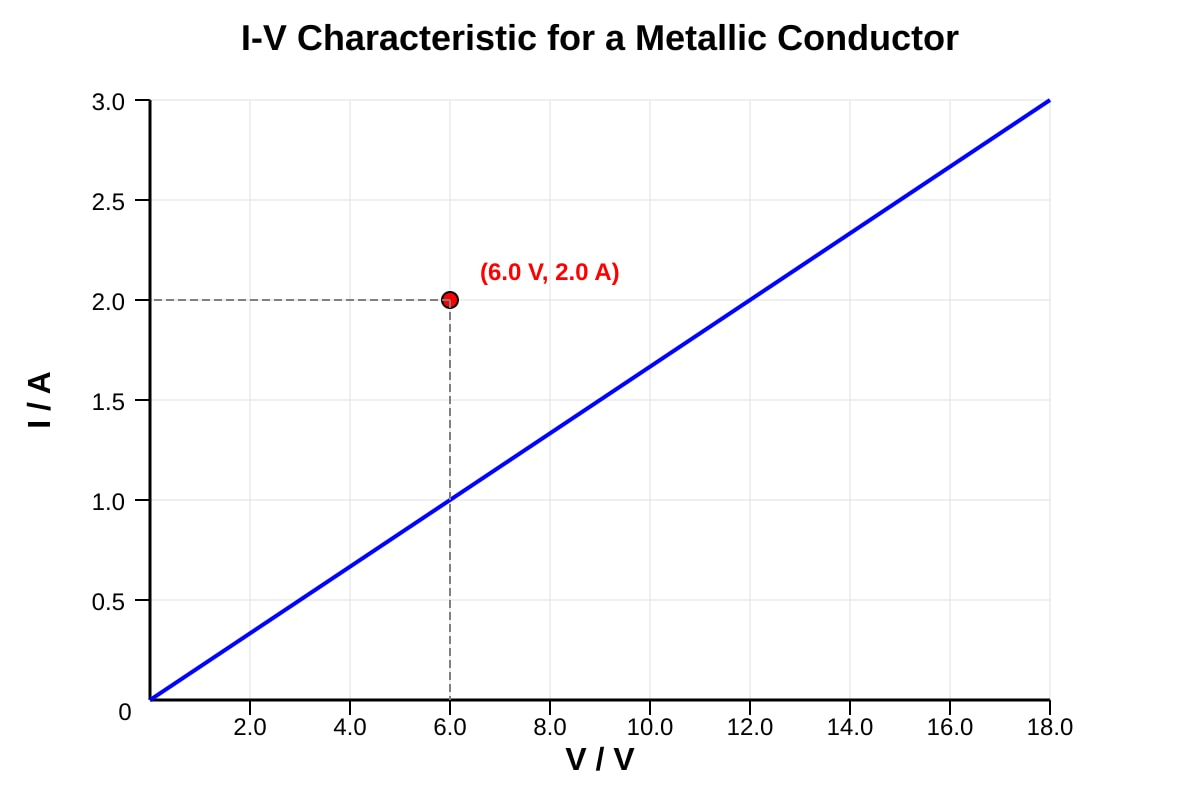
11. The graph shows the current-voltage (I-V) characteristic for a metallic conductor at constant temperature.
<image_placeholder> id: Q11-fig1 type: graph linked_question: Q11 description: I-V graph for ohmic conductor showing straight line through origin, with I on vertical axis and V on horizontal axis labels: I/A (vertical axis), V/V (horizontal axis), straight line through origin with positive gradient values: Point marked at V = 6.0 V, I = 2.0 A on the line must_show: Axes with units, linear relationship through origin, at least one labeled point for reading gradient </image_placeholder>
(a) State the physical quantity represented by the gradient of the I-V graph. (1 mark)
(b) Using the graph, determine the resistance of the conductor. (2 marks)
(c) Explain why the graph passes through the origin. (1 mark)
Total for Q11: __________ (4 marks)
12. A transformer is used to step down voltage from 240 V to 12 V for a low-voltage lighting system. The primary coil has 800 turns.
(a) Calculate the number of turns on the secondary coil. Assume the transformer is ideal. (2 marks)
(b) The lighting system consists of 4 identical lamps connected in parallel, each rated at 12 V, 24 W. Calculate the total current drawn from the secondary coil when all lamps are operating normally. (3 marks)
Total for Q12: __________ (5 marks)
13. A student investigates how the resistance of a light-dependent resistor (LDR) varies with light intensity. The results are shown in the table.
| Light intensity / lux | 10 | 30 | 50 | 70 | 100 |
|---|---|---|---|---|---|
| Resistance / kΩ | 4.0 | 2.0 | 1.2 | 0.86 | 0.60 |
(a) Describe the relationship between light intensity and resistance of the LDR. (1 mark)
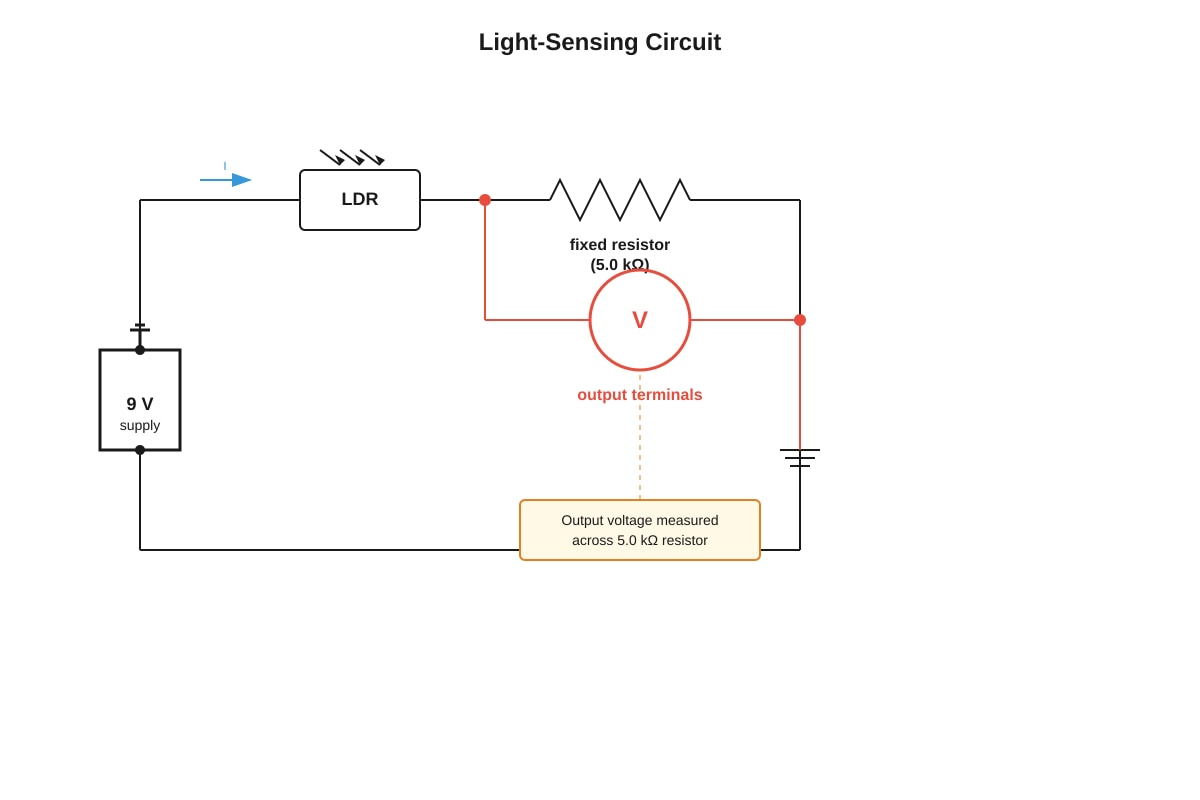
(b) An LDR is used in a light-sensing circuit as shown.
<image_placeholder> id: Q13-fig1 type: diagram linked_question: Q13 description: Light-sensing circuit with LDR and resistor in potential divider arrangement with output voltage measured labels: 9 V supply, LDR, fixed resistor (5 kΩ), output terminals with voltmeter symbol values: Supply = 9 V, fixed resistor = 5.0 kΩ must_show: Series connection of LDR and fixed resistor, clear indication of output voltage measurement points across fixed resistor, all labels visible </image_placeholder>
When the light intensity is 30 lux, calculate the output voltage across the 5.0 kΩ resistor. (3 marks)
(c) Explain why this circuit could be used to switch on a street lamp automatically at night. (2 marks)
Total for Q13: __________ (6 marks)
14. A rectangular coil with 50 turns is placed in a uniform magnetic field of flux density 0.080 T. The coil has dimensions 0.060 m × 0.040 m and is rotated about an axis perpendicular to the magnetic field.
(a) Calculate the maximum magnetic flux through the coil. (2 marks)
(b) The coil is rotated at a constant frequency. Explain why an alternating e.m.f. is induced in the coil. (3 marks)
Total for Q14: __________ (5 marks)
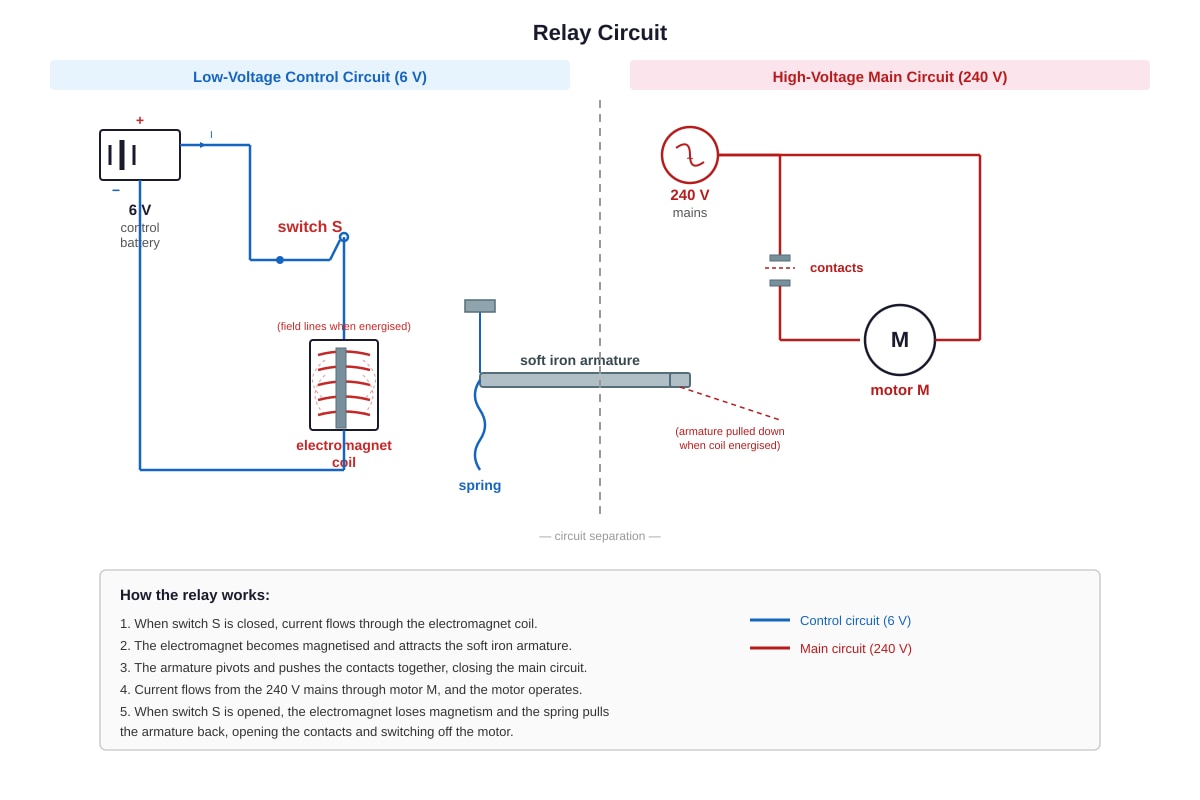
15. The diagram shows a relay circuit used to switch on a high-voltage motor using a low-voltage control circuit.
<image_placeholder> id: Q15-fig1 type: diagram linked_question: Q15 description: Relay circuit with two separate circuits: low-voltage control circuit with battery, switch, and electromagnet coil; high-voltage circuit with mains supply, motor, and switch contacts controlled by electromagnet labels: 6 V control battery, switch S, electromagnet coil, soft iron armature, spring, contacts, 240 V mains, motor M values: Control circuit = 6 V, main circuit = 240 V must_show: Two separate circuits clearly distinguished, electromagnet coil in control circuit, armature spring mechanism, contact points for main circuit, motor in main circuit, all labels visible </image_placeholder>
(a) Explain how closing switch S causes the motor M to operate. (3 marks)
(b) State two reasons why a relay is useful for controlling high-voltage equipment with a low-voltage circuit. (2 marks)
Total for Q15: __________ (5 marks)
Section D: Data Analysis and Extended Response (Questions 16–20)
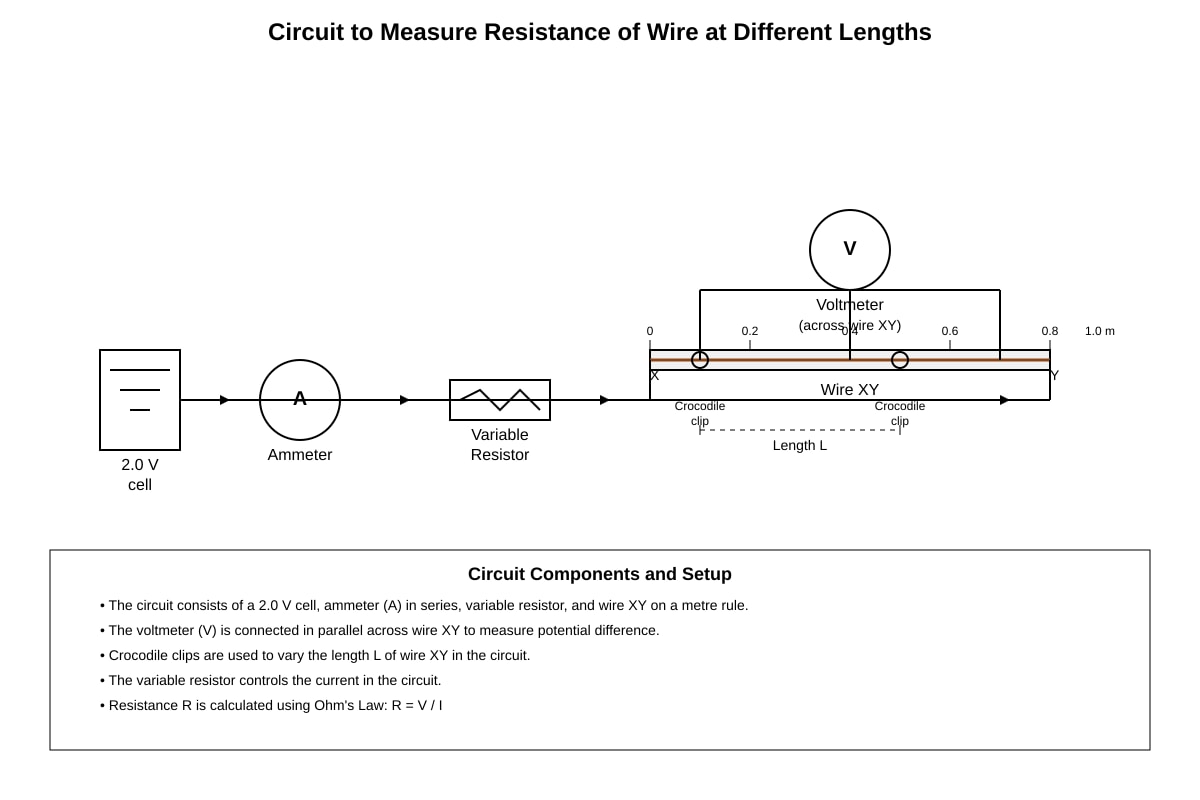
16. A student measures the resistance of a wire at different lengths using the circuit shown.
<image_placeholder> id: Q16-fig1 type: experimental_setup linked_question: Q16 description: Circuit to measure resistance of wire at different lengths using metre rule, ammeter, voltmeter, and variable resistor labels: 2.0 V cell, ammeter (A), voltmeter (V) across wire XY, variable resistor, metre rule with wire XY, crocodile clips to vary length L values: Cell emf = 2.0 V must_show: Complete circuit with ammeter in series, voltmeter in parallel across wire XY, metre rule showing length measurement, variable resistor in series, all labels visible </image_placeholder>
| Length L / m | 0.20 | 0.40 | 0.60 | 0.80 | 1.00 |
|---|---|---|---|---|---|
| Resistance R / Ω | 1.2 | 2.4 | 3.6 | 4.8 | 6.0 |
(a) Identify the independent variable and the dependent variable in this investigation. (2 marks)
Independent variable: _______________________________________________
Dependent variable: _________________________________________________
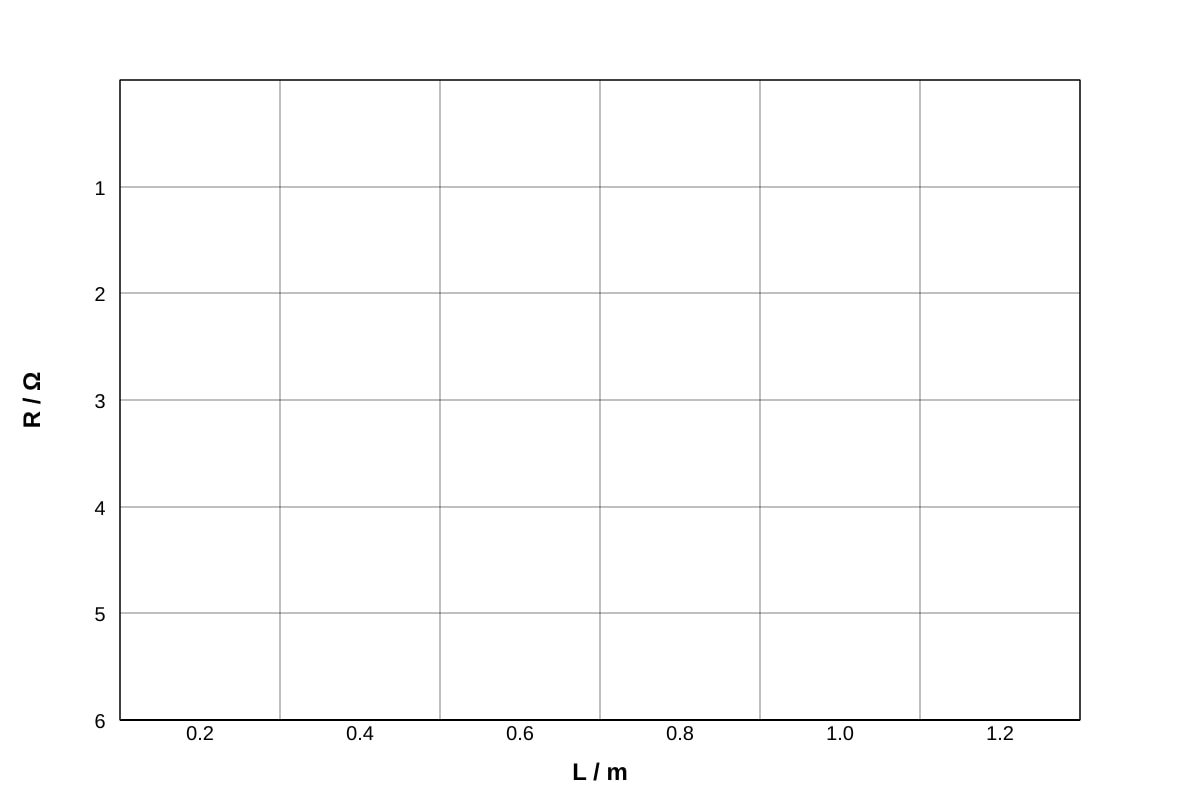
(b) Plot a graph of R (vertical axis) against L (horizontal axis) using the data provided. (3 marks)
<image_placeholder> id: Q16-fig2 type: graph linked_question: Q16 description: Blank graph grid for student to plot R vs L with axes already drawn labels: R/Ω (vertical axis), L/m (horizontal axis), grid with scales: vertical 0 to 7Ω in 1Ω divisions, horizontal 0 to 1.2 m in 0.2 m divisions values: Data points to be plotted: (0.20, 1.2), (0.40, 2.4), (0.60, 3.6), (0.80, 4.8), (1.00, 6.0) must_show: Pre-drawn axes with correct scales and labels, grid lines, space for student to plot points and draw line of best fit </image_placeholder>
(c) Use your graph to determine the resistance per metre of the wire. (2 marks)
Total for Q16: __________ (7 marks)
17. An electric shower is rated at 8.5 kW, 240 V.
(a) Calculate the current drawn by the shower. (2 marks)
(b) The shower is connected to the mains using a cable with total resistance 0.40 Ω. Calculate the power loss in the cable when the shower operates. (3 marks)
(c) Explain why it is important to use a cable with low resistance for high-power appliances. (2 marks)
Total for Q17: __________ (7 marks)
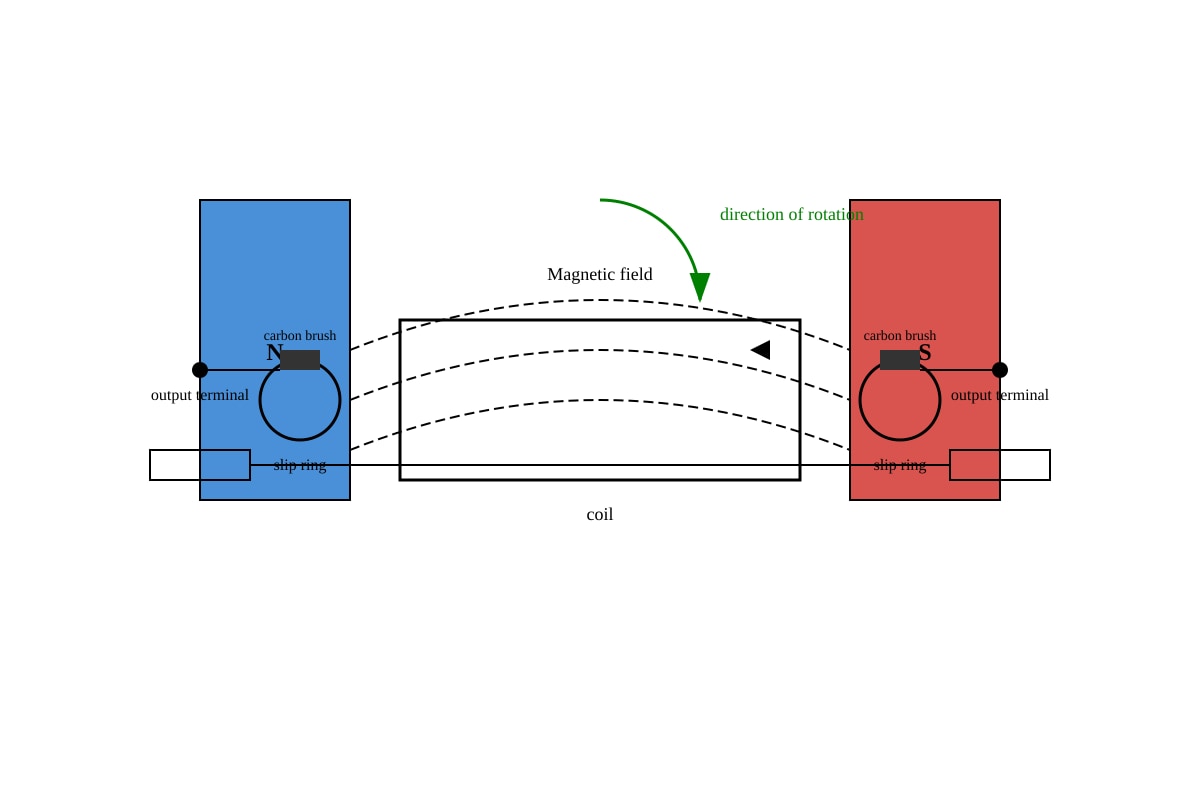
18. The diagram shows a simple a.c. generator.
<image_placeholder> id: Q18-fig1 type: diagram linked_question: Q18 description: Simple a.c. generator with rectangular coil rotating between permanent magnets, connected to external circuit via slip rings and brushes labels: N pole, S pole, coil, slip rings (two complete rings), carbon brushes, output terminals, direction of rotation arrow values: none must_show: Coil positioned horizontally between magnet poles, slip rings (not split) with brushes, external circuit connections, magnetic field direction N to S, rotation arrow </image_placeholder>
(a) Explain the purpose of the slip rings in an a.c. generator. (2 marks)
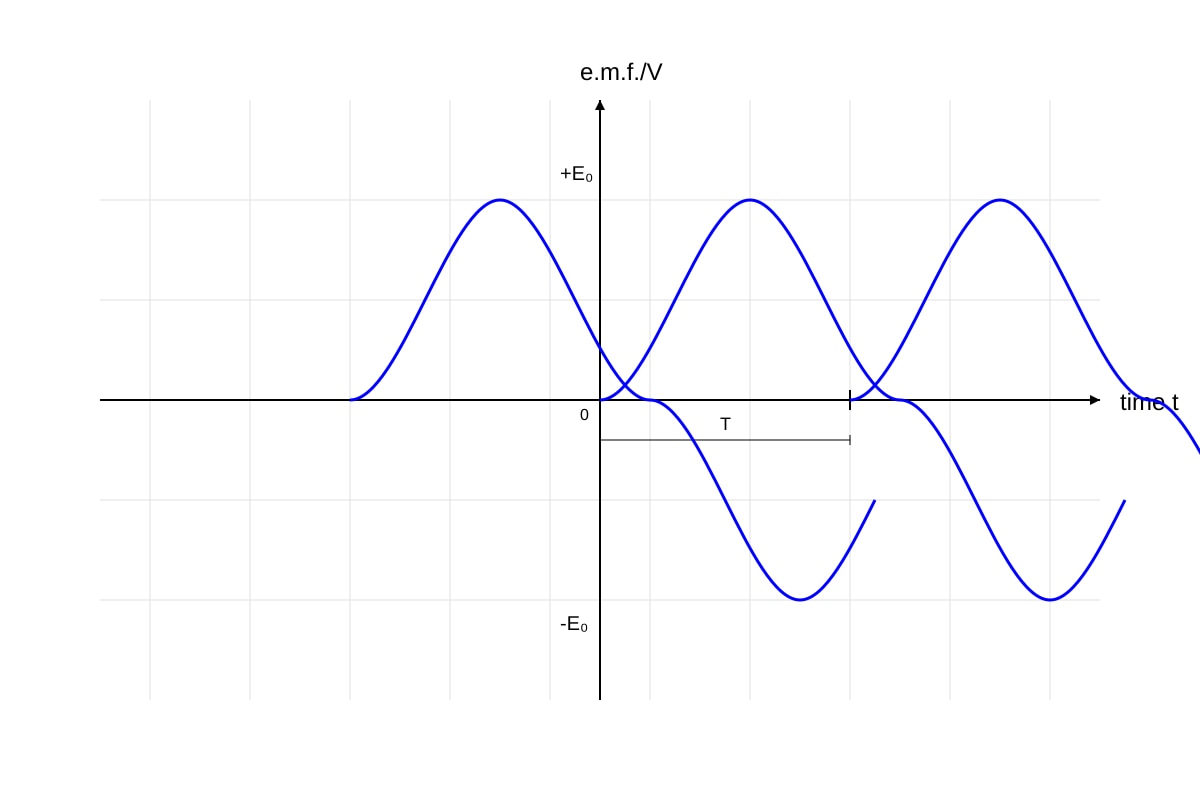
(b) The coil rotates at constant speed. Sketch a graph to show how the induced e.m.f. varies with time over two complete rotations of the coil. (3 marks)
<image_placeholder> id: Q18-fig2 type: graph linked_question: Q18 description: Blank axes for sketching sinusoidal e.m.f. vs time graph for two complete cycles labels: e.m.f./V (vertical axis, center zero line), time t (horizontal axis), two complete cycles needed values: Peak e.m.f. labeled as E0, period labeled as T, two peaks positive and two negative must_show: Sinusoidal shape centered on zero, two complete cycles, labels for peak value E0 and period T, axes with labels </image_placeholder>
(c) State two factors that affect the maximum value of the induced e.m.f. (2 marks)
Total for Q18: __________ (7 marks)
19. In a cathode ray oscilloscope (CRO), electrons are accelerated through a potential difference and then deflected by electric fields.
(a) Explain why electrons are directed through a vacuum in the CRO. (1 mark)
(b) An electron is accelerated through a potential difference of 2.0 kV. Calculate the kinetic energy gained by the electron in joules. (2 marks)
(electron charge C)
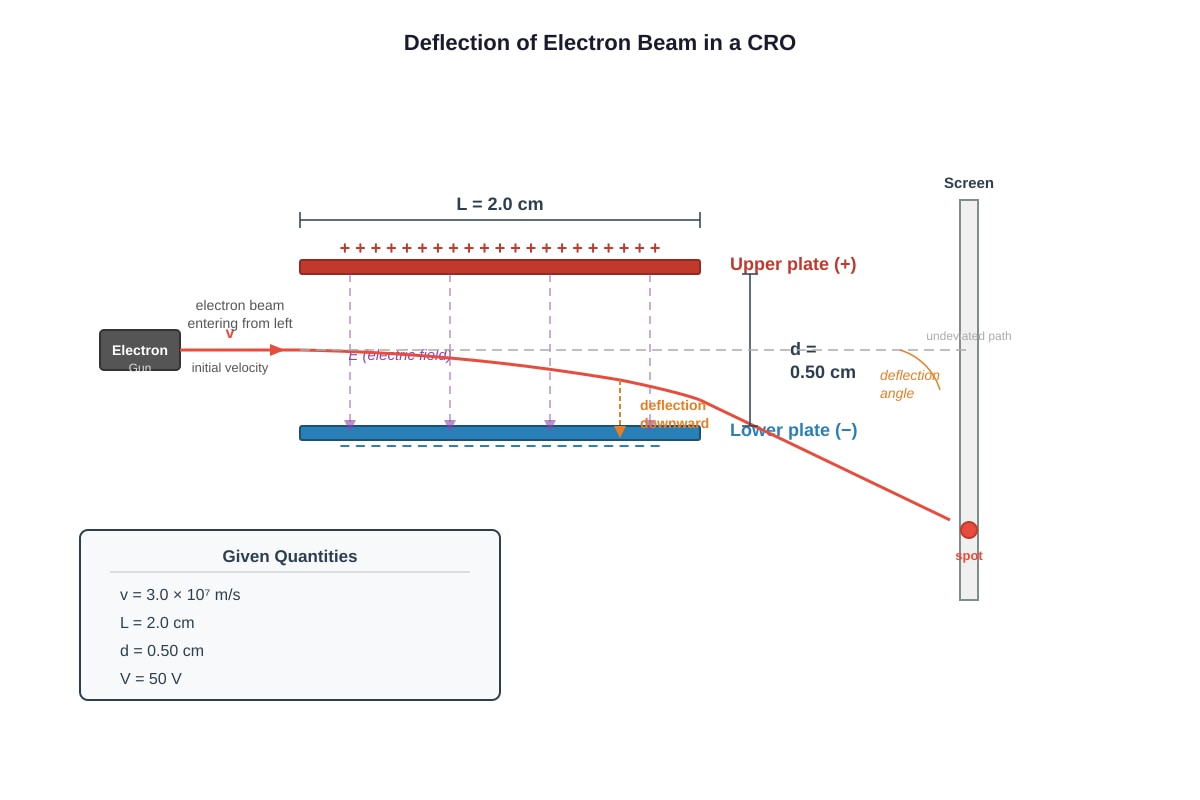
(c) The electron beam enters the region between two parallel deflection plates with a velocity of m/s. The plates are 2.0 cm long and 0.50 cm apart, with a potential difference of 50 V between them.
<image_placeholder> id: Q19-fig1 type: diagram linked_question: Q19 description: Electron beam entering between two horizontal parallel deflection plates in CRO labels: electron beam entering from left, upper plate positive, lower plate negative, length of plates L = 2.0 cm, separation d = 0.50 cm, initial velocity v, deflection downward values: v = 3.0 × 10^7 m/s, L = 2.0 cm, d = 0.50 cm, V = 50 V must_show: Electron path deflecting downward, plate labels with signs, dimension labels for L and d, initial velocity direction arrow </image_placeholder>
Calculate the electric field strength between the plates. (2 marks)
Total for Q19: __________ (5 marks)
20. A student investigates the magnetic field around a current-carrying solenoid using a plotting compass.
(a) Sketch the pattern of the magnetic field lines around a solenoid carrying current. Indicate the direction of the field lines. (3 marks)
<image_placeholder> id: Q20-fig1 type: diagram linked_question: Q20 description: Solenoid with current direction shown, space to draw magnetic field lines labels: solenoid with windings, current direction arrow (clockwise when viewed from left end), space around solenoid for field line sketch, N and S poles to be determined values: none must_show: Solenoid shape with visible windings, current direction indicator, space for student to add field lines and label poles </image_placeholder>
(b) The solenoid has 500 turns and is 0.25 m long. A current of 3.0 A passes through it. Calculate the magnetic flux density inside the solenoid. (2 marks)
(Use the formula where T·m/A)
(c) State one advantage of using an electromagnet rather than a permanent magnet in a scrap yard for lifting iron objects. (1 mark)
Total for Q20: __________ (6 marks)
TOTAL MARKS FOR QUIZ: 40 MARKS
END OF QUIZ
Answers
Secondary 4 Pure Physics Quiz - Electricity Magnetism
ANSWER KEY
Question 1 (2 marks)
Answer: B — Flow of positive charge from positive to negative terminal
Explanation: Conventional current is defined as the flow of positive charge from the higher potential (positive terminal) to the lower potential (negative terminal). This convention was established before the discovery of electrons.
Common mistake: Option A describes electron flow (actual charge carriers in metals), which is opposite in direction to conventional current. Students often confuse electron flow with conventional current direction.
Question 2 (2 marks)
Answer: C — 960 V
Working: For an ideal transformer:
Explanation: This is a step-up transformer because , so . The voltage is stepped up by the same ratio as the turns ratio.
Question 3 (2 marks)
Answer: B — Vertically downward
Working: Use Fleming's Left-Hand Rule:
- First finger (Forefinger): Magnetic Field — North to South (left to right, horizontally)
- Second finger: Current — into page (marked ×)
- Thumb: Force/Motion — vertically downward
Explanation: The motor effect force direction is determined by Fleming's Left-Hand Rule. With magnetic field horizontal (N→S) and current going into the page, the thumb points downward.
Visual check from Q3-fig1: The diagram shows N pole left, S pole right, current into page (×), so force must be perpendicular to both field and current, pointing downward.
Question 4 (2 marks)
Answer: A —
Working: For resistors in parallel:
Explanation: Parallel connection provides additional pathways for current, reducing total resistance. For n identical resistors in parallel, .
Question 5 (2 marks)
Answer: C — 8 V
Working: Total resistance: Ω
Circuit current: A
Voltage across R₂: V
Explanation: In a series circuit, current is the same throughout. Using the potential divider principle: V.
The larger resistor gets the larger share of the voltage in a series circuit.
Question 6 (3 marks)
(a) (1 mark)
Answer: (Ohm's Law) — potential difference equals current multiplied by resistance.
(b) (2 marks)
Working:
Mark scheme:
- Formula: or equivalent (1 mark)
- Correct answer with unit: 4.0 A (1 mark)
Question 7 (5 marks)
(a)(i) (1 mark)
Answer: The galvanometer needle deflects momentarily in one direction (e.g., to the right).
Explanation: Changing magnetic flux through the solenoid induces an e.m.f. (Faraday's Law). The moving magnet changes the magnetic field through the coil.
(a)(ii) (1 mark)
Answer: The needle shows zero deflection / returns to zero.
Explanation: No change in magnetic flux when the magnet is stationary. Induced e.m.f. requires a changing flux, not a steady field.
(a)(iii) (1 mark)
Answer: The needle deflects momentarily in the opposite direction (e.g., to the left).
Explanation: The magnetic flux is decreasing in the same direction (or increasing in opposite sense), and by Lenz's Law, the induced current opposes this change, reversing the direction.
(b) (2 marks) — any two from:
- Move the magnet faster — greater rate of change of flux
- Use a stronger magnet — greater flux density, so greater change in flux
- Increase number of turns on the solenoid — more conductors cutting flux
- Use a solenoid with smaller cross-sectional area / insert iron core — increases flux linkage
Question 8 (4 marks)
(a) (2 marks)
Answer:
- Each half of the split-ring commutator reverses the current direction in the coil every half-rotation.
- This ensures the current in the side of the coil near each magnetic pole reverses at the correct moment, so the force on each side always produces rotation in the same direction.
Marking points:
- Reverses current every half rotation (1 mark)
- Maintains continuous rotation in same direction / torque always in same direction (1 mark)
(b) (2 marks) — any two from:
- Increase the current through the coil
- Use a stronger magnetic field (stronger magnets)
- Increase number of turns on the coil
- Increase the area of the coil
Question 9 (4 marks)
(a) (2 marks)
Working:
Mark scheme:
- Formula: (1 mark)
- Answer: 8.33 A or 8.3 A (1 mark)
(b) (2 marks)
Working: Time = 5 minutes = h = h ≈ 0.0833 h
Or: kWh ≈ 0.167 kWh or 0.17 kWh
Mark scheme:
- Correct time conversion or working (1 mark)
- Correct answer with unit: 0.167 kWh or kWh or 0.17 kWh (1 mark)
Question 10 (5 marks)
(a) (3 marks)
Working: Total resistance = kΩ = 6000 Ω
Using potential divider:
Or using current: A = 1.0 mA
Mark scheme:
- Total resistance = 6 kΩ or 6000 Ω (1 mark)
- Correct method (potential divider or current method) (1 mark)
- Correct answer: 2.0 V (1 mark)
(b) (2 marks)
Answer: The potential difference across the fixed resistor increases.
Explanation: As temperature increases, the resistance of the thermistor decreases. With lower thermistor resistance, a smaller share of the 6 V appears across it, so a larger share appears across the fixed resistor (or: total resistance decreases, current increases, so across fixed resistor increases).
Mark scheme:
- States "increases" (1 mark)
- Correct explanation linking decreased thermistor resistance to increased V across R (1 mark)
Question 11 (4 marks)
(a) (1 mark)
Answer: or conductance or
Note: The gradient of an I-V graph equals . The reciprocal of the gradient gives resistance.
(b) (2 marks)
Working: Gradient = A/V ≈ 0.333 A/V
Or read any point: Ω
Mark scheme:
- Use of or reciprocal of gradient (1 mark)
- Answer: 3.0 Ω (1 mark)
(c) (1 mark)
Answer: When V = 0, no potential difference exists to drive current, so I = 0.
Or: No electric field, so no force on charge carriers, hence no drift velocity, hence no current.
Question 12 (5 marks)
(a) (2 marks)
Working:
Mark scheme:
- Formula or ratio method (1 mark)
- Answer: 40 turns (1 mark)
(b) (3 marks)
Working: Current in each lamp: A
For 4 identical lamps in parallel: A
Or: Total power = W
Mark scheme:
- Current per lamp = 2.0 A or total power = 96 W (1 mark)
- Method for combining currents in parallel (1 mark)
- Answer: 8.0 A (1 mark)
Question 13 (6 marks)
(a) (1 mark)
Answer: As light intensity increases, the resistance of the LDR decreases. (Inverse relationship / non-linear inverse relationship.)
(b) (3 marks)
Working: At 30 lux, kΩ = 2000 Ω
Total resistance = Ω
Or ≈ 6.4 V or 6.43 V
Mark scheme:
- Correct LDR resistance from table (2.0 kΩ) (1 mark)
- Potential divider method or current method (1 mark)
- Answer: 6.43 V or 6.4 V (1 mark)
(c) (2 marks)
Answer: At night, light intensity is low, so LDR resistance is high. This means the output voltage across the fixed resistor is low. This low voltage can be used to trigger a transistor or switching circuit to turn on the lamp. (Or converse: by day, high light intensity gives low LDR resistance, high output voltage, which keeps lamp off.)
Mark scheme:
- Links low light to high LDR resistance (1 mark)
- Explains how this changes output voltage to switch circuit on/off (1 mark)
Question 14 (5 marks)
(a) (2 marks)
Working: Maximum flux when coil is perpendicular to field (θ = 0°, cos θ = 1):
Or: Wb
Mark scheme:
- Correct area calculation (0.0024 m²) or formula (1 mark)
- Correct answer with unit: Wb or 0.0096 Wb (1 mark)
(b) (3 marks)
Answer:
- As the coil rotates, the angle between the coil's normal and the magnetic field changes continuously.
- This means the magnetic flux linking the coil changes with time.
- By Faraday's Law, an e.m.f. is induced when there is a change in magnetic flux linkage.
- Since the rotation is continuous, the flux alternately increases and decreases, inducing an e.m.f. that reverses direction — hence alternating e.m.f.
Mark scheme:
- Flux linkage changes as angle changes (1 mark)
- Faraday's Law: changing flux induces e.m.f. (1 mark)
- Direction reverses due to continuous rotation / alternating nature explained (1 mark)
Question 15 (5 marks)
(a) (3 marks)
Answer:
- Closing switch S allows current to flow through the electromagnet coil in the control circuit.
- The electromagnet becomes magnetized and attracts the soft iron armature.
- The armature moves, closing the contacts in the high-voltage circuit.
- Current now flows through the main circuit, and motor M operates.
Mark scheme:
- Current flows, electromagnet energized/becomes magnetized (1 mark)
- Armature attracted/moves, contacts close (1 mark)
- Main circuit completed, motor operates (1 mark)
(b) (2 marks) — any two from:
- Electrical isolation: The control circuit and high-voltage circuit are electrically separate, protecting the operator from high voltage.
- Safety: Low-voltage circuits are safer to operate and can use thin, inexpensive wiring.
- Remote control: Allows switching of dangerous/high-power equipment from a safe distance or using automated systems.
- Switching high current: The low-voltage circuit doesn't need to carry the high current required by the motor.
Question 16 (7 marks)
(a) (2 marks)
Answer:
- Independent variable: Length L of the wire (1 mark)
- Dependent variable: Resistance R of the wire (1 mark)
(b) (3 marks)
Marking guidance for graph (Q16-fig2):
- Correct axes labels with units: R/Ω and L/m (1 mark)
- All five points plotted accurately within ±1 mm (1 mark)
- Straight line of best fit through origin (1 mark)
(c) (2 marks)
Working: Gradient = Ω/m
Or using any two points: Ω/m
Resistance per metre = 6.0 Ω/m
Mark scheme:
- Method: gradient calculation or use of two points (1 mark)
- Answer: 6.0 Ω/m or 6 Ω/m (1 mark)
Question 17 (7 marks)
(a) (2 marks)
Working:
Mark scheme:
- Formula: (1 mark)
- Answer: 35.4 A or 35.42 A (1 mark)
(b) (3 marks)
Working: Power loss in cable:
Or using rounded value: W ≈ 500 W
Accept 500–502 W
Mark scheme:
- Use of or equivalent (1 mark)
- Correct substitution (1 mark)
- Answer: approximately 500 W or 502 W (1 mark)
(c) (2 marks)
Answer:
- High current flows in high-power appliances.
- Higher cable resistance leads to greater power loss (), wasting energy as heat in the cable.
- Also, the cable could overheat, creating a fire risk.
- Low resistance cable minimizes energy loss and keeps the cable temperature safe.
Mark scheme:
- Power loss proportional to R (or stated) (1 mark)
- Energy wasted as heat / overheating risk explained (1 mark)
Question 18 (7 marks)
(a) (2 marks)
Answer:
- Slip rings provide continuous electrical connection between the rotating coil and the external circuit without reversing current direction.
- Unlike the split-ring commutator in a d.c. motor, slip rings maintain the same connection to each side of the coil, allowing the natural alternating output to be collected.
Mark scheme:
- Maintain continuous contact with rotating coil (1 mark)
- Do not reverse current / allow alternating output to be transmitted (1 mark)
(b) (3 marks)
Expected sketch features (Q18-fig2):
- Sinusoidal wave shape centered on zero (1 mark)
- Two complete cycles shown (1 mark)
- Labels for peak value and period (1 mark)
(c) (2 marks) — any two from:
- Speed of rotation (angular velocity ω) — faster rotation gives greater rate of change of flux
- Number of turns on the coil (N) — more turns means more flux linkage
- Magnetic flux density (B) — stronger field gives greater flux
- Area of the coil (A) — larger area means more flux linkage
Question 19 (5 marks)
(a) (1 mark)
Answer: Electrons would collide with air molecules, scattering the beam and preventing it from reaching the screen with sufficient energy.
Or: To prevent electrons from being absorbed or scattered by air, which would defocus the beam.
(b) (2 marks)
Working:
Mark scheme:
- Formula: or substitution (1 mark)
- Answer with unit: J (1 mark)
(c) (2 marks)
Working:
Or 10 000 N/C or 10 kV/m
Mark scheme:
- Formula: with d in metres (1 mark)
- Answer: V/m or 10 000 V/m (1 mark)
Question 20 (6 marks)
(a) (3 marks)
Expected answer for Q20-fig1 sketch:
- Field lines emerge from one end of solenoid and enter the other (1 mark)
- Closed loops with lines continuing outside the solenoid (1 mark)
- Correct polarity labeled: Right-hand rule gives N pole where thumb points when fingers curl in current direction. If current is clockwise from left, right end is S pole, left end is N pole. (1 mark)
Direction check: With current clockwise viewed from left, left end is S pole and right end is N pole (use right-hand grip rule: fingers curl with current, thumb points to N pole — actually thumb points to N pole, so if current clockwise from left view, thumb points right, so right is N).
Wait — recheck: Standard right-hand grip rule: fingers curl in direction of conventional current, thumb points to North pole. So if current is clockwise when viewed from left end, thumb points to right, so right end is N pole.
Field lines: emerge from right (N), loop around outside, enter left (S), continue through interior from S to N.
(b) (2 marks)
Working: Number of turns per unit length: turns/m
Or: T ≈ T
Mark scheme:
- Correct n calculation or correct substitution (1 mark)
- Answer: T or 7.54 mT (accept range 7.5–7.6 × 10⁻³ T) (1 mark)
(c) (1 mark)
Answer: The magnetic field can be switched on and off / controlled by turning the current on and off.
Or: The strength of the magnetic field can be varied by changing the current.
Or: Can be used to drop objects by turning off current (permanent magnet would be always on).
END OF ANSWER KEY