From Real Exams Quiz
Secondary 4 Pure Physics Electricity Magnetism Quiz
Free Sec 4 Pure Physics Electricity Magnetism quiz, HY3 Exam version, with questions, answers, and O Level-style practice for Singapore students.
These static practice materials are generated from the site's syllabus and paper-generation workflow, with source and model context shown so students and parents can evaluate the material before use.
Questions
Secondary 4 Pure Physics Quiz - Electricity Magnetism
Name: ___________________________
Class: ___________________________
Date: ___________________________
Score: _______ / 40
Duration: 60 minutes
Total Marks: 40
Instructions:
- Answer all 20 questions.
- Section A: Short structured questions (1–8)
- Section B: Calculation and data questions (9–14)
- Section C: Extended response and interpretation (15–20)
- Show all working clearly. Use SI units.
- Write answers in the spaces provided.
Section A: Short Structured Questions (1–8) [8 marks]
1. State the function of the neutral wire in a household alternating-current circuit. [1]
2. State one advantage of using a circuit breaker rather than a fuse to protect an appliance. [1]
3. A positively charged rod is moved quickly away from a coil connected to a galvanometer. State what is observed on the galvanometer. [1]
4. Define the turns ratio of a transformer. [1]
5. State the energy transformation that occurs in the secondary coil of a transformer during normal operation. [1]
6. State one safety feature of the earth wire in a household appliance. [1]
7. A magnet is pushed into a stationary coil. State the law that predicts the direction of the induced current. [1]
8. State the relationship between primary and secondary currents in an ideal transformer. [1]
Section B: Calculation and Data Questions (9–14) [12 marks]
9. A transformer has a primary voltage of 240 V and a secondary voltage of 12 V. The secondary current is 2.0 A and the transformer is 100% efficient. Calculate the current in the primary coil. [2]
10. Transformer X has 500 turns on the primary coil and 100 turns on the secondary coil. The primary current is 0.50 A and the transformer is ideal. Calculate the secondary current. [2]
11. A transformer is 80% efficient. The secondary coil delivers 60 V at 3.0 A. The primary voltage is 240 V. Calculate the primary current. [2]
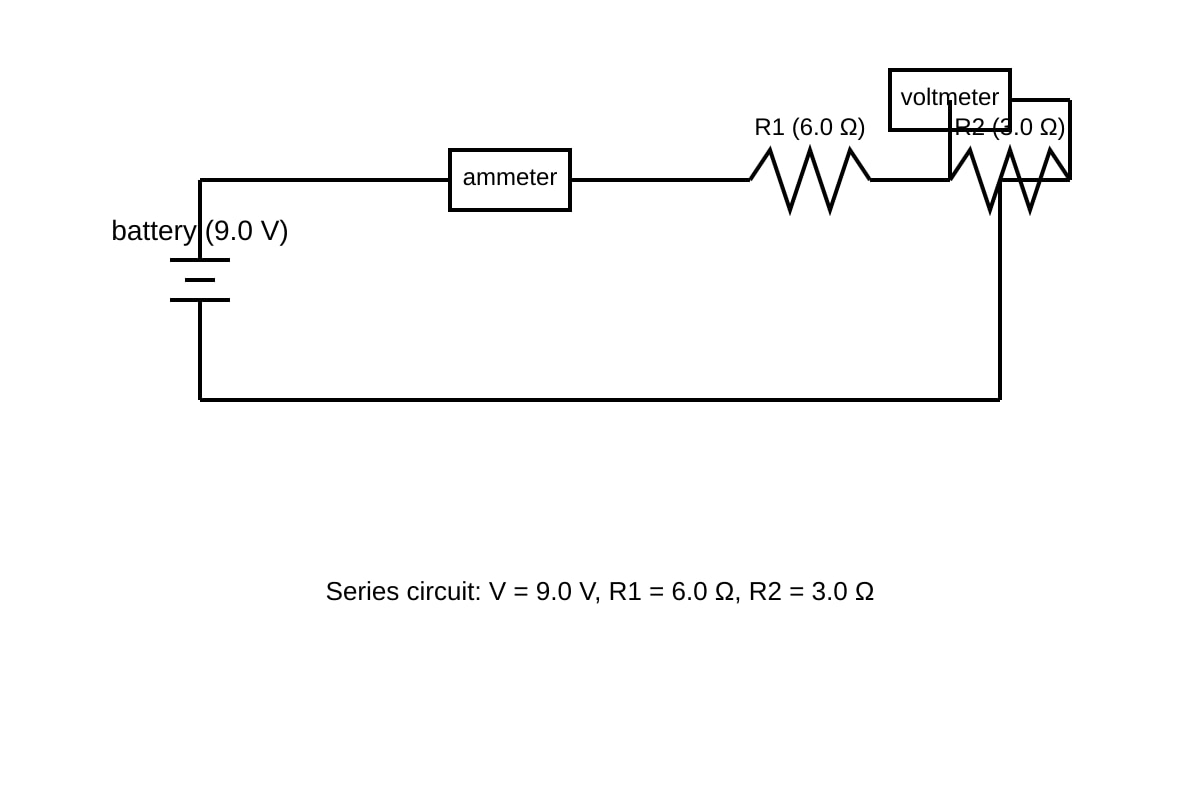
12. The diagram shows a simple DC circuit with two resistors.
Image pending generation: diagram for Q12.
Calculate (a) the total resistance, [1] and (b) the current through the circuit. [1]
13. A coil of wire has a resistance of 4.0 Ω and is connected to a 12 V supply. Calculate the power dissipated in the coil. [2]
14. A step-up transformer has 200 primary turns and 800 secondary turns. If the primary voltage is 50 V, calculate the secondary voltage assuming ideal operation. [2]
Section C: Extended Response and Interpretation (15–20) [20 marks]
15. (a) State Faraday’s law of electromagnetic induction. [1]
(b) A magnet is dropped through a coil connected to a datalogger. Explain why the induced electromotive force (e.m.f.) is zero when the magnet is at the centre of the coil. [2]
16. A household appliance has a metal casing and is connected to a 230 V supply with a live, neutral, and earth wire.
(a) State the function of the earth wire. [1]
(b) Explain how the earth wire protects a person from electric shock if the live wire touches the metal casing. [3]
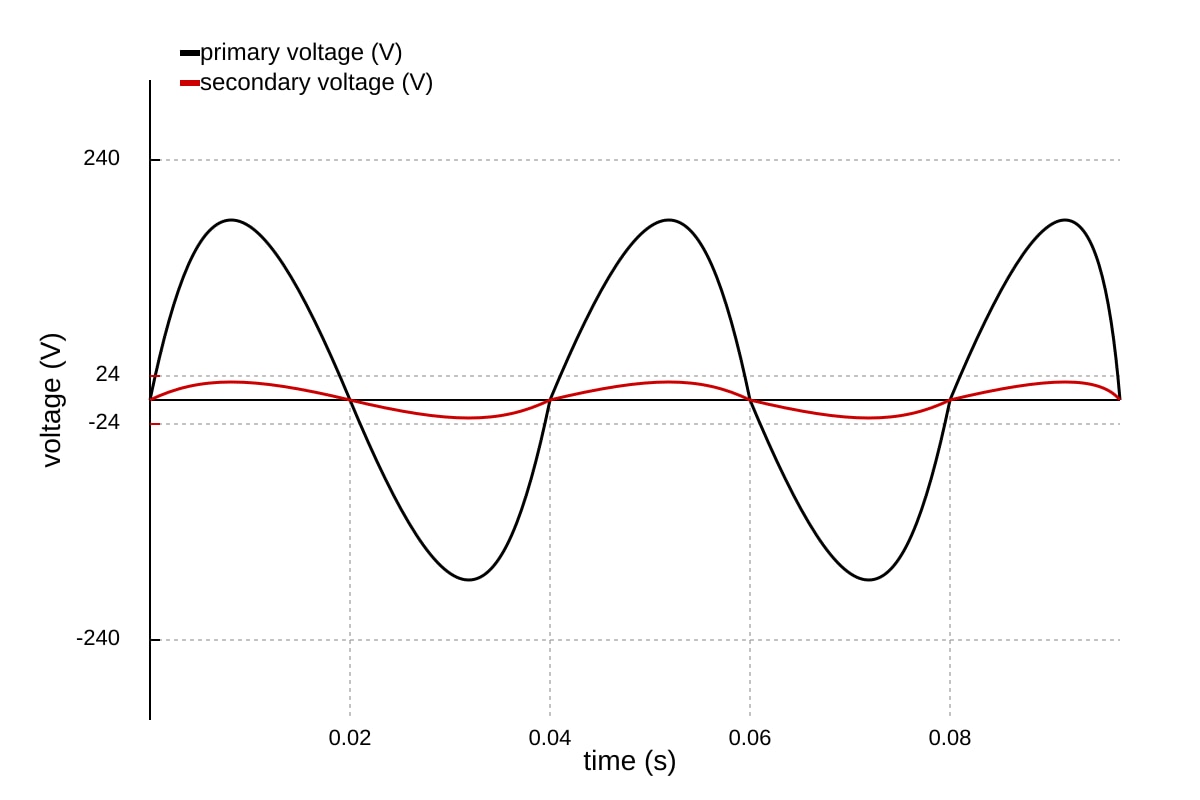
17. The graph shows the output voltage of a transformer primary and secondary over time.
Image pending generation: graph for Q17.
(a) Determine the turns ratio of the transformer. [2]
(b) State whether this is a step-up or step-down transformer and give a reason. [2]
18. A student builds an electromagnet by wrapping 100 turns of insulated wire around a soft-iron core and connects it to a 6.0 V battery with total circuit resistance 2.0 Ω.
(a) Calculate the current in the wire. [2]
(b) State two ways to increase the strength of the magnetic field of the electromagnet. [2]
19. A transformer is used to charge a laptop. The primary is connected to 230 V mains and the secondary provides 19 V at 3.4 A. The transformer has an efficiency of 90%.
(a) Calculate the useful output power. [2]
(b) Calculate the input power drawn from the mains. [2]
(c) Calculate the primary current. [2]
20. (a) Explain how electromagnetic induction is used in a bicycle dynamo to light a lamp. [3]
(b) State one factor that affects the magnitude of the induced e.m.f. in the dynamo and explain why. [2]
Answers
Secondary 4 Pure Physics Quiz - Electricity Magnetism: Answer Key
Total Marks: 40
Topic: Electricity & Magnetism
Section A: Short Structured Questions
1. [1 mark]
Answer: The neutral wire provides the return path for current to the supply and is at approximately zero potential.
Teaching note: In an AC household circuit, current flows out through the live wire and returns through the neutral wire, completing the circuit.
2. [1 mark]
Answer: A circuit breaker can be reset and reused after tripping; a fuse must be replaced. (Also accept: faster response to overcurrent.)
Teaching note: Fuses melt and are single-use; circuit breakers trip electronically and can be switched on again.
3. [1 mark]
Answer: The galvanometer needle deflects momentarily in the opposite direction to when the rod was brought near.
Teaching note: Removing the charged rod changes magnetic flux; by Lenz’s law the induced current opposes the change, causing opposite deflection.
4. [1 mark]
Answer: Turns ratio = number of turns on primary coil ÷ number of turns on secondary coil = Np/Ns.
Teaching note: This ratio determines voltage and current changes in a transformer.
5. [1 mark]
Answer: Electrical energy in the primary is transferred magnetically and induced as electrical energy in the secondary (electrical → magnetic → electrical).
Teaching note: No direct electrical connection exists between coils.
6. [1 mark]
Answer: The earth wire connects the metal casing to ground so it cannot become live.
Teaching note: Prevents dangerous potential on exposed metal.
7. [1 mark]
Answer: Lenz’s law.
Teaching note: Lenz’s law states induced current direction opposes the change producing it.
8. [1 mark]
Answer: Ip/Is=Ns/Np (or Is/Ip=Np/Ns); currents are inversely proportional to turns.
Teaching note: Ideal transformer conserves power: VpIp=VsIs.
Section B: Calculation and Data Questions
9. [2 marks]
Given: Vp=240 V, Vs=12 V, Is=2.0 A, η=100%=1.
Step 1: VpIp=VsIs
Step 2: Ip=VpVsIs=24012×2.0=0.10 A
Answer: 0.10 A
Marking: 1 mark substitution, 1 mark correct answer with unit.
10. [2 marks]
Given: Np=500, Ns=100, Ip=0.50 A, ideal.
Step 1: IpIs=NsNp
Step 2: Is=0.50×100500=2.5 A
Answer: 2.5 A
Marking: 1 mark for ratio use, 1 mark final answer.
11. [2 marks]
Given: η=0.80, Vs=60 V, Is=3.0 A, Vp=240 V.
Step 1: Output power Ps=VsIs=60×3.0=180 W
Step 2: Input power Pp=Ps/η=180/0.80=225 W
Step 3: Ip=Pp/Vp=225/240=0.9375≈0.94 A
Answer: 0.94 A
Marking: 1 mark working, 1 mark answer.
12. [2 marks]
(a) [1] Rtotal=R1+R2=6.0+3.0=9.0 Ω
(b) [1] I=V/R=9.0/9.0=1.0 A
Answer: (a) 9.0 Ω, (b) 1.0 A
13. [2 marks]
Given: R=4.0 Ω, V=12 V.
Step 1: P=V2/R=122/4.0=144/4.0=36 W
Answer: 36 W
Marking: 1 mark formula, 1 mark answer.
14. [2 marks]
Given: Np=200, Ns=800, Vp=50 V.
Step 1: VpVs=NpNs
Step 2: Vs=50×200800=200 V
Answer: 200 V
Marking: 1 mark ratio, 1 mark answer.
Section C: Extended Response and Interpretation
15. [3 marks]
(a) [1] Faraday’s law: induced e.m.f. is proportional to the rate of change of magnetic flux linkage.
(b) [2] At the centre, the rate of change of flux is zero because the magnet’s field through the coil is symmetric and not changing at that instant; hence e.m.f. = 0.
Marking: 1 mark law, 2 marks explanation with flux change zero.
16. [4 marks]
(a) [1] Earth wire connects casing to ground at zero potential.
(b) [3] If live touches casing, current flows through earth wire to ground (low resistance path). This large current trips breaker/fuse, cutting supply. Person touching casing not shocked as casing near 0 V.
Marking: 1 + 3 with reasoning.
17. [4 marks]
(a) [2] Turns ratio Np/Ns=Vp/Vs=240/24=10.
(b) [2] Step-down; secondary voltage lower than primary.
Marking: 2 + 2.
18. [4 marks]
(a) [2] I=V/R=6.0/2.0=3.0 A
(b) [2] Increase turns, increase current, use soft-iron core (any two).
Marking: 2 + 2.
19. [6 marks]
(a) [2] Pout=19×3.4=64.6 W
(b) [2] Pin=64.6/0.90=71.8 W
(c) [2] Ip=71.8/230=0.312 A
Marking: 2 each step.
20. [5 marks]
(a) [3] Dynamo has coil rotating in magnetic field (or magnet near coil). Rotation changes flux, inducing e.m.f. in coil, current lights lamp.
(b) [2] Factor: speed of rotation; faster rotation → greater rate of flux change → larger e.m.f. (also accept number of turns, field strength).
Marking: 3 + 2.
Free quiz and exam paper access
Enter your details to view this paper
Your access is remembered on this device.