From Real Exams Quiz
Secondary 4 Pure Physics Electricity Magnetism Quiz
Free Sec 4 Pure Physics Electricity Magnetism quiz, Exam version, with questions, answers, and O Level-style practice for Singapore students.
These static practice materials are generated from the site's syllabus and paper-generation workflow, with source and model context shown so students and parents can evaluate the material before use.
Questions
Free quiz and exam paper access
Enter your details to view this paper
Your access is remembered on this device.
Answers
Secondary 4 Pure Physics Quiz - Electricity Magnetism (Answers)
Section A: Short Answer Questions [8 marks]
1. State the function of the neutral wire in a household electrical circuit. [1]
Answer: Provides return path for current / Completes the circuit at zero potential Mark: 1 mark for correct function
2. State one advantage of using a circuit breaker rather than a fuse to protect electrical appliances. [1]
Answer: Can be reset without replacement / Reusable / Faster response to overcurrent Mark: 1 mark for any correct advantage
3. A transformer has a turns ratio of 5:1 (primary to secondary). If the primary voltage is 240 V, calculate the secondary voltage. [2]
Working: Vₛ/Vₚ = Nₛ/Nₚ Vₛ/240 = 1/5 Vₛ = 240 × 1/5 = 48 V
Answer: 48 V Marks: 1 mark for correct formula/method, 1 mark for correct answer with unit
4. Define electromagnetic induction. [2]
Answer: The process by which an EMF (electromotive force) is induced in a conductor when there is a change in magnetic flux through it / when a conductor moves through a magnetic field Marks: 1 mark for EMF/voltage induced, 1 mark for change in magnetic flux/field
5. State the principle that explains why a galvanometer needle deflects when a magnet is moved near a coil. [2]
Answer: Faraday's Law of electromagnetic induction - when magnetic flux through a coil changes, an EMF is induced which causes current to flow Marks: 1 mark for Faraday's Law, 1 mark for explanation of flux change causing EMF/current
Section B: Structured Questions [17 marks]
6. A step-down transformer is used to reduce the voltage from 240 V to 12 V. The transformer has an efficiency of 80%.
(a) Calculate the turns ratio (primary : secondary) of this transformer. [2]
Working: Nₚ/Nₛ = Vₚ/Vₛ = 240/12 = 20 Turns ratio = 20:1
Answer: 20:1 Marks: 1 mark for correct formula, 1 mark for correct ratio
(b) If the secondary current is 2.5 A, calculate the primary current. [3]
Working: Efficiency η = (VₛIₛ)/(VₚIₚ) 0.80 = (12 × 2.5)/(240 × Iₚ) 0.80 = 30/(240 × Iₚ) Iₚ = 30/(0.80 × 240) = 30/192 = 0.156 A
Answer: 0.156 A (or 0.16 A) Marks: 1 mark for efficiency formula, 1 mark for correct substitution, 1 mark for correct answer
(c) Calculate the power loss in the transformer. [2]
Working: Input power = VₚIₚ = 240 × 0.156 = 37.5 W Output power = VₛIₛ = 12 × 2.5 = 30 W Power loss = 37.5 - 30 = 7.5 W
Answer: 7.5 W Marks: 1 mark for calculating input and output power, 1 mark for correct power loss
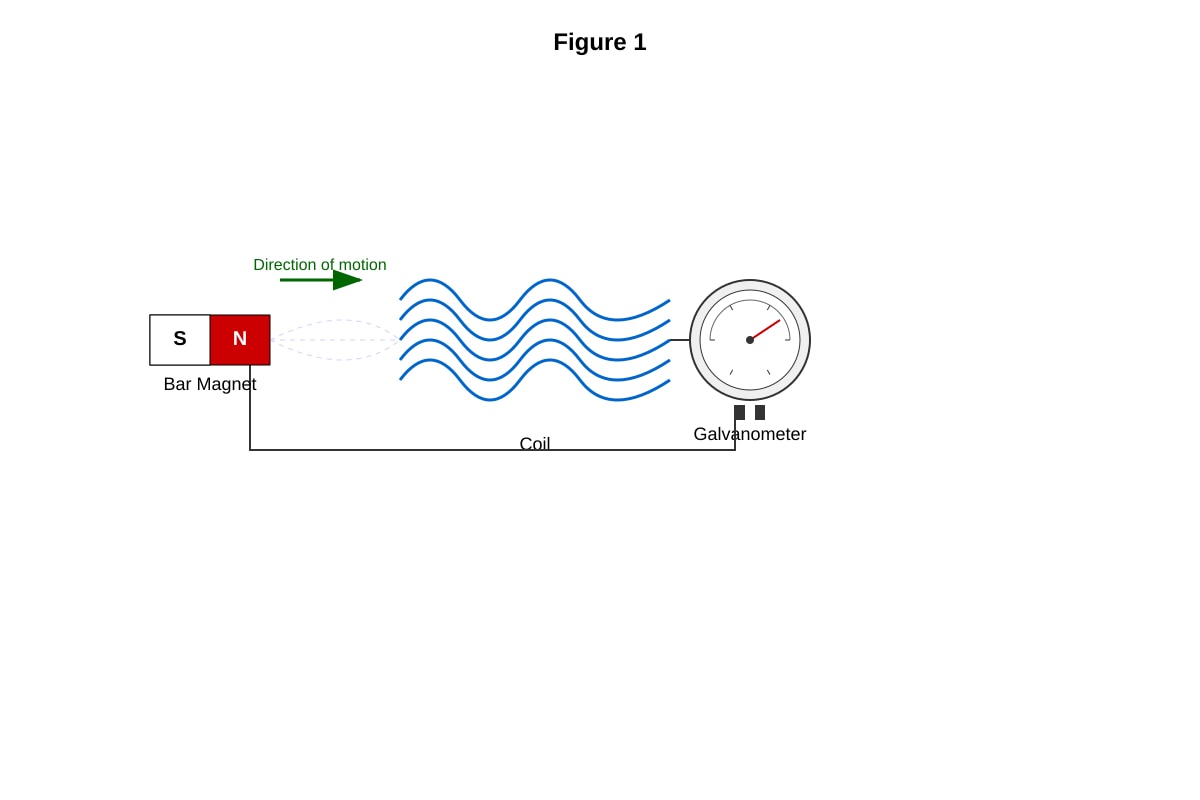
7. Figure 1 shows a simple electromagnetic induction experiment.
(a) State what is observed on the galvanometer when the north pole of the magnet is moved quickly towards the coil. [1]
Answer: The needle deflects (in one direction) Mark: 1 mark for deflection
(b) Explain why this observation occurs. [2]
Answer: Moving the magnet changes the magnetic flux through the coil, which induces an EMF (Faraday's Law), causing current to flow and deflecting the galvanometer needle Marks: 1 mark for flux change, 1 mark for EMF induced causing current
(c) State what happens to the galvanometer reading when the magnet is held stationary inside the coil. [1]
Answer: No deflection / Reading returns to zero Mark: 1 mark for correct observation
8. A household electrical circuit contains a 2 kW electric kettle connected to the 240 V mains supply.
(a) Calculate the current flowing through the kettle. [2]
Working: P = VI 2000 = 240 × I I = 2000/240 = 8.33 A
Answer: 8.33 A (or 8.3 A) Marks: 1 mark for correct formula, 1 mark for correct answer with unit
(b) If the kettle is used for 15 minutes per day, calculate the electrical energy consumed in one day. [2]
Working: Time = 15 minutes = 15/60 = 0.25 hours Energy = Power × Time = 2 × 0.25 = 0.5 kWh
Answer: 0.5 kWh Marks: 1 mark for time conversion, 1 mark for correct energy calculation
(c) State two safety features that should be present in the household electrical circuit. [2]
Answer:
- Fuse/Circuit breaker
- Earth wire/Earthing system
Marks: 1 mark each for two correct safety features Accept: RCCB/ELCB, Double insulation, Proper wiring standards