AI Generated Exam Paper
Secondary 4 Pure Physics Practice Paper 5
Free Sec 4 Pure Physics Practice Paper 5, HY3 AI version, with questions, answers, and O Level-style practice for Singapore students.
These static practice materials are generated from the site's syllabus and paper-generation workflow, with source and model context shown so students and parents can evaluate the material before use.
Questions
TuitionGoWhere Practice Paper - Pure Physics Secondary 4
TuitionGoWhere Practice Paper (AI) — Version 5
Subject: Pure Physics
Level: Secondary 4
Paper: Practice Paper (Topic: Electricity & Magnetism)
Duration: 60 minutes
Total Marks: 60
Name: ________________________
Class: ________
Date: ________
Instructions:
- Answer all questions in the spaces provided.
- Show all working clearly where calculation is required.
- Use SI units and appropriate symbols.
- This practice paper is syllabus-first generated content (Version 5 of 5). It is not an official examination paper.
Section A: Multiple Choice and Short Structured (Marks: 20)
1. A transformer has 100 primary turns and 400 secondary turns. The primary coil is connected to a 12 V a.c. supply. What is the secondary voltage for an ideal transformer? [1]
A. 3 V
B. 48 V
C. 24 V
D. 400 V
2. State the function of the neutral wire in a household a.c. circuit. [1]
3. State one advantage of a circuit breaker over a fuse. [1]
4. A coil is connected to a galvanometer. A negatively charged ebonite rod is quickly removed from inside the coil. State what is observed on the galvanometer. [1]
5. Calculate the total resistance of a 6 Ω and a 3 Ω resistor connected in parallel. [2]
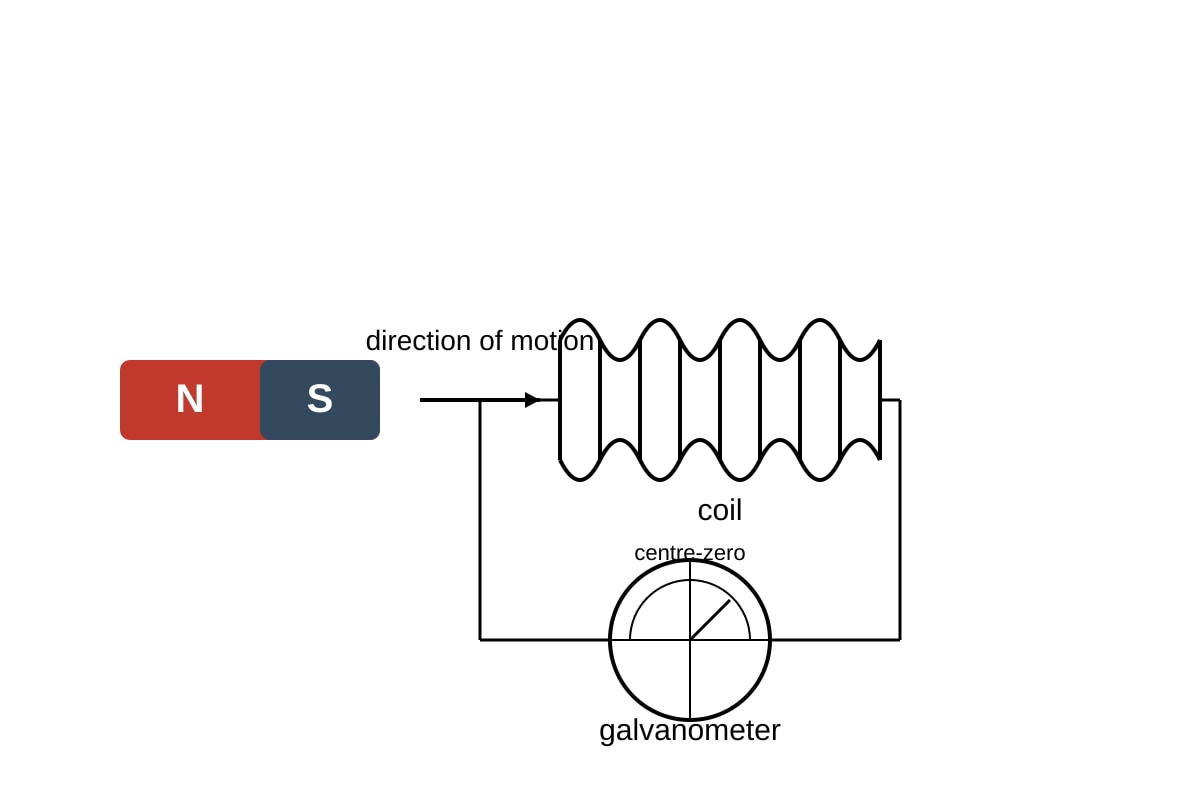
6. The diagram below shows a bar magnet being pushed into a coil connected to a galvanometer.
Image pending generation: diagram for 6.
State the direction of the induced current in the coil as the magnet enters, according to Lenz's law. [2]
7. A 230 V mains supply feeds a 1840 W heater. Calculate the current drawn. [2]
8. State Faraday's law of electromagnetic induction in one sentence. [1]
9. A household appliance has a metal casing. State the purpose of the earth wire. [1]
10. Two resistors of 4 Ω and 6 Ω are connected in series to a 20 V battery. Calculate the current in the circuit. [2]
Section B: Structured Response and Calculations (Marks: 24)
11. A household has three appliances: a microwave (1100 W), a kettle (2000 W), and a fan (300 W) connected to a 230 V supply protected by a 13 A fuse.
(a) Calculate the total current drawn when all three operate at once. [2]
(b) Determine whether the fuse will blow. [1]
(c) Suggest one safety improvement. [1]
12. An ideal transformer has a primary voltage of 240 V and secondary voltage of 12 V. The secondary coil current is 2.0 A.
(a) Calculate the secondary power output. [1]
(b) Calculate the primary current. [2]
(c) State one assumption made in your calculation. [1]
13. A student moves a magnet at 0.40 m/s through a coil of 250 turns, area 8.0 cm², in a field of 0.04 T.
(a) State Faraday's law. [1]
(b) Calculate the induced EMF. (Use EMF=B×A×N×v after converting area.) [3]
(c) Predict the galvanometer reading if the magnet reverses direction. [1]
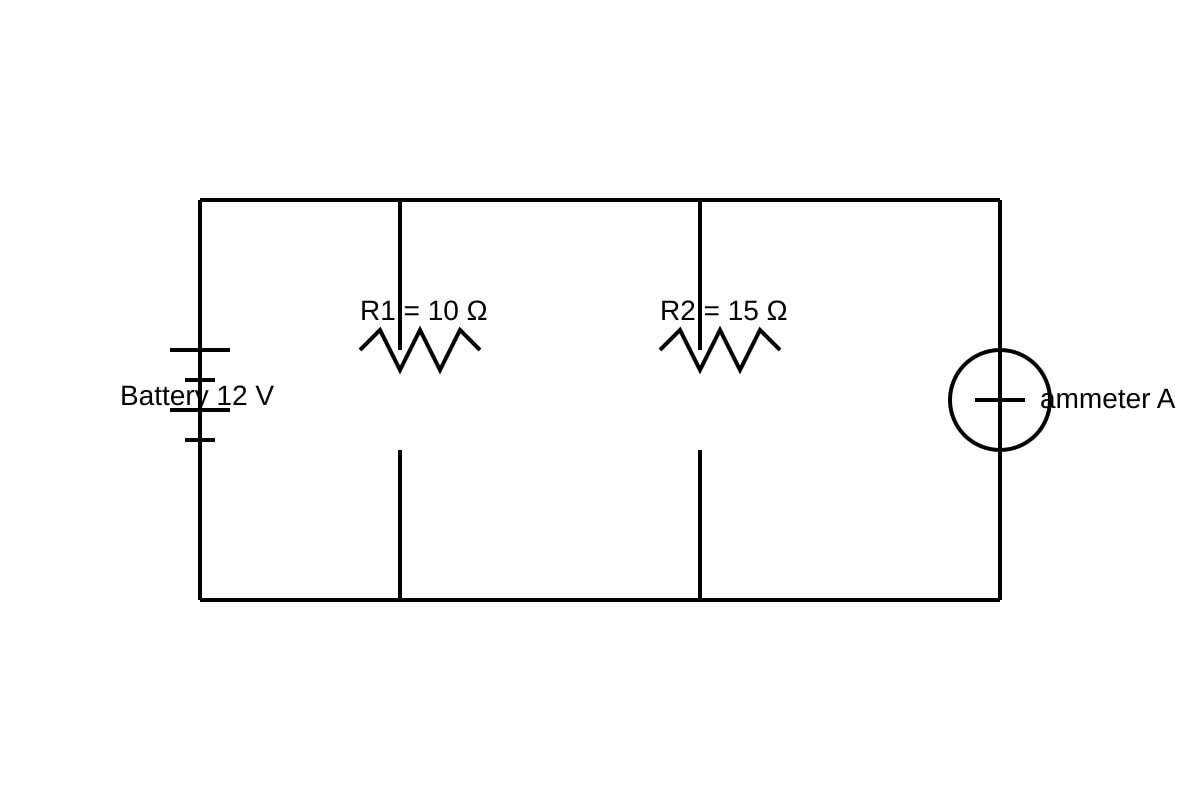
14. The circuit below shows two resistors (R1 = 10 Ω, R2 = 15 Ω) in parallel, connected to a 12 V battery.
Image pending generation: circuit for 14.
(a) Calculate the effective resistance. [2]
(b) Calculate the total current from the battery. [1]
(c) Calculate current through R1. [1]
15. A power cable carries 5 A at 230 V to an appliance 40 m away. The cable has total resistance 0.8 Ω.
(a) Calculate the power loss in the cable. [2]
(b) Calculate the voltage drop across the cable. [1]
(c) State why thick cables reduce this loss. [1]
Section C: Extended Application (Marks: 16)
16. A step-down transformer is used in a mobile charger. Primary: 240 V, 500 turns. Secondary: 12 V.
(a) Calculate the number of secondary turns. [2]
(b) If the charger outputs 1.5 A, calculate primary current assuming 100% efficiency. [2]
(c) Explain why the transformer core is made of laminated soft iron. [2]
17. Describe an experiment to demonstrate electromagnetic induction using a coil, magnet, and galvanometer. Include the observation and the physics principle. [4]
18. A 12 V battery powers a 4 Ω resistor and a 2 Ω resistor in series.
(a) Calculate total resistance. [1]
(b) Calculate current. [1]
(c) Calculate potential difference across the 2 Ω resistor. [1]
(d) State one way to double the current without changing the battery. [1]
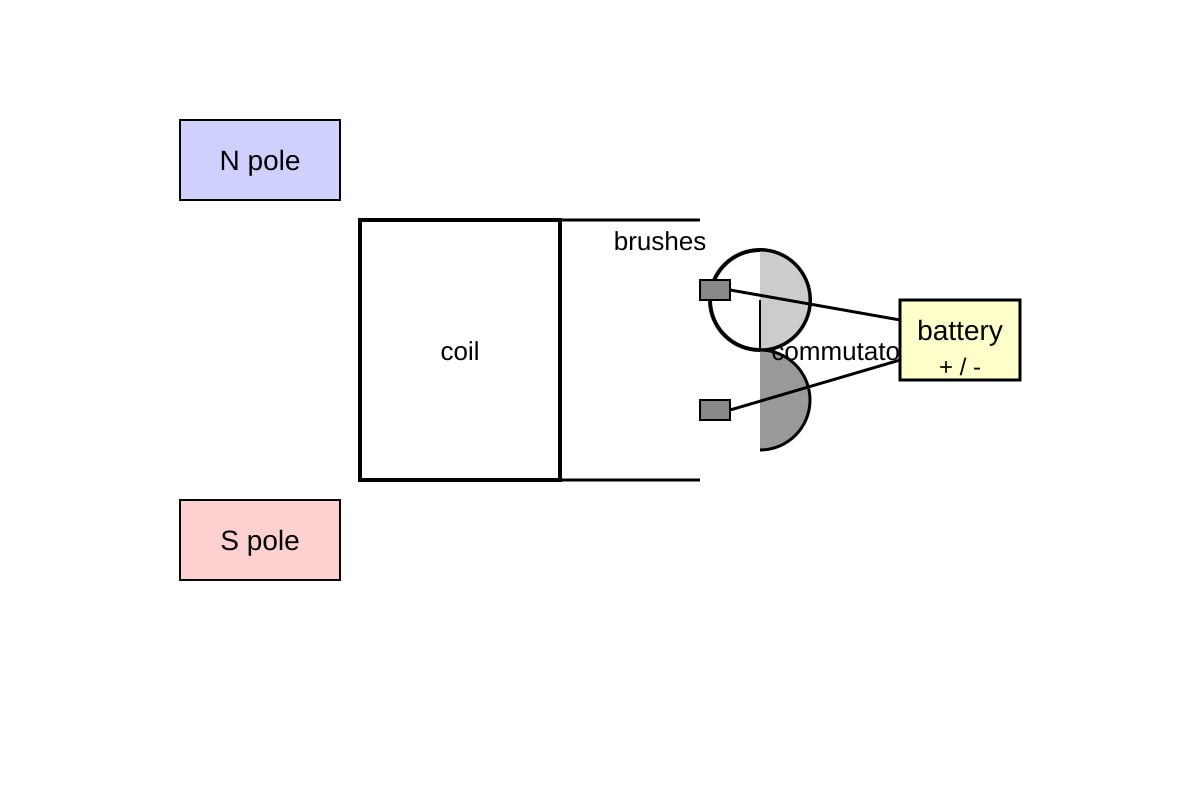
19. The diagram shows a simple d.c. motor.
Image pending generation: diagram for 19.
(a) State the function of the commutator. [1]
(b) Explain how the motor produces continuous rotation. [2]
(c) State one method to increase the motor speed. [1]
20. A house uses the following over 1 hour: air-con (1000 W), lights (200 W), TV (150 W). The mains is 230 V.
(a) Calculate total energy used in kWh. [2]
(b) Calculate the total current drawn at any instant. [2]
Answers
TuitionGoWhere Practice Paper - Pure Physics Secondary 4 (Answers)
Version 5 — Answer Key and Teaching Notes
Section A Answers (20 marks)
1. B [1]
Secondary voltage Vs=Vp×NpNs=12×100400=48 V.
Teaching: Transformer ratio VsVp=NsNp; for step-up, secondary turns > primary.
2. [1]
The neutral wire provides the return path for current and is at approximately zero potential.
Teaching: In a.c. mains, live carries alternating potential, neutral completes circuit at near 0 V.
3. [1]
A circuit breaker can be reset and reused; a fuse must be replaced after blowing.
(Also accept: faster response, no need for spare fuses.)
4. [1]
The galvanometer needle deflects momentarily in the opposite direction to when the rod was inserted.
Teaching: Removing charge changes flux; Lenz's law gives opposite induced current direction.
5. [2]
RT1=61+31=61+62=63=21
RT=2 Ω.
Mark: 1 for reciprocal sum, 1 for final answer with unit.
6. [2]
The induced current flows so as to oppose the increase in flux (magnet entering). Coil end facing N pole acts as N to repel. Current direction shown by right-hand grip rule is anticlockwise as viewed from magnet side.
Mark: 1 for reference to Lenz's law, 1 for correct direction stated.
7. [2]
P=IV⇒I=VP=2301840=8.0 A.
Mark: 1 for formula, 1 for answer.
8. [1]
The induced EMF is directly proportional to the rate of change of magnetic flux linkage.
9. [1]
The earth wire connects the metal casing to ground so that if a fault occurs, current flows to earth and blows the fuse/breaker instead of shocking the user.
10. [2]
RT=4+6=10 Ω; I=RV=1020=2.0 A.
Mark: 1 for series sum, 1 for current.
Section B Answers (24 marks)
11. [4]
(a) Ptot=1100+2000+300=3400 W; I=2303400=14.8 A [2]
(b) Fuse blows because 14.8 A > 13 A [1]
(c) Use a 30 A fuse, or separate circuits, or operate fewer simultaneously [1]
12. [4]
(a) Ps=VsIs=12×2.0=24 W [1]
(b) Ideal: VpIp=VsIs⇒Ip=24024=0.10 A [2]
(c) 100% efficiency / no power loss [1]
13. [5]
(a) Induced EMF ∝ rate of change of magnetic flux linkage [1]
(b) A=8.0 cm2=8.0×10⁻⁴ m2;
EMF=BANv=0.04×8.0×10−4×250×0.40=3.2×10⁻³ V [3]
(c) Deflects opposite way [1]
14. [4]
(a) R1=101+151=303+2=305⇒R=6 Ω [2]
(b) I=612=2.0 A [1]
(c) I1=1012=1.2 A [1]
15. [4]
(a) Ploss=I2R=52×0.8=20 W [2]
(b) Vdrop=IR=5×0.8=4.0 V [1]
(c) Thicker cable → lower R → lower loss [1]
Section C Answers (16 marks)
16. [6]
(a) NpNs=VpVs⇒Ns=500×24012=25 turns [2]
(b) Ip=VpVsIs=24012×1.5=0.075 A [2]
(c) Laminated soft iron reduces eddy currents and hysteresis loss, improves efficiency [2]
17. [4]**
Setup: coil connected to galvanometer, move magnet in/out. Observation: needle deflects on motion, zero when still. Principle: Faraday's law — changing flux induces EMF.
Mark: 1 setup, 1 observation, 1 principle, 1 direction mention.
18. [4]**
(a) R=4+2=6 Ω [1]
(b) I=12/6=2.0 A [1]
(c) V=IR=2.0×2=4.0 V [1]
(d) Halve total resistance (e.g., add parallel resistor) [1]
19. [4]**
(a) Reverses current direction every half-turn to maintain torque [1]
(b) Commutator swaps contact so force on coil sides stays rotational [2]
(c) Increase voltage, stronger magnet, more turns [1]
20. [4]**
(a) E=(1000+200+150)×1h=1.35 kWh [2]
(b) I=2301350=5.87 A [2]
Total Marks: 60 — matches paper.
Free quiz and exam paper access
Enter your details to view this paper
Your access is remembered on this device.