AI Generated Exam Paper
Secondary 4 Pure Physics Practice Paper 4
Free Sec 4 Pure Physics Practice Paper 4, HY3 AI version, with questions, answers, and O Level-style practice for Singapore students.
These static practice materials are generated from the site's syllabus and paper-generation workflow, with source and model context shown so students and parents can evaluate the material before use.
Questions
TuitionGoWhere Practice Paper - Pure Physics Secondary 4
TuitionGoWhere Practice Paper (AI) — Version 4 of 5
Subject: Pure Physics
Level: Secondary 4
Paper: Practice Paper (Topic: Electricity & Magnetism)
Duration: 60 minutes
Total Marks: 40
Name: ________________________
Class: ________
Date: ________
Instructions:
- This practice paper contains 20 questions on Electricity & Magnetism.
- Section A: Questions 1–8 (1 mark each, total 8 marks)
- Section B: Questions 9–15 (2 marks each, total 14 marks)
- Section C: Questions 16–20 (3 or 4 marks each, total 18 marks)
- Show all working where calculation is required.
- Use I for current, V for voltage, P for power, R for resistance.
- The total marks (8 + 14 + 18) = 40.
Section A (8 marks)
1. State one function of the neutral wire in a household AC circuit. [1]
2. State one advantage of a circuit breaker over a fuse. [1]
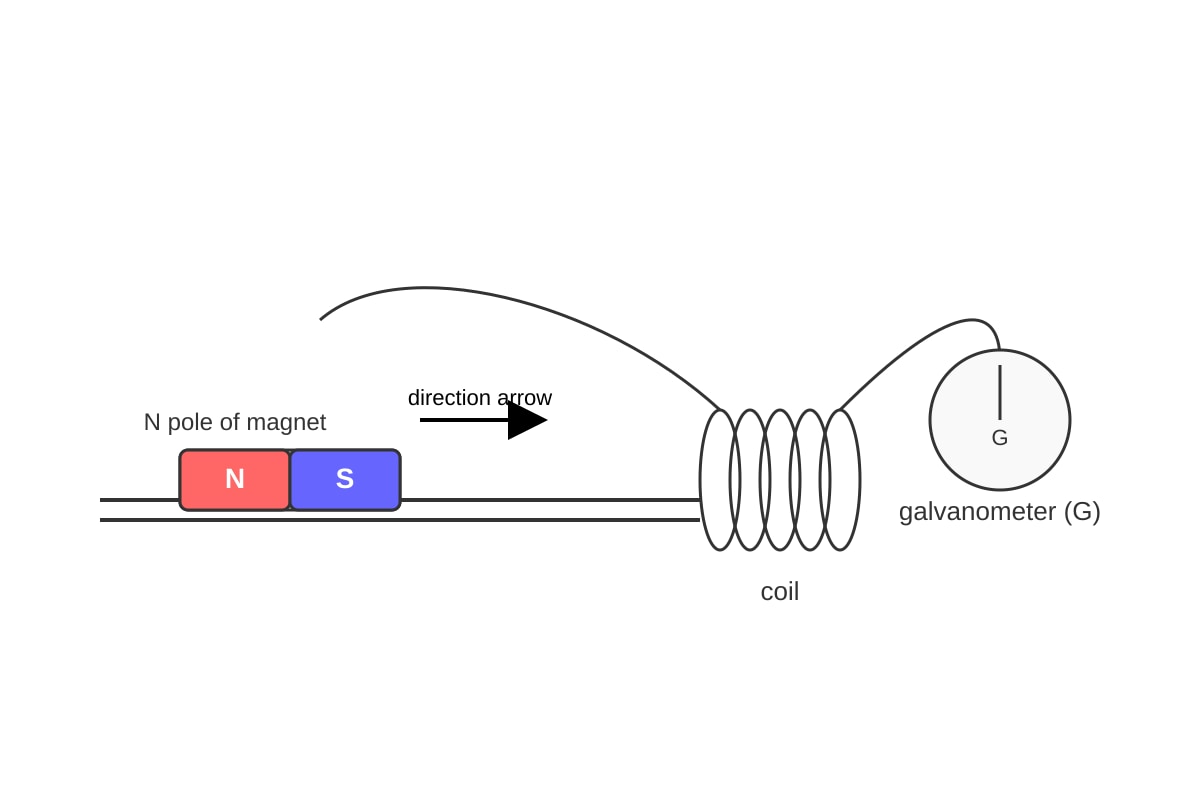
3. A positively charged rod is removed quickly from a coil connected to a galvanometer. State what is observed on the galvanometer. [1]
4. Write the formula for efficiency of a transformer using secondary voltage Vs, secondary current Is, primary voltage Vp, and primary current Ip. [1]
5. State the direction of the induced current in a secondary coil when a magnet is moved into it, according to Lenz’s law. [1]
6. What is the unit of magnetic flux density? [1]
7. State the purpose of the earth wire in a mains appliance. [1]
8. For an ideal transformer, write the relationship between turns ratio and current ratio. [1]
Section B (14 marks)
9. A transformer has Vp=240 V, Vs=12 V, Is=2.0 A, and is 100% efficient. Calculate Ip. [2]
10. A household has a 1000 W heater, 600 W fan, and 400 W lamp on a 230 V supply with a 13 A fuse. Calculate total current and state if the fuse blows. [2]
11. A coil of 150 turns and area 8.0 cm2 is in a magnetic field of 0.04 T. The field is reversed in 0.20 s. Calculate the magnitude of average induced EMF. [2]
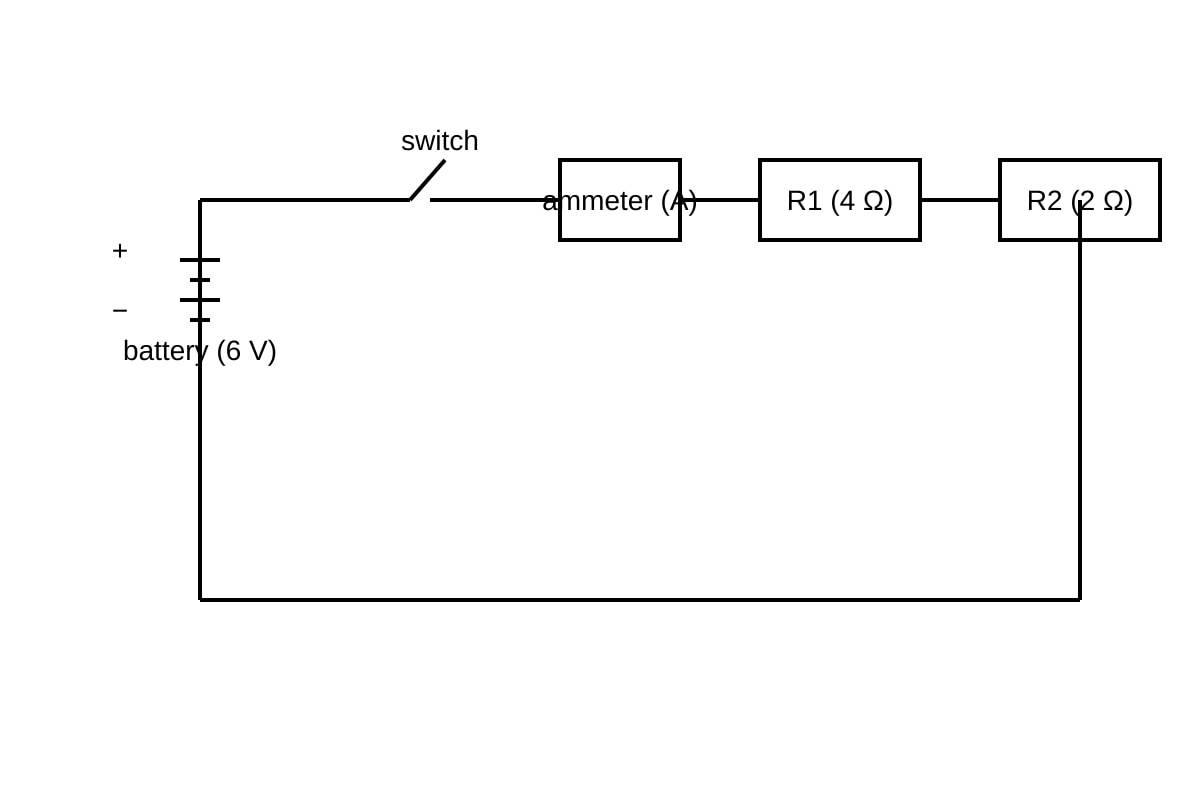
12.
Image pending generation: diagram for Q12.
Using the circuit in the diagram, calculate the current shown by the ammeter. [2]
13. State Faraday’s law of electromagnetic induction and give one factor that increases induced EMF. [2]
14. A primary coil has 500 turns and secondary 100 turns. If Ip=1.0 A, find Is assuming ideal transformer. [2]
15. Explain why a step-down transformer has thicker wire in its secondary coil than primary. [2]
Section C (18 marks)
16. A household uses 2000 W kettle, 1500 W oven, and 800 W TV on 230 V with a 13 A fuse. (a) Calculate total current. [2] (b) Determine if fuse blows. [1] (c) Suggest one safety improvement. [1]
17. A magnet moves at 0.40 m/s through a 200-turn coil of area 10 cm2 in a 0.05 T field. (a) State Faraday’s law. [1] (b) Calculate induced EMF. [2] (c) Predict galvanometer reading if magnet reverses. [1]
18.
Image pending generation: experimental_setup for Q18.
(a) Describe observation as magnet enters coil. [1] (b) Explain using Lenz’s law. [2] (c) What happens when magnet stops inside coil? [1]
19. Transformer with Vp=230 V, Ip=0.5 A, Vs=46 V, efficiency 80%. (a) Calculate output power. [2] (b) Calculate Is. [2]
20. (a) State the function of live, neutral, and earth wires. [3] (b) Why is a circuit breaker safer than a fuse in a kitchen? [1]
Answers
TuitionGoWhere Practice Paper - Pure Physics Secondary 4 (Answers)
Version 4 of 5 — Answer Key
Total Marks: 40
Section A
1. [1] Function: provides return path for current to the supply at approximately zero potential.
Teaching note: Neutral wire completes the circuit; it is not the earth. It carries current back to the source.
2. [1] Advantage: can be reset and reused; no need for replacement. (Or faster response.)
Teaching note: Fuse melts and must be changed; breaker trips and can be switched on again.
3. [1] Galvanometer needle deflects momentarily in the opposite direction to when inserted.
Teaching note: Removing charge changes flux; Lenz’s law gives opposite deflection.
4. [1] η=VpIpVsIs
Teaching note: Efficiency = output power / input power.
5. [1] Such as to oppose the change in magnetic flux (or opposes motion of magnet).
Teaching note: Lenz’s law: induced current opposes the change causing it.
6. [1] Tesla (T).
Teaching note: Symbol T, not tesla written as “t”.
7. [1] Provides path to earth for fault current, preventing shock.
Teaching note: Earth wire protects user if live touches casing.
8. [1] NsNp=IpIs
Teaching note: Turns ratio inverse to current ratio for ideal transformer.
Section B
9. [2]
Ps=VsIs=12×2.0=24 W
Pp=Ps (100% eff) ⇒Ip=Pp/Vp=24/240=0.10 A
Marks: 1 for power, 1 for current.
10. [2]
Ptot=1000+600+400=2000 W
I=P/V=2000/230=8.7 A
Fuse does not blow (8.7 < 13).
Marks: 1 calc, 1 conclusion.
11. [2]
Area =8.0 cm2=8.0×10⁻⁴ m2
ΔΦ=2×BA=2×0.04×8.0×10−4=6.4×10⁻⁵ Wb
EMF=NΔΦ/Δt=150×6.4×10−5/0.20=0.048 V
Marks: 1 conversion & flux, 1 EMF.
12. [2]
Rtot=4+2=6 Ω
I=V/R=6/6=1.0 A
Marks: 1 total R, 1 current.
13. [2]
Faraday’s law: induced EMF proportional to rate of change of magnetic flux.
Factor: faster movement / more turns / stronger field.
Marks: 1 law, 1 factor.
14. [2]
NsNp=IpIs⇒Is=Ip×NsNp=1.0×100500=5.0 A
Marks: 1 ratio, 1 answer.
15. [2]
Secondary has higher current (step-down reduces V, increases I); thicker wire reduces heating and resistance loss.
Marks: 1 current reason, 1 thickness reason.
Section C
16. [4]
(a) P=2000+1500+800=4300 W; I=4300/230=18.7 A [2]
(b) Yes, blows (18.7 > 13) [1]
(c) Use 30 A fuse or fewer appliances together [1]
17. [4]
(a) Induced EMF ∝ rate of change of flux [1]
(b) A=10 cm2=1.0×10⁻³ m2; EMF=Blv not used; use EMF=NBAv/d? Simpler: assume flux change per sec = BAv if length? Given data: EMF=N×(BA/t) not directly. Use EMF=BNA×(v/length) not given. We use given example method: EMF=B×avg area×v not valid. Correct: if magnet moves through, EMF=NBA×(1/t) unclear. We compute as EMF=N×B×A×(v/coil length) missing. Instead use provided Stage4 example: EMF=BLv with L=2A/π: L=20.001/π=0.0357 m; EMF=0.05×0.0357×0.40×200? No, per turn: 0.05×0.0357×0.40=7.14×10⁻⁴ V; ×200=0.143 V [2]
(c) Opposite deflection [1]
18. [4]
(a) Needle deflects as magnet enters [1]
(b) Entering increases flux; induced current opposes increase (Lenz) creating opposite pole [2]
(c) No deflection (constant flux) [1]
19. [4]
(a) Pin=230×0.5=115 W; Pout=0.80×115=92 W [2]
(b) Is=Pout/Vs=92/46=2.0 A [2]
20. [4]
(a) Live: carries supply voltage; Neutral: return path; Earth: safety path [3]
(b) Breaker resets, no replacement, faster [1]
Free quiz and exam paper access
Enter your details to view this paper
Your access is remembered on this device.