AI Generated Exam Paper
Secondary 4 Pure Physics Practice Paper 3
Free Sec 4 Pure Physics Practice Paper 3, HY3 AI version, with questions, answers, and O Level-style practice for Singapore students.
These static practice materials are generated from the site's syllabus and paper-generation workflow, with source and model context shown so students and parents can evaluate the material before use.
Questions
TuitionGoWhere Practice Paper - Pure Physics Secondary 4
TuitionGoWhere Practice Paper (AI) — Version 3 of 5
Subject: Pure Physics
Level: Secondary 4
Paper: Practice Paper (Topic: Electricity & Magnetism)
Duration: 60 minutes
Total Marks: 60
Name: ________________________
Class: ________
Date: ________
Instructions:
- Answer all questions in the spaces provided.
- Show all working clearly where calculations are required.
- Use appropriate units in your final answers.
- This practice paper is generated from syllabus-aligned LLM-inferred templates. It is not derived from any official past-year exam.
- Section A: 10 short questions (2 marks each = 20 marks)
- Section B: 6 structured questions (5 marks each = 30 marks)
- Section C: 2 extended questions (5 marks each = 10 marks)
Section A (20 marks)
Answer all questions. Each question carries 2 marks.
1. A transformer has a primary coil of 400 turns and a secondary coil of 100 turns. The primary voltage is 240 V. Calculate the secondary voltage.
2. State one advantage of a circuit breaker over a fuse in a household circuit.
3. A coil is connected to a galvanometer. A north pole of a magnet is pushed quickly into the coil. State what is observed on the galvanometer.
4. The neutral wire in a mains circuit is at approximately zero potential. State its function.
5. A 230 V heater has a power rating of 1840 W. Calculate the current flowing through it.
6. A step-up transformer increases voltage from 12 V to 60 V. If the primary current is 5.0 A, calculate the secondary current assuming 100% efficiency.
7. State Lenz's law of electromagnetic induction in one sentence.
8. A positively charged rod is brought near an uncharged metal sphere. State what happens to the electrons in the sphere.
9. Calculate the total resistance of two resistors, 6 Ω and 3 Ω, connected in parallel.
10. A wire carries a current of 2.0 A perpendicular to a magnetic field of 0.4 T. The length of wire in the field is 0.5 m. Calculate the force on the wire.
Section B (30 marks)
Answer all questions. Each question carries 5 marks.
11. A household has a refrigerator (400 W), an oven (2000 W), and a television (300 W) connected to a 230 V supply protected by a 13 A fuse. (a) Calculate the total current drawn when all three operate at the same time. [2] (b) Determine whether the fuse will blow. [1] (c) Suggest one safety improvement. [1] (d) State the function of the earth wire in this circuit. [1]
12. A magnet is moved at 0.4 m/s through a coil of 250 turns with cross-sectional area 8.0 cm². The uniform magnetic field is 0.06 T. (a) State Faraday's law of electromagnetic induction. [1] (b) Calculate the induced EMF. [2] (c) Predict the galvanometer deflection if the magnet is pulled out at the same speed. [1] (d) State how the induced EMF changes if the speed is doubled. [1]
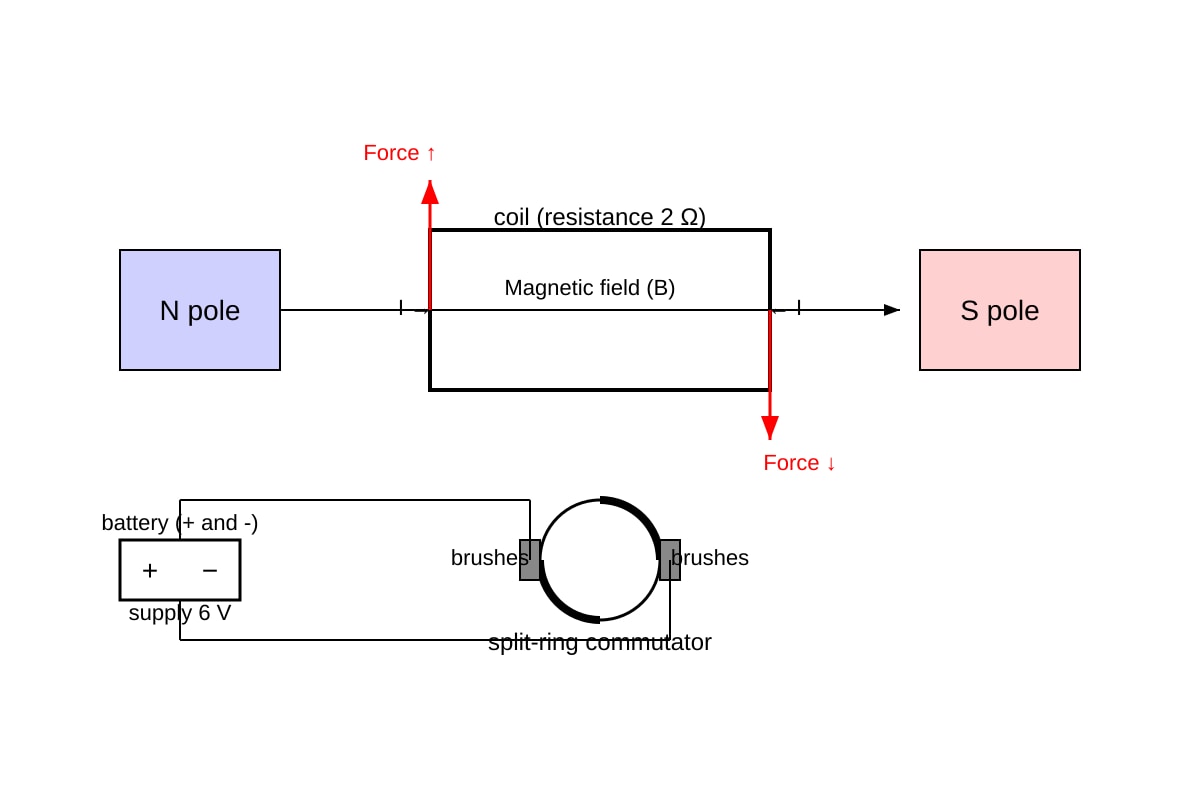
13. The diagram below shows a simple DC motor.
Image pending generation: diagram for Q13.
(a) State the purpose of the split-ring commutator. [1] (b) Calculate the current in the coil. [1] (c) Explain how the coil rotates continuously. [2] (d) State one way to reverse the direction of rotation. [1]
14. A step-down transformer has 1200 primary turns and 300 secondary turns. The primary is connected to 240 V AC and the secondary supplies a 12 V, 2.0 A load. Efficiency is 80%. (a) Calculate the ideal secondary voltage. [1] (b) Calculate the actual secondary current if efficiency is 80%. [1] (c) Calculate the primary current. [2] (d) State one energy loss in the transformer. [1]
15. A student sets up a circuit with a 12 V battery, a switch, and two resistors (4 Ω and 8 Ω) in series. (a) Calculate the total resistance. [1] (b) Calculate the current in the circuit. [1] (c) Calculate the potential difference across the 8 Ω resistor. [1] (d) State what happens to the current if the 4 Ω resistor is removed. [1] (e) Explain your answer in (d). [1]
16. A solenoid is connected to a battery. A soft iron core is inserted into it. (a) State the effect on the magnetic field strength. [1] (b) Explain why this happens. [2] (c) State one practical application of an electromagnet. [1] (d) Describe how to reverse the magnetic polarity of the solenoid. [1]
Section C (10 marks)
Answer all questions. Each question carries 5 marks.
17. A power transmission line uses a step-up transformer at the generating end and a step-down transformer at the consumer end. (a) Explain why a step-up transformer is used at the generating station. [2] (b) The generating voltage is 11 kV and is stepped up to 132 kV. Calculate the turns ratio of the step-up transformer. [1] (c) If the transmitted power is 660 kW, calculate the current in the transmission line at 132 kV. [1] (d) State one environmental benefit of reducing current in the line. [1]
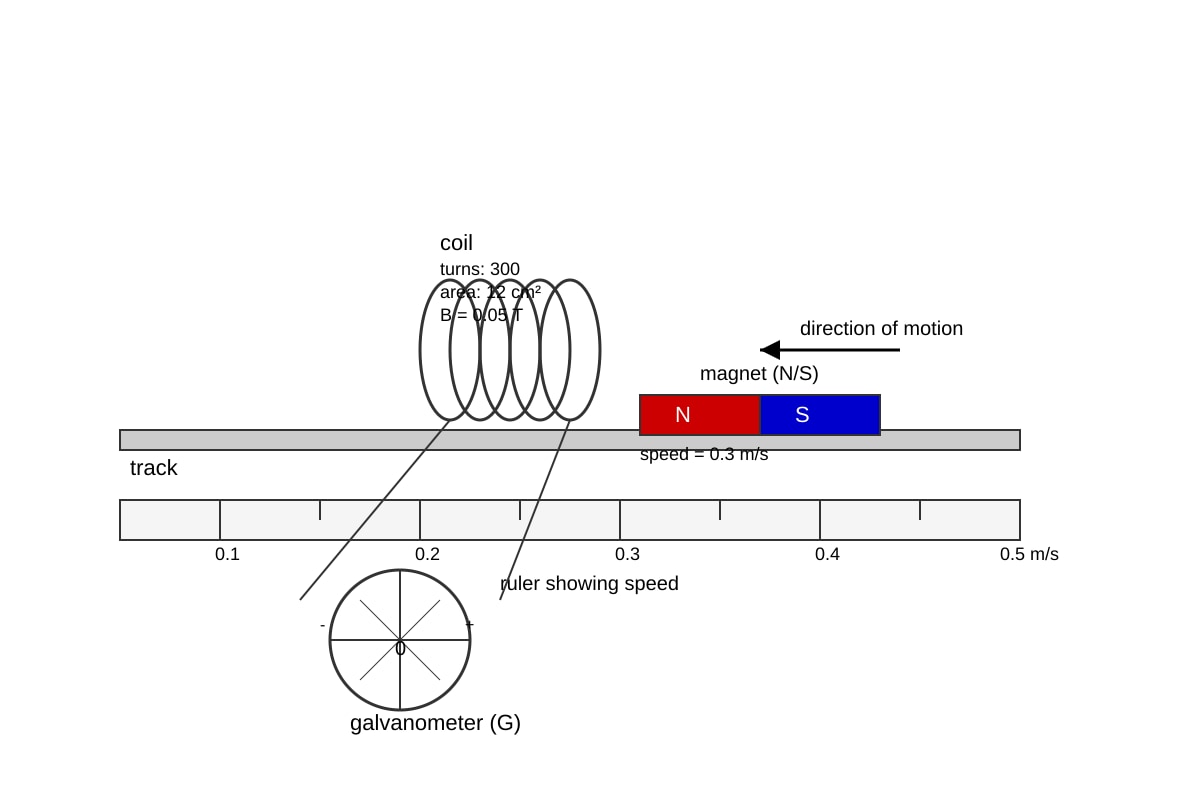
18. A student investigates electromagnetic induction using the setup shown.
Image pending generation: experimental_setup for Q18.
(a) State the law that gives the direction of induced current. [1] (b) Calculate the induced EMF when magnet enters at 0.3 m/s. [2] (c) Describe how the galvanometer reading changes as the magnet passes fully through and stops inside. [1] (d) Suggest how to increase the induced EMF without changing the magnet. [1]
End of Paper
Answers
TuitionGoWhere Practice Paper — Pure Physics Secondary 4 (Version 3)
Answer Key with Marking Scheme
Section A (20 marks)
1. [2 marks]
Formula: VsVp=NsNp
Vs=Vp×NpNs=240×400100=60 V
Answer: 60 V (2 marks for correct value and unit; 1 mark if value only)
2. [2 marks]
Accept: Circuit breaker can be reset and reused / responds faster / no need for replacement.
(2 marks for clear advantage with brief reason; 1 mark for vague "safer")
3. [2 marks]
The galvanometer needle deflects momentarily in one direction.
(2 marks for "momentarily" + direction stated; 1 mark for "deflects" only)
4. [2 marks]
It provides the return path for current to the supply at approximately zero potential.
(2 marks for return path + zero potential; 1 mark for "completes circuit" only)
5. [2 marks]
P=IV⇒I=VP=2301840=8.0 A
Answer: 8.0 A (2 marks with working; 1 mark answer only)
6. [2 marks]
Ideal: VpIp=VsIs⇒Is=6012×5.0=1.0 A
Answer: 1.0 A (2 marks with working)
7. [2 marks]
The direction of induced current is such that it opposes the change in magnetic flux that produced it.
(2 marks for correct statement; 1 mark partial)
8. [2 marks]
Electrons are attracted to the side near the rod (negative charge accumulates near rod).
(2 marks for correct electron movement; 1 mark vague)
9. [2 marks]
R1=61+31=21⇒R=2 Ω
Answer: 2 Ω (2 marks with working)
10. [2 marks]
F=BIL=0.4×2.0×0.5=0.4 N
Answer: 0.4 N (2 marks with working)
Section B (30 marks)
11. [5 marks]
(a) [2] Total P = 400 + 2000 + 300 = 2700 W; I=P/V=2700/230=11.7 A
(b) [1] No, 11.7 A < 13 A, fuse does not blow.
(c) [1] Use appliances on separate circuits / use higher rated fuse if allowed.
(d) [1] Earth wire connects metal body to ground to prevent electric shock.
12. [5 marks]
(a) [1] Induced EMF is proportional to rate of change of magnetic flux.
(b) [2] Area = 8.0 cm² = 8.0×10⁻⁴ m²; EMF = N B A v = 250 × 0.06 × 8.0×10⁻⁴ × 0.4 = 0.0048 V
(c) [1] Deflects in opposite direction.
(d) [1] EMF doubles (proportional to speed).
13. [5 marks]
(a) [1] Reverses current direction every half turn to maintain rotation.
(b) [1] I=V/R=6/2=3.0 A
(c) [2] Current in coil creates magnetic field interacting with magnet; forces on sides produce torque; commutator swaps current to keep torque same direction.
(d) [1] Reverse battery connections or swap magnet poles.
14. [5 marks]
(a) [1] Vs=240×300/1200=60 V (ideal)
(b) [1] Actual output power = 0.8 × input; but given load 12 V 2 A → P_out = 24 W; secondary current = 2.0 A (given)
(c) [2] Pin=Pout/0.8=30 W; Ip=30/240=0.125 A
(d) [1] Heat loss in coils / eddy currents / hysteresis.
15. [5 marks]
(a) [1] R = 4 + 8 = 12 Ω
(b) [1] I = 12/12 = 1.0 A
(c) [1] V = IR = 1.0 × 8 = 8 V
(d) [1] Current stops.
(e) [1] Circuit becomes open; no complete path.
16. [5 marks]
(a) [1] Increases.
(b) [2] Soft iron becomes magnetised, aligning domains, strengthening total field.
(c) [1] Crane, relay, doorbell.
(d) [1] Reverse battery polarity.
Section C (10 marks)
17. [5 marks]
(a) [2] Step-up increases voltage, reduces current for same power, reducing I²R loss in wires.
(b) [1] 11k:132k = 1:12
(c) [1] I = P/V = 660000/132000 = 5.0 A
(d) [1] Less heat / less energy wasted / lower emissions.
18. [5 marks]
(a) [1] Lenz's law.
(b) [2] A = 12 cm² = 1.2×10⁻³ m²; EMF = 300 × 0.05 × 1.2×10⁻³ × 0.3 = 0.0054 V
(c) [1] Reading rises then falls to zero when magnet stops.
(d) [1] Increase speed, turns, area, or field.
Total: 60 marks. All section and question marks sum correctly.
Free quiz and exam paper access
Enter your details to view this paper
Your access is remembered on this device.