AI Generated Exam Paper
Secondary 4 Pure Physics Practice Paper 2
Free Sec 4 Pure Physics Practice Paper 2, HY3 AI version, with questions, answers, and O Level-style practice for Singapore students.
These static practice materials are generated from the site's syllabus and paper-generation workflow, with source and model context shown so students and parents can evaluate the material before use.
Questions
TuitionGoWhere Practice Paper - Pure Physics Secondary 4
TuitionGoWhere Practice Paper (AI) — Version 2 of 5
Subject: Pure Physics
Level: Secondary 4
Paper: Practice Paper (Topic: Electricity & Magnetism)
Duration: 60 minutes
Total Marks: 60
Name: ________________________
Class: ________
Date: ________
Instructions:
- This practice paper contains 20 questions on Electricity & Magnetism.
- Section A: 10 short questions (2 marks each). Section B: 6 structured questions (3 marks each). Section C: 4 extended questions (5 marks each).
- Write all answers in the spaces provided. Show your working clearly.
- Use g=10 m/s2 where needed.
- Marks for each question are shown in brackets [ ].
Section A (Short Questions) — 20 marks
Questions 1 to 10 carry 2 marks each.
1. A transformer has a primary coil of 200 turns and secondary coil of 50 turns. The primary voltage is 240 V. Calculate the secondary voltage. [2]
2. State one advantage of a circuit breaker over a fuse in a household circuit. [2]
3. A coil is connected to a galvanometer. A north pole of a magnet is pushed quickly into the coil. State what is observed on the galvanometer. [2]
4. The neutral wire in a mains circuit is at approximately zero potential. State its function. [2]
5. A resistor of 10 Ω is connected to a 5 V battery. Calculate the current through the resistor. [2]
6. A primary coil carries 0.50 A at 230 V. The secondary coil outputs 12 V at 90% efficiency. Calculate the secondary current. [2]
7. State Lenz’s law of electromagnetic induction in one sentence. [2]
8. A household appliance uses 1840 W at 230 V. Calculate the current drawn. [2]
9. A bar magnet is dropped through a vertical copper pipe. Explain why it falls slower than in air (1 mark for observation, 1 mark for reason). [2]
10. State the colour of the live wire in a standard Singapore household three-pin plug. [2]
Section B (Structured Questions) — 18 marks
Questions 11 to 16 carry 3 marks each.
11. A transformer has 400 primary turns and 100 secondary turns. The primary current is 2.0 A and primary voltage is 240 V. Assume ideal transformer. (a) Calculate the secondary voltage. [1] (b) Calculate the secondary current. [1] (c) State one assumption made in an ideal transformer. [1]
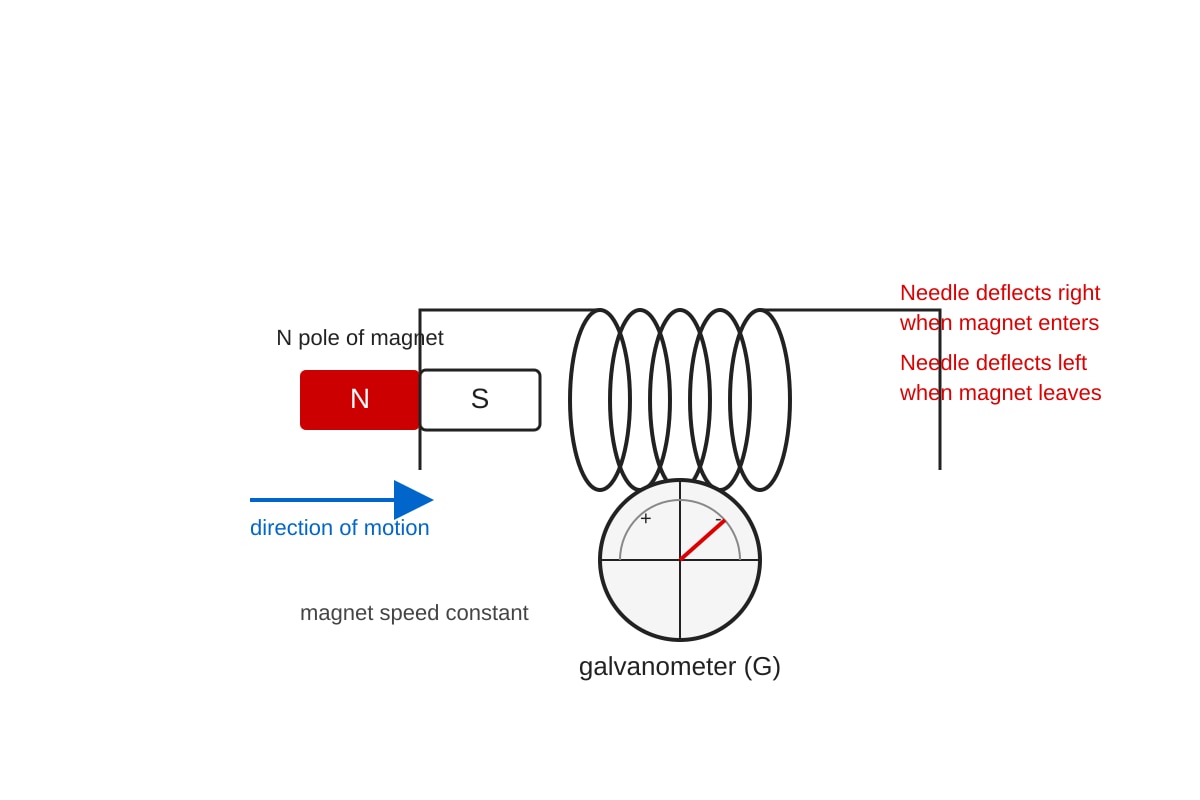
12. A student sets up a coil and galvanometer. A magnet is moved in and out at constant speed.
Image pending generation: experimental_setup for Q12.
(a) State Faraday’s law. [1] (b) Describe the galvanometer reading as the magnet enters the coil. [1] (c) Describe the reading as the magnet is held stationary inside the coil. [1]
13. A 230 V household circuit has a 13 A fuse. Three appliances operate: 1000 W heater, 750 W fan, 500 W lamp. (a) Calculate total power. [1] (b) Calculate total current. [1] (c) State whether the fuse blows and why. [1]
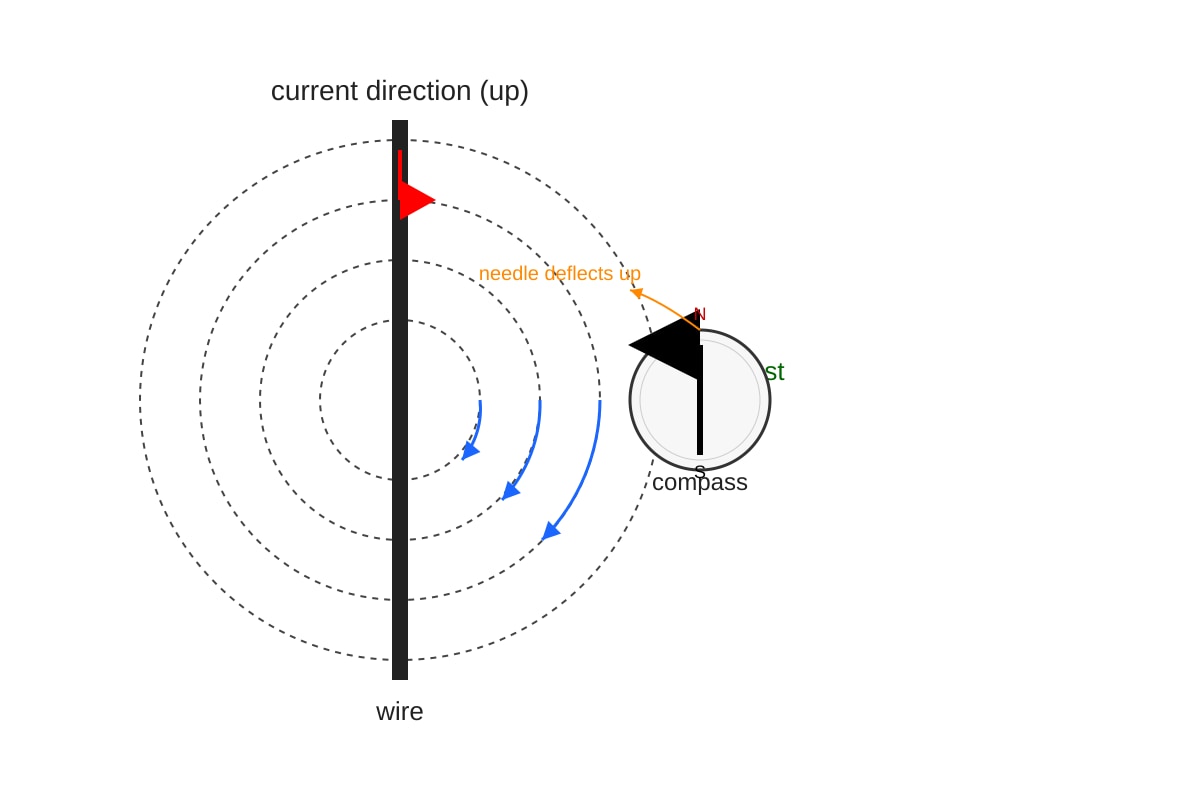
14. A wire carries a current upward. A compass is placed to the east of the wire.
Image pending generation: diagram for Q14.
(a) State the direction of the magnetic field produced by the wire at the compass. [1] (b) State the rule used to find this direction. [1] (c) Explain what happens if current is reversed. [1]
15. A dc motor has a coil in a magnetic field. (a) State two parts that cause the coil to keep rotating in one direction. [2] (b) State one way to increase the motor speed. [1]
16. A solenoid is connected to a battery. A soft iron core is inserted. (a) State the effect on the magnetic field strength. [1] (b) Explain why. [1] (c) State one practical use of a solenoid with iron core. [1]
Section C (Extended Questions) — 22 marks
Questions 17 to 20 carry 5 marks each.
17. A step-down transformer supplies 6 V, 0.5 A to a device. Primary is connected to 240 V. Efficiency is 80%. (a) Calculate output power. [1] (b) Calculate input power. [1] (c) Calculate primary current. [1] (d) State one energy loss in a real transformer. [1] (e) Explain why step-down transformers are used for mobile chargers. [1]
18. A student investigates EM induction. Coil of 150 turns, area 8.0 cm2, magnetic field 0.04 T, magnet speed 0.5 m/s. (a) State Faraday’s law. [1] (b) Calculate rate of change of flux if field reverses in 0.1 s. [2] (c) Predict galvanometer deflection when magnet reversed. [1] (d) State how to increase induced EMF. [1]
19. Household circuit: live, neutral, earth wires to a washing machine (230 V, 2000 W). (a) Function of earth wire. [1] (b) Calculate current. [1] (c) State suitable fuse rating from 5 A, 13 A, 30 A. [1] (d) Explain why fuse must be on live wire. [1] (e) State one danger if earth wire is missing. [1]
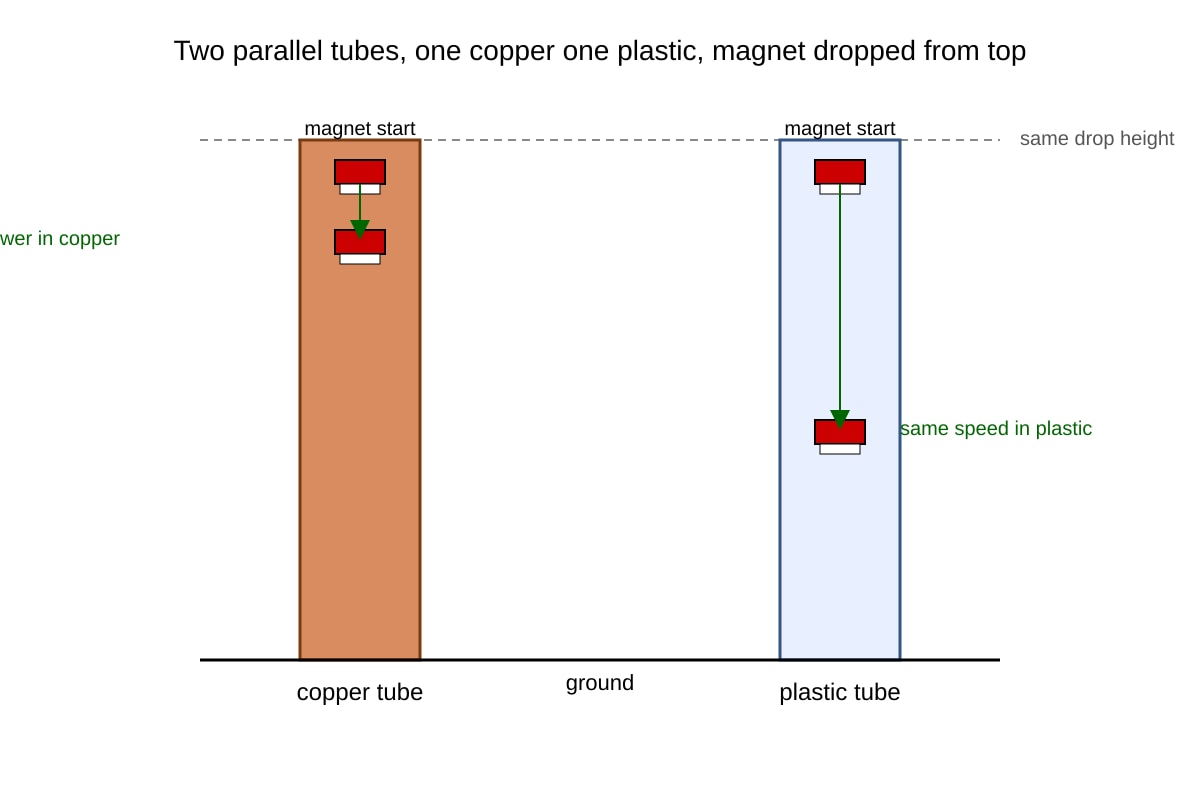
20. A magnet falls through a copper tube and a plastic tube of same length.
Image pending generation: diagram for Q20.
(a) Describe motion in plastic tube. [1] (b) Describe motion in copper tube and reason. [2] (c) State law explaining induced current direction. [1] (d) State one application of eddy current braking. [1]
End of Paper
Answers
TuitionGoWhere Practice Paper — Pure Physics Secondary 4 (Answers)
Version 2 of 5 — Answer Key
Total Marks: 60
Section A Answers (2 marks each)
1. [2]
Using turns ratio: VpVs=NpNs
Vs=Vp×NpNs=240×20050=60 V
Answer: 60 V.
Teaching note: Step-down transformer reduces voltage; ratio inverse of turns.
2. [2]
Advantage: A circuit breaker can be reset and reused after tripping, unlike a fuse which must be replaced.
Marking: 2 marks for clear explanation; 1 mark if only says "reusable".
3. [2]
The galvanometer needle deflects momentarily in one direction (e.g. to the right).
Teaching: Moving magnet changes flux, inducing EMF/current (Faraday).
4. [2]
It provides the return path for current to the supply at approximately zero potential, completing the circuit.
1 mark return path, 1 mark zero potential.
5. [2]
I=RV=105=0.5 A.
Answer: 0.5 A.
6. [2]
Efficiency η=0.90.
Input power Pp=VpIp=230×0.50=115 W.
Output power Ps=ηPp=0.90×115=103.5 W.
Is=VsPs=12103.5=8.625≈8.6 A.
Answer: 8.6 A.
7. [2]
Lenz’s law: The direction of induced current is such that it opposes the change in magnetic flux that produced it.
8. [2]
I=VP=2301840=8.0 A.
Answer: 8.0 A.
9. [2]
Observation: It falls slowly / with terminal velocity. Reason: Induced eddy currents in copper oppose motion (Lenz).
1+1 marks.
10. [2]
Brown (live wire in Singapore plug is brown).
Section B Answers (3 marks each)
11. [3]
(a) Vs=240×400100=60 V [1]
(b) Is=Ip×NsNp=2.0×100400=8.0 A [1]
(c) No energy loss / 100% efficiency [1]
12. [3]
(a) Induced EMF proportional to rate of change of magnetic flux [1]
(b) Needle deflects to one side while magnet enters [1]
(c) No deflection (zero EMF) when stationary [1]
Image: shows coil+galvanometer, magnet entering causes deflection.
13. [3]
(a) P=1000+750+500=2250 W [1]
(b) I=2250/230=9.78 A [1]
(c) No, because 9.78 A<13 A [1]
14. [3]
(a) Field circles wire; at east side, field points south (into page if viewed top) [1]
(b) Right-hand grip rule [1]
(c) Compass deflects opposite direction [1]
Image must show circular field, needle deflection.
15. [3]
(a) Split-ring commutator and brushes (or permanent magnets) [2]
(b) Increase current / voltage / number of turns [1]
16. [3]
(a) Increases [1]
(b) Iron core concentrates magnetic field lines (higher permeability) [1]
(c) Relay, electromagnet, doorbell [1]
Section C Answers (5 marks each)
17. [5]
(a) Pout=VsIs=6×0.5=3.0 W [1]
(b) Pin=Pout/η=3.0/0.80=3.75 W [1]
(c) Ip=Pin/Vp=3.75/240=0.0156 A [1]
(d) Heat loss in coils / eddy currents / hysteresis [1]
(e) Reduces mains 240 V to safe low voltage for device [1]
18. [5]
(a) EMF ∝ rate of change of flux [1]
(b) Area A=8.0×10⁻⁴ m2; ΔΦ=2×BA=2×0.04×8e−4=6.4e−5 Wb; rate = 6.4e−5/0.1=6.4e−4 Wb/s [2]
(c) Opposite deflection to original [1]
(d) More turns, faster motion, stronger B [1]
19. [5]
(a) Safety path to ground if fault occurs [1]
(b) I=2000/230=8.7 A [1]
(c) 13 A [1]
(d) Cuts live supply, prevents shock [1]
(e) Risk of electric shock if live touches casing [1]
20. [5]
(a) Free fall, constant acceleration g [1]
(b) Slower due to eddy currents opposing motion (Lenz) [2]
(c) Lenz’s law [1]
(d) Train braking, roller coaster brake [1]
Image: copper slows magnet, plastic no effect.
End of Answer Key
Free quiz and exam paper access
Enter your details to view this paper
Your access is remembered on this device.