AI Generated Exam Paper
Secondary 4 Pure Physics Practice Paper 1
Free AI-Generated Secondary 4 Pure Physics Practice Paper 1 practice paper with questions and answers for Singapore students. This page is rendered as a direct URL so the questions and answers can be discovered without pressing in-page buttons.
These static practice materials are generated from the site's syllabus and paper-generation workflow, with source and model context shown so students and parents can evaluate the material before use.
Questions
TuitionGoWhere Practice Paper - Pure Physics Secondary 4
TuitionGoWhere Practice Paper (AI)
Subject: Pure Physics
Level: Secondary 4
Paper: 2 (Structured Questions)
Duration: 1 hour 45 minutes
Total Marks: 80
Name: _________________ Class: _________ Date: _________
Instructions to Candidates
- This paper consists of Section A and Section B.
- Answer ALL questions from Section A and any THREE questions from Section B.
- Write your answers in the spaces provided.
- Show all working clearly. Marks may be awarded for correct methods even if the final answer is incorrect.
- Take g = 10 m/s² and the speed of light c = 3.0 × 10⁸ m/s unless otherwise stated.
- Give numerical answers to 3 significant figures unless otherwise specified.
Section A [40 marks]
Answer ALL questions in this section
Question 1: Household Electrical Safety [10 marks]
A modern household electrical installation includes various safety devices and proper wiring systems.
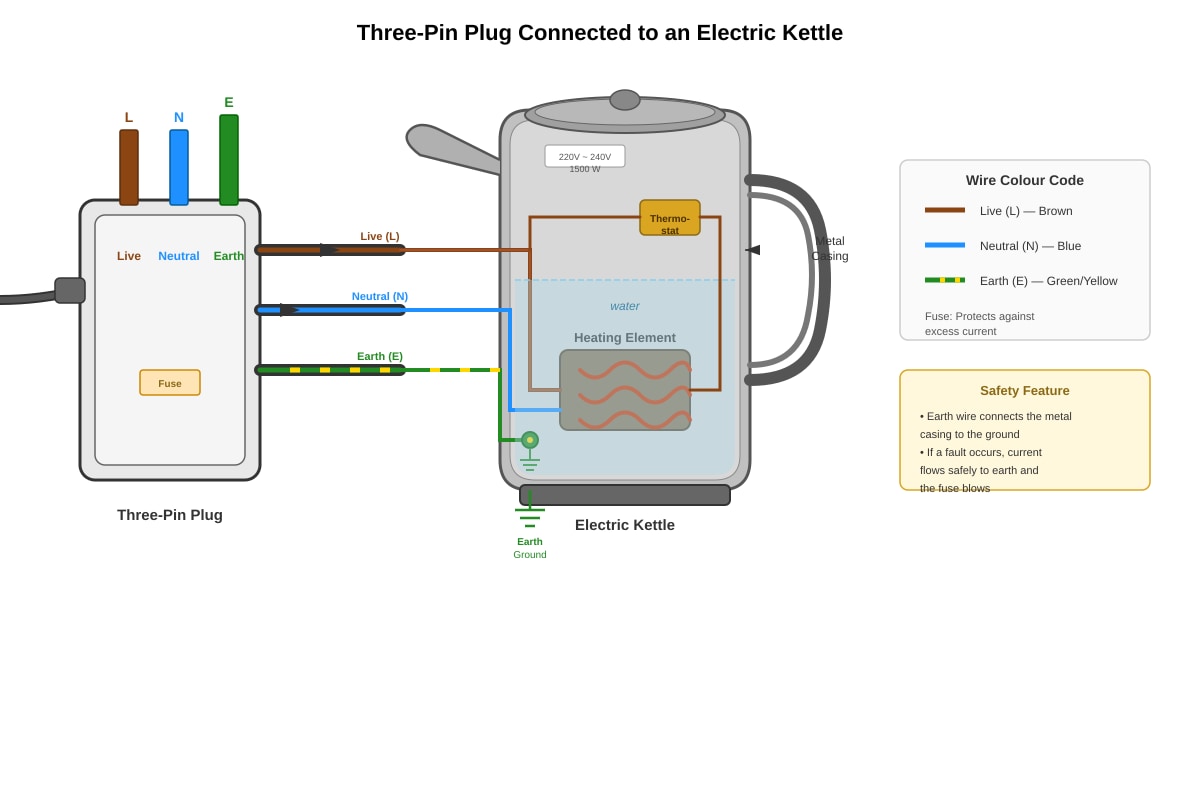
(a) The diagram below shows a three-pin plug connected to an electric kettle.
[Diagram would show: Three-pin plug with Live (L), Neutral (N), and Earth (E) connections to kettle heating element and metal casing]
(i) State the function of the neutral wire in this circuit. [1]
(ii) Explain why the metal casing of the kettle is connected to the earth wire. [2]
(b) The electric kettle is rated at 2.5 kW, 230 V. Calculate:
(i) The current drawn by the kettle during normal operation. [2]
Working:
Answer: _____________ A
(ii) The resistance of the heating element. [2]
Working:
Answer: _____________ Ω
(c) The household circuit is protected by a 32 A circuit breaker. State two advantages of using a circuit breaker instead of a fuse. [2]
(d) If the kettle operates for 15 minutes daily, calculate the electrical energy consumed in one month (30 days). Express your answer in kWh. [1]
Working:
Answer: _____________ kWh
Question 2: Electromagnetic Induction and Transformers [12 marks]
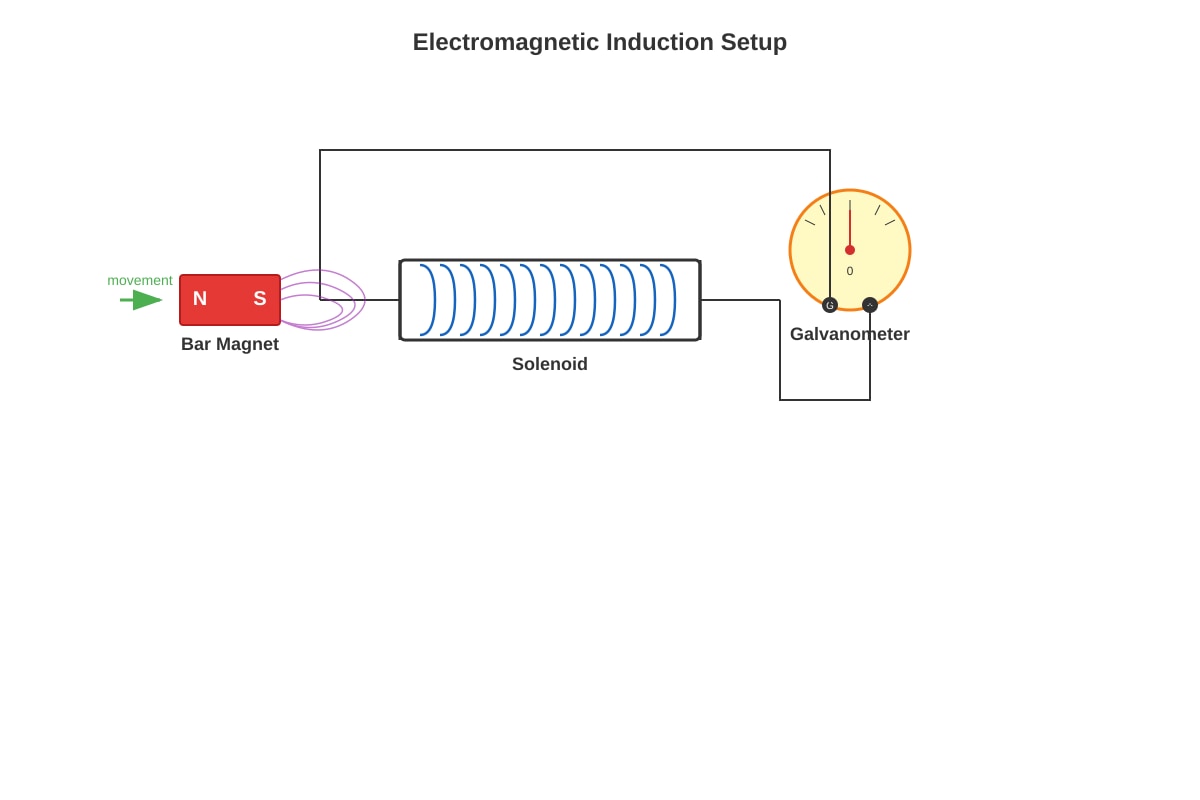
(a) A student investigates electromagnetic induction using a solenoid, bar magnet, and sensitive galvanometer as shown in the diagram below.
[Diagram would show: Solenoid connected to galvanometer, with bar magnet positioned near one end]
(i) State Faraday's law of electromagnetic induction. [2]
(ii) When the magnet is pushed into the solenoid, the galvanometer needle deflects to the right. Predict the direction of deflection when the magnet is withdrawn from the solenoid. Explain your answer. [2]
Direction: _________________________________
Explanation: _________________________________
(b) The same solenoid is now used as the secondary coil of a transformer. The primary coil has 400 turns and the secondary coil has 100 turns.
(i) Calculate the output voltage when the input voltage is 240 V. [2]
Working:
Answer: _____________ V
(ii) If the transformer has an efficiency of 90% and the secondary current is 2.0 A, calculate the primary current. [3]
Working:
Answer: _____________ A
(c) State two reasons why transformers are not 100% efficient. [2]
(d) Explain why transformers only work with alternating current and not with direct current. [1]
Question 3: Waves and Electromagnetic Spectrum [10 marks]
(a) The electromagnetic spectrum consists of different types of waves arranged in order of frequency.
(i) List four types of electromagnetic waves in order of increasing frequency. [2]
- _________________ 2. _________________ 3. _________________ 4. _________________
(ii) State two properties that are common to all electromagnetic waves. [2]
(b) A radio station broadcasts at a frequency of 95.5 MHz.
(i) Calculate the wavelength of these radio waves. [2]
Working:
Answer: _____________ m
(ii) Explain why radio waves can travel around the Earth's curvature while light waves cannot. [2]
(c) X-rays have a typical frequency of 3.0 × 10¹⁸ Hz.
(i) Calculate the wavelength of these X-rays. [1]
Working:
Answer: _____________ m
(ii) State one medical application of X-rays and explain why X-rays are suitable for this purpose. [1]
Application: _________________________________
Explanation: _________________________________
Question 4: Optics and Total Internal Reflection [8 marks]
(a) A light ray travels from glass into air. The refractive index of glass is 1.52.
(i) Calculate the critical angle for total internal reflection at the glass-air boundary. [2]
Working:
Answer: _____________ °
(ii) A light ray in the glass hits the boundary at an angle of 45° to the normal. Determine whether the ray will be refracted into air or undergo total internal reflection. [1]
(b) Optical fibers use the principle of total internal reflection to transmit light signals over long distances.
(i) Explain how total internal reflection allows light to travel through an optical fiber. [2]
(ii) State two advantages of using optical fibers instead of copper wires for telecommunications. [2]
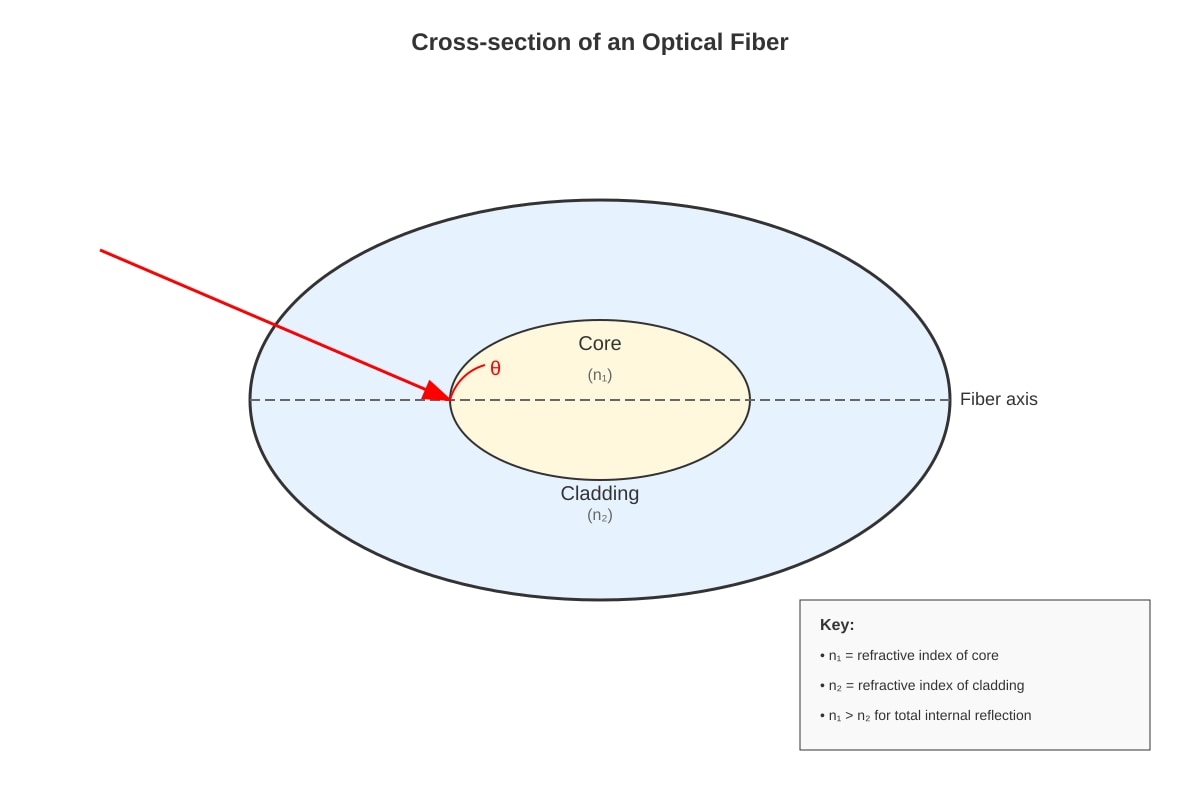
(c) The diagram shows a ray of light entering an optical fiber at angle θ to the fiber axis.
[Diagram would show: Cross-section of optical fiber with core and cladding, showing light ray entering at angle θ]
Explain why there is a maximum value of θ for which the light ray can be transmitted through the fiber. [1]
Section B [40 marks]
Answer any THREE questions from this section
Question 5: Electrical Circuits and Power [15 marks]
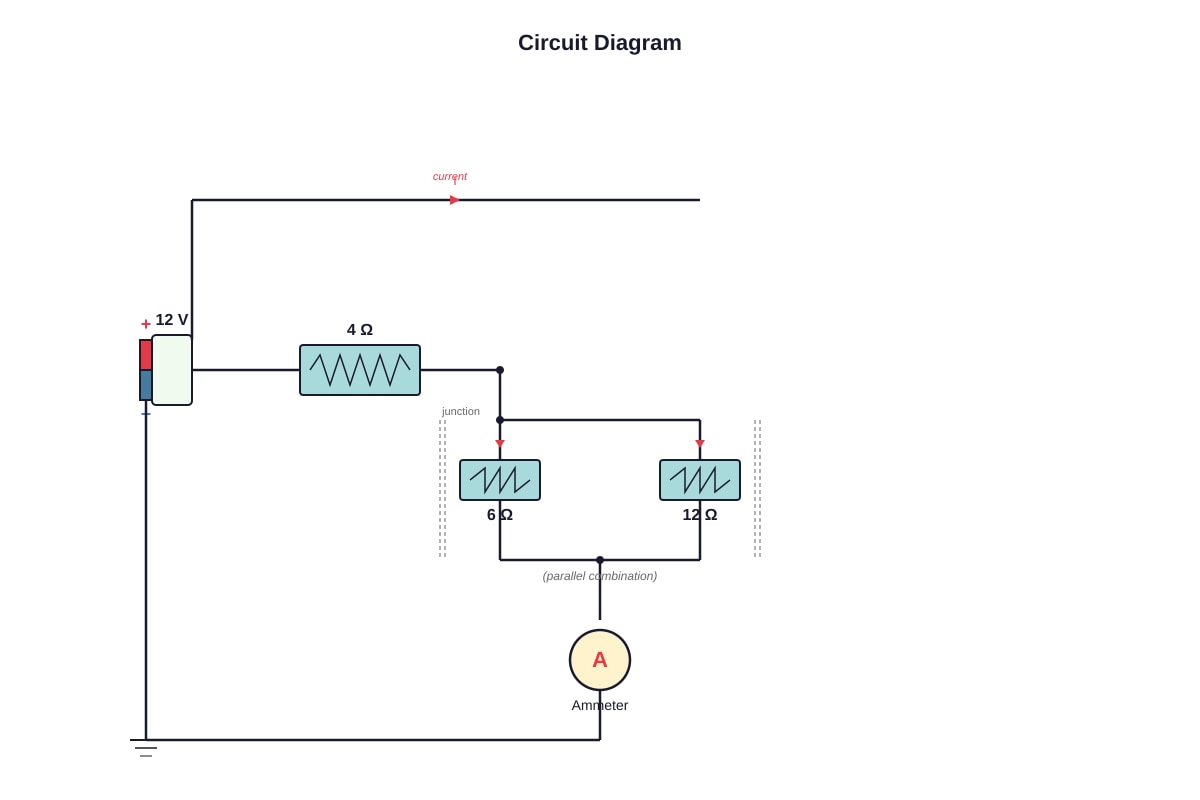
(a) The circuit diagram below shows a battery connected to two resistors and an ammeter.
[Diagram would show: 12V battery connected to 4Ω resistor in series with parallel combination of 6Ω and 12Ω resistors, with ammeter measuring total current]
(i) Calculate the total resistance of the circuit. [3]
(ii) Calculate the current shown on the ammeter. [2]
(iii) Calculate the potential difference across the 4 Ω resistor. [2]
(b) A student uses the circuit to investigate the relationship between power and resistance. The battery maintains a constant voltage of 12 V.
(i) Calculate the power dissipated in the 6 Ω resistor. [2]
(ii) Show that the total power supplied by the battery equals the sum of powers dissipated in all resistors. [3]
(c) In practice, the battery has internal resistance. Explain how internal resistance affects:
(i) The terminal voltage of the battery [1]
(ii) The maximum power that can be delivered to an external load [2]
Question 6: Mechanics and Energy [15 marks]
(a) A ball of mass 0.5 kg is thrown horizontally from the top of a building 45 m high with an initial speed of 20 m/s.
(i) Calculate the time taken for the ball to reach the ground. [2]
(ii) Calculate the horizontal distance traveled by the ball. [2]
(iii) Calculate the speed of the ball just before it hits the ground. [3]
(b) Using the principle of conservation of energy, verify your answer to part (a)(iii). [3]
(c) In reality, air resistance acts on the ball during its flight.
(i) Describe how air resistance affects the motion of the ball. [2]
(ii) Sketch velocity-time graphs for both horizontal and vertical components of velocity, showing the effect of air resistance. [3]
Question 7: Thermal Physics and Energy Transfer [15 marks]
(a) A student investigates heat transfer by mixing hot and cold water in a calorimeter.
Hot water: mass = 0.20 kg, initial temperature = 80°C Cold water: mass = 0.30 kg, initial temperature = 20°C Final temperature of mixture = 45°C
(i) Calculate the heat lost by the hot water. [2]
(ii) Calculate the heat gained by the cold water. [2]
(iii) Comment on your answers to parts (i) and (ii). [1]
(b) The student repeats the experiment using a metal block instead of hot water.
Metal block: mass = 0.15 kg, initial temperature = 100°C Cold water: mass = 0.25 kg, initial temperature = 15°C Final temperature = 25°C
Calculate the specific heat capacity of the metal. [4]
(c) Explain why the calculated value in part (b) might be less accurate than the theoretical value. [2]
(d) The metal block is made of aluminum. State two methods of heat transfer that occur when the hot aluminum block is placed in air, and explain each method in terms of particle behavior. [4]
Question 8: Modern Physics and Radioactivity [15 marks]
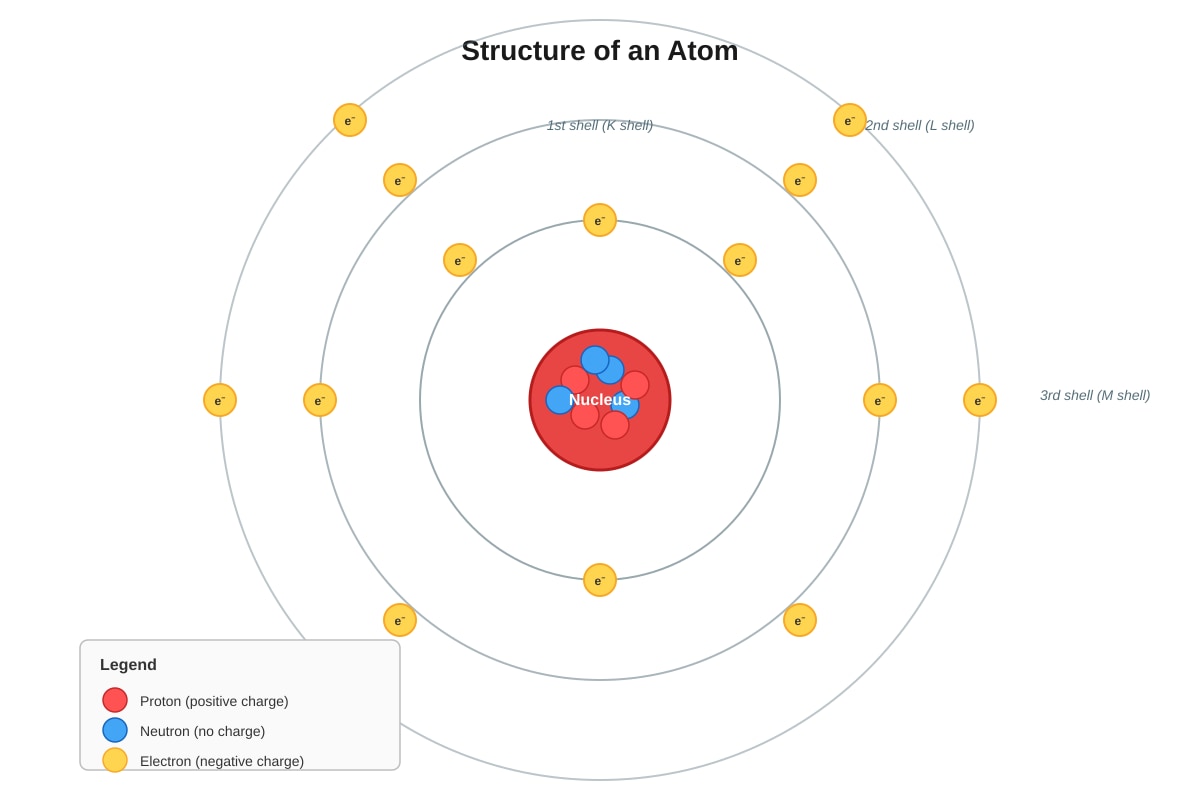
(a) The diagram shows the structure of an atom.
[Diagram would show: Simple atomic model with nucleus and electron orbits]
(i) Name the particles found in the nucleus and state their charges. [2]
(ii) Explain why atoms are normally electrically neutral. [1]
(b) A radioactive isotope undergoes alpha decay with a half-life of 8 years. The initial activity is 1600 Bq.
(i) State what is meant by half-life. [1]
(ii) Calculate the activity after 24 years. [2]
(iii) Calculate the time taken for the activity to fall to 100 Bq. [3]
(c) Compare the properties of alpha, beta, and gamma radiations in terms of:
(i) Nature of the radiation [3]
(ii) Penetrating power [3]
Answers
TuitionGoWhere Practice Paper - Pure Physics Secondary 4 (Answer Key)
Section A [40 marks]
Question 1: Household Electrical Safety [10 marks]
(a)(i) [1 mark] Provides return path for current / Completes the circuit at zero potential [1]
(a)(ii) [2 marks] If the live wire touches the metal casing, the casing becomes live [1] The earth wire provides a low resistance path for current to flow to ground, causing the fuse/circuit breaker to trip and disconnect the supply [1]
(b)(i) [2 marks] P = IV, so I = P/V [1] I = 2500/230 = 10.9 A [1]
(b)(ii) [2 marks] P = V²/R, so R = V²/P [1] R = 230²/2500 = 21.2 Ω [1]
(c) [2 marks] Any two from:
- Can be reset without replacement [1]
- Faster response to overcurrent [1]
- More convenient to use [1]
- Can be tested easily [1]
(d) [1 mark] Energy = Power × time = 2.5 × (15/60) × 30 = 18.8 kWh [1]
Question 2: Electromagnetic Induction and Transformers [12 marks]
(a)(i) [2 marks] The induced EMF is proportional to the rate of change of magnetic flux [1] OR EMF = -dΦ/dt [1]
(a)(ii) [2 marks] Direction: Left (opposite direction) [1] Explanation: By Lenz's law, the induced current opposes the change causing it [1]
(b)(i) [2 marks] Vs/Vp = Ns/Np [1] Vs = 240 × (100/400) = 60 V [1]
(b)(ii) [3 marks] Efficiency = (Vs × Is)/(Vp × Ip) [1] 0.90 = (60 × 2.0)/(240 × Ip) [1] Ip = (60 × 2.0)/(0.90 × 240) = 0.556 A [1]
(c) [2 marks] Any two from:
- Heat loss in windings (I²R losses) [1]
- Eddy current losses in core [1]
- Hysteresis losses in core [1]
- Flux leakage [1]
(d) [1 mark] DC produces constant flux, so no change in flux and no induced EMF [1]
Question 3: Waves and Electromagnetic Spectrum [10 marks]
(a)(i) [2 marks] Radio waves, microwaves, infrared, visible light [2] (Accept any four in correct order)
(a)(ii) [2 marks] Any two from:
- Travel at speed of light in vacuum [1]
- Transverse waves [1]
- Electromagnetic waves [1]
- Do not require a medium [1]
(b)(i) [2 marks] λ = c/f [1] λ = (3.0 × 10⁸)/(95.5 × 10⁶) = 3.14 m [1]
(b)(ii) [2 marks] Radio waves have longer wavelengths [1] Longer wavelengths can diffract around obstacles/Earth's curvature more effectively [1]
(c)(i) [1 mark] λ = (3.0 × 10⁸)/(3.0 × 10¹⁸) = 1.0 × 10⁻¹⁰ m [1]
(c)(ii) [1 mark] Application: Medical imaging/radiography [0.5] Explanation: Penetrate soft tissue but absorbed by bones, creating contrast [0.5]
Question 4: Optics and Total Internal Reflection [8 marks]
(a)(i) [2 marks] sin θc = n₂/n₁ = 1.0/1.52 = 0.658 [1] θc = 41.1° [1]
(a)(ii) [1 mark] 45° > 41.1°, so total internal reflection occurs [1]
(b)(i) [2 marks] Light enters the fiber core and hits the core-cladding boundary [1] At angles greater than the critical angle, total internal reflection occurs repeatedly, keeping light trapped in the core [1]
(b)(ii) [2 marks] Any two from:
- Higher data transmission rates [1]
- Immune to electromagnetic interference [1]
- Lower signal loss over long distances [1]
- Lighter weight [1]
- More secure (difficult to tap) [1]
(c) [1 mark] If θ is too large, the light ray will hit the core-cladding boundary at less than the critical angle and will not undergo total internal reflection [1]
Section B [40 marks]
Answer any THREE questions
Question 5: Electrical Circuits and Power [15 marks]
(a)(i) [3 marks] Parallel resistance: 1/Rp = 1/6 + 1/12 = 3/12, so Rp = 4 Ω [1] Total resistance: R = 4 + 4 = 8 Ω [2]
(a)(ii) [2 marks] I = V/R = 12/8 = 1.5 A [2]
(a)(iii) [2 marks] V = IR = 1.5 × 4 = 6.0 V [2]
(b)(i) [2 marks] Voltage across parallel section = 12 - 6 = 6 V [1] P = V²/R = 6²/6 = 6.0 W [1]
(b)(ii) [3 marks] Power in 4 Ω: P = I²R = 1.5² × 4 = 9.0 W [1] Power in 12 Ω: P = V²/R = 6²/12 = 3.0 W [1] Total power dissipated = 9.0 + 6.0 + 3.0 = 18.0 W Power supplied = VI = 12 × 1.5 = 18.0 W ✓ [1]
(c)(i) [1 mark] Terminal voltage decreases as current increases due to voltage drop across internal resistance [1]
(c)(ii) [2 marks] Maximum power occurs when external resistance equals internal resistance [1] As internal resistance increases, maximum deliverable power decreases [1]
Question 6: Mechanics and Energy [15 marks]
(a)(i) [2 marks] s = ut + ½at², with u = 0, s = 45 m, a = 10 m/s² [1] t = √(2s/g) = √(2 × 45/10) = 3.0 s [1]
(a)(ii) [2 marks] Horizontal distance = horizontal velocity × time [1] x = 20 × 3.0 = 60 m [1]
(a)(iii) [3 marks] Horizontal velocity remains 20 m/s [1] Vertical velocity: v = u + at = 0 + 10 × 3.0 = 30 m/s [1] Resultant speed = √(20² + 30²) = √1300 = 36.1 m/s [1]
(b) [3 marks] Initial energy = KE + PE = ½mv² + mgh = ½ × 0.5 × 20² + 0.5 × 10 × 45 [1] = 100 + 225 = 325 J [1] Final KE = ½ × 0.5 × 36.1² = 326 J (within rounding error) ✓ [1]
(c)(i) [2 marks] Air resistance opposes motion, reducing both horizontal and vertical speeds [1] Terminal velocity may be reached in vertical direction [1]
(c)(ii) [3 marks] Horizontal v-t graph: decreasing curve approaching constant value [1.5] Vertical v-t graph: increasing curve approaching terminal velocity [1.5]
Question 7: Thermal Physics and Energy Transfer [15 marks]
(a)(i) [2 marks] Q = mcΔT = 0.20 × 4200 × (80-45) = 29,400 J [2]
(a)(ii) [2 marks] Q = mcΔT = 0.30 × 4200 × (45-20) = 31,500 J [2]
(a)(iii) [1 mark] Values should be equal by conservation of energy, but heat loss to surroundings causes discrepancy [1]
(b) [4 marks] Heat lost by metal = Heat gained by water [1] mcΔT (metal) = mcΔT (water) [1] 0.15 × c × (100-25) = 0.25 × 4200 × (25-15) [1] c = (0.25 × 4200 × 10)/(0.15 × 75) = 933 J/kg·K [1]
(c) [2 marks] Heat loss to surroundings/calorimeter [1] Heat capacity of calorimeter not accounted for [1]
(d) [4 marks] Conduction: Faster-moving particles in hot aluminum collide with slower particles, transferring kinetic energy [2] Convection: Hot aluminum heats nearby air, which becomes less dense and rises, creating convection currents [2]
Question 8: Modern Physics and Radioactivity [15 marks]
(a)(i) [2 marks] Protons (positive charge) and neutrons (no charge/neutral) [2]
(a)(ii) [1 mark] Number of protons equals number of electrons [1]
(b)(i) [1 mark] Time taken for half the nuclei to decay / activity to halve [1]
(b)(ii) [2 marks] 24 years = 3 half-lives [1] Activity = 1600 × (½)³ = 200 Bq [1]
(b)(iii) [3 marks] 100 = 1600 × (½)ⁿ [1] (½)ⁿ = 100/1600 = 1/16 = (½)⁴ [1] Time = 4 × 8 = 32 years [1]
(c)(i) [3 marks] Alpha: Helium nuclei/2 protons + 2 neutrons [1] Beta: High-speed electrons [1] Gamma: High-energy electromagnetic radiation [1]
(c)(ii) [3 marks] Alpha: Stopped by paper/few cm of air [1] Beta: Stopped by thin aluminum/few mm [1] Gamma: Very penetrating, requires thick lead/concrete [1]
Total: 80 marks
Marking Scheme Notes:
- Award method marks even if final answer is incorrect
- Accept equivalent expressions and reasonable alternative approaches
- Deduct marks for missing units where specified
- Round final answers to 3 significant figures unless otherwise stated