From Real Exams Exam Paper
Secondary 4 Pure Physics Preliminary Examination Paper 5
Free Sec 4 Pure Physics Prelim Paper 5, HY3 Exam version, with questions, answers, and O Level-style practice for Singapore students.
These static practice materials are generated from the site's syllabus and paper-generation workflow, with source and model context shown so students and parents can evaluate the material before use.
Questions
TuitionGoWhere Exam Practice (AI) - Pure Physics Secondary 4 PRELIM (Version 5)
School: TuitionGoWhere Secondary School (AI)
Subject: Pure Physics
Level: Secondary 4
Paper: PRELIM Practice Paper (Version 5 of 5)
Duration: 75 minutes
Total Marks: 60
Name: ______________________
Class: ______________
Date: ______________
Instructions
- Answer all questions in the spaces provided.
- Show all working clearly where calculations are required.
- Use SI units unless otherwise stated.
- Section A: Structured Questions (1–8)
- Section B: Calculation and Data Questions (9–14)
- Section C: Conceptual and Applied Questions (15–20)
Section A: Structured Questions (16 marks)
1. [2 marks]
State the function of the neutral wire in a household alternating current (AC) circuit.
2. [1 mark]
State one advantage of using a circuit breaker rather than a fuse to protect an appliance.
3. [2 marks]
A positively charged plastic rod is brought near a coil connected to a galvanometer. The needle deflects to the right. State what is observed when the rod is removed quickly.
4. [2 marks]
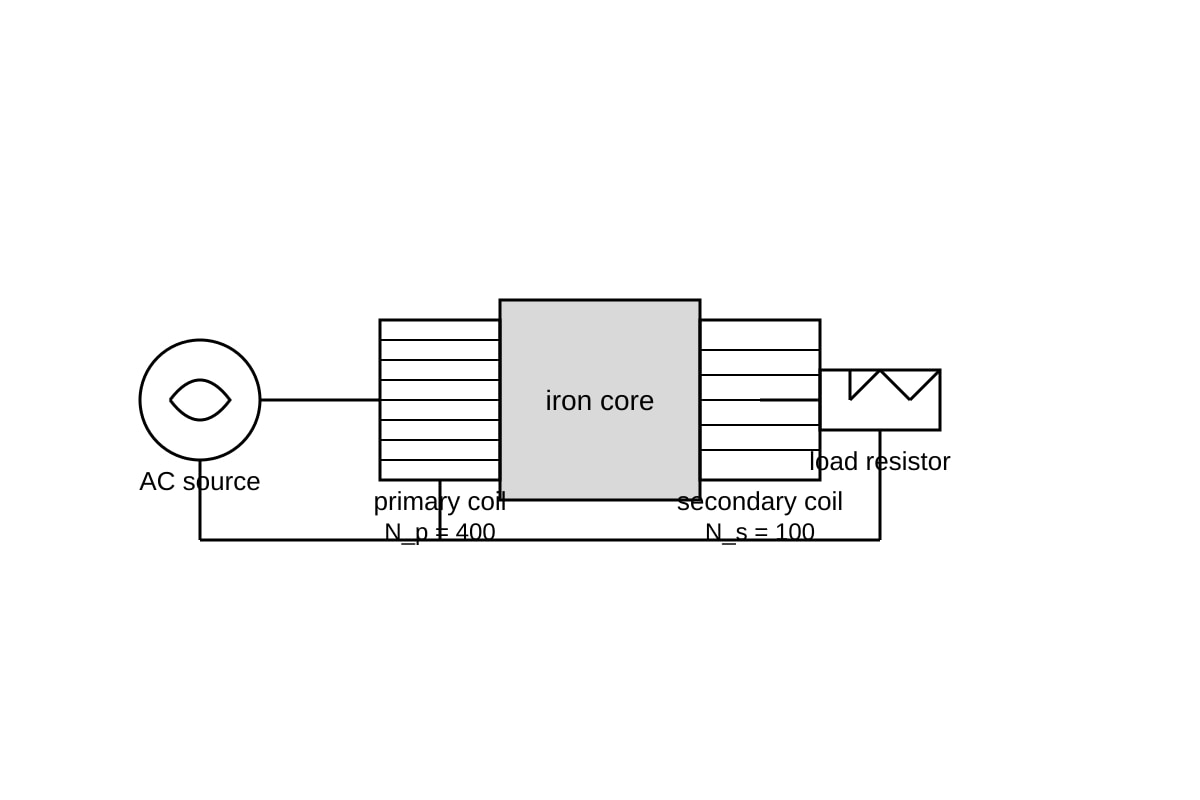
The diagram below shows a simple transformer.
Image pending generation: diagram for 4.
State the relationship between the turns ratio and the voltage ratio for an ideal transformer.
5. [2 marks]
Explain why the efficiency of a real transformer is always less than 100%.
6. [2 marks]
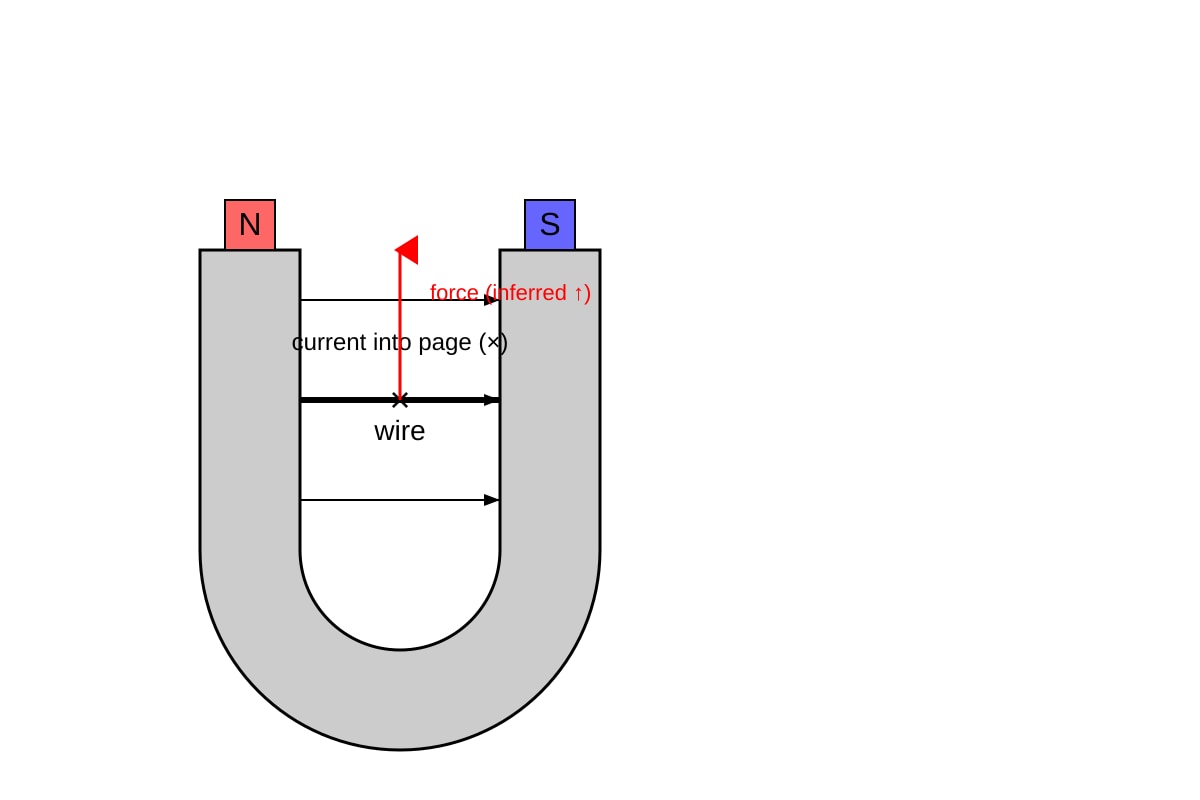
A wire carrying current is placed between the poles of a magnet as shown.
Image pending generation: diagram for 6.
Using Fleming’s left-hand rule, state the direction of the force acting on the wire.
7. [2 marks]
State two ways to increase the magnitude of the induced electromotive force (e.m.f.) in a coil by electromagnetic induction.
8. [3 marks]
The earth wire in a household appliance is normally not carrying current. Explain its purpose and state what happens to it during a fault.
Section B: Calculation and Data Questions (24 marks)
9. [2 marks]
A transformer has a primary voltage of 240 V and a secondary voltage of 12 V. The primary coil has 600 turns. Calculate the number of turns in the secondary coil.
Working:
Answer: ________ turns
10. [2 marks]
An ideal transformer has 1200 turns on the primary and 300 turns on the secondary. If the primary current is 0.50 A, calculate the secondary current.
Working:
Answer: ________ A
11. [3 marks]
A transformer is 80% efficient. The secondary coil delivers 9.0 V at 2.0 A. The primary voltage is 230 V. Calculate the current in the primary coil.
Working:
Answer: ________ A
12. [3 marks]
A coil of wire is moved quickly into a magnetic field. The magnetic flux changes by 0.040 Wb in 0.020 s. The coil has 50 turns. Calculate the magnitude of the induced e.m.f.
Working:
Answer: ________ V
13. [4 marks]
The graph below shows the output voltage of a generator over time.
Image pending generation: graph for 13.
(a) Determine the frequency of the output. [2]
(b) State the type of current produced. [1]
(c) Explain one way to increase the frequency. [1]
Working / Answers:
(a) ________ Hz
(b) ________________________
(c) ________________________
14. [4 marks]
A 12 V battery supplies a current of 3.0 A to a circuit for 10 minutes.
(a) Calculate the total charge transferred. [2]
(b) Calculate the electrical energy supplied. [2]
Working:
(a) ___________________________________________________________
(b) ___________________________________________________________
Answers: (a) ________ C (b) ________ J
15. [5 marks]
A step-down transformer supplies a 24 V, 5.0 A lamp from a 240 V mains. Assume ideal.
(a) Calculate the secondary power. [2]
(b) Calculate the primary current. [2]
(c) State one reason why the actual primary current would be higher. [1]
Working:
(a) ___________________________________________________________
(b) ___________________________________________________________
(c) ___________________________________________________________
Answers: (a) ________ W (b) ________ A (c) ________________________
Section C: Conceptual and Applied Questions (20 marks)
16. [3 marks]
A student says: “If I double the number of turns on the secondary coil of an ideal transformer, the secondary current will double.” Explain whether this is correct, using transformer equations.
17. [3 marks]
Describe an experiment to demonstrate electromagnetic induction using a magnet, a coil, and a galvanometer. Include the observation.
18. [4 marks]
The diagram shows a DC motor.
Image pending generation: diagram for 18.
(a) State the energy conversion in the motor. [1]
(b) Explain the role of the commutator. [2]
(c) State how to reverse the direction of rotation. [1]
Answers:
(a) ________________________
(b) ________________________
(c) ________________________
19. [4 marks]
Household electrical appliances are connected in parallel, not in series.
(a) State one reason for this arrangement. [2]
(b) Explain what happens to the other appliances if one appliance in parallel fails (open circuit). [2]
Answers:
(a) ________________________
(b) ________________________
20. [6 marks]
A power transmission line uses a step-up transformer at the generating station and a step-down transformer at the consumer end.
(a) Explain why the voltage is stepped up for transmission. [3]
(b) Calculate the transmission current if 100 kW is sent at 20 kV. [2]
(c) State one environmental benefit of reducing current in the wires. [1]
Working / Answers:
(a) ___________________________________________________________
(b) ________ A
(c) ___________________________________________________________
End of Paper
Answers
TuitionGoWhere Exam Practice (AI) - Pure Physics Secondary 4 PRELIM (Version 5) Answer Key
Total Marks: 60
Section A: Structured Questions
1. [2 marks]
Expected: The neutral wire provides the return path for current to the supply and is maintained at approximately zero potential.
Marking: 1 mark for “return path / completes circuit”, 1 mark for “zero potential / reference”.
2. [1 mark]
Expected: A circuit breaker can be reset and reused; no need for replacement (or faster response).
Marking: 1 mark for any valid advantage.
3. [2 marks]
Expected: The galvanometer needle deflects momentarily in the opposite direction (to the left).
Marking: 1 mark “momentarily / briefly”, 1 mark “opposite direction / left”.
Teaching: Removing the charged rod reduces flux; Lenz’s law gives opposite induced current.
4. [2 marks]
Expected: For ideal transformer, NsNp=VsVp.
Marking: 2 marks for correct ratio equation.
5. [2 marks]
Expected: Energy is lost as heat in the coils (resistance) and as eddy currents in the core; some flux leakage.
Marking: 1 mark for coil heating, 1 mark for core/eddy loss.
6. [2 marks]
Expected: Force is upward (away from the magnet, perpendicular to field and current).
Using Fleming’s left-hand: Field N→S (left to right), current into page, force up.
Marking: 2 marks for correct direction with rule stated or implied.
7. [2 marks]
Expected: Increase rate of change of magnetic flux (faster movement / stronger magnet); increase number of turns.
Marking: 1 mark each.
8. [3 marks]
Expected: Earth wire is safety path; normally no current. During fault (live touches casing), current flows to earth, causing breaker/fuse to cut off.
Marking: 1 mark purpose, 1 mark no current normally, 1 mark fault action.
Section B: Calculation and Data Questions
9. [2 marks]
NsNp=VsVp⇒Ns=Np×VpVs=600×24012=30 turns.
Answer: 30 turns.
Marking: 1 mark formula, 1 mark answer.
10. [2 marks]
NsNp=IpIs⇒Is=Ip×NsNp=0.50×3001200=2.0 A.
Answer: 2.0 A.
Marking: 1 mark rearrangement, 1 mark answer.
11. [3 marks]
η=VpIpVsIs⇒Ip=ηVpVsIs=0.80×2309.0×2.0=18418=0.098 A.
Answer: 0.098 A (or 9.8×10⁻² A).
Marking: 1 mark efficiency eq, 1 mark substitution, 1 mark answer.
12. [3 marks]
∣ε∣=NΔtΔΦ=50×0.0200.040=50×2=100 V.
Answer: 100 V.
Marking: 1 mark Faraday eq, 1 mark sub, 1 mark answer.
13. [4 marks]
(a) f=1/T=1/0.04=25 Hz [2]
(b) Alternating current (AC) [1]
(c) Increase rotation speed of coil / more poles [1]
Marking: per mark as shown.
14. [4 marks]
(a) Q=It=3.0×(10×60)=1800 C [2]
(b) E=VIt=12×3.0×600=21600 J [2]
Marking: 1 mark formula, 1 mark answer each.
15. [5 marks]
(a) Ps=VsIs=24×5.0=120 W [2]
(b) Pp=Ps⇒Ip=Pp/Vp=120/240=0.50 A [2]
(c) Real losses (heat) mean more primary current needed [1]
Marking: as shown.
Section C: Conceptual and Applied Questions
16. [3 marks]
Incorrect. For ideal: Vs/Vp=Ns/Np and Is/Ip=Np/Ns. Doubling Ns doubles Vs but halves Is (if primary fixed). So secondary current decreases, not doubles.
Marking: 1 mark correct claim, 2 marks explanation with equations.
17. [3 marks]
Connect coil to galvanometer. Move magnet in/out of coil. Observe needle deflects one way then opposite. Faster motion → larger deflection.
Marking: 1 mark setup, 1 mark action, 1 mark observation.
18. [4 marks]
(a) Electrical → kinetic (rotational) energy [1]
(b) Reverses current direction every half-turn to keep torque same direction [2]
(c) Reverse DC supply polarity or swap magnet poles [1]
19. [4 marks]
(a) Each appliance gets full mains voltage independent of others [2]
(b) Others keep working because parallel branches have separate paths [2]
20. [6 marks]
(a) Higher voltage → lower current for same power; lowers I2R heat loss in wires [3]
(b) I=P/V=100000/20000=5.0 A [2]
(c) Less energy wasted → lower fuel use / emissions [1]
End of Answer Key
Free quiz and exam paper access
Enter your details to view this paper
Your access is remembered on this device.