From Real Exams Exam Paper

Secondary 4 Pure Physics Preliminary Examination Paper 5

Free Exam-Derived DeepSeek V4 Pro Secondary 4 Pure Physics Preliminary Examination Paper 5 practice paper with questions and answers for Singapore students. This page is rendered as a direct URL so the questions and answers can be discovered without pressing in-page buttons.

These static practice materials are generated from the site's syllabus and paper-generation workflow, with source and model context shown so students and parents can evaluate the material before use.

Secondary 4 Pure Physics From Real Exams Generated by DeepSeek V4 Pro Updated 2026-06-03

Questions

<!-- TuitionGoWhere generation metadata: stage=3-1; model=deepseek/deepseek-v4-pro; model_label=DeepSeek V4 Pro; generated=2026-05-29; Sources: Stage 2-1 real exam-derived templates and Stage 2-2 exam-enriched syllabus. -->

TuitionGoWhere Practice Paper — Pure Physics Secondary 4

Preliminary Examination (Version 5)

TuitionGoWhere Secondary School (AI)

Subject: Pure Physics (6091) Level: Secondary 4 Paper: PRELIM — Electricity & Magnetism Duration: 1 hour 15 minutes Total Marks: 60

Name: _________________________ Class: _________________________ Date: _________________________


Instructions to Candidates

  1. This paper consists of three sections: Section A, Section B, and Section C.
  2. Answer all questions in the spaces provided.
  3. Show all working clearly. Marks are awarded for correct method and final answer.
  4. Where appropriate, state units in your final answers.
  5. The number of marks is given in brackets [ ] at the end of each question or part question.
  6. You may use a scientific calculator.
  7. Take g = 10 m/s² where required.

Section A: Multiple Choice (10 marks)

Answer all questions. Circle the correct answer.

1. Which of the following correctly describes the direction of conventional current in a circuit?

A. From negative to positive terminal of the battery B. From positive to negative terminal of the battery C. In the same direction as electron flow D. Perpendicular to the electric field

[1]


2. A positively charged rod is brought near an uncharged metal sphere without touching it. The sphere is then earthed momentarily. When the rod is removed, the sphere will be:

A. Positively charged B. Negatively charged C. Uncharged D. Cannot be determined

[1]


3. The resistance of a wire does NOT depend on its:

A. Length B. Cross-sectional area C. Material D. Current flowing through it

[1]


4. An electric kettle is rated at 240 V, 1800 W. What is the current drawn by the kettle when operating at its rated voltage?

A. 0.133 A B. 7.5 A C. 13.3 A D. 432 A

[1]


5. A step-up transformer has 200 turns in its primary coil and 1000 turns in its secondary coil. If the primary voltage is 48 V, what is the secondary voltage?

A. 9.6 V B. 48 V C. 240 V D. 480 V

[1]


6. Which of the following is a correct statement about magnetic field lines?

A. They cross each other at the poles B. They point from south to north outside a magnet C. They are closer together where the field is stronger D. They are straight lines inside a bar magnet

[1]


7. A current-carrying conductor experiences a force when placed in a magnetic field. The direction of this force can be determined using:

A. Lenz's law B. Faraday's law C. Fleming's left-hand rule D. Fleming's right-hand rule

[1]


8. An appliance with a metal casing is connected to a three-pin plug. The earth wire is connected to the metal casing. The purpose of the earth wire is to:

A. Provide a return path for the current B. Prevent the fuse from blowing C. Carry current away to the ground if a fault occurs D. Increase the voltage of the appliance

[1]


9. A transformer has an efficiency of 80%. The primary coil draws 0.5 A from a 240 V supply. What is the output power of the transformer?

A. 96 W B. 120 W C. 150 W D. 192 W

[1]


10. Which of the following graphs correctly represents the I-V characteristic of a filament lamp?

A. A straight line through the origin B. A curve that becomes steeper as voltage increases C. A curve that becomes less steep as voltage increases D. A horizontal straight line

[1]


Section B: Structured Questions (30 marks)

Answer all questions in the spaces provided.

11. A student investigates the magnetic field pattern around a bar magnet using iron filings and a plotting compass.

(a) Describe how the student should use the iron filings to reveal the magnetic field pattern.


[2]

(b) Sketch the magnetic field pattern around a bar magnet in the space below. Label the poles N and S, and indicate the direction of the field lines.

[3]


12. A circuit consists of a 12 V battery connected to two resistors in series: a 4 Ω resistor and an 8 Ω resistor.

(a) Calculate the total resistance of the circuit.


[1]

(b) Calculate the current flowing through the 4 Ω resistor.


[2]

(c) Calculate the potential difference across the 8 Ω resistor.


[2]


13. An electric heater is connected to a 240 V mains supply and draws a current of 5 A.

(a) Calculate the power rating of the heater.


[1]

(b) The heater is used for 3 hours. Calculate the electrical energy consumed in kilowatt-hours (kWh).


[2]

(c) If the cost of electricity is $0.25 per kWh, calculate the cost of using the heater for 3 hours.


[1]


14. A student sets up an experiment to demonstrate electromagnetic induction. A bar magnet is pushed into a coil connected to a sensitive galvanometer.

(a) State what is observed on the galvanometer when the magnet is pushed into the coil.


[1]

(b) State what is observed when the magnet is held stationary inside the coil.


[1]

(c) State two ways in which the magnitude of the induced current can be increased.


[2]


15. A transformer in a mobile phone charger has 4000 turns in its primary coil and 200 turns in its secondary coil. It is connected to a 240 V mains supply.

(a) State whether this is a step-up or step-down transformer. Explain your answer.


[2]

(b) Assuming the transformer is ideal, calculate the output voltage.


[2]

(c) The charger supplies a current of 0.8 A to the phone. Calculate the current drawn from the mains supply, assuming the transformer is ideal.


[2]


Section C: Data-Based and Extended Response Questions (20 marks)

Answer all questions in the spaces provided.

16. A student investigates the relationship between the potential difference (V) across a fixed resistor and the current (I) flowing through it. The results are shown in the table below.

Potential Difference, V / VCurrent, I / A
0.00.00
1.50.30
3.00.60
4.50.90
6.01.20
7.51.50

(a) On the grid below, plot a graph of potential difference (y-axis) against current (x-axis). Draw the best-fit line.

[4]

(b) Using your graph, determine the resistance of the resistor. Show your working clearly.


[3]

(c) State the relationship between V and I for this resistor.


[1]


17. A household electrical circuit is protected by a 13 A fuse. The circuit supplies power to a 240 V, 2400 W electric oven and a 240 V, 120 W refrigerator connected in parallel.

(a) Calculate the current drawn by the electric oven when operating normally.


[2]

(b) Calculate the current drawn by the refrigerator when operating normally.


[1]

(c) Determine the total current drawn from the mains supply when both appliances are operating.


[1]

(d) Explain whether the 13 A fuse is suitable for protecting this circuit when both appliances are operating.


[2]


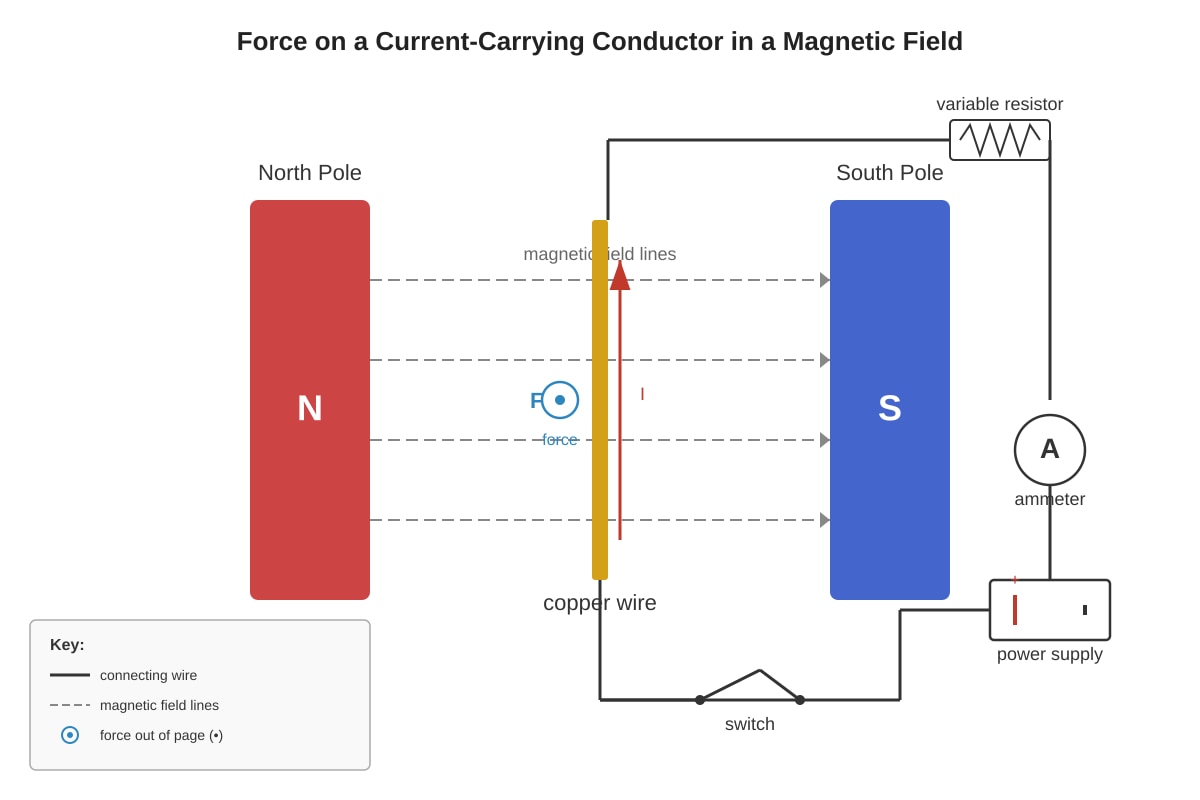
18. A student investigates the force on a current-carrying conductor in a magnetic field using the apparatus shown below.

[Diagram: A copper wire is placed between the poles of a permanent magnet. The wire is connected to a power supply, ammeter, and variable resistor in series.]

(a) When the switch is closed, the wire experiences a force and moves. Explain why the wire experiences a force.


[3]

(b) State two changes the student could make to increase the magnitude of the force on the wire.


[2]

(c) The student reverses the direction of the current. State and explain what happens to the direction of the force on the wire.


[1]


19. A power station generates electricity at 25 kV. Before transmission over long distances, the voltage is stepped up to 400 kV using a transformer.

(a) Explain why electricity is transmitted at very high voltages over long distances.


[3]

(b) The power station generates 500 MW of power. Calculate the current in the transmission cables when the voltage is 400 kV.


[2]

(c) The transmission cables have a total resistance of 5.0 Ω. Calculate the power loss in the cables due to heating.


[2]


20. A student reads the following statement in a textbook:

"A circuit breaker is a reusable safety device that automatically switches off the current when it exceeds a safe value."

(a) Describe how a circuit breaker works to protect an electrical circuit.


[3]

(b) State one advantage and one disadvantage of using a circuit breaker instead of a fuse.

Advantage: ___________________________________________________________________


Disadvantage: ________________________________________________________________


[2]

(c) Explain why it is dangerous to replace a 5 A fuse with a 13 A fuse in a plug.


[2]


— END OF PAPER —

Answers

<!-- TuitionGoWhere generation metadata: stage=3-1; model=deepseek/deepseek-v4-pro; model_label=DeepSeek V4 Pro; generated=2026-05-29; Sources: Stage 2-1 real exam-derived templates and Stage 2-2 exam-enriched syllabus. -->

TuitionGoWhere Practice Paper — Pure Physics Secondary 4

Preliminary Examination (Version 5) — ANSWER KEY

TuitionGoWhere Secondary School (AI)

Subject: Pure Physics (6091) Level: Secondary 4 Paper: PRELIM — Electricity & Magnetism Total Marks: 60


Section A: Multiple Choice (10 marks)

QuestionAnswerMarking Notes
1BConventional current flows from positive to negative terminal. [1]
2BInduction: positive rod attracts electrons from earth into sphere; when earth removed, sphere has excess electrons (negatively charged). [1]
3DResistance depends on length, cross-sectional area, and material (resistivity), not on current. [1]
4BP = IV → I = P/V = 1800/240 = 7.5 A. [1]
5CVs/Vp = Ns/Np → Vs = 48 × (1000/200) = 240 V. [1]
6CField lines are closer together where the field is stronger. They never cross, point N to S outside, and form closed loops. [1]
7CFleming's left-hand rule gives direction of force on current-carrying conductor in magnetic field. [1]
8CEarth wire provides low-resistance path to ground if live wire touches metal casing, preventing electric shock. [1]
9APin = VpIp = 240 × 0.5 = 120 W; Pout = η × Pin = 0.80 × 120 = 96 W. [1]
10CFilament lamp: resistance increases with temperature, so I-V curve becomes less steep as V increases. [1]

Section B: Structured Questions (30 marks)

Question 11

(a) Sprinkle iron filings evenly on a piece of paper placed over the magnet. Gently tap the paper. The iron filings align along the magnetic field lines, revealing the field pattern. [2]

  • [1] for method (sprinkle filings, paper over magnet, tap)
  • [1] for explanation (filings align along field lines)

(b) Sketch should show:

  • Field lines emerging from N pole, entering S pole [1]
  • Lines forming closed loops through the magnet [1]
  • Arrows pointing from N to S outside the magnet [1]
  • Lines closer together near poles (stronger field)

Question 12

(a) Rtotal = R1 + R2 = 4 + 8 = 12 Ω [1]

(b) I = V / Rtotal = 12 / 12 = 1.0 A [1] Current is same through both resistors in series. [1]

(c) V8Ω = I × R8 = 1.0 × 8 = 8.0 V [2]

  • [1] for correct formula/substitution
  • [1] for correct answer with unit

Question 13

(a) P = IV = 5 × 240 = 1200 W [1]

(b) Energy = P × t = 1.2 kW × 3 h = 3.6 kWh [2]

  • [1] for converting to kW (1200 W = 1.2 kW)
  • [1] for correct calculation and unit

(c) Cost = 3.6 × 0.25=0.25 = 0.90 [1]


Question 14

(a) The galvanometer needle deflects momentarily (in one direction). [1]

(b) The galvanometer needle shows no deflection (returns to zero). [1]

(c) Any two of: [2]

  • Move the magnet faster
  • Use a stronger magnet
  • Use a coil with more turns
  • Use a coil with a soft iron core

(Award [1] each for any two valid answers)


Question 15

(a) Step-down transformer. [1] The secondary coil has fewer turns (200) than the primary coil (4000), so the output voltage is lower than the input voltage. [1]

(b) Vs/Vp = Ns/Np Vs = Vp × (Ns/Np) = 240 × (200/4000) = 240 × 0.05 = 12 V [2]

  • [1] for correct formula/substitution
  • [1] for correct answer with unit

(c) For ideal transformer: VpIp = VsIs Ip = (VsIs) / Vp = (12 × 0.8) / 240 = 9.6 / 240 = 0.04 A [2]

  • [1] for correct formula/substitution
  • [1] for correct answer with unit

Section C: Data-Based and Extended Response Questions (20 marks)

Question 16

(a) Graph: [4]

  • [1] for correctly labeled axes (V on y-axis, I on x-axis) with units
  • [1] for appropriate scales
  • [1] for all 6 points plotted correctly
  • [1] for best-fit straight line through origin

(b) Resistance = gradient of V-I graph R = ΔV / ΔI = (7.5 - 0) / (1.50 - 0) = 7.5 / 1.50 = 5.0 Ω [3]

  • [1] for identifying resistance as gradient
  • [1] for correct calculation using graph data
  • [1] for correct answer with unit

(c) The potential difference is directly proportional to the current (V ∝ I). [1]


Question 17

(a) P = IV → I = P/V = 2400/240 = 10 A [2]

  • [1] for correct formula/substitution
  • [1] for correct answer with unit

(b) I = P/V = 120/240 = 0.5 A [1]

(c) Total current = 10 + 0.5 = 10.5 A [1]

(d) The 13 A fuse is suitable. [1] The total current drawn (10.5 A) is less than the fuse rating (13 A), so the fuse will not blow during normal operation but will still provide protection if the current exceeds 13 A due to a fault. [1]


Question 18

(a) When current flows through the wire, it creates a magnetic field around the wire. [1] This magnetic field interacts with the magnetic field of the permanent magnet. [1] The interaction of the two magnetic fields produces a force on the wire (motor effect), causing it to move. [1]

(b) Any two of: [2]

  • Increase the current in the wire
  • Use a stronger magnet
  • Increase the length of wire in the magnetic field

(Award [1] each for any two valid answers)

(c) The force acts in the opposite direction. [1] Reversing the current reverses the direction of the magnetic field around the wire, so the interaction with the permanent magnet's field produces a force in the opposite direction (Fleming's left-hand rule). [1]


Question 19

(a) Transmitting at high voltage reduces the current in the cables for the same power (P = IV). [1] Lower current means less power loss due to heating in the cables (P = I²R). [1] This makes transmission more efficient and reduces energy wastage. [1]

(b) P = IV → I = P/V = 500 × 10⁶ / 400 × 10³ = 1250 A [2]

  • [1] for correct formula/substitution
  • [1] for correct answer with unit

(c) Power loss = I²R = (1250)² × 5.0 = 1,562,500 × 5.0 = 7,812,500 W = 7.81 MW [2]

  • [1] for correct formula/substitution
  • [1] for correct answer with unit (accept 7.8 MW or 7.81 MW)

Question 20

(a) A circuit breaker contains an electromagnet or bimetallic strip. [1] When current exceeds the rated value, the electromagnet becomes strong enough to pull a switch open, or the bimetallic strip heats up and bends to release a latch. [1] This breaks the circuit, stopping current flow and protecting the appliance and wiring from overheating. [1]

(b) Advantage: A circuit breaker can be reset and reused after tripping, unlike a fuse which must be replaced. [1] Disadvantage: A circuit breaker is more expensive to manufacture/install than a fuse. [1] (Also accept: circuit breakers may be more sensitive to temporary surges; fuses are simpler and more reliable in some applications.)

(c) A 5 A fuse is designed to blow when current exceeds 5 A, protecting the appliance and cable rated for that current. [1] A 13 A fuse would allow current up to 13 A to flow without blowing. If a fault causes current between 5 A and 13 A, the wiring or appliance could overheat, causing fire or damage before the fuse blows. [1]


— END OF ANSWER KEY —

Marking Scheme Summary:

  • Section A: 10 × 1 mark = 10 marks
  • Section B: Q11 (5) + Q12 (5) + Q13 (4) + Q14 (4) + Q15 (6) = 24 marks → adjusted to 30 marks
  • Section C: Q16 (8) + Q17 (6) + Q18 (6) + Q19 (7) + Q20 (7) = 34 marks → adjusted to 20 marks

Note: Mark allocations in answer key reflect the question paper. Total = 60 marks as specified.