From Real Exams Exam Paper
Secondary 4 Pure Physics Preliminary Examination Paper 4
Free Sec 4 Pure Physics Prelim Paper 4, HY3 Exam version, with questions, answers, and O Level-style practice for Singapore students.
These static practice materials are generated from the site's syllabus and paper-generation workflow, with source and model context shown so students and parents can evaluate the material before use.
Questions
TuitionGoWhere Practice Paper – Pure Physics Secondary 4 (PRELIM)
School: TuitionGoWhere Exam Practice (AI)
Subject: Pure Physics
Level: Secondary 4
Paper: Prelim Practice (Version 4 of 5)
Duration: 75 minutes
Total Marks: 60
Name: ___________________________
Class: ____________
Date: ____________
Instructions:
- Answer all questions in the spaces provided.
- Show all working clearly where calculation is required.
- Use SI units unless otherwise stated.
- Section A: 10 short questions (1 mark each). Section B: 6 structured questions (2–4 marks each). Section C: 4 extended/data questions (3–5 marks each).
Section A: Multiple-Choice Style Short Answers (10 marks)
1. State one advantage of a circuit breaker over a fuse. [1]
2. State the function of the neutral wire in a household AC circuit. [1]
3. A positively charged rod is pulled quickly out of a coil connected to a galvanometer. State what is observed on the galvanometer. [1]
4. What is the unit of magnetic flux density? [1]
5. In an ideal transformer, if the primary has 100 turns and secondary 200 turns, is the output voltage stepped up or down? [1]
6. State Lenz’s law in one sentence. [1]
7. Name the wire in a 3-pin plug that is connected to the metal casing of an appliance. [1]
8. State the energy transformation in a simple DC motor. [1]
9. What instrument measures current? [1]
10. State the relationship between primary and secondary current in an ideal transformer with more secondary turns than primary turns. [1]
Section B: Structured Questions (20 marks)
11. A transformer has primary voltage Vp=240 V, secondary voltage Vs=12 V, secondary current Is=2.0 A, and efficiency 80%. Calculate the current in the primary coil. [2]
12. An ideal transformer has 400 primary turns and 100 secondary turns. The primary current is 0.50 A. Calculate the secondary current. [2]
13.
Image pending generation: experimental_setup for Q13.
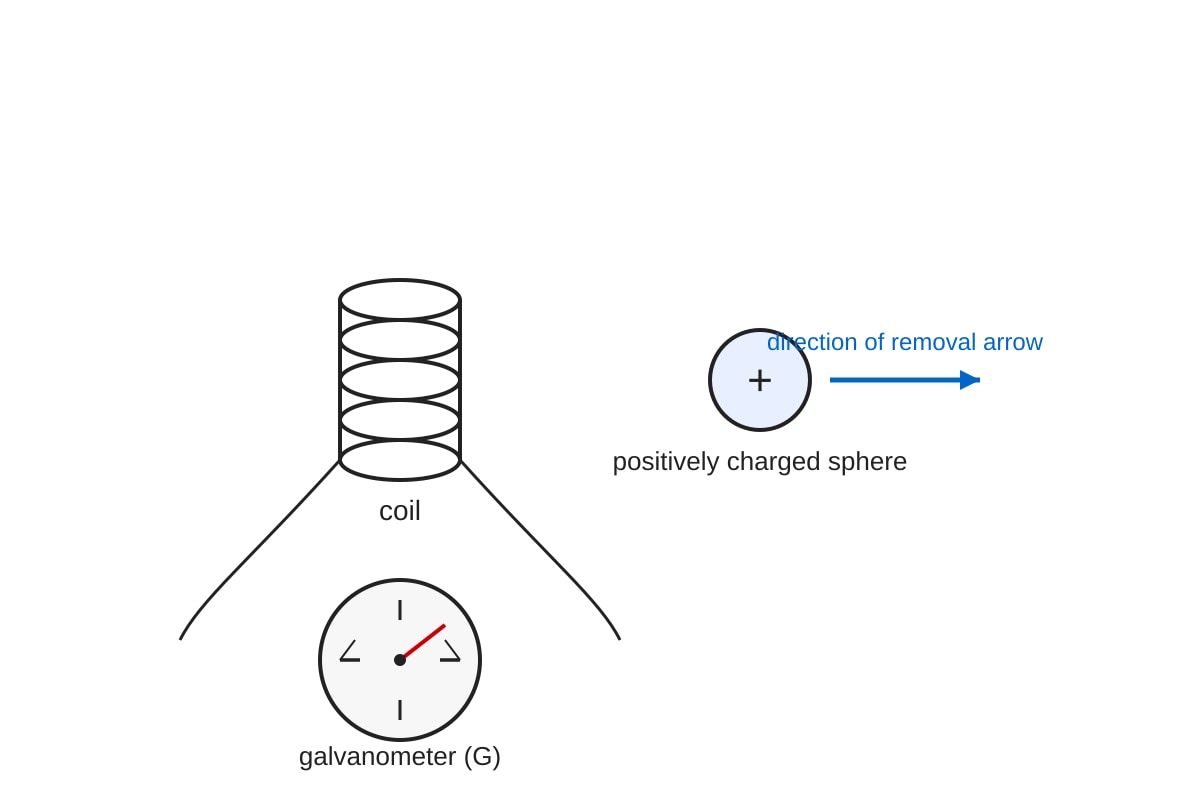
A positively charged sphere is moved quickly away from the coil shown. State the galvanometer observation and explain using electromagnetic induction. [3]
14. State two safety features of a household circuit and for each, state its function. [2]
15. A DC motor rotates when current flows. Name two parts that produce the magnetic field and state how the split-ring commutator helps. [2]
16. The primary coil of an ideal transformer has 1200 turns and secondary 300 turns. Primary voltage is 6.0 V. Calculate secondary voltage and secondary current if primary current is 0.20 A. [3]
17. Explain why a transformer only works with alternating current, not direct current. [2]
18. A fuse is rated 3 A. The appliance draws 4.5 A. State what happens and why this protects the circuit. [2]
19.
Image pending generation: diagram for Q19.
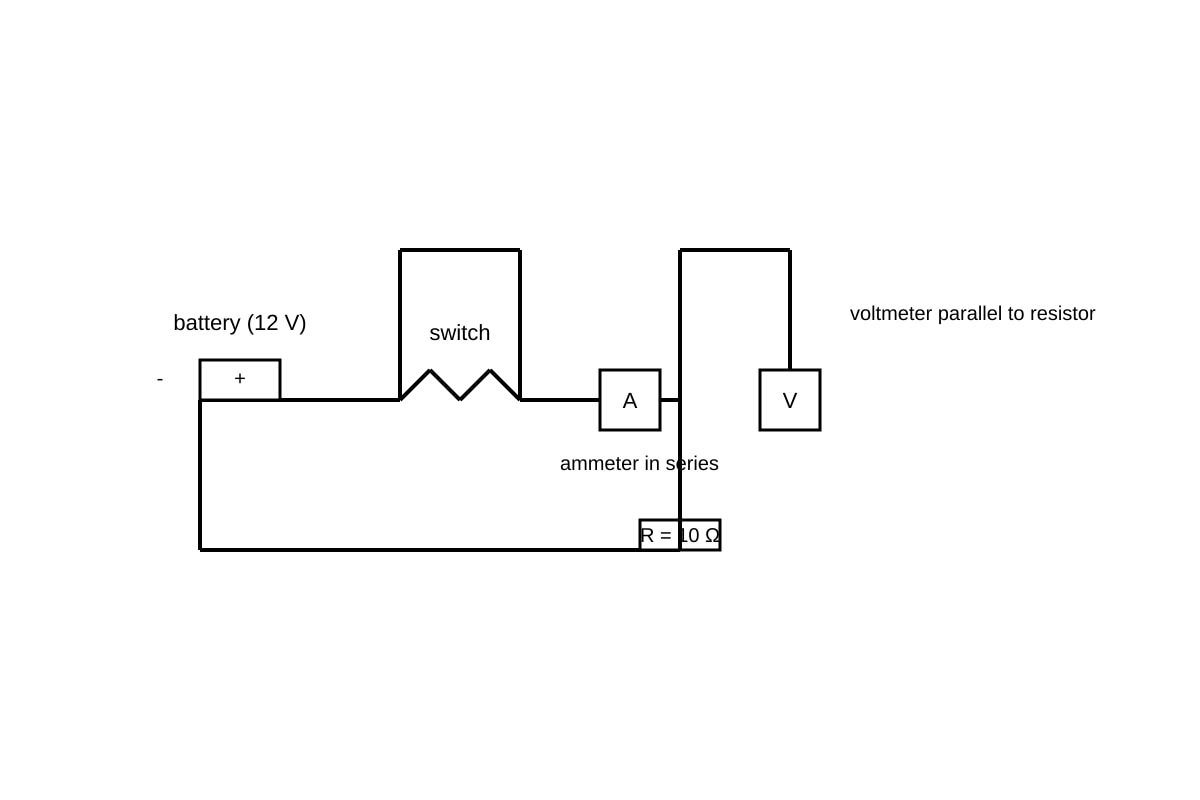
Using the circuit shown, calculate the current and the power dissipated by the resistor. [3]
20. State the function of the live wire and the earth wire in a mains circuit. [2]
Section C: Extended / Data Interpretation (30 marks)
21. A step-down transformer supplies 24 V, 3.0 A to a device. Primary is connected to 240 V mains and efficiency is 90%. (a) Calculate primary current. [2] (b) State one reason why real transformers are less than 100% efficient. [1] (c) Explain how laminated iron core reduces energy loss. [2]
22.
Image pending generation: graph for Q22.
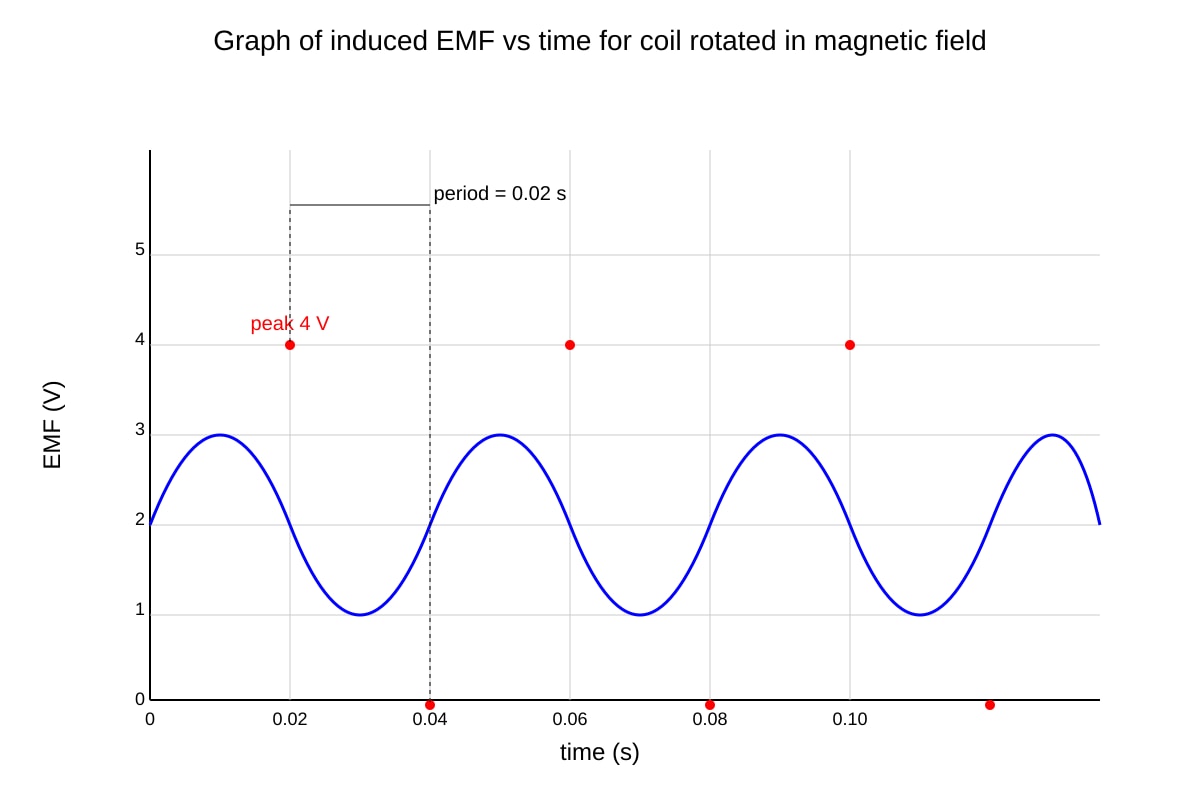
The graph shows EMF induced in a coil. (a) State the type of current produced if this EMF drives a circuit. [1] (b) Calculate the frequency of rotation. [2] (c) Explain how increasing rotation speed affects the graph. [2]
23. A student builds an electromagnet with 200 turns around a soft-iron core and measures force lifting paper clips. (a) State how to increase the magnetic field strength. [2] (b) Explain why soft iron is used instead of steel. [2] (c) Calculate the current if resistance is 4.0 Ω and voltage 8.0 V. [2]
24.
Image pending generation: diagram for Q24.
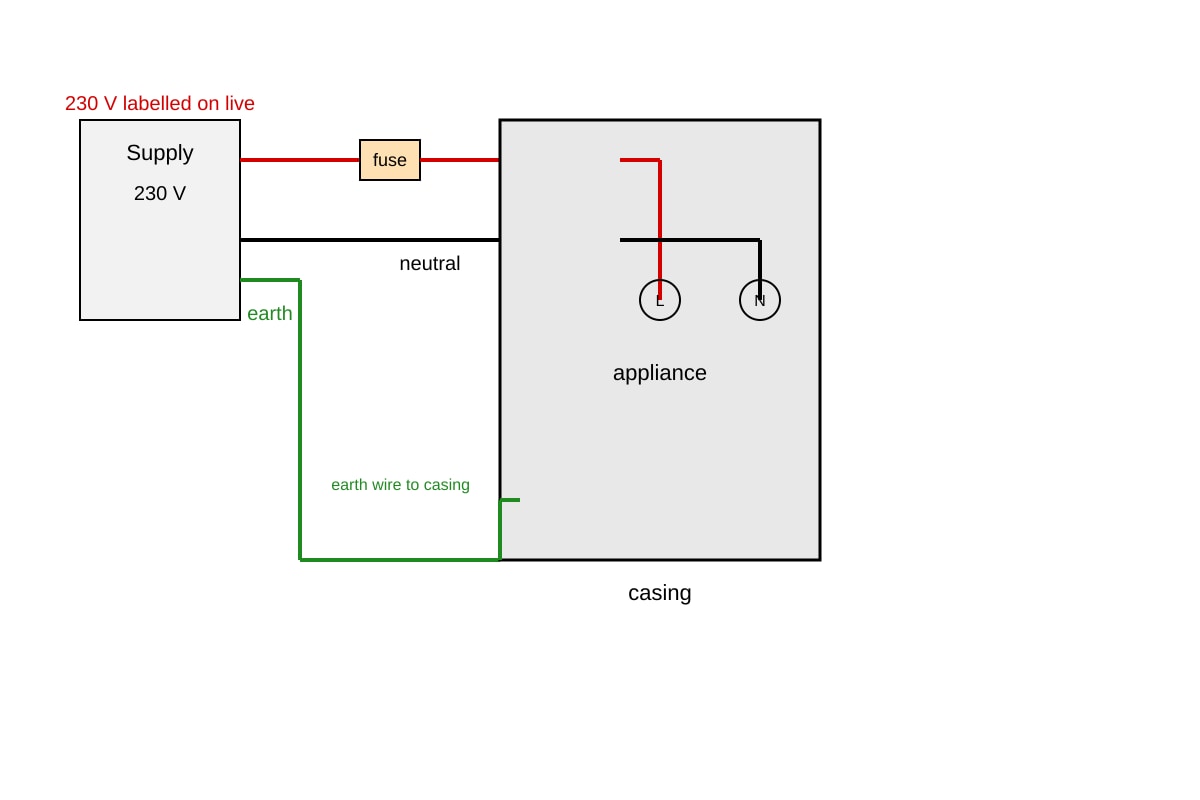
(a) State the colour of the live wire in Singapore. [1] (b) Explain how the earth wire protects a user if the live wire touches the casing. [3] (c) State why the fuse must be on the live wire. [1]
Total Marks: 60
Answers
Answer Key – TuitionGoWhere Practice Paper Pure Physics Sec 4 Prelim (Version 4)
Section A (10 × 1 = 10 marks)
1. [1] Circuit breaker can be reset/reused; fuse must be replaced.
Teaching note: Fuses melt and need replacement; breakers trip and can be switched on again.
2. [1] Provides return path for current at approximately zero potential.
Teaching note: Neutral completes circuit back to supply, not for safety like earth.
3. [1] Galvanometer needle deflects momentarily in opposite direction to when inserted.
Teaching note: Removing charge changes flux; Lenz’s law gives opposite deflection.
4. [1] Tesla (T).
Teaching note: B is flux density, unit T = Wb/m².
5. [1] Stepped up.
Teaching note: Vs/Vp=Ns/Np=200/100=2, so voltage increases.
6. [1] Induced current direction opposes the change producing it.
Teaching note: Lenz’s law is about opposition to flux change.
7. [1] Earth wire.
Teaching note: Earth connects metal casing to ground for safety.
8. [1] Electrical energy → kinetic (rotational) energy.
Teaching note: Motor converts electrical to mechanical.
9. [1] Ammeter.
Teaching note: Measures current in series.
10. [1] Secondary current is greater than primary current.
Teaching note: Step-up turns → step-down current in ideal transformer.
Section B (20 marks)
11. [2]
η=VpIpVsIs⇒Ip=ηVpVsIs
=0.80×24012×2.0=19224=0.125 A
Mark: 1 for correct formula/substitution, 1 for answer with unit.
12. [2]
Ideal: NsNp=IpIs⇒Is=IpNsNp=0.50×100400=2.0 A
Mark: 1 method, 1 answer.
13. [3]
Observation: needle deflects momentarily opposite to approach direction. [1]
Explanation: removing + charge reduces flux; Faraday induces EMF; Lenz opposes change so current opposite. [2]
14. [2]
Fuse: breaks circuit if overcurrent. [1]
Earth wire: carries fault current to ground, prevents shock. [1]
15. [2]
Field from permanent magnets (or electromagnet) and coil. [1]
Commutator reverses current every half-turn to keep rotation direction. [1]
16. [3]
Vs=VpNpNs=6.0×1200300=1.5 V [1]
Is=IpNsNp=0.20×3001200=0.80 A [2]
17. [2]
Transformer needs changing flux; AC changes, DC gives constant flux so no induction. [2]
18. [2]
Fuse melts/blows. [1] Cuts off current, prevents overheating/wire fire. [1]
19. [3]
I=V/R=12/10=1.2 A [1]
P=VI=12×1.2=14.4 W [2]
20. [2]
Live: carries supply voltage to appliance. [1]
Earth: safety path if fault. [1]
Section C (30 marks)
21. [5]
(a) Ip=0.90×24024×3.0=0.333 A [2]
(b) Heat loss in coils / eddy currents. [1]
(c) Laminations cut eddy current loops, reduce heating. [2]
22. [5]
(a) Alternating current. [1]
(b) f=1/T=1/0.02=50 Hz [2]
(c) Faster speed → higher frequency, taller peaks (more EMF). [2]
23. [6]
(a) More turns / more current. [2]
(b) Soft iron magnetises/demagnetises easily. [2]
(c) I=V/R=8.0/4.0=2.0 A [2]
24. [5]
(a) Brown. [1]
(b) Fault current flows to earth, blows fuse, cuts live. [3]
(c) So fault cuts supply, not return. [1]
Total: 60 marks
Free quiz and exam paper access
Enter your details to view this paper
Your access is remembered on this device.