From Real Exams Exam Paper
Secondary 4 Pure Physics Preliminary Examination Paper 3
Free Sec 4 Pure Physics Prelim Paper 3, HY3 Exam version, with questions, answers, and O Level-style practice for Singapore students.
These static practice materials are generated from the site's syllabus and paper-generation workflow, with source and model context shown so students and parents can evaluate the material before use.
Questions
TuitionGoWhere Exam Practice (AI) — Preliminary Practice Paper
Pure Physics Secondary 4 — Electricity & Magnetism (Version 3 of 5)
School: TuitionGoWhere Secondary School (AI)
Subject: Pure Physics
Level: Secondary 4
Paper: PRELIM Practice Paper 3 of 5
Duration: 75 minutes
Total Marks: 60
Name: ______________________
Class: ____________
Date: ____________
Instructions:
- Answer all questions in the spaces provided.
- Show all working clearly where calculation is required.
- Use SI units in your answers.
- Section A: 10 short questions (1 mark each).
Section B: 6 structured questions (2–4 marks each).
Section C: 4 data/interpretation questions (3–5 marks each). - The total marks for Section A = 10, Section B = 26, Section C = 24. Total = 60.
Section A (10 marks)
Answer all questions. Each carries 1 mark.
1. State one advantage of using a circuit breaker rather than a fuse to protect an appliance.
2. State the function of the neutral wire in a household AC circuit.
3. A positively charged rod is removed quickly from a coil connected to a galvanometer. State what is observed on the galvanometer.
4. State the turns ratio NsNp of an ideal step-down transformer.
5. Name the principle that explains why a current is induced when a magnet moves relative to a coil.
6. State the unit of electromotive force (e.m.f.).
7. In a DC circuit, what does a higher resistance do to the current if the voltage is fixed?
8. State one safety feature of the earth wire in a household appliance.
9. What is the relationship between primary and secondary current in an ideal transformer?
10. State Lenz’s law in one sentence.
Section B (26 marks)
Answer all questions. Show working where required.
11. A transformer has efficiency 80%, secondary voltage 12 V, secondary current 2.0 A, and primary voltage 240 V. Calculate the current in the primary coil. [2]
12. An ideal transformer has Np=500 turns and Ns=100 turns. The primary current is 1.5 A. Calculate the secondary current. [2]
13. (a) State the function of a step-up transformer. [1]
(b) A transformer has Vp=50 V and Vs=250 V. Calculate the turns ratio NpNs. [2]
14. (a) State one difference between a fuse and a circuit breaker. [1]
(b) Explain why a circuit breaker can be safer in a home. [2]
15. A coil is connected to a galvanometer. A bar magnet is pushed into the coil and then held stationary inside.
(a) State what is observed as the magnet is pushed in. [1]
(b) State what is observed when the magnet is stationary inside the coil. [1]
(c) Explain your answer in (b) using Faraday’s law. [2]
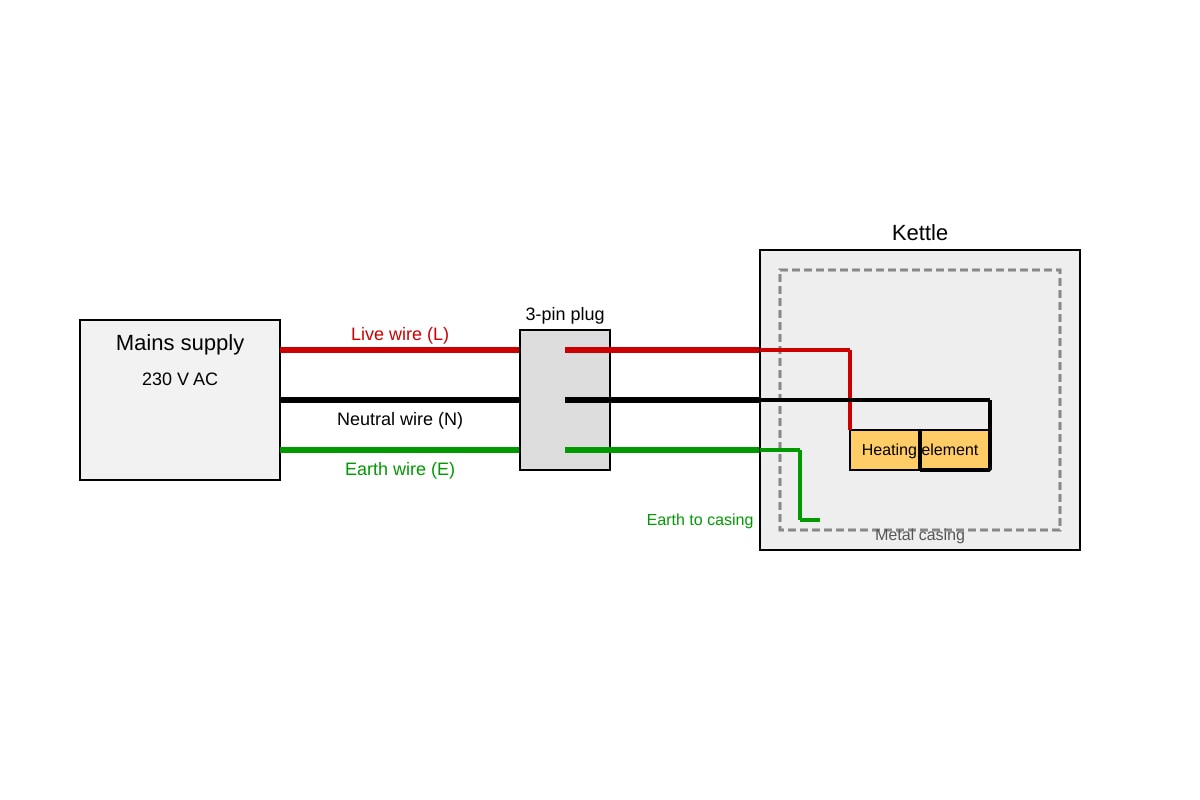
16. The diagram shows a simple household circuit with a live, neutral, and earth wire.
Image pending generation: diagram for 16.
(a) State the potential of the neutral wire relative to earth. [1]
(b) Explain how the earth wire protects the user if the live wire touches the metal casing. [3]
Section C (24 marks)
Answer all questions using the data provided.
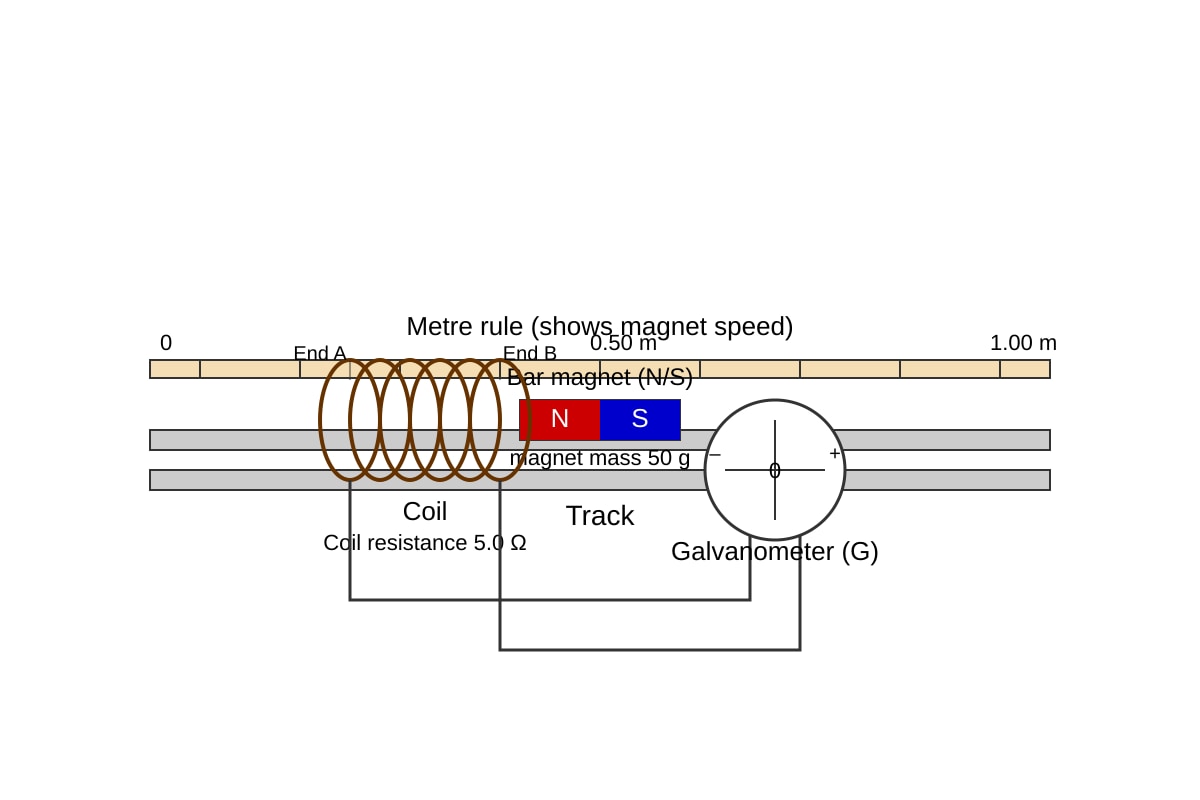
17. A student sets up the circuit below to investigate electromagnetic induction.
Image pending generation: experimental_setup for 17.
(a) The magnet is dropped through the coil. State the direction of induced current as the north pole enters the coil (use Lenz’s law). [2]
(b) The magnet falls at 0.20 m/s and induces e.m.f. 0.10 V. Calculate the induced current in the coil. [2]
(c) Suggest one way to increase the induced e.m.f. [1]
18. A power transmission line uses a step-up transformer at the station and a step-down transformer at the town.
Primary voltage at station = 11 kV, secondary = 132 kV. Efficiency = 95%.
If the secondary current is 20 A, calculate the primary current. [4]
19. Read the table of a household’s appliances on one circuit:
| Appliance | Power (W) | Voltage (V) |
|---|---|---|
| Kettle | 2000 | 230 |
| Oven | 1500 | 230 |
| Light | 100 | 230 |
(a) Calculate the total current drawn when all are used together. [3]
(b) The circuit has a 13 A fuse. State whether the fuse will blow and explain. [2]
20. A student claims: “A transformer can work with a DC supply if the current is high enough.”
(a) State whether this is correct. [1]
(b) Explain your answer using the principle of electromagnetic induction. [4]
End of Paper
Answers
TuitionGoWhere Exam Practice (AI) — Preliminary Practice Paper
Pure Physics Secondary 4 — Electricity & Magnetism (Version 3 of 5) — Answer Key
Total Marks: 60
Section A: 10 marks | Section B: 26 marks | Section C: 24 marks
Section A — Answers (1 mark each)
1. A circuit breaker can be reset and reused; a fuse must be replaced.
Teaching note: Circuit breakers trip and can be switched on again; fuses melt and need new ones.
2. The neutral wire provides the return path for current to the supply and is at approximately zero potential.
Teaching note: It completes the circuit at near 0 V relative to earth.
3. The galvanometer needle deflects momentarily in the opposite direction to when the rod was inserted.
Teaching note: Removing charge changes flux; Lenz’s law gives opposite deflection.
4. NsNp>1 (primary turns more than secondary).
Teaching note: Step-down reduces voltage, so fewer secondary turns.
5. Electromagnetic induction.
Teaching note: Moving magnet changes magnetic flux, inducing e.m.f.
6. Volt (V).
Teaching note: e.m.f. is potential difference, measured in volts.
7. It decreases the current (I=V/R).
Teaching note: From Ohm’s law, larger R means smaller I for fixed V.
8. It connects the metal casing to earth so current flows to earth if fault occurs.
Teaching note: Prevents user from electric shock.
9. IpVp=IsVs (or inverse to voltage ratio).
Teaching note: Ideal transformer conserves power.
10. The induced current flows in a direction that opposes the change producing it.
Teaching note: Lenz’s law is about opposition to flux change.
Section B — Answers
11. [2 marks]
Given: η=0.80, Vs=12 V, Is=2.0 A, Vp=240 V
Formula: η=VpIpVsIs⇒Ip=ηVpVsIs
Sub: Ip=0.80×24012×2.0=19224=0.125 A
Answer: 0.125 A
Marking: 1 mark formula/rearrangement, 1 mark answer with unit.
12. [2 marks]
Ideal: NsNp=IpIs⇒Is=Ip×NsNp
Sub: Is=1.5×100500=1.5×5=7.5 A
Answer: 7.5 A
Marking: 1 mark method, 1 mark answer.
13. [3 marks total]
(a) [1] Increases voltage from primary to secondary.
(b) [2] VpVs=NpNs⇒50250=5, so NpNs=5.
Marking: 1 mark ratio use, 1 mark answer.
14. [3 marks total]
(a) [1] Fuse melts permanently; breaker can be reset.
(b) [2] Breaker responds faster and can be reused, reducing shock risk and downtime.
Marking: 2 marks for clear safety explanation.
15. [4 marks total]
(a) [1] Needle deflects momentarily.
(b) [1] No deflection (needle at zero).
(c) [2] Faraday’s law: e.m.f. induced only when flux changes; stationary magnet = no change = no current.
Marking: 2 marks for correct law application.
16. [4 marks total]
(a) [1] Approximately zero potential (0 V).
(b) [3] If live touches casing, earth provides low-resistance path; current flows to earth, breaker trips, user safe.
Marking: 3 marks for path + trip + safety.
Section C — Answers
17. [5 marks total]
(a) [2] Current opposes north entering, so coil north pole faces magnet (repel). Direction by Lenz.
(b) [2] I=RV=5.00.10=0.020 A.
(c) [1] Increase magnet speed or use stronger magnet.
18. [4 marks]
η=0.95, Vp=11 kV, Vs=132 kV, Is=20 A
Ps=VsIs=132000×20=2.64×10⁶ W
Pp=Ps/0.95=2.7789×106 W
Ip=Pp/Vp=2.7789×106/11000=253 A
Answer: 253 A
Marking: 1 formula, 1 Ps, 1 Pp, 1 Ip.
19. [5 marks total]
(a) [3] I=P/V: Kettle 2000/230=8.70 A, Oven 1500/230=6.52 A, Light 100/230=0.435 A; total =15.65 A.
(b) [2] Yes, fuse blows because 15.65>13 A; overcurrent melts fuse.
20. [5 marks total]
(a) [1] Incorrect.
(b) [4] Transformer needs changing flux; DC gives constant flux, no continuous induction; only brief pulse at switch-on/off.
Marking: 4 marks for explanation with flux change concept.
End of Answer Key
Free quiz and exam paper access
Enter your details to view this paper
Your access is remembered on this device.