From Real Exams Exam Paper
Secondary 4 Pure Physics Preliminary Examination Paper 2
Free Sec 4 Pure Physics Prelim Paper 2, HY3 Exam version, with questions, answers, and O Level-style practice for Singapore students.
These static practice materials are generated from the site's syllabus and paper-generation workflow, with source and model context shown so students and parents can evaluate the material before use.
Questions
Free quiz and exam paper access
Enter your details to view this paper
Your access is remembered on this device.
Answers
TuitionGoWhere Practice Paper – Pure Physics Secondary 4 (PRELIM) Answer Key (Version 2)
Total Marks: 60
Section A (10 marks)
1. [1] A circuit breaker can be reset and reused; a fuse must be replaced after it melts.
Teaching note: Circuit breakers trip and can be switched on again; fuses are one-time protective devices.
2. [1] The neutral wire provides the return path for current to the supply and is at approximately zero potential.
Teaching note: It completes the circuit but does not carry dangerous voltage under normal conditions.
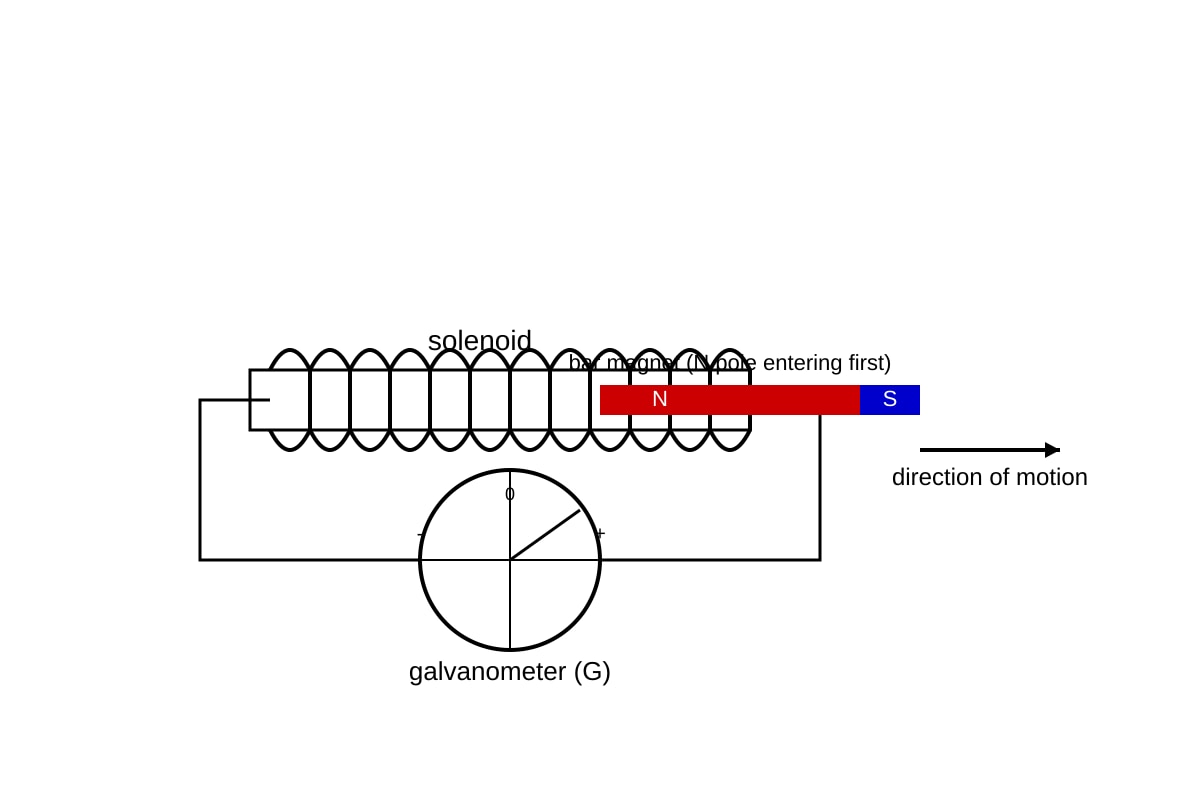
3. [1] The galvanometer needle deflects momentarily in the opposite direction to when the rod was inserted.
Teaching note: Removing charge changes flux; by Lenz’s law the induced current opposes the change.
4. [1] (or 20:1).
Teaching note: Turns ratio equals voltage ratio for ideal transformer.
5. [1] Electromagnetic induction (Faraday’s law).
Teaching note: Changing magnetic flux induces EMF.
6. [1] Brown.
Teaching note: Live = brown, neutral = blue, earth = green/yellow in Singapore.
7. [1] Step-down transformer.
Teaching note: Fewer secondary turns means lower secondary voltage.
8. [1] It provides a safe path to earth for fault current / prevents shock by connecting metal casing to ground.
Teaching note: Earth wire protects users from electric shock.
9. [1] The galvanometer deflects momentarily as current is switched on (due to changing flux).
Teaching note: Sudden current change creates changing magnetic field, inducing EMF.
10. [1] Tesla (T).
Teaching note: Magnetic flux density B is measured in tesla.
Section B (24 marks)
11. [2]
Efficiency
W
W
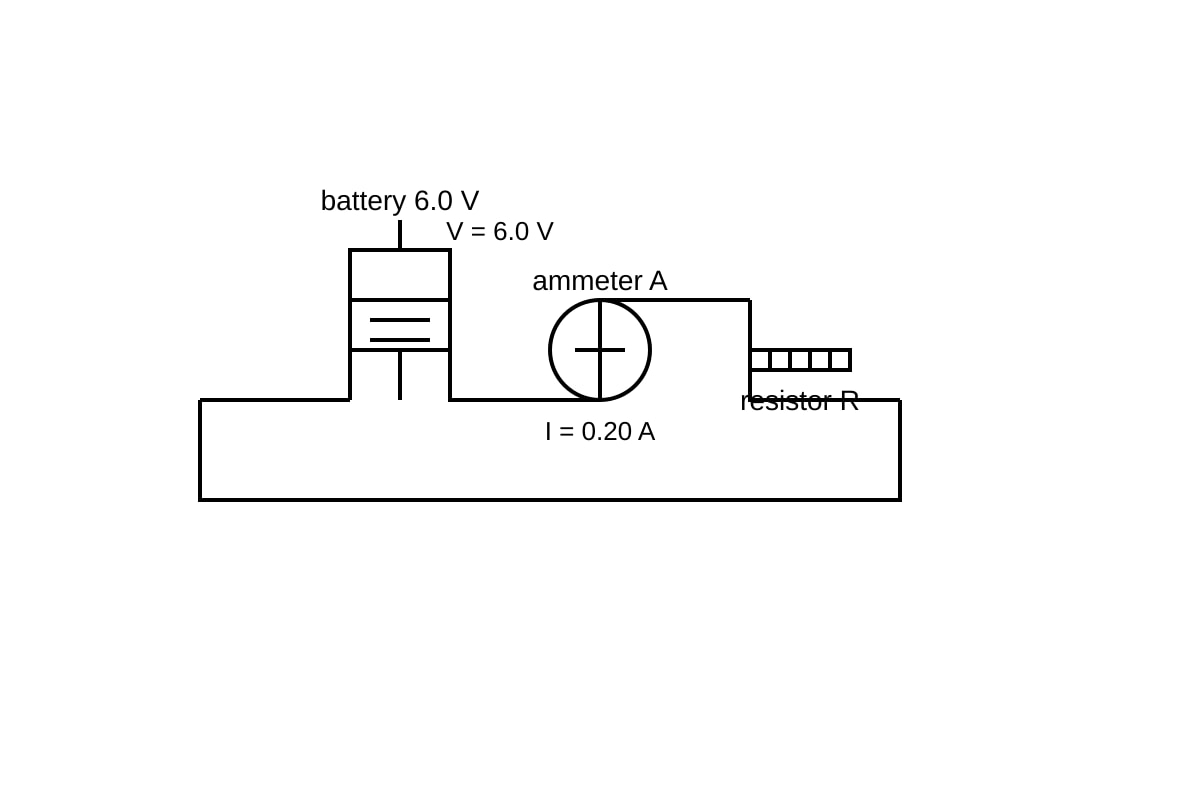
A ≈ 0.025 A
Marking: 1 mark for correct power/effort, 1 mark for final answer with unit.
12. [2]
Ideal transformer:
A
Marking: 1 mark rearrangement, 1 mark answer.
13. [3]
- As magnet is pulled out, magnetic flux through coil decreases. [1]
- Lenz’s law: induced current opposes change, so it tries to maintain flux. [1]
- Direction of induced current causes galvanometer to deflect opposite to when magnet inserted. [1]
14. [2]
Live wire: carries supply voltage (≈230 V) into appliance. [1]
Earth wire: safety path to ground for fault current. [1]
15. [2]
Incorrect. [1] Transformer needs changing flux; DC gives constant flux so no continuous induction. [1]
16. [2]
Marking: 1 mark formula, 1 mark answer.
Section C (26 marks)
17. [4 total]
(a) [1] Electromagnet needs current to produce field; permanent magnet always magnetic.
(b) [2] Iron core becomes magnetised easily, concentrating field lines and increasing strength. (1 for magnetisation, 1 for concentration)
(c) [1] A-turns.
18. [5 total]
(a) [2] turns. (1 formula, 1 answer)
(b) [2] A. (1 method, 1 answer)
(c) [1] Real transformer has losses (heat, flux leakage) so more primary current needed.
19. [4 total]
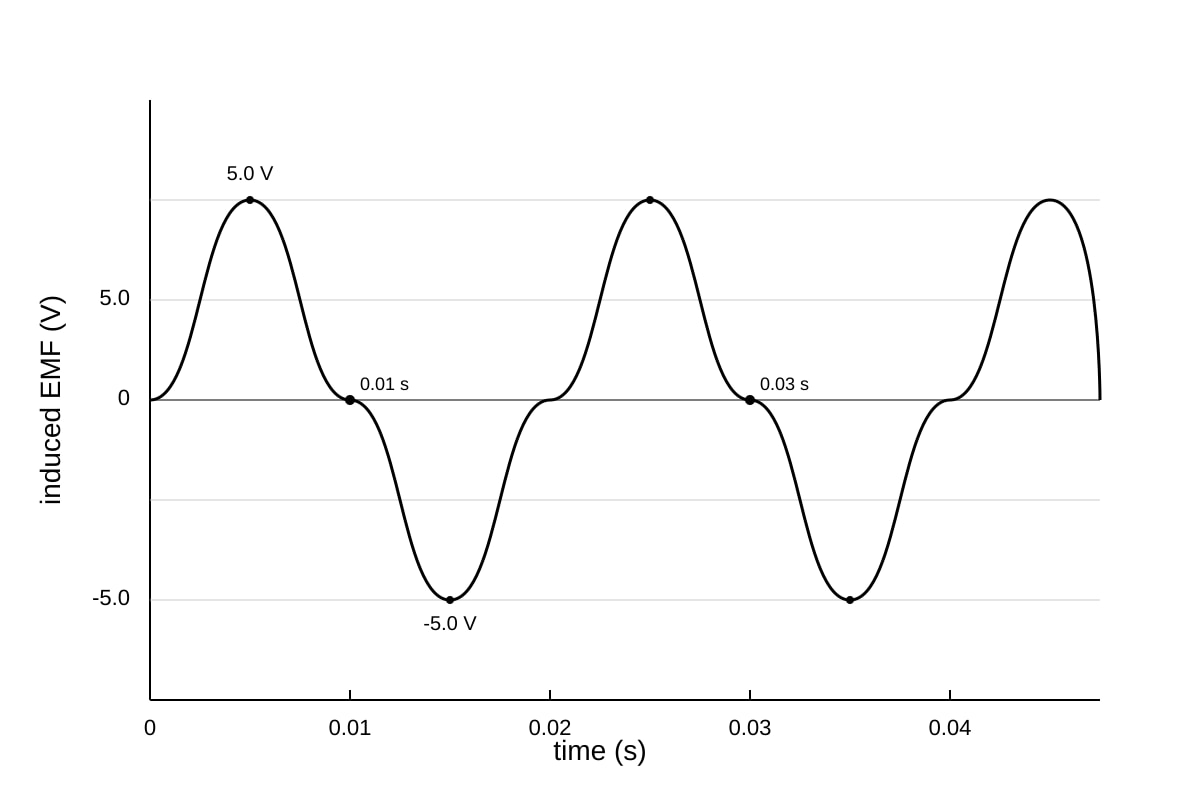
(a) [1] Period = 0.02 s → Hz.
(b) [1] Peak EMF doubles (proportional to rotation speed).
(c) [2] EMF zero when flux change rate zero (coil plane parallel to field at those instants). [1] Graph crosses axis at max/min flux positions. [1]
20. [5 total]
(a) [1] Zero (or approximately zero) potential.
(b) [3] If live touches casing, current flows to earth via earth wire. [1] Large current blows fuse/trips breaker. [1] Cuts off supply, preventing user shock. [1]
(c) [1] Fuse melts at 8 A > 5 A rating, breaking circuit and protecting user.