From Real Exams Exam Paper
Secondary 4 Pure Physics Preliminary Examination Paper 1
Free Sec 4 Pure Physics Prelim Paper 1, HY3 Exam version, with questions, answers, and O Level-style practice for Singapore students.
These static practice materials are generated from the site's syllabus and paper-generation workflow, with source and model context shown so students and parents can evaluate the material before use.
Questions
Free quiz and exam paper access
Enter your details to view this paper
Your access is remembered on this device.
Answers
TuitionGoWhere Practice Paper - Pure Physics Secondary 4 (Answers)
Version 1 of 5 — PRELIM Practice
Section A Answers
1. [2 marks]
Function of neutral wire: provides the return path for current to the supply and is at approximately zero potential.
Teaching note: In AC household circuits, the live wire supplies current at high alternating potential; the neutral completes the circuit back to the source at near 0 V.
Marking: 1 mark for return path, 1 mark for zero potential / completes circuit.
2. [1 mark]
Advantage: A circuit breaker can be reset and reused; a fuse must be replaced after it melts. (Also accept: faster response to overcurrent.)
Teaching note: Fuses are single-use; breakers improve convenience and safety.
3. [1 mark]
The galvanometer needle deflects momentarily in the opposite direction to when the rod was brought near.
Teaching note: Removing the charged rod changes magnetic flux; by Lenz’s law the induced current opposes the change, giving opposite deflection.
4. [2 marks]
Electrical energy in primary → magnetic energy in core → electrical energy in secondary.
Marking: 1 mark each stage (electrical to magnetic, magnetic to electrical).
5. [2 marks]
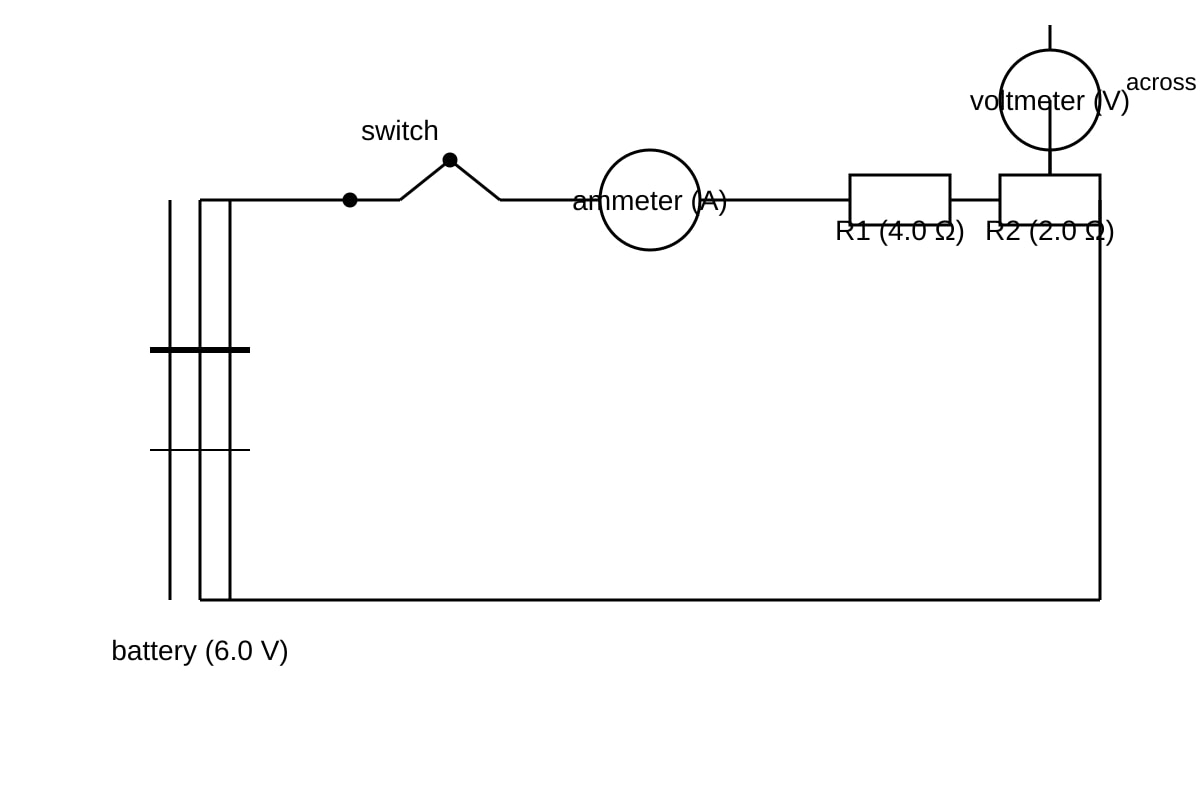
Total resistance = R1 + R2 = 4.0 + 2.0 = 6.0 Ω.
Working: Series resistors add directly.
Answer: 6.0 Ω.
6. [2 marks]
Current I = V / R_total = 6.0 / 6.0 = 1.0 A.
Same current flows through all series components, so through 4.0 Ω resistor = 1.0 A.
Answer: 1.0 A.
7. [3 marks]
(i) Fuse: breaks circuit if current too high.
(ii) Earth wire: prevents shock by carrying fault current to ground.
(iii) Circuit breaker: automatically switches off on overload.
Marking: 1 mark each feature + purpose.
8. [3 marks]
Moving magnet changes magnetic flux through coil (1). Faraday’s law: induced EMF proportional to rate of change of flux (1). EMF drives current through galvanometer causing deflection (1).
Teaching note: Flux change is essential; static magnet gives no deflection.
Section B Answers
9. [2 marks]
For ideal transformer: V_s / V_p = N_s / N_p
V_s = 12 × (400/100) = 48 V.
Answer: 48 V.
10. [2 marks]
I_s / I_p = N_p / N_s → I_s = 2.0 × (100/400) = 0.50 A.
Answer: 0.50 A.
11. [3 marks]
η = V_s I_s / (V_p I_p) → I_p = V_s I_s / (η V_p)
η = 0.80, V_s = 24, I_s = 0.50, V_p = 240
I_p = (24 × 0.50) / (0.80 × 240) = 12 / 192 = 0.0625 A.
Answer: 0.0625 A (or 6.25 × 10⁻² A).
Common mistake: using 80 instead of 0.80.
12. [4 marks]
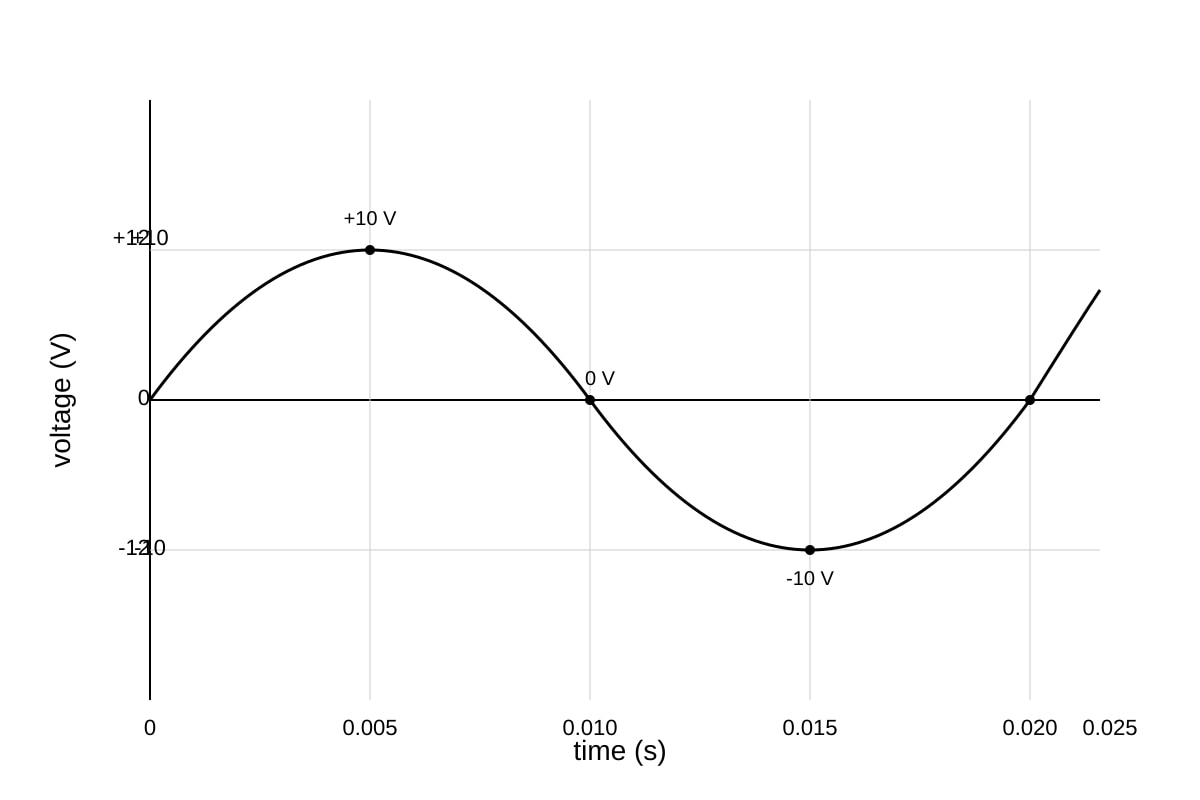
(a) Period = 0.020 s [1]
(b) f = 1/T = 1/0.020 = 50 Hz [1]
(c) At t = 0.010 s coil plane is parallel to field / flux linkage zero so rate of change zero → EMF zero [2]
Teaching note: Sinusoidal EMF from rotating coil; zero at neutral plane.
13. [4 marks]
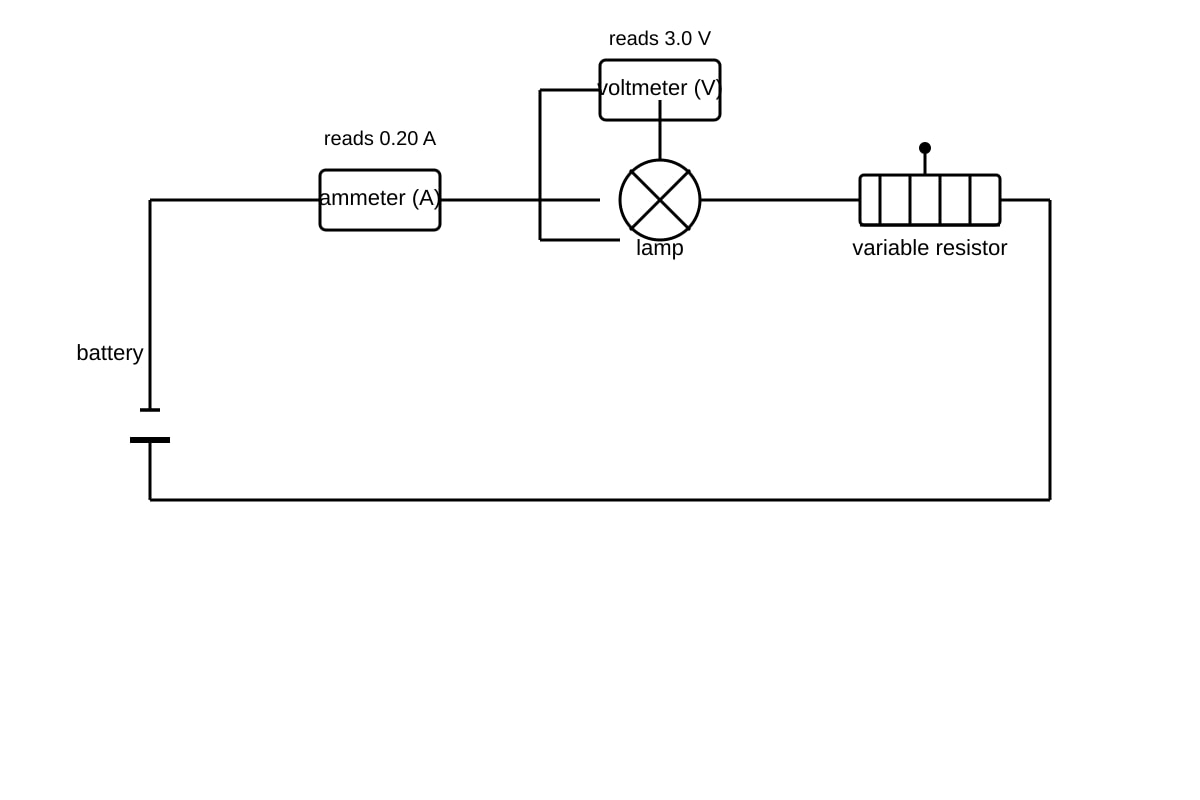
R = V / I = 3.0 / 0.20 = 15 Ω [3].
Variable resistor used to vary current / take multiple readings [1].
Answer: 15 Ω.
14. [3 marks]
Electromagnet: coil of insulated wire around soft-iron core [1]. Passing current magnetises core [1]. Attracts armature by magnetic force; principle: current in coil produces magnetic field (electromagnetism) [1].
Section C Answers
15. [4 marks]
(a) V_s = 240 × (100/1000) = 24 V [2]
(b) I_p = V_s I_s / V_p = (24 × 2.0)/240 = 0.20 A [2]
Answer: (a) 24 V, (b) 0.20 A.
16. [3 marks]
Transformer needs changing flux (1). DC gives constant current → constant flux (1). No change → no induced EMF in secondary (1).
17. [4 marks]
(a) Neutral wire at ~0 V / zero potential [1].
(b) Earth wire connects casing to ground (1). If live touches casing, fault current flows to earth (1), causing fuse/breaker to cut off, preventing shock (1).
18. [3 marks]
Yes, EMF induced (1) because AC produces changing magnetic field (1) which changes flux in coil (1).
19. [3 marks]
EMF = N × ΔΦ / Δt = 200 × (0.040 – 0.010) / 0.02
= 200 × 0.030 / 0.02 = 6.0 / 0.02 = 300 V.
Answer: 300 V.
20. [3 marks]
Fuse protects circuit by melting at rated current (1). Higher rating allows excess current (1) causing overheating/fire before blowing (1). So less safe.
End of Answer Key