From Real Exams Exam Paper
Secondary 4 Pure Physics Preliminary Examination Paper 1
Free Sec 4 Pure Physics Prelim Paper 1, Exam version, with questions, answers, and O Level-style practice for Singapore students.
These static practice materials are generated from the site's syllabus and paper-generation workflow, with source and model context shown so students and parents can evaluate the material before use.
Questions
Free quiz and exam paper access
Enter your details to view this paper
Your access is remembered on this device.
Answers
TuitionGoWhere Practice Paper - Pure Physics Secondary 4 (Marking Scheme)
Total Marks: 60 marks
Section A: Multiple Choice Questions [10 marks]
1. B - The direction of induced current opposes the change causing it (Lenz's Law) Mark: 1 mark
2. A - 60 V Working: Vs/Vp = Ns/Np = 50/200 = 1/4, so Vs = 240 × 1/4 = 60 V Mark: 1 mark
3. B - It can be reset after tripping Mark: 1 mark
4. B - Is connected to the metal casing of appliances for safety Mark: 1 mark
5. B - Velocity is zero but acceleration is 10 m/s² downward Mark: 1 mark
Section B: Structured Questions [50 marks]
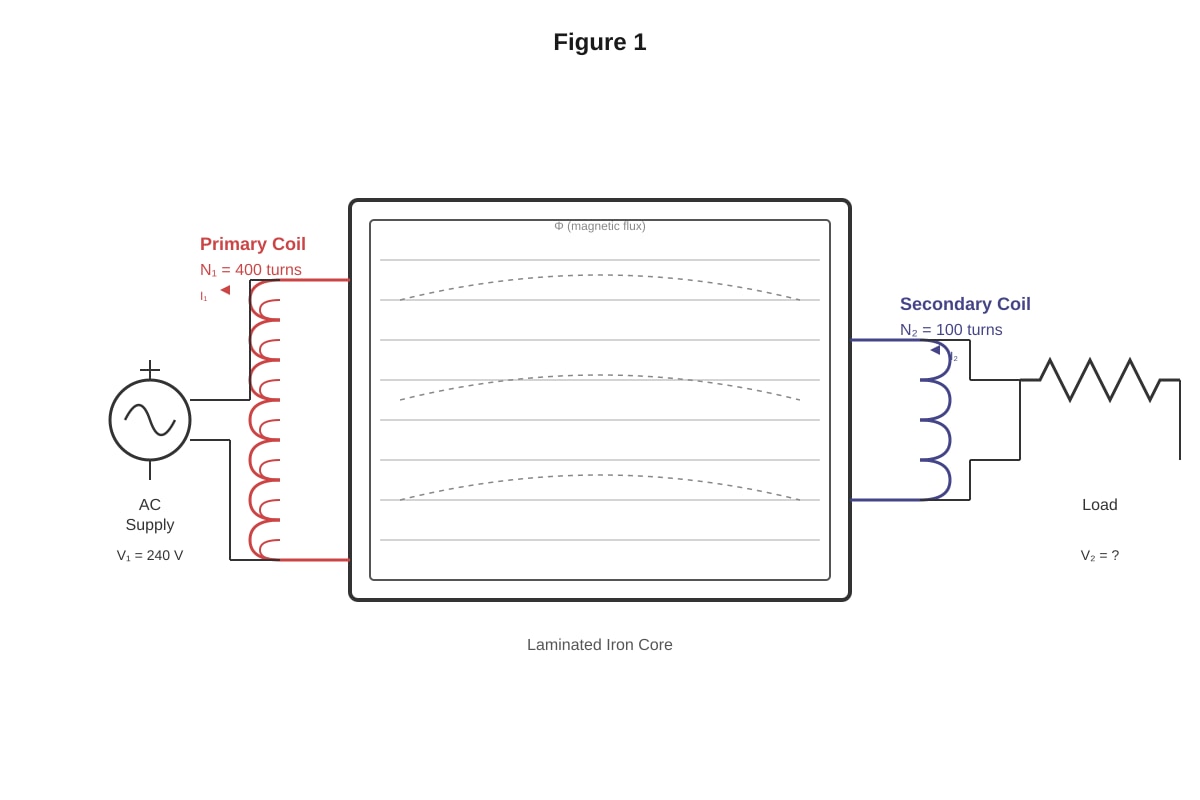
6. Transformer calculations [9 marks]
(a) Calculate the secondary voltage. [2]
Working: Vs/Vp = Ns/Np Vs/240 = 100/400 = 1/4 Vs = 240 × 1/4 = 60 V
Answer: 60 V Marks: 1 mark for correct formula/method, 1 mark for correct answer
(b) Calculate the primary current. [3]
Working: Efficiency η = (VsIs)/(VpIp) 0.75 = (60 × 3.0)/(240 × Ip) 0.75 = 180/(240 × Ip) Ip = 180/(0.75 × 240) = 180/180 = 1.0 A
Answer: 1.0 A Marks: 1 mark for efficiency formula, 1 mark for correct substitution, 1 mark for correct answer
(c) Calculate the power loss. [2]
Working: Input power = VpIp = 240 × 1.0 = 240 W Output power = VsIs = 60 × 3.0 = 180 W Power loss = 240 - 180 = 60 W
Answer: 60 W Marks: 1 mark for calculating input/output power, 1 mark for correct power loss
(d) Two reasons for inefficiency. [2]
Answers:
- Heat loss in windings due to resistance / I²R losses
- Eddy current losses in the core / Hysteresis losses
Marks: 1 mark each for two valid reasons Accept: Magnetic flux leakage, Core heating, Sound energy loss
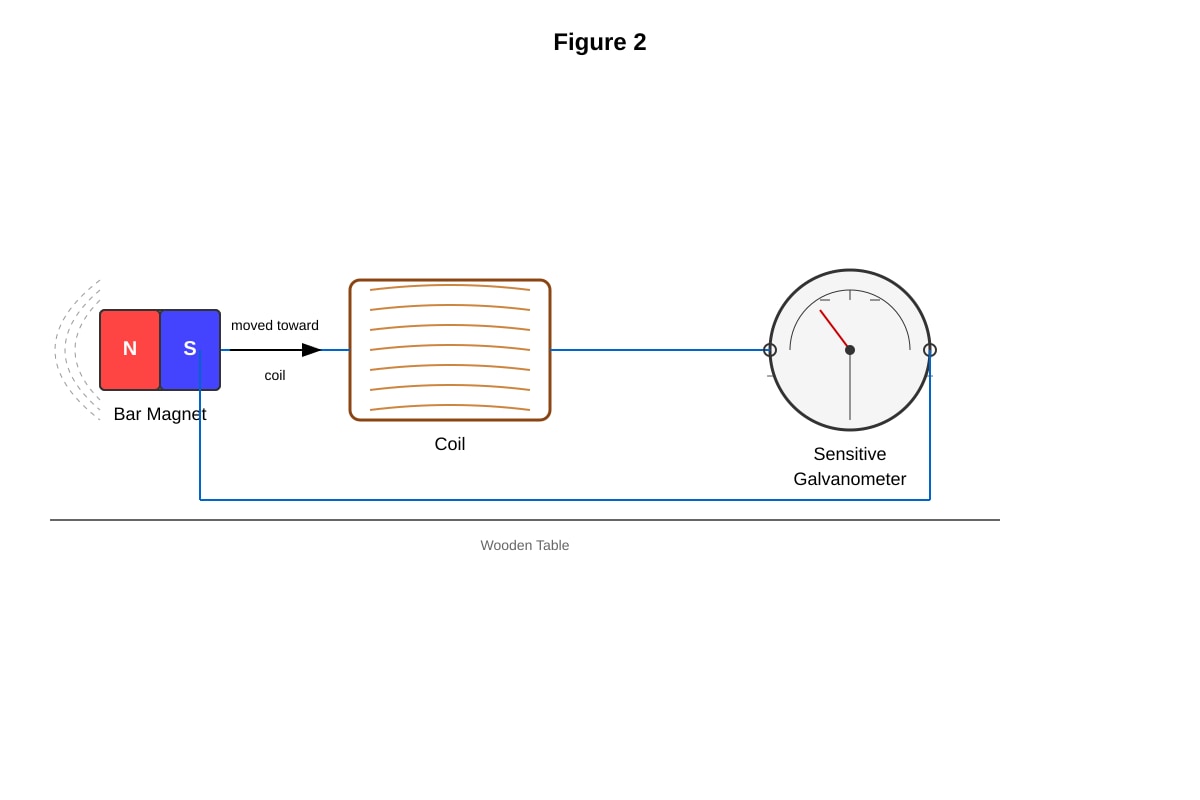
7. Electromagnetic induction experiment [9 marks]
(a) Observation when magnet approaches coil. [2]
Answer: The galvanometer needle deflects in one direction / shows a reading Marks: 1 mark for deflection, 1 mark for specifying direction or temporary nature
(b) Explanation of observation. [3]
Answer: Moving the magnet toward the coil changes the magnetic flux through the coil. According to Faraday's Law, this change in flux induces an EMF, which causes current to flow through the circuit, deflecting the galvanometer needle. Marks: 1 mark for flux change, 1 mark for Faraday's Law/EMF induced, 1 mark for current flow
(c)(i) Magnet moved away. [1]
Answer: The needle deflects in the opposite direction Mark: 1 mark for opposite deflection
(c)(ii) Magnet held stationary. [1]
Answer: No deflection / Reading returns to zero Mark: 1 mark for correct observation
(d) Ways to increase induced EMF. [2]
Answers:
- Move the magnet faster / increase rate of change of flux
- Use a stronger magnet / increase magnetic field strength Marks: 1 mark each for two valid methods Accept: More turns in coil, Larger coil area
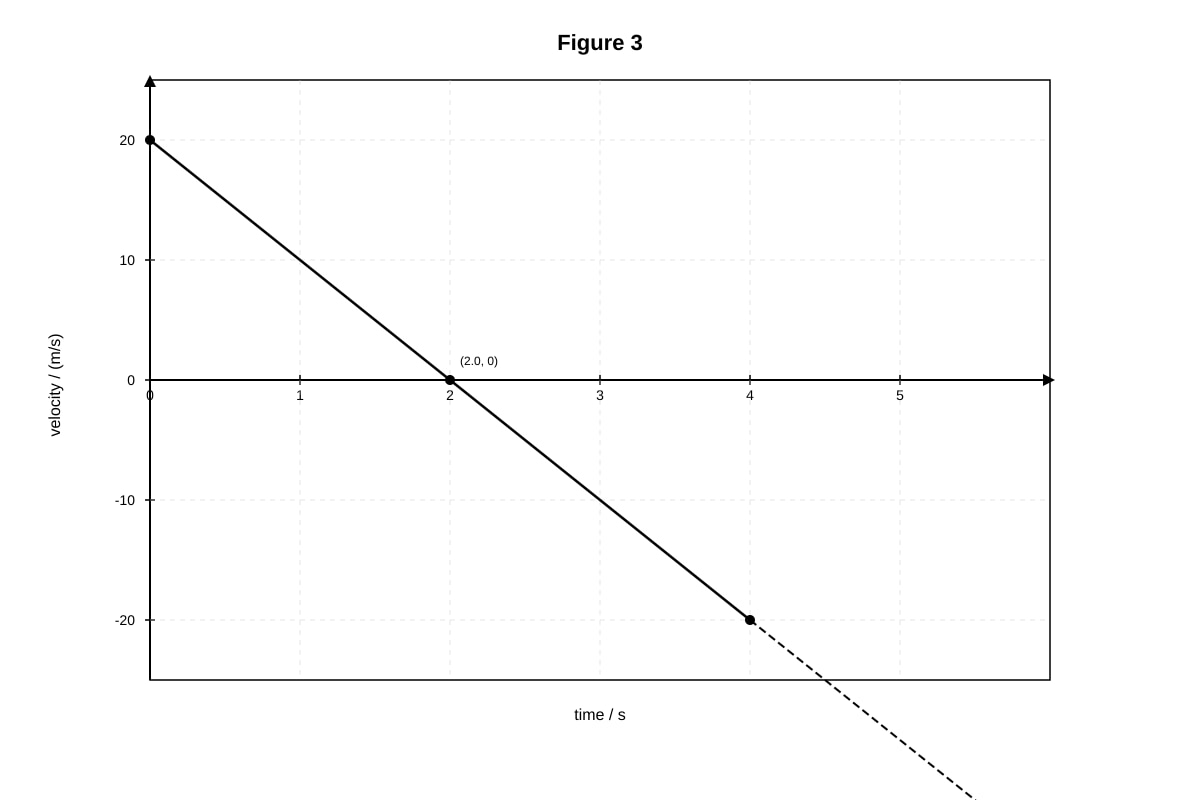
8. Kinematics - velocity-time graph [8 marks]
(a) Initial velocity. [1]
Answer: 20 m/s Mark: 1 mark
(b) Acceleration. [2]
Working: a = (v - u)/t = (0 - 20)/(2 - 0) = -10 m/s²
Answer: -10 m/s² Marks: 1 mark for method, 1 mark for correct answer with sign
(c) Maximum height. [3]
Working: Using v² = u² + 2as 0² = 20² + 2(-10)s 0 = 400 - 20s s = 400/20 = 20 m
Answer: 20 m Marks: 1 mark for appropriate formula, 1 mark for correct substitution, 1 mark for correct answer
(d) Displacement after 4 seconds. [2]
Working: Area under v-t graph = ½ × 4 × 20 - ½ × 2 × 20 = 40 - 20 = 20 m OR: Ball returns to starting point, displacement = 0 m
Answer: 0 m Marks: 1 mark for method (area under graph), 1 mark for correct answer
9. Household electricity [9 marks]
(a) Function of live wire. [1]
Answer: Carries current from the supply to the appliance / Provides electrical energy Mark: 1 mark
(b) Earth wire connection. [2]
Answer: If the live wire touches the metal casing, current flows through the earth wire instead of through a person touching the appliance, preventing electric shock. Marks: 1 mark for safety aspect, 1 mark for explanation of current path
(c)(i) Current calculation. [2]
Working: P = VI 2500 = 240 × I I = 2500/240 = 10.4 A
Answer: 10.4 A Marks: 1 mark for formula, 1 mark for correct answer
(c)(ii) Appropriate fuse rating. [1]
Answer: 13 A Mark: 1 mark (must be next rating above calculated current)
(c)(iii) Energy consumed in one week. [3]
Working: Daily energy = 2.5 × 3 = 7.5 kWh Weekly energy = 7.5 × 7 = 52.5 kWh
Answer: 52.5 kWh Marks: 1 mark for daily energy, 1 mark for multiplication by 7, 1 mark for correct answer
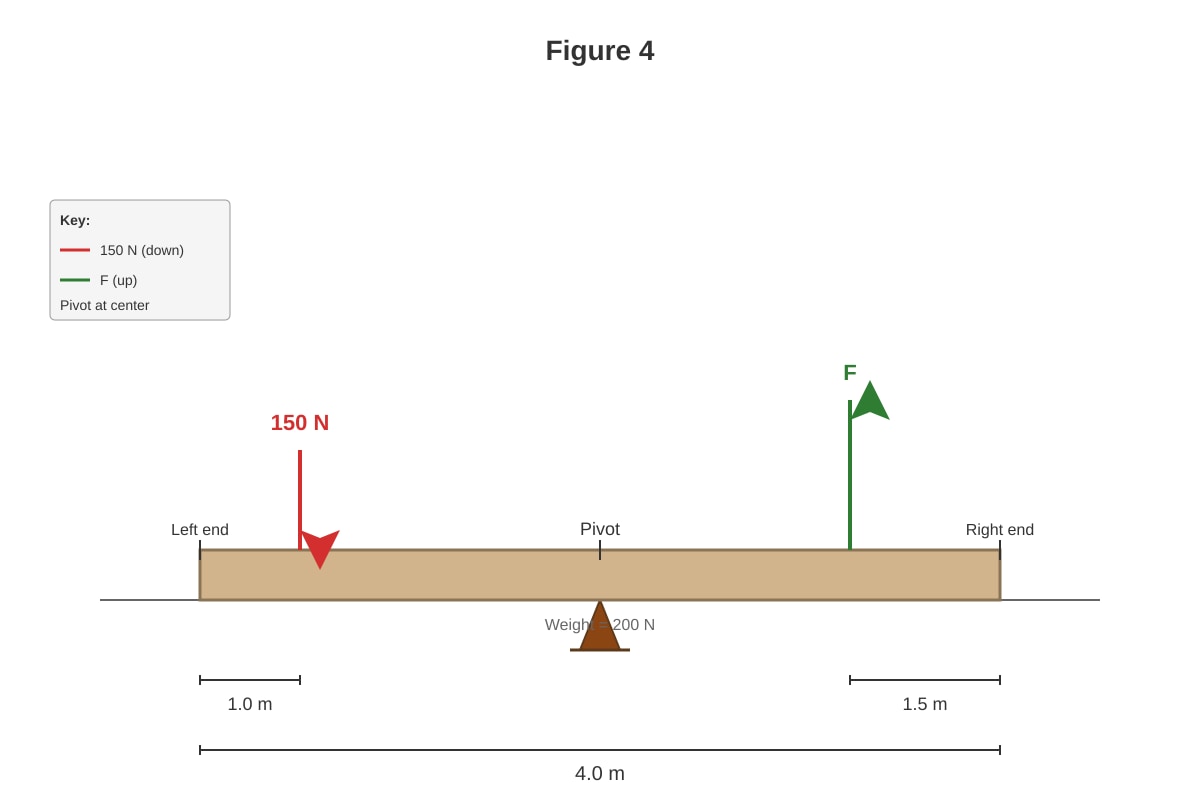
10. Principle of moments [8 marks]
(a) State principle of moments. [2]
Answer: For a body in equilibrium, the sum of clockwise moments about a point equals the sum of anticlockwise moments about the same point. Marks: 1 mark for equilibrium condition, 1 mark for clockwise = anticlockwise moments
(b) Calculate force F. [4]
Working: Taking moments about the pivot: Clockwise moments = 150 × 1.0 = 150 N⋅m Anticlockwise moments = F × 1.5 For equilibrium: 150 = F × 1.5 F = 150/1.5 = 100 N
Answer: 100 N Marks: 1 mark for taking moments about pivot, 1 mark for correct moment calculations, 1 mark for equilibrium equation, 1 mark for correct answer
(c) Reaction force at pivot. [2]
Working: Total downward forces = 200 + 150 = 350 N Total upward forces = F + R = 100 + R For equilibrium: R = 350 - 100 = 250 N
Answer: 250 N Marks: 1 mark for force balance, 1 mark for correct answer
Grade Boundaries (Suggested):
- A1: 54-60 marks (90-100%)
- A2: 48-53 marks (80-89%)
- B3: 42-47 marks (70-79%)
- B4: 36-41 marks (60-69%)
- C5: 30-35 marks (50-59%)
- C6: 24-29 marks (40-49%)