AI Generated Quiz
Secondary 4 Pure Chemistry Redox Electrochemistry Quiz
Free Sec 4 Pure Chemistry Redox Electrochemistry quiz, HY3 AI version, with questions, answers, and O Level-style practice for Singapore students.
These static practice materials are generated from the site's syllabus and paper-generation workflow, with source and model context shown so students and parents can evaluate the material before use.
Questions
Secondary 4 Pure Chemistry Quiz - Redox Electrochemistry
Name: ___________________________
Class: ___________________________
Date: ___________________________
Score: _______ / 40
Duration: 50 minutes
Total Marks: 40
Instructions:
- Answer all 20 questions.
- Section A: Multiple-choice style short items (1 mark each).
- Section B: Structured short-answer questions (2 marks each).
- Section C: Extended response and data-interpretation questions (3–4 marks each).
- Write your answers in the spaces provided.
- Use proper chemical notation and state symbols where required.
Section A (Questions 1–5, 1 mark each)
1. In the reaction 2Mg+O2→2MgO, magnesium acts as a ____________________ agent.
2. Which species is reduced in the reaction Cu2+(aq)+Zn(s)→Cu(s)+Zn2+(aq)?
3. During electrolysis of molten PbBr2, at the cathode we expect to observe formation of ____________________.
4. The process of oxidation always involves ____________________.
5. In a simple electrochemical cell using Zn and Cu electrodes, the electrode that acts as the negative terminal is ____________________.
Section B (Questions 6–10, 2 marks each)
6. Define oxidation and reduction in terms of electron transfer.
7. Write the ionic half-equation for the discharge of bromide ions at the anode during electrolysis of molten lead(II) bromide.
8. A student connects a zinc half-cell and a copper half-cell. State the direction of electron flow in the external wire and explain why.
9. State two observations when aqueous copper(II) sulfate is electrolysed using inert graphite electrodes.
10. Identify the reducing agent in the reaction below and give one reason.
Fe2O3+3CO→2Fe+3CO2
Section C (Questions 11–20)
11. (3 marks) A redox reaction occurs when iron wool is placed in copper(II) sulfate solution.
(a) Write the ionic equation for the reaction.
(b) State which species is oxidised and which is reduced.
(c) Explain your answer using electron transfer.
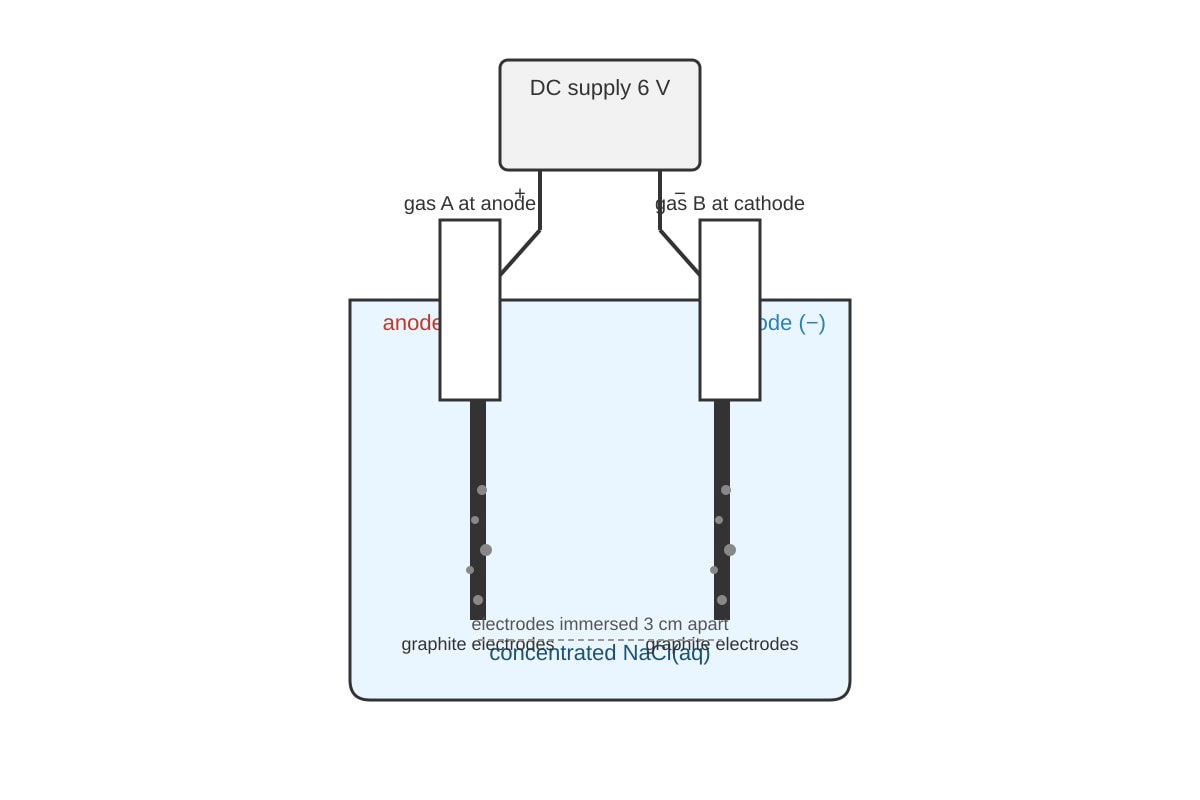
12. (3 marks) The diagram below shows an electrolysis setup for concentrated aqueous sodium chloride using inert electrodes.
Image pending generation: experimental_setup for Q12.
(a) Name gas A and gas B. (1 mark)
(b) Write the half-equation at the cathode. (1 mark)
(c) Why is chlorine produced at the anode instead of oxygen? (1 mark)
13. (3 marks) Calculate the charge required to deposit 0.635 g of copper from aqueous Cu2+(aq) at the cathode.
(Relative atomic mass of Cu = 63.5; 1 mole of electrons carries 96500 C)
Show your working.
14. (4 marks) A student sets up an electrochemical cell with magnesium and silver half-cells.
(a) Which metal is the anode? Explain. (2 marks)
(b) Write the overall cell reaction. (1 mark)
(c) State one use of such electrochemical cells. (1 mark)
15. (3 marks) Concentrated aqueous sodium chloride and dilute sulfuric acid are each electrolysed using inert electrodes. Compare the substance produced at the cathode in each case and explain the difference.
16. (3 marks) The table shows standard conditions for a hydrogen half-cell.
| Half-cell | E∘ (V) |
|---|---|
| Zn2+/Zn | -0.76 |
| Cu2+/Cu | +0.34 |
(a) Which is the stronger reducing agent, Zn or Cu? (1 mark)
(b) Calculate the cell potential for a Zn–Cu cell. (1 mark)
(c) State the direction of electron flow. (1 mark)
17. (4 marks) Electroplating is used to coat a steel spoon with silver.
(a) Identify the anode, cathode, and electrolyte used. (3 marks)
(b) Give one reason why electroplating is useful. (1 mark)
18. (3 marks) When acidified potassium manganate(VII) is added to iron(II) sulfate solution, the purple colour decolourises.
(a) Identify the species being oxidised. (1 mark)
(b) Write the half-equation for the reduction of MnO4− in acid. (1 mark)
(c) State the colour change of the solution. (1 mark)
19. (3 marks) A battery contains the reaction:
Zn+2MnO2+2NH4+→Zn2++Mn2O3+2NH3+H2O
(a) State the oxidation state change of Zn. (1 mark)
(b) Identify the species reduced. (1 mark)
(c) Explain why this reaction can generate electricity. (1 mark)
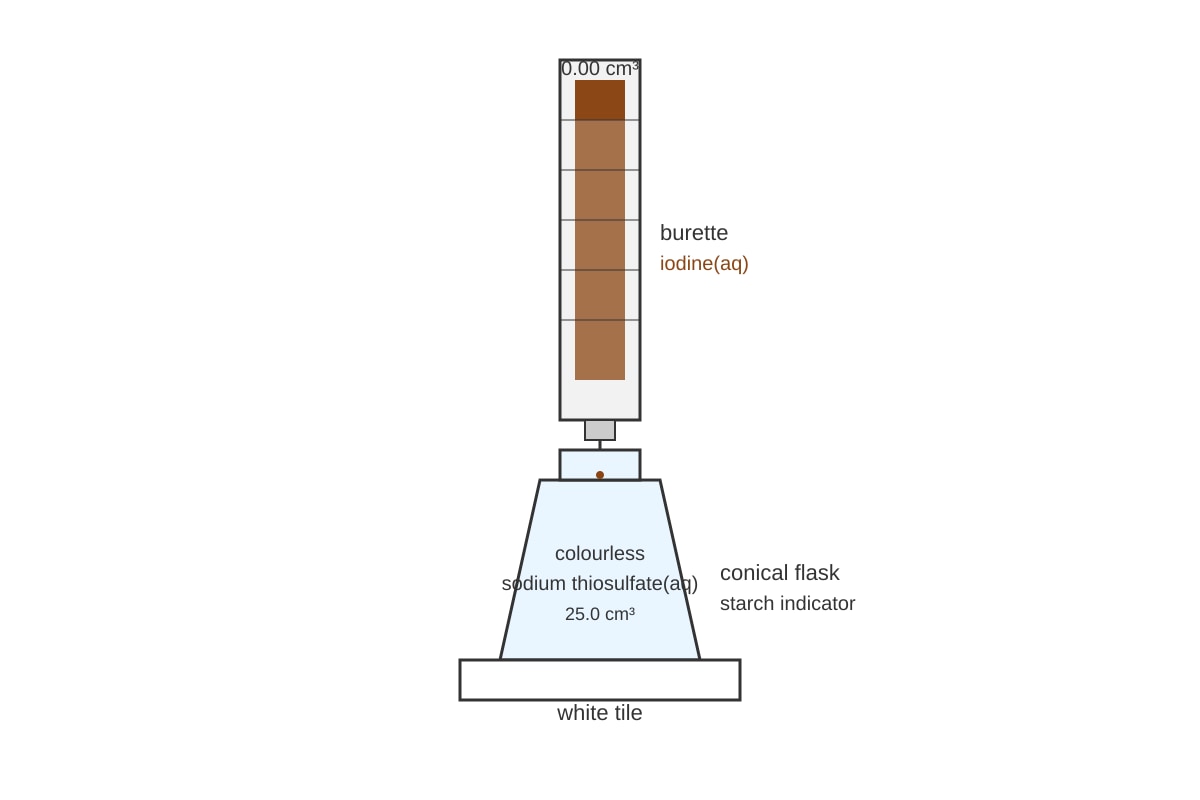
20. (4 marks) The diagram shows a redox titration setup where aqueous iodine is added from a burette to sodium thiosulfate solution.
Image pending generation: experimental_setup for Q20.
(a) Write the ionic equation for the reaction between iodine and thiosulfate. (2 marks)
(b) State the colour change at the end point with starch. (1 mark)
(c) Explain the role of starch. (1 mark)
Answers
Secondary 4 Pure Chemistry Quiz - Redox Electrochemistry (Answer Key)
Total Marks: 40
Topic: Redox Electrochemistry
Note: Generated from LLM-inferred syllabus-first templates (Stage 4/5). Not claimed as past-year exam derived.
Section A (1 mark each)
1. reducing
Teaching note: Magnesium loses electrons (Mg→Mg2++2e−), so it is oxidised and acts as the reducing agent (it causes oxygen to be reduced).
2. Cu2+(aq)
Teaching note: Cu2+ gains electrons to become Cu(s); gain of electrons = reduction.
3. molten lead (Pb) / lead metal
Teaching note: At cathode, Pb2++2e−→Pb. Molten PbBr2 gives Pb2+ and Br− ions.
4. loss of electrons
Teaching note: OIL RIG – Oxidation Is Loss, Reduction Is Gain (of electrons).
5. zinc (Zn)
Teaching note: Zn is more reactive, loses electrons, is the negative terminal (anode) in the cell.
Section B (2 marks each)
6. Oxidation: loss of electrons. Reduction: gain of electrons. (1 mark each)
Teaching note: Use OIL RIG. Example: Na→Na++e− is oxidation.
7. 2Br−(l)→Br2(l)+2e−
Marking: 1 for Br−→Br2, 1 for electrons and balance. State symbol (l) acceptable as molten.
Common mistake: Writing Br−→Br+e− (not balanced).
8. Electrons flow from Zn to Cu. (1) Zn is more reactive / higher in reactivity series, loses electrons more readily, so it is the negative terminal. (1)
Teaching note: Electron flow is always from anode (−) to cathode (+) externally.
9. Any two:
- Brown deposit of copper forms at cathode.
- Colourless gas (oxygen) at anode / blue solution fades.
(1 mark each)
Teaching note: With inert electrodes, Cu2+ discharged at cathode, OH− / water oxidised at anode.
10. Reducing agent: CO. (1) Carbon monoxide loses oxygen / gains oxygen from Fe2O3 or is oxidised itself (C in CO goes from +2 to +4). (1)
Teaching note: Reducing agent is oxidised while reducing the other species.
Section C
11. (3 marks)
(a) Fe(s)+Cu2+(aq)→Fe2+(aq)+Cu(s) (1)
(b) Oxidised: Fe; Reduced: Cu2+ (1)
(c) Fe loses 2e− to become Fe2+; Cu2+ gains 2e− to become Cu. (1)
Teaching note: Redox = reduction + oxidation simultaneously.
12. (3 marks)
(a) Gas A: chlorine (Cl2); Gas B: hydrogen (H2). (1)
(b) 2H2O(l)+2e−→H2(g)+2OH−(aq) or 2H++2e−→H2. (1)
(c) Chloride ions are discharged preferentially over hydroxide because concentrated chloride lowers O2 evolution potential / Cl⁻ oxidised to Cl2. (1)
Image note: Setup must show anode (+), cathode (−), gas tubes, concentrated NaCl(aq).
13. (3 marks)
Step 1: Moles Cu = mass / Ar = 0.635 / 63.5 = 0.0100 mol. (1)
Step 2: Cu2++2e−→Cu; 1 mol Cu needs 2 mol e−. So 0.0100 × 2 = 0.0200 mol e−. (1)
Step 3: Charge = 0.0200 × 96500 = 1930 C. (1)
Answer: 1930 C.
14. (4 marks)
(a) Mg is anode. (1) Mg is more reactive / higher in reactivity series than Ag, loses electrons. (1)
(b) Mg+2Ag+→Mg2++2Ag (1)
(c) Used in batteries / portable power source. (1)
15. (3 marks)
Cathode in NaCl(aq): H2 produced from water/H+. (1)
Cathode in dilute H2SO4: H2 from H+ ions. (1)
Both give hydrogen but in NaCl the H+ comes from water; in acid directly from acid; reactive metal ions not discharged. (1)
Teaching note: In both, H+ is reduced because Na and H (from water) are less reactive than expected discharge order.
16. (3 marks)
(a) Zn (1) – more negative E∘ means stronger reducer.
(b) Cell potential = 0.34 − (−0.76) = 1.10 V (1)
(c) Electrons flow from Zn to Cu. (1)
17. (4 marks)
(a) Anode: silver bar (1); Cathode: steel spoon (1); Electrolyte: silver nitrate solution (1).
(b) Prevents rust / improves appearance / reduces wear. (1)
18. (3 marks)
(a) Fe2+ (1)
(b) MnO4−+8H++5e−→Mn2++4H2O (1)
(c) Purple to colourless (1)
19. (3 marks)
(a) 0 to +2 (1)
(b) MnO2 / Mn (from +4 to +3) (1)
(c) Spontaneous redox reaction releases electrons through external circuit. (1)
20. (4 marks)
(a) I2+2S2O32−→2I−+S4O62− (2: 1 for species, 1 for balance)
(b) Blue-black to colourless. (1)
(c) Starch forms complex with iodine, making end point visible. (1)
Image note: Burette iodine brown, flask colourless until end point.
Free quiz and exam paper access
Enter your details to view this paper
Your access is remembered on this device.