AI Generated Quiz
Secondary 4 Pure Chemistry Periodic Table Quiz
Free Sec 4 Pure Chemistry Periodic Table quiz, HY3 AI version, with questions, answers, and O Level-style practice for Singapore students.
These static practice materials are generated from the site's syllabus and paper-generation workflow, with source and model context shown so students and parents can evaluate the material before use.
Questions
Free quiz and exam paper access
Enter your details to view this paper
Your access is remembered on this device.
Answers
Secondary 4 Pure Chemistry Quiz - Periodic Table (Answer Key)
Topic: Periodic Table
Version: 1 of 5
Total Marks: 40
Section A Answers (1 mark each)
1. Noble gases have a full outer shell of electrons (stable octet/duplet), so they do not need to gain, lose, or share electrons.
Teaching note: Group 18 elements have electronic configurations ending in 2 (He) or 8 (others); stable valence shell = low reactivity.
2. Group 1, Period 3.
Teaching note: Proton number 11 = sodium, Na. Electronic config 2,8,1 → 1 valence electron → Group 1; 3 shells → Period 3.
3. Atomic radius increases down Group 1.
Teaching note: Extra electron shells added; inner shielding reduces pull of nucleus on outer electron.
4. Chlorine.
Teaching note: 2,8,7 = 17 electrons = proton number 17 = Cl.
5. Covalent bonding (non-polar covalent).
Teaching note: Cl₂ is two non-metals sharing a pair of electrons.
6. Mg²⁺.
Teaching note: Mg (2,8,2) loses 2 electrons → 2,8 = stable; charge +2.
7. Yellow / golden-yellow.
Teaching note: Sodium flame test is characteristic yellow.
8. Acidic.
Teaching note: Non-metal oxides (e.g., SO₂) dissolve in water to form acids (H₂SO₃).
9. Isotopes.
Teaching note: Same proton number, different nucleon number (different neutron count).
10. Group 17.
Teaching note: Proton number 17 = Cl, halogens = Group 17.
Section B Answers (2 marks each)
11. [1] Down Group 1, atoms have more electron shells (increased shielding). [1] Metallic bond (attraction between positive ion and delocalised electrons) becomes weaker, so less energy needed to melt.
Marking: 1 for extra shells/shielding, 1 for weaker metallic bonding → lower MP.
12. Electron configuration: 2,6. Ion charge: 2– (or O²⁻).
Teaching note: Period 2 Group 16 = oxygen. 8 electrons → 2,6. Gains 2 e⁻ to reach 2,8.
Marks: 1 for config, 1 for charge.
13. [1] Al electron is removed from a 3p orbital, Mg from a 3s orbital. [1] 3p electron is slightly higher energy and more shielded by 3s², so easier to remove → lower IE than Mg.
Common mistake: Saying Al has more protons but forgetting orbital type.
14. [1] Electronegativity increases from Na to Cl. [1] Across period, more protons but similar shielding → stronger nuclear pull on bonding electrons.
Marks: 1 trend, 1 reason.
15. [1] Add barium nitrate to sample. [1] Sulfate gives white ppt of BaSO₄; chloride gives no ppt (or use AgNO₃ separately for chloride).
Note: Ba(NO₃)₂ + Na₂SO₄ → BaSO₄(s) + 2NaNO₃.
Section C Answers
16. (3 marks)
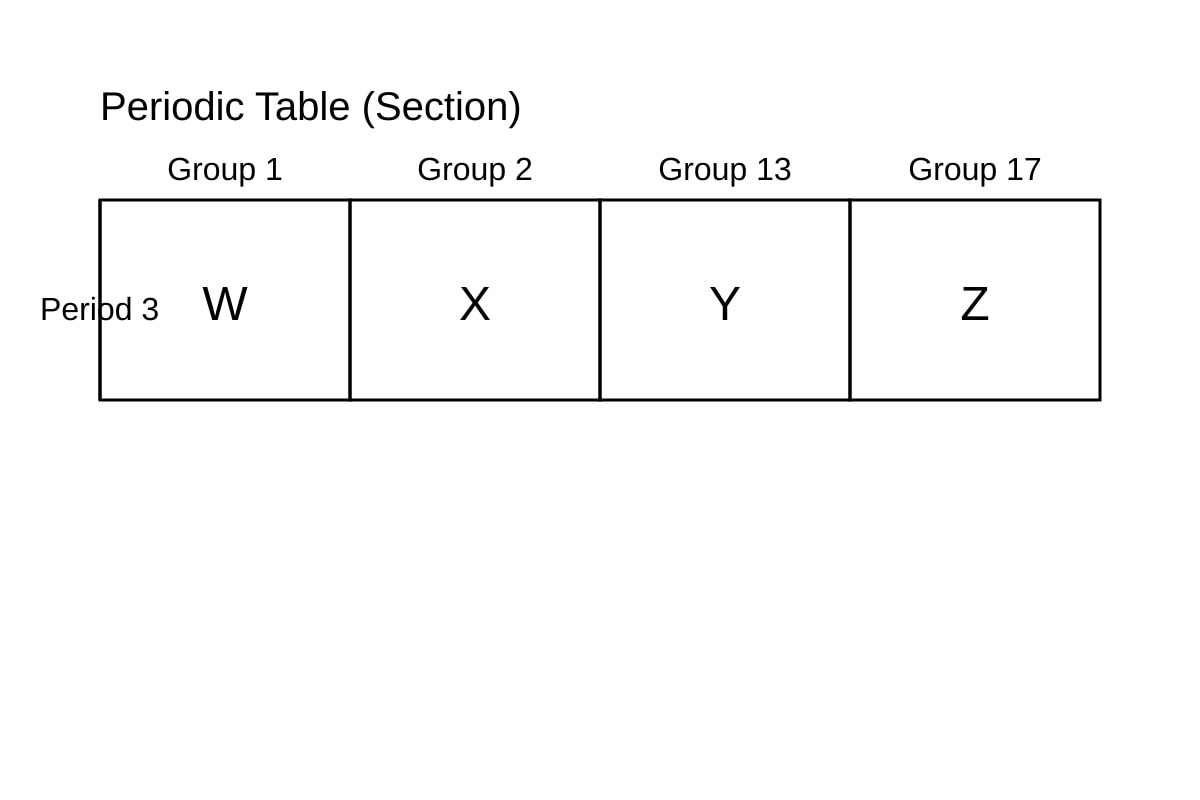
- Formula: WZ (e.g., NaCl-type) → if W = Na, Z = Cl, compound is NaCl. [1]
- W is metal (Group 1) loses 1e⁻; Z is non-metal (Group 17) gains 1e⁻. [1]
- Ionic bond forms by transfer → electrostatic attraction between Na⁺ and Cl⁻. [1]
Teaching note: Group 1 + Group 17 → 1:1 ionic compound.
17. (4 marks)
- Na₂O: basic oxide; reacts with water to form NaOH (alkaline, pH > 7). [1+1]
- SO₂: acidic oxide; reacts with water to form H₂SO₃ (acidic, pH < 7). [1+1]
Equations: Na₂O + H₂O → 2NaOH; SO₂ + H₂O → H₂SO₃.
Marking: 2 for Na₂O properties/type, 2 for SO₂ properties/type.
18. (3 marks)
- Ne to Ar: Ar larger because extra shell (n=3 vs n=2). [1]
- Na to Cl (same period): radius decreases because more protons, same shells, greater nuclear pull. [2]
Teaching note: Down group = bigger; across period = smaller.
19. (4 marks)
- Student is incorrect. [1]
- Reactivity of Group 17 decreases down group. [1]
- Larger atom → added shells → more shielding. [1]
- Weaker attraction for incoming electron from another atom → less reactive. [1]
Common mistake: Confusing with Group 1 trend.
20. (4 marks)
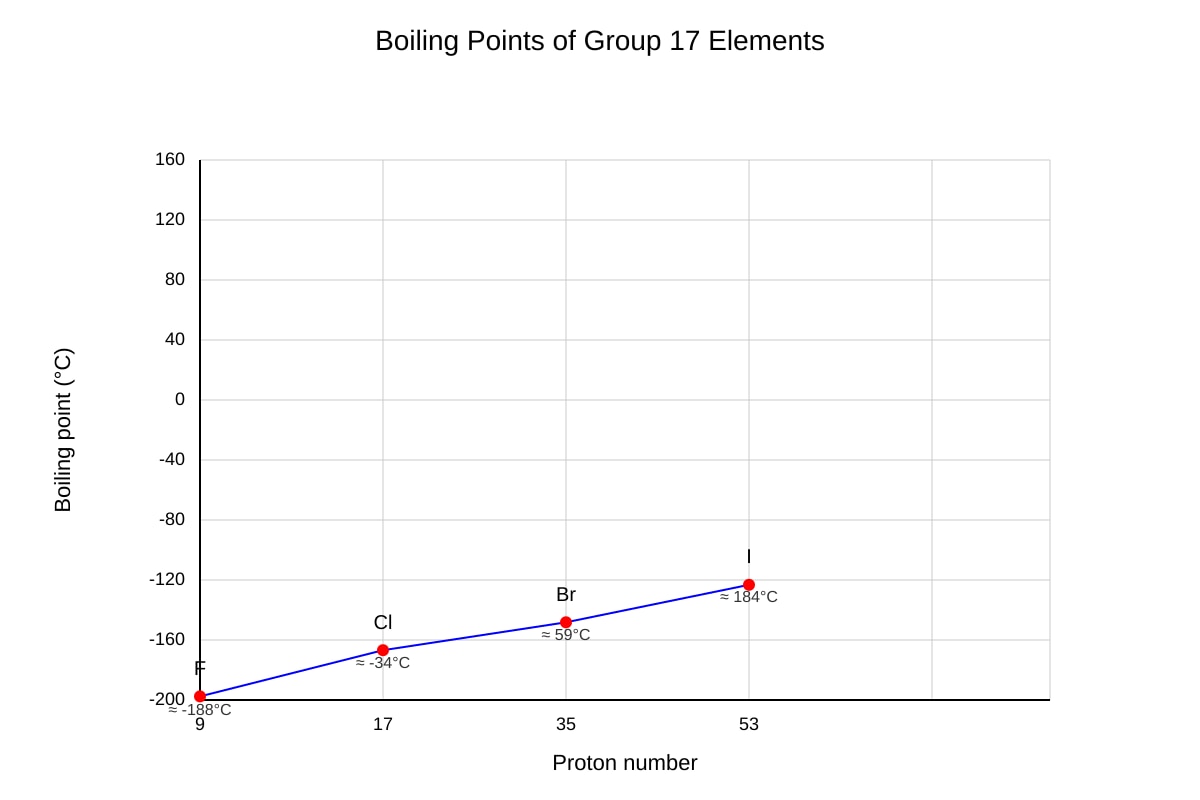
- Trend: boiling point increases down Group 17. [1]
- Elements are diatomic molecules (F₂, Cl₂, Br₂, I₂). [1]
- Intermolecular forces (London dispersion) stronger with more electrons / larger molecules. [1]
- More energy needed to separate molecules → higher BP. [1]
From graph: F (−188) < Cl (−34) < Br (59) < I (184) °C confirms.