AI Generated Quiz
Secondary 4 Pure Chemistry Organic Chemistry Quiz
Free Sec 4 Pure Chemistry Organic Chemistry quiz, HY3 AI version, with questions, answers, and O Level-style practice for Singapore students.
These static practice materials are generated from the site's syllabus and paper-generation workflow, with source and model context shown so students and parents can evaluate the material before use.
Questions
Free quiz and exam paper access
Enter your details to view this paper
Your access is remembered on this device.
Answers
Secondary 4 Pure Chemistry Quiz - Organic Chemistry (Answer Key)
Total Marks: 40
Topic: Organic Chemistry (syllabus-first; Stage 3 past-paper evidence for organic chemistry was limited but used as context, not claimed as exam-derived)
1. [1]
Teaching note: Alkenes are unsaturated hydrocarbons with one C=C double bond. The general formula is (e.g., ethene ). Common mistake: using (alkanes).
2. [1] Hydroxyl group (–OH)
Teaching note: Alcohols contain the –OH functional group attached to a carbon chain. Not to be confused with hydroxide ion OH⁻ in bases.
3. [1] Hydrogenation (addition reaction)
Teaching note: Alkene + H₂ (with Ni catalyst) → alkane. This is an addition reaction because H₂ adds across the double bond.
4. [1] Poly(ethene) / polyethylene
Teaching note: Ethene monomers polymerise to form poly(ethene). Common mistake: calling it “polyethylene” without brackets is acceptable but poly(ethene) is syllabus style.
5. [1] (or )
Teaching note: Ethanol has 2 carbons. Molecular formula . Methanol is .
6. [2] Structural formula: CH₃–CH=CH₂
Marking: 1 mark for carbon skeleton (3 C), 1 mark for double bond between C2 and C3.
Teaching note: Propene is propylene; double bond gives unsaturation.
7. [2]
Marking: 1 mark equation balanced, 1 mark state symbols.
Teaching note: Combustion needs O₂, products CO₂ + H₂O. Balance C:2, H:6→3H₂O, O: 4+3=7 → 3O₂.
8. [2] Similar: colourless, less dense than water, insoluble in water. Trend: boiling point increases with chain length.
Marking: 1 mark for two properties, 1 mark for trend.
Teaching note: Longer chains → stronger van der Waals forces → higher boiling point.
9. [2] Add bromine water to sample; if unsaturated, orange-brown colour decolourises.
Marking: 1 mark test method, 1 mark observation.
Teaching note: Bromine adds across C=C, consuming colour.
10. [2] Ethyl ethanoate (ester)
Marking: 1 mark name, 1 mark identify as ester.
Teaching note: Acid + alcohol → ester + water (esterification).
11. [2] Same functional group (–OH) → same type of reactions (e.g., combustion, esterification).
Marking: 1 mark homologous series definition, 1 mark application.
Teaching note: Members differ by –CH₂– unit but same functional group.
12. [2]
Marking: 1 mark monomer, 1 mark repeating unit.
Teaching note: Double bond opens to form chain.
13. [2] Oxidation; carbon oxidation state increases from –2 (ethanol) to 0 (ethanal) approx.
Marking: 1 mark reaction type, 1 mark oxidation state change.
Teaching note: Gain of O / loss of H = oxidation.
14. [2] Carboxyl group (–COOH); methanoic acid HCOOH.
Marking: 1 mark group, 1 mark formula.
Teaching note: Simplest is methanoic acid (formic acid).
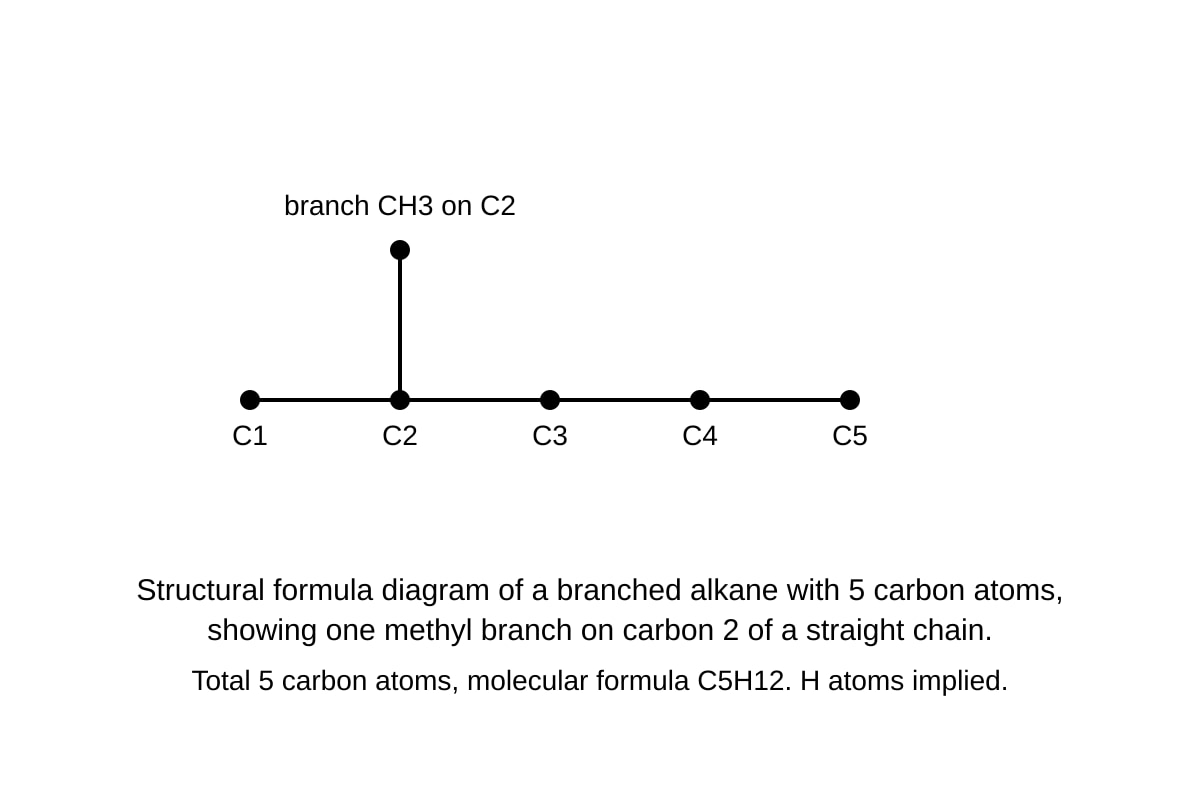
15. [2] 2-methylbutane
Marking: 1 mark correct chain (butane), 1 mark branch position.
Teaching note: Longest chain = 4 C (butane), methyl on C2. Image must show branch on second carbon.
16. [4] Natural rubber: monomer isoprene, addition polymer, elastic due to cross-links. Poly(ethene): monomer ethene, addition polymer, thermoplastic, used in bags. Both addition polymers.
Marking: 1 mark each for monomer, type, property, use.
Teaching note: Both from alkenes; rubber has cis double bonds in chain pre-polymer.
17. [4] (a) Alkene [1] (b) e.g., CH₂=CHCH₂CH₃ [1] (c) [2]
Teaching note: Decolourisation shows C=C. Addition product dibromoalkane.
18. [4] Mix ethanol + ethanoic acid + few drops conc. H₂SO₄, warm in water bath, reflux. Catalyst: H₂SO₄ speeds esterification. Precaution: avoid open flame (flammable).
Marking: 2 marks method, 1 catalyst, 1 safety.
19. [4] Saturated: only single bonds (alkanes), do not decolourise Br₂ water (e.g., methane). Unsaturated: C=C (alkenes), decolourise Br₂ (e.g., ethene).
Marking: 2 marks definitions, 2 marks test + examples.
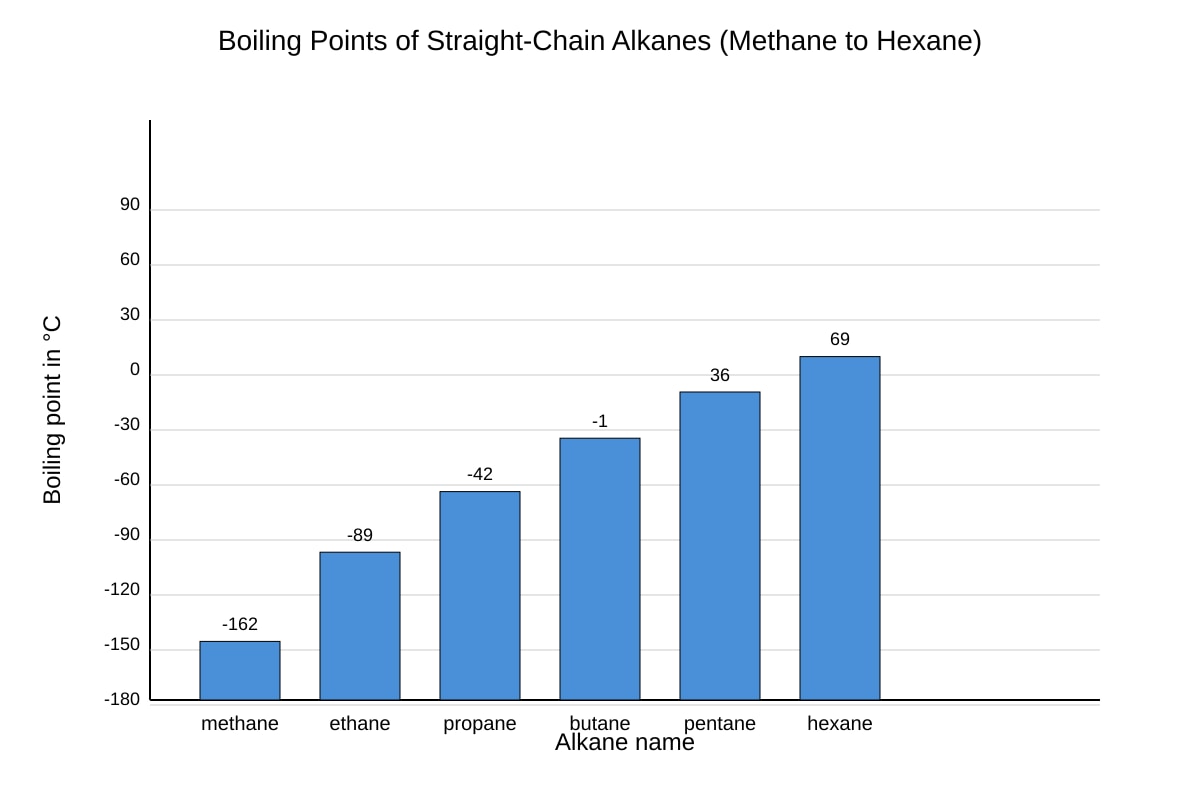
20. [4] Boiling points increase from methane to hexane. Reason: longer chains → greater surface area → stronger van der Waals forces → more energy to separate.
Marking: 1 trend, 3 explanation (chain, forces, energy). Graph shows values as listed in placeholder.