AI Generated Quiz
Secondary 4 Pure Chemistry Atomic Structure Bonding Quiz
Free Sec 4 Pure Chemistry Atomic Structure Bonding quiz, HY3 AI version, with questions, answers, and O Level-style practice for Singapore students.
These static practice materials are generated from the site's syllabus and paper-generation workflow, with source and model context shown so students and parents can evaluate the material before use.
Questions
Free quiz and exam paper access
Enter your details to view this paper
Your access is remembered on this device.
Answers
Secondary 4 Pure Chemistry Quiz - Atomic Structure Bonding (Answer Key)
Total Marks: 40
Topic: Atomic Structure & Bonding (syllabus-first, LLM-inferred from Stage 4 templates; not claimed as past-year derived)
Section A Answers (Q1–5)
Q1. [1 mark]
Relative charge = 0 (neutral); relative mass = 1.
Teaching note: Neutrons are neutral particles in the nucleus. Protons have charge +1 and relative mass 1; electrons have charge –1 and negligible mass (~1/1840).
Q2. [1 mark]
Neutrons = nucleon number – proton number = 23 – 11 = 12.
Method: Nucleon number = protons + neutrons. So neutrons = 23 – 11 = 12.
Q3. [1 mark]
Isotopes are atoms of the same element with the same number of protons but different numbers of neutrons.
Teaching note: They have same proton number, different nucleon number; e.g. Cl-35 and Cl-37.
Q4. [1 mark]
Notation: Superscript = nucleon number (17+20), subscript = proton number (17).
Q5. [1 mark]
Protons and neutrons.
Teaching note: Electrons orbit the nucleus in shells; only protons and neutrons are in the nucleus.
Section B Answers (Q6–15)
Q6. [2 marks]
Electron configuration: 2, 8, 7.
Ion charge: –1 (forms Cl⁻).
Mark breakdown: 1 mark for configuration, 1 mark for charge.
Reason: Group 17 element gains 1 electron to achieve stable 2,8,8 noble gas config.
Q7. [2 marks]
Mg: 2,8,2 → loses 2 e⁻; O: 2,6 → gains 2 e⁻.
Dot-and-cross: Mg gives 2 outer electrons to O; Mg²⁺ and O²⁻ with cross/cross or dot for transferred electrons.
Expected diagram: Mg with empty outer shell, O with 8 outer (2 from Mg shown differently).
Common mistake: Not showing charge or showing shared electrons (that would be covalent).
Q8. [2 marks]
Solid NaCl: ions fixed in lattice, cannot move → no conduction.
Molten NaCl: ions free to move and carry charge → conducts.
Marking: 1 mark each for solid and molten explanation.
Q9. [2 marks]
Bonding: covalent (with delocalised electrons).
Structure: layers of carbon atoms with weak forces between; delocalised electrons move between layers → conducts.
Marking: 1 mark type, 1 mark explanation.
Q10. [2 marks]
Diamond is hard because each C atom forms 4 strong covalent bonds in a rigid 3D network. Being carbon does not make it soft; graphite is carbon but soft due to layers.
Common trap: Assuming all carbon soft.
Q11. [2 marks]
Copper: metallic bonding; Yes.
Ice: covalent (within molecule) / hydrogen bonded molecular; No.
Marking: 1 mark per row correct.
Q12. [2 marks]
Ca atom: 2, 8, 8, 2.
Ca²⁺: 2, 8, 8.
Method: Loses 2 valence electrons.
Q13. [2 marks]
I₂ is simple molecular with covalent bonds between atoms but no free charged particles; electrons localised → no conduction.
Note: Non-polar molecules lack mobile ions/electrons.
Q14. [2 marks]
Structure: simple molecular (covalent). Example: iodine (I₂) or methane (CH₄).
Marking: 1 mark each.
Q15. [2 marks]
Ionic: high melting point, conducts when molten/dissolved. Covalent (simple molecular): low melting point, non-conductor.
Accept any two valid differences.
Section C Answers (Q16–20)
Q16. [4 marks]
- Diamond: giant covalent, each C bonded to 4 others tetrahedrally, strong bonds throughout 3D → very hard. (2 marks)
- Graphite: layers of hex rings, strong covalent within layers, weak van der Waals between → layers slide, soft. (2 marks)
Descriptors: Structure (1), bonding (1) per substance.
Q17. [4 marks]
(a) [2] Y = K (19): 2, 8, 8, 1.
(b) [2] K loses 1 e⁻ to Cl (2,8,7 gains 1 → 2,8,8). Diagram: K⁺ and Cl⁻ with transferred electron shown.
Common mistake: Wrong electron count or no charges.
Q18. [4 marks]
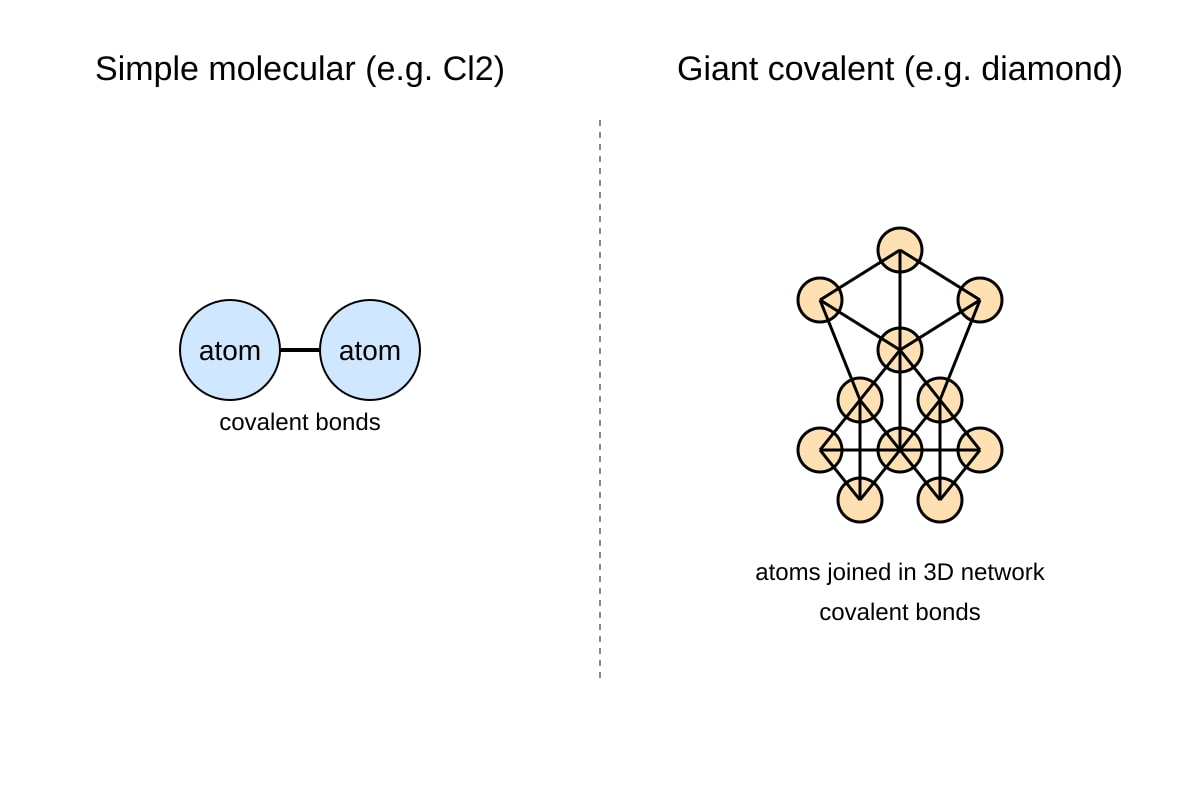
Simple molecular: few atoms held by covalent bonds; intermolecular forces weak → little energy to overcome → low mp. (2)
Giant covalent: many strong covalent bonds in network; all must break → lots of energy → high mp. (2)
Ref to diagram required for full marks.
Q19. [4 marks]
Metallic: positive ions in sea of delocalised electrons; electrostatic attraction. Property: conducts electricity (mobile e⁻). (2)
Ionic: oppositely charged ions in lattice; electrostatic forces. Property: high mp (strong attraction). (2)
Q20. [4 marks]
Neon: noble gas, single atoms, weak van der Waals only → low bp, gas at RT. (2)
Sodium: metallic bonding, delocalised electrons + positive ions, strong lattice → solid, conducts. (2)
Syllabus link: Structure determines state and properties.