AI Generated Quiz
Secondary 4 Pure Chemistry Acids Bases Salts Quiz
Free Sec 4 Pure Chemistry Acids Bases Salts quiz, HY3 AI version, with questions, answers, and O Level-style practice for Singapore students.
These static practice materials are generated from the site's syllabus and paper-generation workflow, with source and model context shown so students and parents can evaluate the material before use.
Questions
Free quiz and exam paper access
Enter your details to view this paper
Your access is remembered on this device.
Answers
Secondary 4 Pure Chemistry Quiz - Acids Bases Salts (Answer Key)
Total Marks: 40
Note: Syllabus-first generated content from LLM templates; not past-year derived.
Section A (1 mark each)
Q1. Sulfur dioxide (SO₂).
Teaching note: Burning fossil fuels containing sulfur produces SO₂, which dissolves in rain to form sulfurous acid — a cause of acid rain. Common mistake: writing SO₃ (formed only on further oxidation).
Q2. Acidic oxide (or non-metal oxide).
Teaching note: CO₂ dissolves in water to form carbonic acid; it neutralises NaOH to form a salt, so it acts as an acidic oxide.
Q3. Red.
Teaching note: Litmus is red below pH 7 (acidic), blue above pH 7. pH 3 is strongly acidic.
Q4. KNO₃.
Teaching note: HNO₃ + KOH → KNO₃ + H₂O. Nitrate salt from nitric acid and potassium base.
Q5. CH₃COOH (ethanoic acid / acetic acid).
Teaching note: HCl and H₂SO₄ are strong acids (fully ionised); CH₃COOH is weak (partially ionised).
Section B (2 marks each)
Q6. [2 marks] Add NaOH(aq) dropwise: Al³⁺ gives white ppt of Al(OH)₃ that dissolves in excess NaOH to colourless solution; Pb²⁺ gives white ppt of Pb(OH)₂ that does NOT dissolve in excess.
Marking: 1 mark for correct reagent and Al observation, 1 mark for Pb observation.
Teaching: Al(OH)₃ is amphoteric; Pb(OH)₂ is not.
Q7. [2 marks] ZnCO₃(s) + H₂SO₄(aq) → ZnSO₄(aq) + H₂O(l) + CO₂(g); method = excess reactant + filtration + crystallisation.
Marking: 1 eq with states, 1 method name.
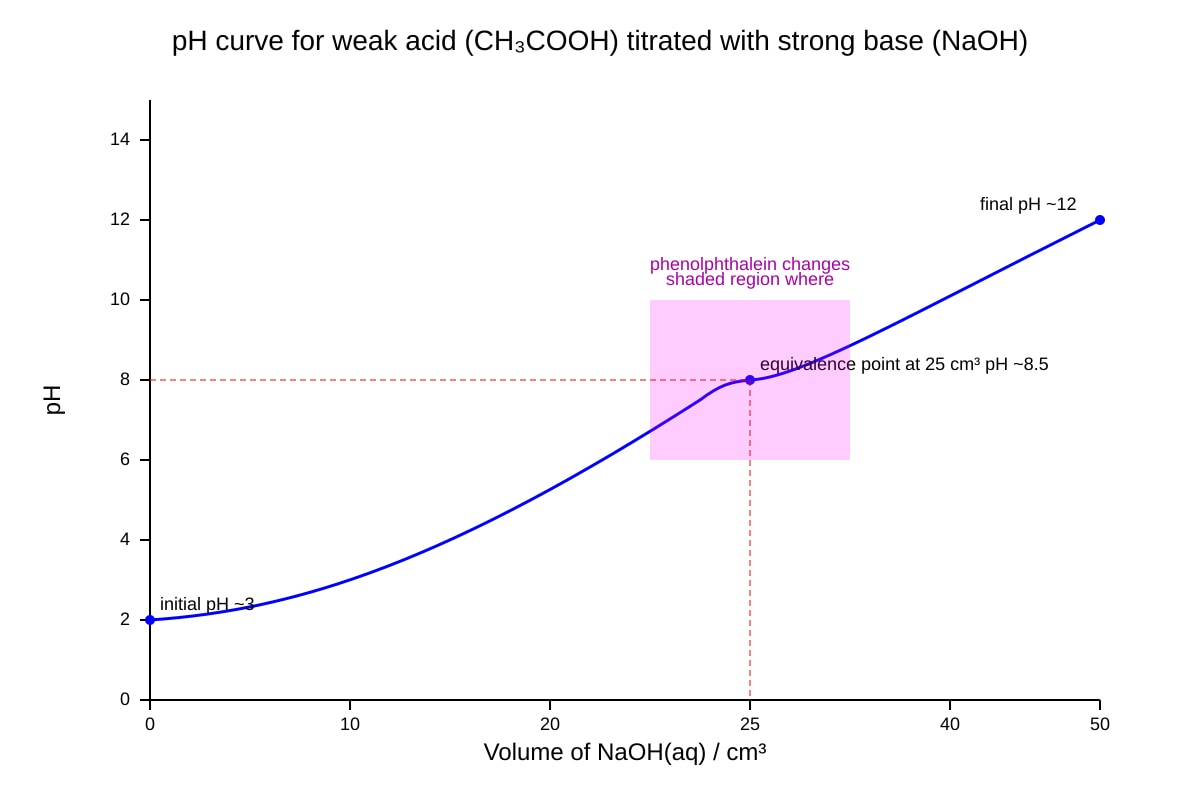
Q8. [2 marks] Equivalence point is above pH 7 (~8.5) because weak acid + strong base; phenolphthalein changes at pH 8.3–10, matching the jump.
Marking: 1 for pH reason, 1 for indicator match.
Q9. [2 marks] Observation: vigorous effervescence / explosion / heat released. Unsuitable due to violence, unsafe, hard to control.
Marking: 1 obs, 1 safety reason.
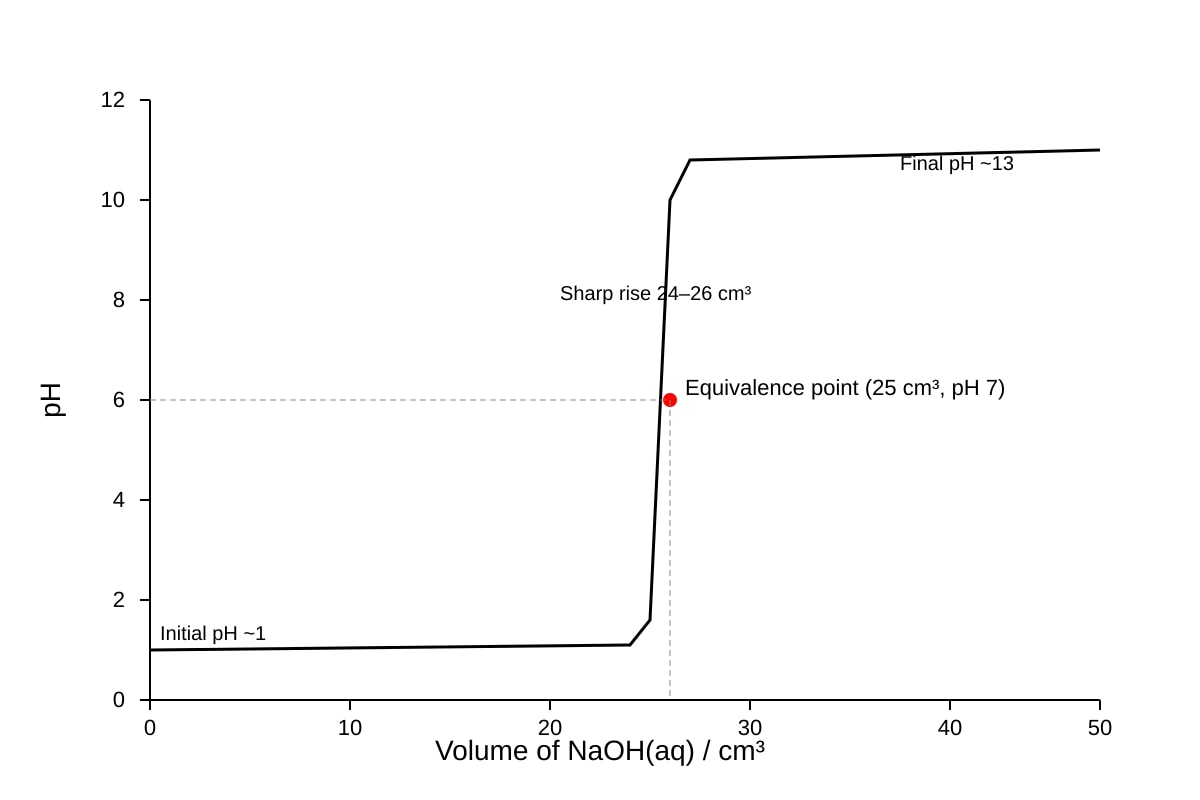
Q10. [2 marks] pH = 7 at equivalence; suitable indicator: methyl orange or phenolphthalein (either, due to sharp jump).
From graph: vertical rise at 25 cm³ crossing pH 7.
Q11. [2 marks] H⁺(aq) + OH⁻(aq) → H₂O(l).
Marking: 1 species, 1 states.
Q12. [2 marks] Effervescence (H₂ gas); magnesium dissolves / disappears; solution may warm.
Marking: any 2 valid obs.
Q13. [2 marks] NH₃(g) + H₂O(l) ⇌ NH₄⁺(aq) + OH⁻(aq).
Marking: 1 eq, 1 OH⁻ shown.
Q14. [2 marks] Add calcium hydroxide (lime) / CaCO₃; preferred because less corrosive, safer, supplies Ca²⁺ nutrients.
Marking: 1 substance, 1 reason.
Q15. [2 marks] Heat CuO with dilute H₂SO₄, add excess CuO, filter, crystallise.
Marking: 1 reaction step, 1 crystallisation.
Section C
Q16. [3 marks]
(a) Titration using indicator (1)
(b) Na₂CO₃(aq) + 2HCl(aq) → 2NaCl(aq) + H₂O(l) + CO₂(g) (1)
(c) Both soluble, so exact neutralisation via titration needed to avoid excess reactant (1)
Teaching: Soluble + soluble → titration; insoluble + acid → excess method.
Q17. [3 marks]
- Weak acid not fully neutralised at equivalence leaves conjugate base hydrolysing to OH⁻ → pH > 7 (1)
- Phenolphthalein suitable as it changes in pH 8.3–10 region (1)
- Methyl orange unsuitable (1)
From graph: equivalence at 25 cm³, pH 8.5.
Q18. [4 marks]
- Zn + H₂SO₄ → ZnSO₄ + H₂; method: excess metal + filter + crystallise (2)
- BaCl₂ + Na₂SO₄ → BaSO₄(s) + 2NaCl; method: mix, filter ppt, wash, dry (2)
Key diff: soluble salt needs crystallisation; insoluble needs filtration of ppt.
Q19. [3 marks]
- Strong acid fully ionises in water: HCl → H⁺ + Cl⁻ (1)
- Weak acid partially ionises: CH₃COOH ⇌ H⁺ + CH₃COO⁻ (1)
- Therefore same concentration of weak acid has lower [H⁺] and higher pH (1)
Q20. [4 marks]
(a) Effervescence, solid dissolves (1)
(b) CaCO₃(s) + 2HCl(aq) → CaCl₂(aq) + H₂O(l) + CO₂(g) (1)
(c) Neutralisation / acid-carbonate reaction (1)
(d) Evaporate filtrate / crystallise to get CaCl₂·xH₂O (1)