From Real Exams Quiz
Secondary 4 Pure Chemistry Stoichiometry Moles Quiz
Free Sec 4 Pure Chemistry Stoichiometry Moles quiz, HY3 Exam version, with questions, answers, and O Level-style practice for Singapore students.
These static practice materials are generated from the site's syllabus and paper-generation workflow, with source and model context shown so students and parents can evaluate the material before use.
Questions
Secondary 4 Pure Chemistry Quiz - Stoichiometry Moles
Name: ___________________________
Class: ___________________________
Date: ___________________________
Score: _______ / 40
Duration: 60 minutes
Total Marks: 40
Instructions: Answer all 20 questions. Show your working clearly for calculation questions. Use appropriate units and state symbols where required.
Section A: Multiple Choice and Short Answer (Questions 1–10)
1. What is the relative atomic mass of an element defined as? [1]
A. The mass of one atom in grams
B. The mass of an atom relative to 1/12 the mass of a carbon-12 atom
C. The number of protons in the nucleus
D. The mass of one mole of the element in kilograms
2. Calculate the molar mass of H2SO4. (Relative atomic masses: H = 1, S = 32, O = 16) [1]
3. How many moles are there in 22 g of CO2? (C = 12, O = 16) [1]
4. State the value of the Avogadro constant. [1]
5. A sample contains 3.01×10²³ atoms of oxygen. How many moles of oxygen atoms is this? [1]
6. Write the balanced equation with state symbols for the reaction between hydrochloric acid and sodium hydroxide. [1]
7. Define the term "empirical formula". [1]
8. What volume does 1 mole of any gas occupy at room temperature and pressure (r.t.p.)? [1]
9. Calculate the number of moles in 250 cm³ of 0.2 mol/dm³ sodium chloride solution. [1]
10. A compound has the formula C2H6O. Is this an empirical or molecular formula? Give a reason. [1]
Section B: Structured Calculations (Questions 11–15)
11. 4.0 g of magnesium reacts completely with excess hydrochloric acid according to the equation:
Mg(s)+2HCl(aq)→MgCl2(aq)+H2(g)
(Mg = 24, H = 1, Cl = 35.5)
(a) Calculate the number of moles of magnesium used. [1]
(b) Calculate the mass of MgCl2 produced. [2]
12. When 10.0 g of calcium carbonate is heated, it decomposes:
CaCO3(s)→CaO(s)+CO2(g)
(Ca = 40, C = 12, O = 16)
(a) Calculate the molar mass of CaCO3. [1]
(b) Calculate the mass of CaO formed from 10.0 g of CaCO3. [2]
13. 20.0 cm³ of 0.50 mol/dm³ sulfuric acid reacts with potassium hydroxide:
H2SO4(aq)+2KOH(aq)→K2SO4(aq)+2H2O(l)
(a) Calculate the number of moles of H2SO4 used. [1]
(b) Calculate the number of moles of KOH required for complete neutralisation. [1]
(c) Calculate the volume of 0.20 mol/dm³ KOH solution needed. [1]
14. A hydrocarbon X contains 85.7% carbon and 14.3% hydrogen by mass.
(a) Determine the empirical formula of X. [2]
(b) Given that the relative molecular mass of X is 56, determine its molecular formula. [1]
15. In an experiment, 8.0 g of copper(II) oxide was reduced by hydrogen:
CuO(s)+H2(g)→Cu(s)+H2O(g)
(Cu = 64, O = 16, H = 1)
(a) Calculate the molar mass of CuO. [1]
(b) Calculate the theoretical mass of copper produced from 8.0 g CuO. [2]
(c) If the actual mass of copper obtained was 5.6 g, calculate the percentage yield. [1]
Section C: Data Interpretation and Reasoning (Questions 16–20)
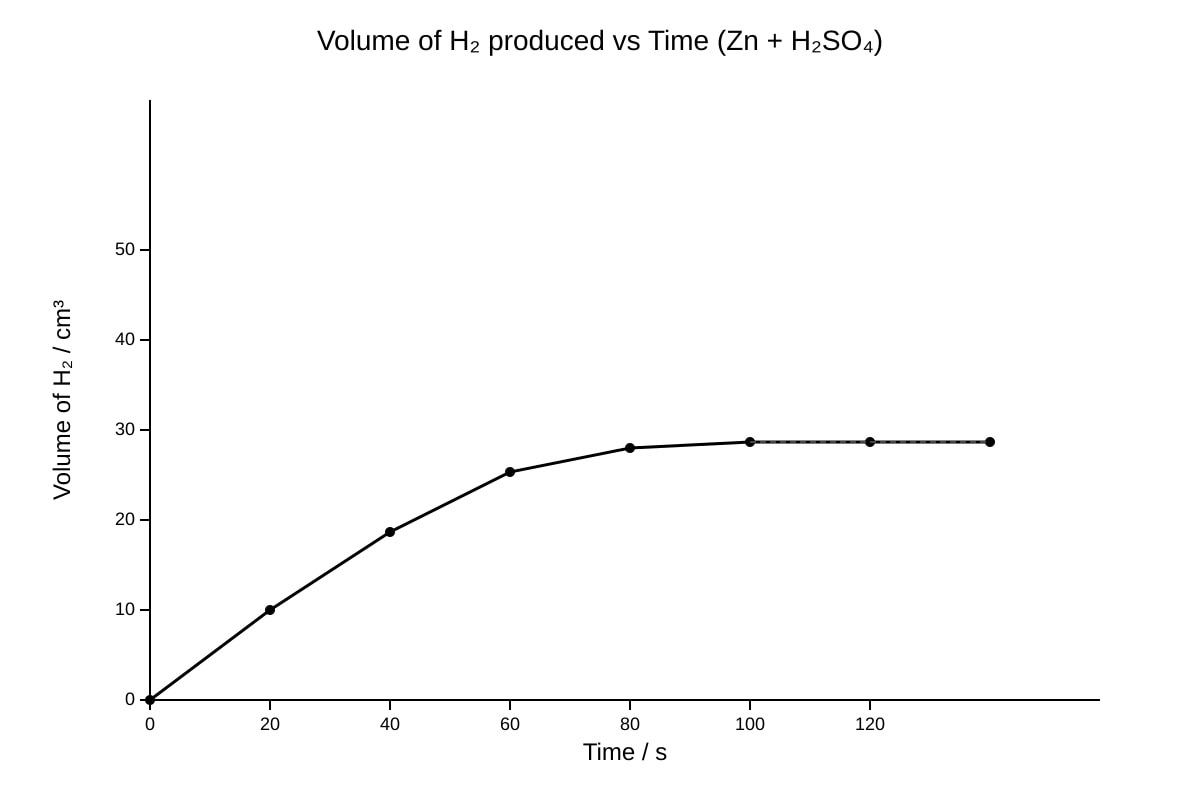
16. The graph below shows the volume of hydrogen gas produced over time when excess zinc reacts with dilute sulfuric acid.
Image pending generation: graph for Q16.
(a) What volume of gas was produced after 60 s? [1]
(b) Suggest why the graph becomes horizontal after 100 s. [1]
17. A student prepared a salt by reacting 5.0 g of sodium carbonate with excess hydrochloric acid:
Na2CO3(s)+2HCl(aq)→2NaCl(aq)+CO2(g)+H2O(l)
(Na = 23, C = 12, O = 16, H = 1, Cl = 35.5)
(a) Calculate the molar mass of Na2CO3. [1]
(b) Calculate the maximum mass of NaCl that could be produced. [2]
(c) State one reason why the actual mass of dry NaCl obtained would be less than the calculated maximum. [1]
18. The table shows the masses of elements in two compounds formed from X and oxygen.
| Compound | Mass of X / g | Mass of O / g |
|---|---|---|
| A | 2.4 | 3.2 |
| B | 1.2 | 3.2 |
Given that X has relative atomic mass 24, deduce the empirical formulae of compounds A and B. [3]
19. 50.0 cm³ of 0.10 mol/dm³ barium chloride solution is mixed with 50.0 cm³ of 0.10 mol/dm³ sodium sulfate solution:
BaCl2(aq)+Na2SO4(aq)→BaSO4(s)+2NaCl(aq)
(Ba = 137, Cl = 35.5, Na = 23, S = 32, O = 16)
(a) Calculate the number of moles of BaCl2 used. [1]
(b) Calculate the mass of BaSO4 precipitate formed. [2]
(c) State the observation made in the reaction mixture. [1]
20. A sample of impure magnesium ribbon weighing 2.4 g reacted completely with acid to produce 2.24 dm³ of hydrogen gas at r.t.p. (Molar volume at r.t.p. = 24 dm³/mol; Mg = 24)
(a) Calculate the moles of H2 produced. [1]
(b) Calculate the mass of pure Mg that would produce this H2. [1]
(c) Calculate the percentage purity of the magnesium ribbon. [1]
(d) Suggest one possible impurity in the ribbon. [1]
Answers
Secondary 4 Pure Chemistry Quiz - Stoichiometry Moles: Answer Key
Total Marks: 40
Instructions for use: Each answer includes teaching notes for students new to the topic.
Section A Answers (Q1–10)
Q1. [1 mark] B
Teaching note: Relative atomic mass (Ar) compares the mass of one atom of an element to 1/12 the mass of a carbon-12 atom. It has no unit. Option A is wrong because atomic masses are tiny in grams; C is proton number; D mixes units.
Q2. [1 mark] 98 g/mol
Working: H2SO4=(2×1)+32+(4×16)=2+32+64=98.
Note: Molar mass in g/mol equals the relative formula mass.
Q3. [1 mark] 0.5 mol
Working: Mr(CO2)=12+32=44; moles = 4422=0.5 mol.
Q4. [1 mark] 6.02×10²³ per mol
Note: Avogadro constant is the number of particles in one mole.
Q5. [1 mark] 0.5 mol
Working: moles = 6.02×10233.01×1023=0.5 mol.
Q6. [1 mark] HCl(aq)+NaOH(aq)→NaCl(aq)+H2O(l)
Note: Must include state symbols. Balanced 1:1.
Q7. [1 mark] The simplest whole-number ratio of atoms of each element in a compound.
Common mistake: Confusing with molecular formula (actual number of atoms).
Q8. [1 mark] 24 dm³ (or 24000 cm³) at r.t.p.
Note: At s.t.p. it is 22.4 dm³; r.t.p. is room temp and pressure (~25°C, 1 atm).
Q9. [1 mark] 0.050 mol
Working: Convert volume: 250 cm³ = 0.250 dm³; moles = c×V=0.2×0.250=0.050 mol.
Q10. [1 mark] Molecular formula.
Reason: It can be simplified to C1H3O0.5 which is not whole number; empirical would be C2H6O divided by common factor – actually C2H6O is already simplest whole ratio? Wait: C2H6O ratio 2:6:1 has no common divisor >1, so it is both empirical and molecular. Correction: It is both empirical and molecular because the subscripts have no common factor. Accept "molecular (and also empirical)" with reason that simplest ratio is 2:6:1, no further simplification possible.
Marking: 1 mark for correct classification with valid reason.
Section B Answers (Q11–15)
Q11. [3 marks total]
(a) [1] moles Mg = 244.0=0.167 mol (accept 0.17).
(b) [2] From eq: 1 mol Mg → 1 mol MgCl2. Mr(MgCl2)=24+71=95. Mass = 0.167×95=15.9 g.
Teaching: Mole ratio from balanced eq is 1:1. Molar mass MgCl2=24+2×35.5=95.
Q12. [3 marks]
(a) [1] Mr(CaCO3)=40+12+48=100.
(b) [2] moles CaCO3=10.0/100=0.10 mol → 0.10 mol CaO. Mr(CaO)=40+16=56. Mass = 0.10×56=5.6 g.
Q13. [3 marks]
(a) [1] V=20.0/1000=0.0200 dm³; moles = 0.50×0.0200=0.0100 mol.
(b) [1] Ratio 1:2 → 0.0200 mol KOH.
(c) [1] V=n/c=0.0200/0.20=0.100 dm³ = 100 cm³.
Q14. [3 marks]
(a) [2] In 100 g: C = 85.7 g → 85.7/12 = 7.14; H = 14.3 g → 14.3/1 = 14.3. Ratio C:H = 7.14:14.3 ≈ 1:2. Empirical = CH2.
(b) [1] Mr(CH2)=14; 56/14=4 → molecular = C4H8.
Q15. [4 marks]
(a) [1] Mr(CuO)=64+16=80.
(b) [2] moles CuO = 8.0/80 = 0.10 mol → 0.10 mol Cu. Mass Cu = 0.10×64=6.4 g.
(c) [1] % yield = (5.6/6.4)×100=87.5%.
Section C Answers (Q16–20)
Q16. [2 marks]
(a) [1] 38 cm³ (read from graph at 60 s).
(b) [1] Reaction complete; all zinc used up (acid excess but Zn limiting) so no more gas.
Q17. [4 marks]
(a) [1] Mr(Na2CO3)=46+12+48=106.
(b) [2] moles = 5.0/106 = 0.0472 mol → 2 × 0.0472 = 0.0944 mol NaCl. Mr(NaCl)=58.5. Mass = 0.0944×58.5=5.52 g.
(c) [1] Some product lost during filtration/transfer; or solution not fully evaporated.
Q18. [3 marks]
For A: X:O mass ratio 2.4:3.2 → mol X = 2.4/24 = 0.1; mol O = 3.2/16 = 0.2 → ratio 1:2 → XO2. [1.5]
For B: X:O = 1.2:3.2 → mol X = 0.05; mol O = 0.2 → ratio 1:4 → XO4. [1.5]
Note: Show division by Ar and simplification.
Q19. [4 marks]
(a) [1] V=0.050 dm³; moles = 0.10×0.050=0.0050 mol.
(b) [2] 1:1 ratio → 0.0050 mol BaSO4. Mr=137+32+64=233. Mass = 0.0050×233=1.165 g.
(c) [1] White precipitate formed.
Q20. [4 marks]
(a) [1] moles H2=2.24/24=0.0933 mol.
(b) [1] Mg + 2H⁺ → Mg²⁺ + H₂; 1:1 → 0.0933 mol Mg; mass = 0.0933×24=2.24 g.
(c) [1] % purity = (2.24/2.4)×100=93.3%.
(d) [1] MgO coating / grease / other inert impurity.
Common marking notes:
- Always award method mark if correct formula used even if arithmetic error.
- State symbols required only where specified.
- In empirical formula, show mole ratio clearly.
Free quiz and exam paper access
Enter your details to view this paper
Your access is remembered on this device.