From Real Exams Quiz
Secondary 4 Pure Chemistry Redox Electrochemistry Quiz
Free Sec 4 Pure Chemistry Redox Electrochemistry quiz, HY3 Exam version, with questions, answers, and O Level-style practice for Singapore students.
These static practice materials are generated from the site's syllabus and paper-generation workflow, with source and model context shown so students and parents can evaluate the material before use.
Questions
Secondary 4 Pure Chemistry Quiz - Redox Electrochemistry
Name: ___________________________
Class: ____________
Date: ____________
Score: ____________ / 40
Duration: 60 minutes
Total Marks: 40
Instructions:
- Answer all 20 questions.
- Section A: Multiple-choice style short responses. Section B: Structured short answers. Section C: Data and extended responses.
- Show all working and reasoning where required.
- Use proper chemical notation and state symbols where appropriate.
Section A: Redox Basics (Questions 1–5)
1. [1 mark] In the reaction 2Mg+O2→2MgO, which species is oxidised?
2. [1 mark] State the oxidation state of iron in Fe2O3.
3. [1 mark] Identify the reducing agent in the equation:
Zn+Cu2+→Zn2++Cu
4. [1 mark] Write the half-equation for the oxidation of bromide ions to bromine.
5. [1 mark] A substance gains electrons. State the term used for this process.
Section B: Electrolysis and Cells (Questions 6–15)
6. [2 marks] During electrolysis of molten lead(II) bromide, write the electrode reactions at:
(a) the cathode: ________________________________________
(b) the anode: __________________________________________
7. [2 marks] Explain why electrolysis of aqueous sodium chloride using inert electrodes produces hydrogen at the cathode instead of sodium.
8. [2 marks] A simple cell is set up using zinc and copper half-cells.
(a) Which metal is the negative terminal? ____________________
(b) Write the overall cell reaction. __________________________
9. [2 marks] State two observations seen at the anode during electrolysis of aqueous copper(II) sulfate with copper electrodes.
10. [2 marks] Calculate the charge transferred when 0.5 mol of electrons pass through a circuit. (1 mol e⁻ = 96500 C) Show your working.
Working: ________________________________________________________
Answer: ____________________ C
11. [2 marks] The reactivity series places potassium above calcium. In a simple cell with these two metals, which is the anode? Explain.
12. [2 marks] Complete and balance the ionic half-equation for discharge of hydroxide ions:
4OH−→O2+___H2O+___e−
13. [2 marks] State the product at the anode during electrolysis of concentrated aqueous sodium chloride (brine) and give the reason for its formation over other ions.
14. [2 marks] A student connects two beakers, one with AgNO3(aq) and silver rod, the other with CuSO4(aq) and copper rod.
(a) Which electrode loses mass? ____________________
(b) Name the process occurring there. ____________________
15. [2 marks] Explain, in terms of electron transfer, why Cl2 is a stronger oxidising agent than Br2.
Section C: Data Interpretation and Extended Response (Questions 16–20)
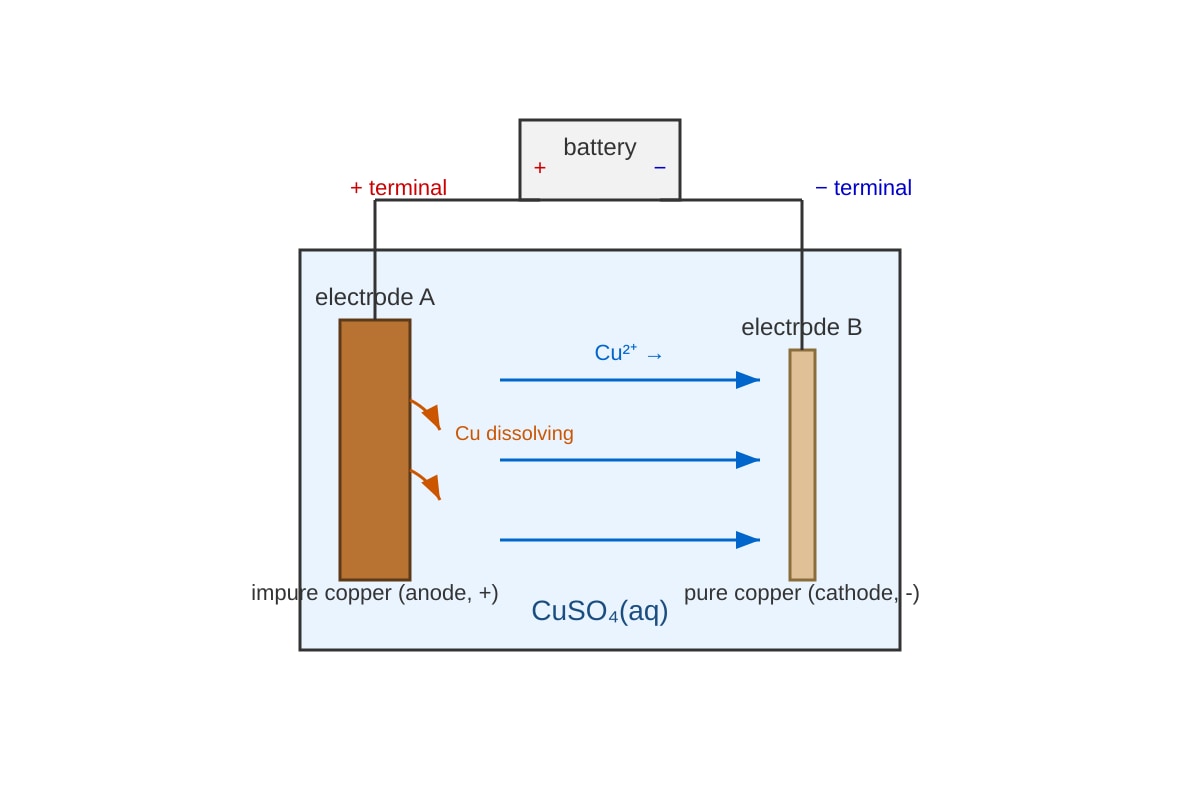
16. [3 marks] The diagram below shows an electrolysis cell for purifying copper.
Image pending generation: experimental_setup for Q16.
Using the setup:
(a) State which electrode is the anode. [1]
(b) Write the reaction at the impure copper electrode. [1]
(c) Explain how pure copper is obtained on the other electrode. [1]
17. [3 marks] A cell is made from magnesium and iron half-cells with salt bridge.
Given: Mg2+/Mg E∘=−2.37 V, Fe2+/Fe E∘=−0.44 V.
(a) Which is the more reactive metal? [1]
(b) Calculate the cell potential. [1]
(c) Write the overall redox equation. [1]
Working: ________________________________________________________
18. [4 marks] Electrolysis of aqueous potassium iodide (KI) is carried out with inert graphite electrodes.
(a) State the product at the cathode and give the half-equation. [2]
(b) State the product at the anode and give the half-equation. [2]
19. [3 marks] The table shows standard electrode potentials:
| Half-cell | E∘ (V) |
|---|---|
| Zn2+/Zn | -0.76 |
| Ag+/Ag | +0.80 |
(a) Construct the overall cell reaction. [1]
(b) Calculate Ecell∘. [1]
(c) Identify the oxidising agent. [1]
20. [4 marks] A student proposes using seawater (contains Na+, Cl−, Mg2+, Br−) for electrolysis to extract bromine.
(a) State which anion is discharged first at the anode and why. [2]
(b) Write the half-equation for the anion discharge. [1]
(c) Give one reason why sodium is not produced at the cathode. [1]
Answers
Secondary 4 Pure Chemistry Quiz - Redox Electrochemistry (Answer Key)
Total Marks: 40
Topic: Redox Electrochemistry
Section A: Redox Basics
1. [1 mark] Mg (magnesium)
Teaching note: Oxidation is loss of electrons (OIL). Mg goes from 0 to +2, losing 2e⁻. O2 is reduced. Common mistake: naming O2 as oxidised.
2. [1 mark] +3
Teaching note: Oxygen is -2. In Fe2O3: 2x+3(−2)=0⇒2x=6⇒x=+3.
3. [1 mark] Zn (zinc)
Teaching note: Reducing agent is the species that is oxidised (loses e⁻). Zn → Zn2++2e−.
4. [1 mark] 2Br−→Br2+2e−
Teaching note: Oxidation of bromide: 2 bromide ions lose 2 electrons to form Br2. Include charge balance.
5. [1 mark] Reduction
Teaching note: Gain of electrons = reduction (RED). Opposite of oxidation.
Section B: Electrolysis and Cells
6. [2 marks]
(a) Cathode: Pb2++2e−→Pb [1]
(b) Anode: 2Br−→Br2+2e− [1]
Teaching note: Molten salt → only ions present. Cations to cathode, anions to anode.
7. [2 marks]
Sodium is more reactive than hydrogen / Na+ is harder to reduce than H+ [1]. Hydrogen is discharged because H+ from water is lower in reactivity and gains electrons: 2H++2e−→H2 [1].
Marking: 1 for reactivity reason, 1 for correct identification of H2 production.
8. [2 marks]
(a) Zinc [1]
(b) Zn+Cu2+→Zn2++Cu [1]
Teaching note: More reactive metal (Zn) is anode/negative.
9. [2 marks]
- Brown copper deposit on cathode (or pure copper electrode) [1]
- Anode (impure copper) loses mass / dissolves [1]
Note: With copper electrodes, anode dissolves as Cu → Cu2++2e−.
10. [2 marks]
Working: Charge = moles e⁻ × Faraday = 0.5×96500 [1]
Answer: 48250 C [1]
Teaching note: Q=nF.
11. [2 marks]
Potassium is the anode [1] because it is more reactive (higher in series) and loses electrons more readily [1].
12. [2 marks]
4OH−→O2+2H2O+4e−
Award: 1 for 2H2O, 1 for 4e−.
Check: LHS charge -4, RHS 0 + 0 -4 = -4. Balanced.
13. [2 marks]
Chlorine (Cl2) [1]; Cl− is discharged preferentially over OH− in concentrated brine due to higher concentration of Cl− [1].
14. [2 marks]
(a) Copper rod (in CuSO4) [1]
(b) Oxidation [1]
Teaching note: More reactive Ag does not dissolve; Cu → Cu2++2e−, loses mass.
15. [2 marks]
Cl2 more readily gains electrons to form Cl− than Br2 forms Br− [1]; due to smaller atomic radius / higher electronegativity of Cl [1].
Teaching note: Stronger oxidising agent = easier reduction.
Section C: Data Interpretation and Extended Response
16. [3 marks]
(a) Impure copper block (electrode A, +) [1]
(b) Cu→Cu2++2e− [1]
(c) Cu2+ from solution gains electrons at pure Cu cathode: Cu2++2e−→Cu, depositing pure copper [1].
Image requirement: Setup must show anode (+) impure, cathode (-) pure, Cu²⁺ arrows to cathode.
17. [3 marks]
(a) Magnesium [1]
(b) Ecell∘=(−0.44)−(−2.37)=+1.93 V [1]
(c) Mg+Fe2+→Mg2++Fe [1]
Teaching note: Cell potential = Ecathode−Eanode (using reduction potentials).
18. [4 marks]
(a) Cathode: Hydrogen (H2); 2H++2e−→H2 or 2H2O+2e−→H2+2OH− [2]
(b) Anode: Iodine (I2); 2I−→I2+2e− [2]
Note: I− discharged preferentially over OH− (less reactive halide).
19. [3 marks]
(a) Zn+2Ag+→Zn2++2Ag [1]
(b) Ecell∘=0.80−(−0.76)=1.56 V [1]
(c) Ag+ [1]
Teaching note: Oxidising agent is reduced species (Ag+).
20. [4 marks]
(a) Br− discharged first [1] because it is the least reactive halide present (easier to oxidise than Cl−) and Na+ stays in solution [1].
(b) 2Br−→Br2+2e− [1]
(c) Na+ is more difficult to reduce than H+ from water; H₂ evolves instead [1].
Free quiz and exam paper access
Enter your details to view this paper
Your access is remembered on this device.