From Real Exams Quiz
Secondary 4 Pure Chemistry Periodic Table Quiz
Free Sec 4 Pure Chemistry Periodic Table quiz, HY3 Exam version, with questions, answers, and O Level-style practice for Singapore students.
These static practice materials are generated from the site's syllabus and paper-generation workflow, with source and model context shown so students and parents can evaluate the material before use.
Questions
Free quiz and exam paper access
Enter your details to view this paper
Your access is remembered on this device.
Answers
Secondary 4 Pure Chemistry Quiz - Periodic Table: Answer Key
Total Marks: 40
Topic: Periodic Table
Section A (1 mark each)
1. 8
Teaching note: Neon (proton 10) has configuration 2,8. Outermost shell = second shell with 8 electrons. Noble gases (except He) have 8 valence electrons.
2. Iron
Teaching note: Transition metals are in the d-block (Groups 3–12). Iron (Fe) is a transition metal; sodium is Group 1, oxygen Group 16, argon Group 18.
3. Atomic radius increases
Teaching note: Down Group 1, more electron shells are added, so the atom gets larger despite increased nuclear charge.
4. Chlorine
Teaching note: Proton number 17 = chlorine (Cl), a Group 17 halogen.
5. Non-metal
Teaching note: Chlorine is a green gas, non-metal, located on the right of the Periodic Table.
6. Group 17 (halogens)
Teaching note: Halogens are most reactive non-metals due to needing 1 electron to fill outer shell.
7. 3 shells
Teaching note: Mg (12): 2,8,2 → three shells (n=1,2,3).
8. Mg
Teaching note: Period 3 Group 2 = magnesium (proton 12).
9. Generally increases then decreases
Teaching note: Na to Si melting point rises (metallic/network), then drops for P, S, Cl (simple molecular), Ar (monatomic).
10. Argon
Teaching note: Ar: 2,8,8 (proton 18).
Section B (2 marks each)
11. (a) Group 1, Period 3 (1 mark)
(b) Na⁺ (1 mark)
Teaching note: Proton 11 = sodium. Loses 1 electron → Na⁺. Position from config 2,8,1.
12. Noble gases have full outer shells of electrons (e.g., 8 valence, He 2) (1 mark). This stable arrangement means they do not need to gain/lose/share electrons, so they rarely react (1 mark).
Common mistake: Saying "they have no electrons" – wrong.
13. P (3) and Q (11) and R (19) are Group 1 (1 mark); S (4) is Group 2. So P, Q, R same group → Group 1 (1 mark).
Teaching note: Group from valence electrons: Li(2,1), Na(2,8,1), K(2,8,8,1) all Group 1.
14. Electronegativity increases from Li to F (1 mark). Across period, more protons and similar shielding pull bonding electrons closer (1 mark).
Marking: Trend 1m, reason 1m.
15. Incorrect (1 mark). Reactivity of Group 2 increases down the group because outer electrons are further from nucleus, easier to lose (1 mark).
Common mistake: Confusing with Group 17 where reactivity decreases down.
Section C (3 marks each)
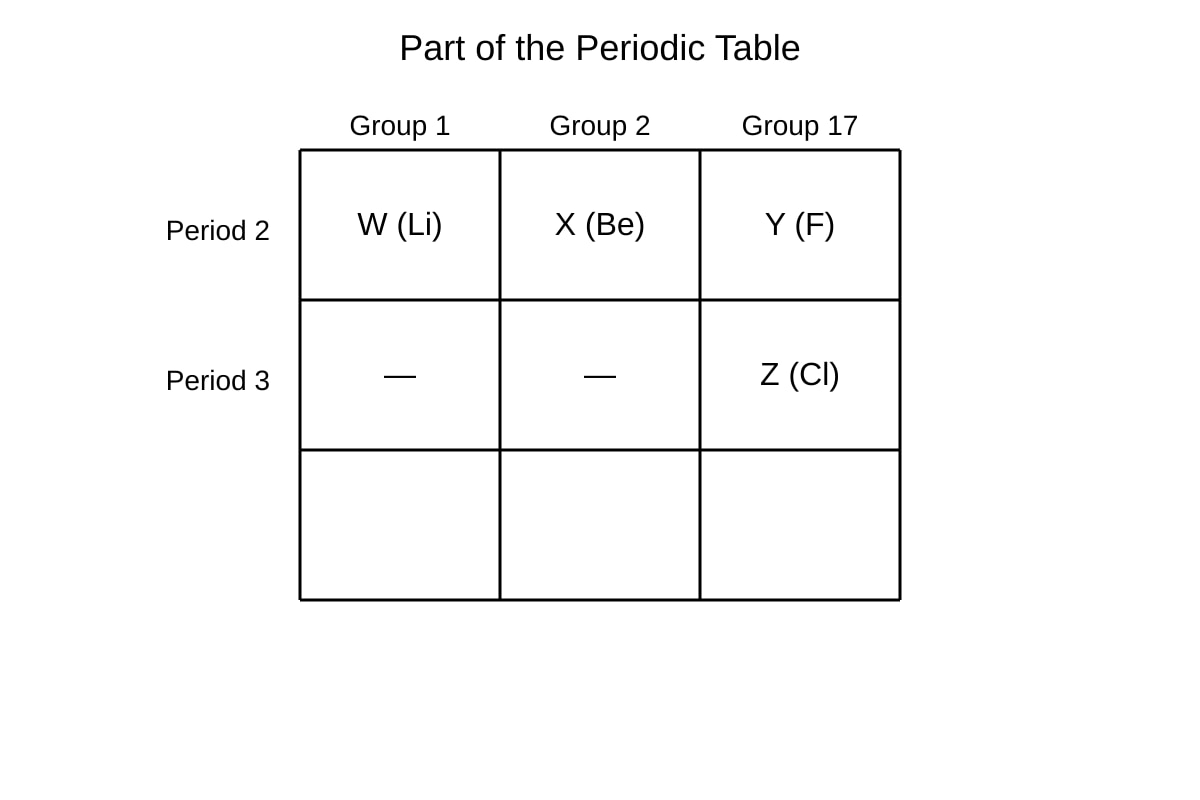
16. (a) Z = chlorine / Cl (1m)
(b) Both are halogens / non-metals / form -1 ions / diatomic (1m)
(c) X (Be) has 2 valence electrons, loses them to form metal cation; Y (F) has 7 valence electrons, gains 1 to complete shell, non-metal (1m)
Image note: Grid must show Be left of F in Period 2; Cl below F.
17. (a) Group 1, potassium K (1m: group 1m, identity 1m but shared → 1 total)
(b) 2K + 2H₂O → 2KOH + H₂ (1m)
(c) Metal hydroxide KOH formed is alkali, releases OH⁻ (1m)
Teaching note: Red litmus blue = alkaline.
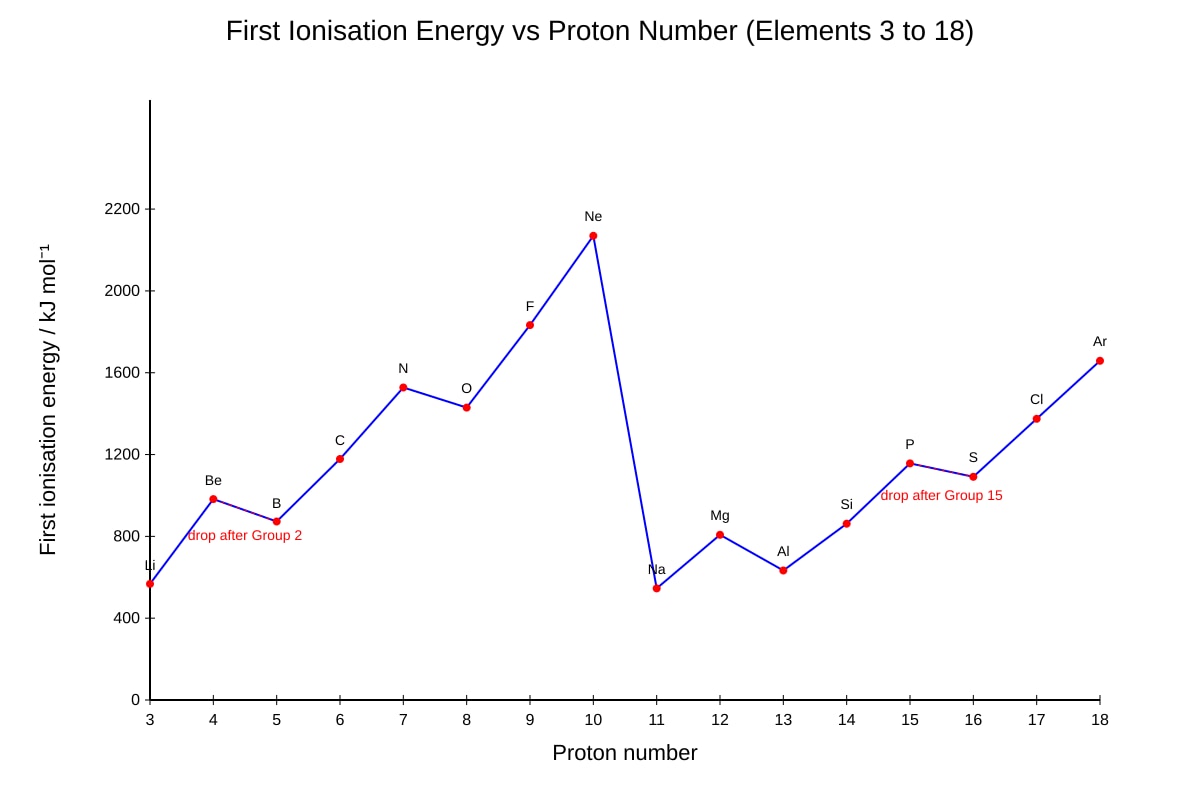
18. (a) Generally increases with small drops (1m)
(b) Al outer electron in p-subshell (higher energy than s) easier to remove than Mg s² (1m)
(c) S electron paired in p-orbital, repulsion makes removal easier than P half-filled stable p³ (1m)
Image note: Graph must show dips after 12 (Mg→Al) and 15 (P→S).
19. (a) Na conducts electricity (mobile electrons), Cl does not (simple molecules) (1m)
(b) Na forms basic oxide Na₂O, Cl forms acidic oxide Cl₂O₇ (1m)
(c) Na reacts vigorously with water producing H₂ and alkali; Cl reacts with water forming acidic HCl/HClO (1m)
20. (a) Aᵣ = (35×0.75)+(37×0.25) = 26.25 + 9.25 = 35.5 (2m: 1m for method, 1m for answer)
(b) Group 17, Period 3 (1m)
Teaching note: This is chlorine isotope mix; Aᵣ 35.5 matches syllabus.