From Real Exams Quiz
Secondary 4 Pure Chemistry Atomic Structure Bonding Quiz
Free Sec 4 Pure Chemistry Atomic Structure Bonding quiz, HY3 Exam version, with questions, answers, and O Level-style practice for Singapore students.
These static practice materials are generated from the site's syllabus and paper-generation workflow, with source and model context shown so students and parents can evaluate the material before use.
Questions
Free quiz and exam paper access
Enter your details to view this paper
Your access is remembered on this device.
Answers
Secondary 4 Pure Chemistry Quiz - Atomic Structure Bonding (Answers)
Total Marks: 40
Section A: 5 marks
Section B: 10 marks
Section C: 30 marks
Section A Answers (1 mark each)
1. 12
Teaching note: Neutrons = nucleon number − proton number = 23 − 11 = 12.
Common mistake: Subtracting electron number instead of proton number.
2. A (2,8,2)
Teaching note: Mg has 12 electrons: 2 in first shell, 8 in second, 2 in third.
Common mistake: Choosing 2,8,8 (that is Mg²⁺ ion, not atom).
3. C (Ionic)
Teaching note: Sodium chloride is formed by transfer of electron from Na to Cl, producing Na⁺ and Cl⁻ held by electrostatic attraction.
4. 13
Teaching note: Carbon proton number = 6. Nucleon = p + n = 6 + 7 = 13. Isotope is (^{13}_{6}\text{C}).
5. C (Electron)
Teaching note: K (proton 19) loses one electron to achieve stable 2,8,8 arrangement as K⁺.
Section B Answers (2 marks each)
6. Electron arrangement: 2,8,8.
Explanation: F (9e) gains 1e to achieve stable noble gas config of Ne (2,8,8). [1 mark arrangement, 1 mark explanation]
Teaching note: Non-metals gain electrons to fill outer shell.
7. Dot-and-cross: H (×) and Cl (•) share one pair. H:× Cl:••••••• → H×Cl (with 3 lone pairs on Cl).
[2 marks for correct shared pair and outer shells]
Teaching note: Covalent bond = shared pair of electrons. Show only valence electrons.
8. Two properties: very hard; high melting point. [1 mark each]
Teaching note: Due to strong covalent bonds in 3D network requiring much energy to break.
9. Solid NaCl: ions fixed in lattice, no mobile charge carriers. Molten: ions free to move, carry current. [1+1]
Teaching note: Conductivity needs mobile delocalised electrons or ions.
10. Ion: Cl⁻. Bond with Na: ionic. [1+1]
Teaching note: Cl gains 1e; Na loses 1e; electrostatic attraction forms ionic bond.
Section C Answers (3 marks each)
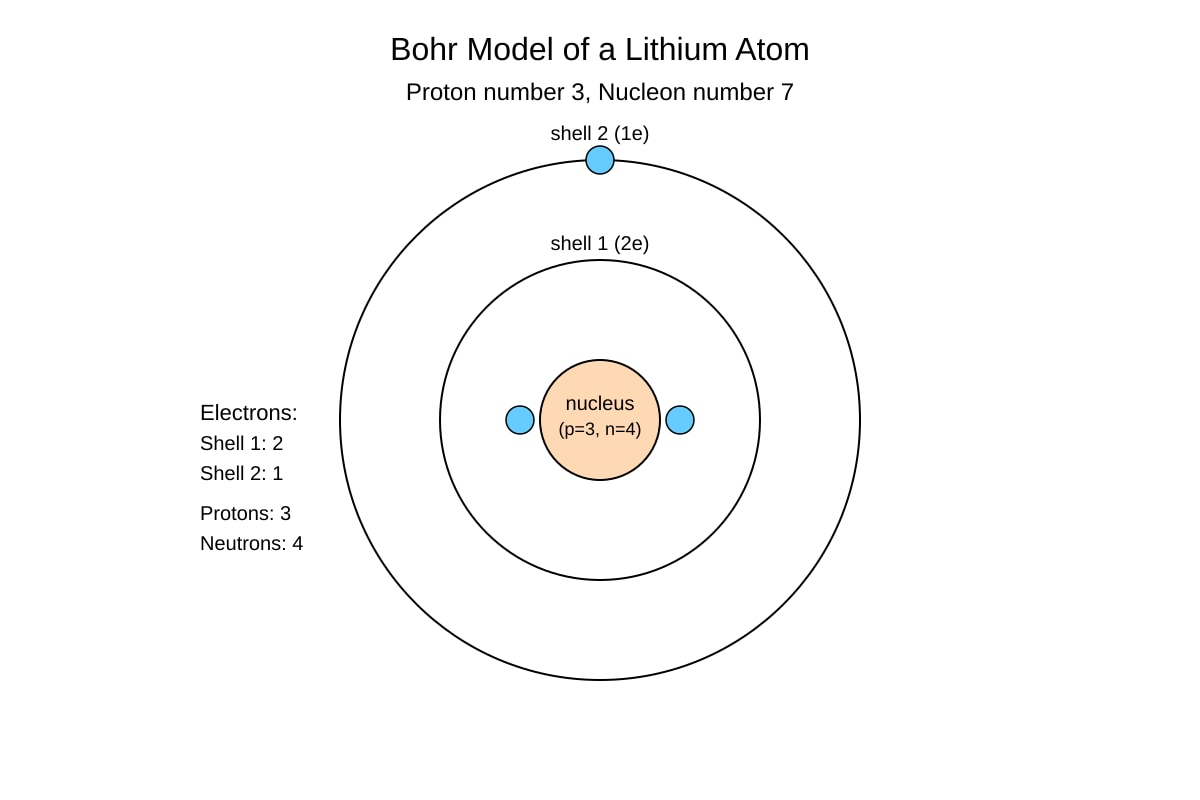
11. (a) Nucleon number = 7 (3p+4n). [1]
(b) Electron arrangement: 2,1. [1]
(c) Li loses 1 valence electron to form Li⁺ with 2,8? No, Li⁺ is 2. Stable duplet. [1]
Teaching note: Li: 2,1 → Li⁺: 2 (like He).
12. Graphite: layers of hex rings, delocalised e between layers → conducts electricity, soft. Diamond: 3D network, no free e → non-conductor, hard. [1 structure, 1 conductivity graphite, 1 diamond]
Marking: 3 marks for clear comparison with structural reason.
13. (a) 35 = nucleon number, 17 = proton number. [1]
(b) Same p, different n. [1]
(c) Neutrons = 37−17 = 20. [1]
Teaching note: Isotopes = same atomic number, different mass number.
14. Mg (2,8,2) → Mg²⁺ (2,8); O (2,6) → O²⁻ (2,8). Transfer 2e from Mg to O. [1 diagram, 1 transfer, 1 charges]
Diagram note: Show Mg losing 2 crosses, O gaining 2 crosses.
15. (a) B. [1]
(b) Giant covalent → strong bonds → very high mp. [1]
(c) Simple molecular: weak intermolecular forces. [1]
Teaching note: A is like chlorine; B is diamond.
16. Ca (2,8,8,2) → Ca²⁺ (2,8,8); O (2,6) → O²⁻ (2,8,8). Transfer 2e. Ionic bond by electrostatic attraction. [1 before, 1 after, 1 bond explanation]
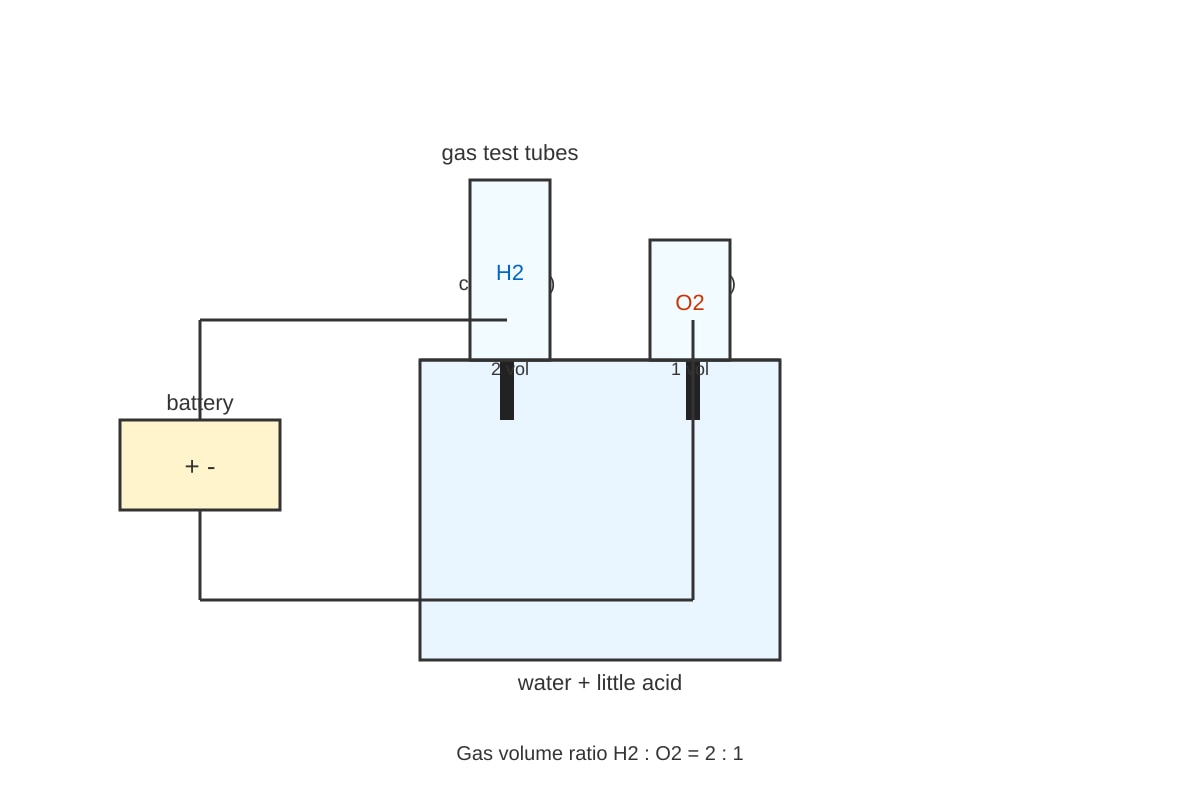
17. (a) Hydrogen (H₂). [1]
(b) 2H⁺ + 2e⁻ → H₂. [1]
(c) Water with acid has mobile H⁺ and OH⁻/anions; metallic bonding is in metals, not solution. [1]
Image note: Setup must show cathode (−) with double volume gas H₂.
18. (i) Covalent: molecules; Ionic: giant lattice. (ii) Covalent: shared e; Ionic: transferred e. (iii) Covalent: low mp simple; Ionic: high mp. [1 each]
Teaching note: Three clear contrasts.
19. (a) Proton number 17 (Cl). [1]
(b) Cl⁻. [1]
(c) H×Cl with 3 lone pairs on Cl. [1]
Teaching note: 2,8,7 → gains 1e.
20. Cl has isotopes 35 (75%) and 37 (25%) approx; average = (35×0.75 + 37×0.25) = 35.5. [1 isotopes, 1 abundance, 1 calc]
Teaching note: Relative atomic mass is weighted average of isotopes.