From Real Exams Quiz
Secondary 4 Pure Chemistry Atomic Structure Bonding Quiz
Free Sec 4 Pure Chemistry Atomic Structure Bonding quiz, DeepSeek Exam version, with questions, answers, and O Level-style practice for Singapore students.
These static practice materials are generated from the site's syllabus and paper-generation workflow, with source and model context shown so students and parents can evaluate the material before use.
Questions
Free quiz and exam paper access
Enter your details to view this paper
Your access is remembered on this device.
Answers
Secondary 4 Pure Chemistry Quiz - Atomic Structure Bonding
ANSWER KEY AND MARKING SCHEME
Total Marks: 40
Section A: Short Answer Questions (10 marks)
1. An element forms an ion X²⁺ which has only three completely filled shells of electrons.
(a) Identify element X. [1]
- Answer: Calcium / Ca
- Marking note: Accept "calcium" or "Ca". Three completely filled shells = 2, 8, 8 configuration (18 electrons). X²⁺ has 18 electrons, so neutral atom has 20 electrons = calcium.
(b) Write the electronic configuration of the ion X²⁺. [1]
- Answer: 2, 8, 8
- Marking note: Must show three shells. Accept "2.8.8" or "2, 8, 8".
2. Chlorine exists as two isotopes, ³⁵Cl and ³⁷Cl.
(a) Define the term isotope. [1]
- Answer: Isotopes are atoms of the same element with the same number of protons (same atomic number) but different numbers of neutrons (different nucleon/mass numbers).
- Marking note: Must mention both "same number of protons" AND "different number of neutrons". Accept "same atomic number, different mass number".
(b) State the number of protons, neutrons, and electrons in an atom of ³⁷Cl. [2]
- Protons: 17
- Neutrons: 20
- Electrons: 17
- Marking note: 1 mark for correct protons and electrons (both 17), 1 mark for correct neutrons (37 - 17 = 20). All three must be correct for full marks.
3. Explain why chlorine gas has a relative atomic mass of 35.5, which is not a whole number. [2]
- Answer: Chlorine exists as a mixture of two isotopes, ³⁵Cl and ³⁷Cl. The relative atomic mass of 35.5 is the weighted average mass of these isotopes, taking into account their relative abundances. Since neither isotope has a mass of 35.5 and they exist in different proportions, the average is not a whole number.
- Marking note: 1 mark for mentioning isotopes/mixture of isotopes. 1 mark for explaining it is a weighted average based on relative abundance. Accept reference to ³⁵Cl being more abundant (approximately 75% ³⁵Cl, 25% ³⁷Cl).
4. State the relative charge and relative mass of each sub-atomic particle. [3]
| Particle | Relative Charge | Relative Mass |
|---|---|---|
| Proton | +1 | 1 |
| Neutron | 0 | 1 |
| Electron | -1 | 1/1840 (or negligible / 0) |
- Marking note: 1 mark for each completely correct row. Accept "0" or "negligible" or "1/1840" for electron mass. Accept "+1", "1+", or "+" for proton charge. Accept "-1", "1-", or "-" for electron charge.
5. Define the term ionic bond. [1]
- Answer: An ionic bond is the electrostatic force of attraction between oppositely charged ions.
- Marking note: Must mention "electrostatic attraction" and "oppositely charged ions". Accept "strong electrostatic attraction between positive and negative ions".
Section B: Diagram and Data Interpretation (10 marks)
6. Carbon tends to form covalent compounds. By drawing the dot-and-cross diagram of a molecule of methane (CH₄), describe how a covalent bond is formed. Show only valence electrons. [3]
-
Diagram (2 marks):
- Carbon atom in centre with 4 valence electrons (shown as dots or crosses)
- Four hydrogen atoms surrounding, each with 1 valence electron (shown as crosses or dots, opposite to carbon)
- Four shared pairs shown as overlapping dots and crosses between C and each H
- All atoms achieve stable electronic configuration (C: 8 valence electrons; each H: 2 valence electrons)
-
Explanation (1 mark):
- A covalent bond is formed when two atoms share a pair of electrons. In methane, each hydrogen atom shares its one electron with carbon, and carbon shares one electron with each hydrogen, forming four C–H covalent bonds.
-
Marking note: 1 mark for correct valence electrons shown for C (4) and H (1 each). 1 mark for correct overlapping/shared pairs showing four covalent bonds. 1 mark for explanation of electron sharing. Deduct 1 mark if non-valence electrons are shown.
7. Draw a dot-and-cross diagram to show the electronic structure of potassium chloride (KCl). Show only the valence shells of the ions formed. [3]
-
Answer:
- Potassium ion: K⁺ shown with no valence electrons (empty outer shell), enclosed in square brackets with + charge. Previous shell (now outermost) has 8 electrons.
- Chloride ion: Cl⁻ shown with 8 valence electrons (dots or crosses), enclosed in square brackets with - charge.
- Alternatively: Show K with one valence electron transferring to Cl (which has 7 valence electrons), resulting in K⁺ [ ]⁺ and Cl⁻ [with 8 electrons]⁻.
-
Marking note: 1 mark for correct K⁺ ion representation (empty valence shell or no valence electrons, with + charge). 1 mark for correct Cl⁻ ion representation (8 valence electrons, with - charge). 1 mark for correct use of dot-and-cross notation and square brackets. Deduct 1 mark if full electron configuration shown instead of valence shells only.
8. The table below shows the melting points and electrical conductivities of four substances, A, B, C, and D.
(a) Identify which substance is likely to be an ionic compound. Explain your answer. [2]
- Substance: A
- Explanation: Substance A has a high melting point (801°C) and conducts electricity only when molten but not in the solid state. This is characteristic of ionic compounds, where ions are held in a fixed lattice in the solid state (cannot move to conduct electricity) but become mobile when molten, allowing electrical conductivity.
- Marking note: 1 mark for identifying A. 1 mark for explanation linking conductivity in molten state only to mobile ions.
(b) Identify which substance is likely to be a metal. Explain your answer in terms of structure and bonding. [2]
- Substance: C
- Explanation: Substance C has a high melting point and conducts electricity in both solid and molten states. This is because metals have a structure of positive ions arranged in a regular lattice surrounded by a "sea" of delocalized electrons. These delocalized electrons are free to move throughout the structure in both solid and molten states, allowing electrical conductivity.
- Marking note: 1 mark for identifying C. 1 mark for explanation mentioning delocalized electrons / sea of electrons that are mobile in both states.
Section C: Structured Response Questions (10 marks)
9. Sodium chloride (NaCl) and magnesium oxide (MgO) are both ionic compounds, but MgO has a much higher melting point than NaCl.
(a) Write the formula of the ions present in magnesium oxide. [1]
- Answer: Mg²⁺ and O²⁻
- Marking note: Both ions must be correct with correct charges. Accept "Mg²⁺ ion and O²⁻ ion".
(b) Explain why MgO has a higher melting point than NaCl, in terms of ionic bonding. [3]
- Answer: In MgO, the ions are Mg²⁺ and O²⁻, which have double charges (+2 and -2). In NaCl, the ions are Na⁺ and Cl⁻, which have single charges (+1 and -1). The electrostatic forces of attraction between Mg²⁺ and O²⁻ ions are much stronger than those between Na⁺ and Cl⁻ ions because the charges are greater. Therefore, more energy is required to overcome the stronger ionic bonds in MgO, resulting in a higher melting point.
- Marking note: 1 mark for identifying the charges on ions in both compounds (Mg²⁺/O²⁻ vs Na⁺/Cl⁻). 1 mark for stating that electrostatic attraction is stronger with higher charges. 1 mark for linking stronger attraction to higher melting point / more energy needed.
10. Graphite and diamond are both allotropes of carbon but have very different physical properties.
(a) Describe the structure of graphite. [2]
- Answer: Graphite has a giant covalent structure consisting of layers of carbon atoms. Each carbon atom is covalently bonded to three other carbon atoms, forming hexagonal rings in flat layers. The layers are held together by weak intermolecular forces of attraction (van der Waals' forces). Each carbon atom has one delocalized electron that is free to move between the layers.
- Marking note: 1 mark for layered structure with each C bonded to three others. 1 mark for weak forces between layers and/or delocalized electrons.
(b) Explain, in terms of structure and bonding, why graphite can conduct electricity but diamond cannot. [3]
- Answer: In graphite, each carbon atom is bonded to only three other carbon atoms, leaving one valence electron per carbon atom that is delocalized. These delocalized electrons are free to move throughout the layers, allowing graphite to conduct electricity. In diamond, each carbon atom is bonded to four other carbon atoms, so all valence electrons are used in covalent bonds. There are no delocalized electrons or mobile charge carriers, so diamond cannot conduct electricity.
- Marking note: 1 mark for identifying delocalized electrons in graphite. 1 mark for explaining that all electrons are used in bonding in diamond. 1 mark for linking presence/absence of mobile charge carriers to electrical conductivity.
11. State one physical property of ionic compounds and explain it in terms of structure and bonding. [1]
- Answer: Ionic compounds have high melting points because of the strong electrostatic forces of attraction between oppositely charged ions in the giant ionic lattice, which require a large amount of energy to overcome. (Accept: Ionic compounds are soluble in water / conduct electricity when molten or aqueous / are hard and brittle.)
- Marking note: 1 mark for any valid physical property with correct explanation in terms of ionic bonding and structure.
Section D: Application and Analysis (10 marks)
12. The element magnesium (atomic number 12) reacts with oxygen (atomic number 8) to form magnesium oxide.
(a) Write the electronic configuration of a magnesium atom. [1]
- Answer: 2, 8, 2
- Marking note: Accept "2.8.2" or "2, 8, 2".
(b) Draw a dot-and-cross diagram to show the bonding in magnesium oxide. Show only valence electrons. [3]
- Answer:
- Magnesium atom with 2 valence electrons (dots or crosses).
- Oxygen atom with 6 valence electrons (crosses or dots, opposite to Mg).
- Transfer of two electrons from Mg to O shown with arrows.
- Resulting ions: Mg²⁺ with empty valence shell [ ]²⁺ and O²⁻ with 8 valence electrons [ ]²⁻, both in square brackets with charges.
- Marking note: 1 mark for correct valence electrons for Mg (2) and O (6). 1 mark for showing transfer of two electrons. 1 mark for correct ion representations with brackets and charges.
(c) Explain why magnesium oxide has a high melting point. [2]
- Answer: Magnesium oxide has a giant ionic lattice structure with strong electrostatic forces of attraction between Mg²⁺ and O²⁻ ions. A large amount of energy is required to overcome these strong ionic bonds, resulting in a high melting point.
- Marking note: 1 mark for mentioning giant ionic lattice / strong electrostatic attraction. 1 mark for linking to large energy required to overcome bonds.
13. The diagram below represents the metallic bonding in copper.
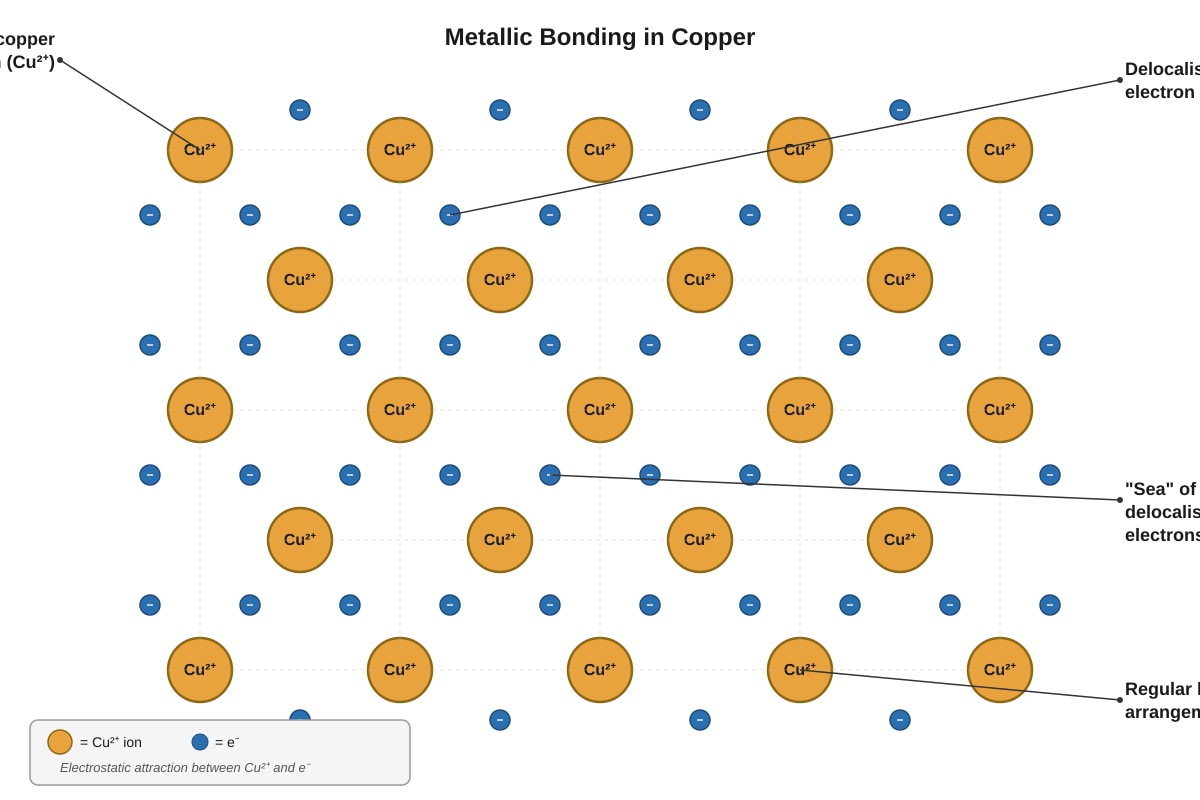
Generated diagram for this question.
(a) Describe the structure of a metal such as copper. [2]
- Answer: A metal consists of a regular lattice of positive metal ions surrounded by a "sea" of delocalized electrons. The delocalized electrons are free to move throughout the entire metallic structure.
- Marking note: 1 mark for positive ions in a lattice. 1 mark for sea of delocalized electrons.
(b) Explain why copper is malleable and can be drawn into wires. [1]
- Answer: When a force is applied, the layers of positive ions in the metal lattice can slide over each other without breaking the metallic bonds because the delocalized electrons can move and continue to hold the ions together.
- Marking note: 1 mark for explanation involving layers sliding and delocalized electrons maintaining bonding.
14. Substance B from the table in Question 8 has a structure similar to diamond. Suggest the type of structure present in substance B and explain why it has a very high melting point. [2]
- Type of structure: Giant covalent structure / giant molecular structure / macromolecular structure
- Explanation: In a giant covalent structure, all atoms are held together by strong covalent bonds extending throughout the entire structure in a three-dimensional network. A very large amount of energy is required to break these numerous strong covalent bonds, resulting in a very high melting point.
- Marking note: 1 mark for identifying giant covalent/macromolecular structure. 1 mark for explanation linking high melting point to strong covalent bonds throughout the structure requiring large energy to overcome.
15. Explain why metals are good conductors of heat. [1]
- Answer: Metals have delocalized electrons that can move freely and transfer thermal energy quickly throughout the structure.
- Marking note: 1 mark for mentioning delocalized electrons transferring heat energy.
16. State the type of bonding present in a molecule of chlorine gas (Cl₂). [1]
- Answer: Covalent bonding / simple covalent bonding
- Marking note: Accept "covalent bond" or "simple molecular covalent bonding".
17. Explain why solid ionic compounds do not conduct electricity but molten ionic compounds do. [2]
- Answer: In the solid state, ions are held in fixed positions in the giant ionic lattice and cannot move, so they cannot conduct electricity. When molten, the ions become mobile and can move freely, allowing them to carry electric charge and conduct electricity.
- Marking note: 1 mark for ions fixed in solid state. 1 mark for ions mobile in molten state.
18. State one difference between a covalent bond and an ionic bond. [1]
- Answer: A covalent bond involves the sharing of electrons between atoms, while an ionic bond involves the transfer of electrons and electrostatic attraction between oppositely charged ions. (Accept: Covalent bonds form between non-metals; ionic bonds form between metals and non-metals.)
- Marking note: 1 mark for any valid difference.
19. Explain why atoms form chemical bonds. [1]
- Answer: Atoms form chemical bonds to achieve a stable electronic configuration (usually a full outer shell / octet structure), which lowers their energy.
- Marking note: 1 mark for mentioning stable electronic configuration or full outer shell.
20. State the number of valence electrons in a nitrogen atom (atomic number 7). [1]
- Answer: 5
- Marking note: Electronic configuration is 2, 5, so 5 valence electrons.
END OF ANSWER KEY